Species · Fishes
Relict Dace Relictus solitarius
The scientific name of the Relict Dace is Relictus solitarius. It is a species of fish in the family Cyprinidae (carps), order Cypriniformes. The name dates from 1972.
- Scientific name
- Relictus solitarius Hubbs & Miller, 1972
- Common name
- Relict Dace
- Genus
- Relictus
- Family
- Cyprinidae (Carps)
- Order
- Cypriniformes
- Class
- Teleostei
- Red List category
- NT Near Threatened
- Environment
- freshwater
- Recorded in
- 1 country
- Name status
- accepted in the Catalogue of Life
Overview
The Relict Dace is a fish and the sole species in the genus Relictus. It is distinguished by dusky olive and brassy coloration, narrow yellowish stripes, often yellow lower fins, and paddle-shaped pelvic fins.
Written 27 November 2026 from the sources listed below. Each statement was checked against the passage it cites; statements that could not be supported were removed.
Appearance
The Relict Dace generally has dusky coloration with olive and brassy shades on its back. Brown-to-green speckling and narrow yellowish stripes occur on its back and belly.[1][2]
Its lower fins are often yellow and can be bright golden in color. The species has relatively small, rounded fins, with particularly paddle-shaped pelvic fins.[3][4]
The Relict Dace has a terminal oblique mouth without horny cutting edges.[5]
Habitat
The Relict Dace inhabits freshwater environments in the Great Basin of western North America. It occurs in a limited number of habitats in eastern Nevada that were formerly covered by prehistoric Lake Lahontan.[6][7]
Documented habitats include springs in Buttle and Ruby Valleys. The species also occurs in the drainage systems of Franklin Lake and Gale Lake.[8][9]
Behaviour
The Relict Dace has body adaptations associated with midwater swimming in quiet water.[10]
Classification of the Relict Dace
| Kingdom | Animalia |
|---|---|
| Phylum | Chordata |
| Subphylum | Vertebrata |
| Infraphylum | Gnathostomata |
| Parvphylum | Osteichthyes |
| Gigaclass | Actinopterygii |
| Superclass | Actinopteri |
| Class | Teleostei (Teleost) |
| Order | Cypriniformes |
| Family | Cyprinidae (Carps) |
| Subfamily | Leuciscinae |
| Genus | Relictus (Relict Daces) |
| Species | Relictus solitarius Hubbs & Miller, 1972 |
Where the Relict Dace is found
Checklists and occurrence records place Relictus solitarius in 1 country. GBIF holds 299 georeferenced records of it.
Countries
Regions and cities with the most records
A number beside a place is its count of GBIF occurrence records. A place without a number comes from a checklist alone. Records show where a species has been observed or collected, which can include escapes and vagrants.
Common names
English
- Relict Dace
Names in 3 other languages
- Chinese
- 孑魚
- Czech
- jelčík nevadský
- Russian
- Американская реликтовая плотва
Related species
-
 GoldfishCarassius auratus
-
 Common CarpCyprinus carpio
- ZebrafishDanio rerio
-
 Grass CarpCtenopharyngodon idella
-
 Common RoachRutilus rutilus
-
 Silver CarpHypophthalmichthys molitrix
-
 Crucian CarpCarassius carassius
-
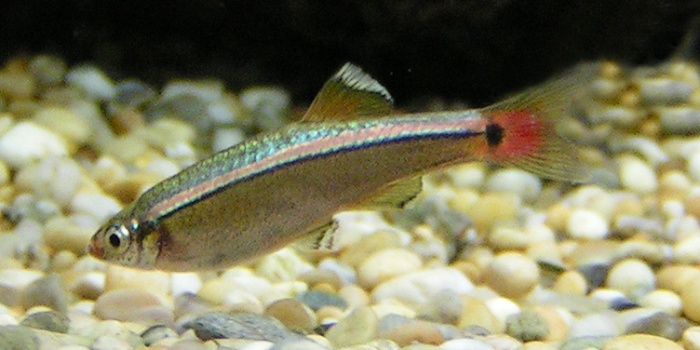 White Cloud Mountain MinnowTanichthys albonubes
Compare
Questions and answers
What is the scientific name of the Relict Dace?
The scientific name of the Relict Dace is Relictus solitarius. Written with its author, the full name is Relictus solitarius Hubbs & Miller, 1972.
Which family does the Relict Dace belong to?
Relictus solitarius belongs to the family Cyprinidae, in the order Cypriniformes and the class Teleostei.
Where is the Relict Dace found?
Checklists and occurrence records place Relictus solitarius in 1 country: United States.
What is the conservation status of the Relict Dace?
The IUCN Red List category recorded for Relictus solitarius is Near Threatened (NT).
Sources
Passages the profile rests on
- The relict dace generally has dusky coloration with olive and brassy shades on its back. Source passage: “generally dusky overall, with olive and brassy shades dorsally.” — English Wikipedia
- The species has brown-to-green speckling and narrow yellowish stripes on its back and belly. Source passage: “An obvious speckling pattern with patches ranging from brown to green, and yellowish narrow stripes appear on the back and belly.” — English Wikipedia
- The lower fins of the relict dace are often yellow and can be bright golden in color. Source passage: “Lower fins are often yellow, and may be a bright golden shade.” — English Wikipedia
- The species has relatively small, rounded fins, with particularly paddle-shaped pelvic fins. Source passage: “The fins are rather small and rounded, with the pelvic fins being especially notable for their paddle shape.” — English Wikipedia
- The relict dace has a terminal oblique mouth without horny cutting edges. Source passage: “The oblique mouth is terminal, and lacks horny cutting edges.” — English Wikipedia
- The relict dace inhabits freshwater environments in the Great Basin of western North America. Source passage: “This fish occurs in the Great Basin of western North America.” — English Wikipedia
- The species occurs in a limited number of habitats in eastern Nevada that were formerly covered by prehistoric Lake Lahontan. Source passage: “The relict dace occurs in only a handful of habitats in eastern Nevada, all of which were once covered by the prehistoric Lake Lahontan.” — English Wikipedia
- Documented habitats include springs in Buttle and Ruby Valleys. Source passage: “Locations include the springs of Buttle and Ruby Valleys” — English Wikipedia
- The species occurs in the drainage systems of Franklin Lake and Gale Lake. Source passage: “the drainage systems of Franklin Lake and Gale Lake.” — English Wikipedia
- The relict dace has body adaptations associated with midwater swimming in quiet water. Source passage: “the body adapting for midwater swimming in quiet water.” — English Wikipedia
Data
- Catalogue of Life, 2026-10-16 XR cc by
- Global Biodiversity Information Facility CC BY 4.0
- Wikidata CC0
- GeoNames CC BY 4.0
- Within the Catalogue of Life, this name comes from World Register of Marine Species cc by
References
- Hubbs, C. L., & Miller, R. R. (1972). Diagnoses of new cyprinid fishes of isolated waters in the Great Basin of western North America. Transactions of the San Diego Society of Natural History, 17 (8): 101–106. where the name was published
This species in other databases
- Catalogue of Life 4RR6C
- Wikidata Q3232230
- iNaturalist 111581
- WoRMS urn:lsid:marinespecies.org:taxname:1383636
- ITIS 163605
Page built on 27 November 2026. See how the catalog is made and all sources and licences.
Cite this page
ScientificNames.org. (2026). Relictus solitarius (Relict Dace). Retrieved November 27, 2026, from https://scientificnames.org/species/relictus-solitarius
“Relictus solitarius (Relict Dace).” ScientificNames.org, 2026, scientificnames.org/species/relictus-solitarius. Accessed 27 Nov. 2026.
ScientificNames.org. “Relictus solitarius (Relict Dace).” Accessed November 27, 2026. https://scientificnames.org/species/relictus-solitarius.
@misc{scientificnames_relictus_solitarius_relict_dace,
  author = {{ScientificNames.org}},
  title = {Relictus solitarius (Relict Dace)},
  year = {2026},
  url = {https://scientificnames.org/species/relictus-solitarius},
  note = {Accessed 2026-11-27}
}