Species · Flowering plants
Japanese-hawthorn Rhaphiolepis umbellata
The scientific name of the Japanese-hawthorn is Rhaphiolepis umbellata. It is a species of flowering plant in the family Rosaceae (rose family), order Rosales.
- Scientific name
- Rhaphiolepis umbellata (Thunb.) Makino
- Common name
- Japanese-hawthorn
- Genus
- Rhaphiolepis
- Family
- Rosaceae (Rose Family)
- Order
- Rosales
- Class
- Magnoliopsida
- Recorded in
- 7 countries
- Name status
- accepted in the Catalogue of Life

Overview
The species is native to Korea, Japan and Taiwan. It has glossy oval leaves and produces scented white flowers that may have pink tinges.
Written 26 November 2026 from the sources listed below. Each statement was checked against the passage it cites; statements that could not be supported were removed.
Appearance
Japanese-hawthorn is an evergreen shrub with glossy oval leaves. It produces scented white flowers that may sometimes have pink tinges.[1][2]
The shrub grows to approximately 1.5 metres in both height and width.[3]
Habitat
Japanese-hawthorn is native to Korea, Japan and Taiwan. It originates from Japan and Korea.[4][5][6]
Diet
The fruits of Japanese-hawthorn are inedible.[7]
Uses
In Japan, Japanese-hawthorn is used as an astringent. The plant is also used to produce dye for Ōshima-tsumugi kimono.[8][9]
The bark is processed into chips and boiled for more than ten hours to produce dye. A tannin-rich decoction of the bark is used to dye silk threads, which are subsequently treated with iron-rich paddy-field mud to turn them black.[10][11][12]
Japanese-hawthorn is planted along roadsides because it tolerates drying and air pollution. Its glossy evergreen leaves make it suitable for garden planting, and it tolerates frequent pruning.[13][14][15]
The shrub is used in containers, hedges and as a small tree in landscaping.[16]
Classification of the Japanese-hawthorn
| Kingdom | Plantae |
|---|---|
| Subkingdom | Pteridobiotina |
| Phylum | Tracheophyta |
| Class | Magnoliopsida |
| Order | Rosales |
| Family | Rosaceae (Rose Family) |
| Subfamily | Amygdaloideae |
| Tribe | Maleae |
| Subtribe | Malinae |
| Genus | Rhaphiolepis |
| Species | Rhaphiolepis umbellata (Thunb.) Makino |
Where the Japanese-hawthorn is found
Checklists and occurrence records place Rhaphiolepis umbellata in 7 countries across Africa, Asia and Oceania. GBIF holds 2,303 georeferenced records of it.
Countries where it is native or its origin is not stated
Countries where it has been introduced
Regions and cities with the most records
- Okinawa, Japan 251
- Jeollanam-do, South Korea 201
- Tokyo, Japan 112
- Kagoshima, Japan 103
- Auckland, New Zealand 95
- Chūō, Japan 87
- Minato City, Japan 87
- Ōta, Japan 87
- Ebara, Japan 86
- Tokyo, Japan 86
- Tōyō, Japan 86
- Den’enchōfu, Japan 85
- Komae, Japan 85
- Noborito, Japan 85
- Shimo’ochiai, Japan 85
- Kita, Japan 84
- Asagaya-minami, Japan 83
- Azamino, Japan 83
- Nakano, Japan 83
- Chōfu, Japan 82
- Katsushika, Japan 82
- Kawasaki, Japan 82
- Machiya, Japan 82
- Inagi, Japan 81
- Yeosu, South Korea 81
- Kamiigusa, Japan 80
- Shimoigusa, Japan 80
- Urayasu, Japan 80
- Ōgi, Japan 80
- Aoi, Japan 79
- Fuchū, Japan 79
- Musashino, Japan 79
- Sekimachi-minami, Japan 79
- Takenotsuka, Japan 79
- Koganei, Japan 77
- Yashio, Japan 77
11 more countries have a few records outside this range
These countries hold a few records of Rhaphiolepis umbellata but lie outside the range the checklists give for it. Such records are often zoo or garden specimens, museum material or vagrants, so the species is not counted as occurring there.
Range as the checklists state it
Mozambique [I]; China; South Korea (Cheju Isl.); Japan (Honshu, Shikoku, Kyushu); Ryukyu Isl.; Ogasawara Isl. (Keetaajima, Chichijima, Anijima, Otohtojima, Hahajima, Mukohjima, Anejima, Imohtojima, Meijima); Taiwan; New Zealand [I]
A number beside a place is its count of GBIF occurrence records. A place without a number comes from a checklist alone. Records show where a species has been observed or collected, which can include escapes and vagrants.
Common names
English
- Japanese-hawthorn
- Yedda-hawthorn
Names in 3 other languages
- Chinese
- hou ye shi ban mu
- German
- japanischer Traubenapfel
- Japanese
- sharinbai
Synonyms
9 other scientific names have been used for this species and are now treated as synonyms of Rhaphiolepis umbellata.
- Pyrus umbellularia M.F.Fay & Christenh.
- Rhaphiolepis indica f. umbellata (Thunb.) Hatus.
- Rhaphiolepis indica f. umbellata (Thunb.) H.Ohashi
- Rhaphiolepis indica subsp. umbellata (Thunb.) Hatus.
- Rhaphiolepis indica var. umbellata (Thunb.) H.Ohashi
- Rhaphiolepis japonica var. japonica
- Rhaphiolepis umbellata (Thunb.) C.K.Schneid.
- Rhaphiolepis umbellata var. ovata (Standish ex J.Dix) Asch. & Graebn.
- Laurus umbellata Thunb. ambiguous synonym
Subspecies and varieties
Related species
-
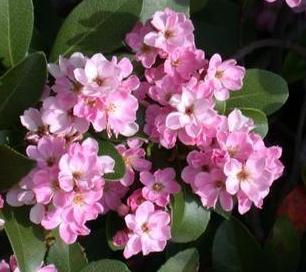 Indian HawthornRhaphiolepis indica
- Rhaphiolepis ferruginea
- Rhaphiolepis integerrima
- Rhaphiolepis major
- Rhaphiolepis philippinensis
- Rhaphiolepis brevipetiolata
- Rhaphiolepis jiulongjiangensis
- Rhaphiolepis lanceolata
Compare
Questions and answers
What is the scientific name of the Japanese-hawthorn?
The scientific name of the Japanese-hawthorn is Rhaphiolepis umbellata. Written with its author, the full name is Rhaphiolepis umbellata (Thunb.) Makino.
Which family does the Japanese-hawthorn belong to?
Rhaphiolepis umbellata belongs to the family Rosaceae, in the order Rosales and the class Magnoliopsida.
Where is the Japanese-hawthorn found?
Checklists and occurrence records place Rhaphiolepis umbellata in 7 countries, including Japan, South Korea, Taiwan, China and Indonesia.
What other names does the Japanese-hawthorn have?
Rhaphiolepis umbellata is also known in English as Yedda-hawthorn.
Sources
Passages the profile rests on
- Rhaphiolepis umbellata is an evergreen shrub with glossy oval leaves. Source passage: “it is an evergreen shrub with glossy oval leaves” — English Wikipedia
- The species produces scented white flowers that may sometimes have pink tinges. Source passage: “scented white flowers, sometimes tinged with pink” — English Wikipedia
- The shrub grows to approximately 1.5 metres in both height and width. Source passage: “Growing to 1.5 m (5 ft) tall and wide” — English Wikipedia
- The species is native to Korea, Japan and Taiwan. Source passage: “native to Korea, Japan and Taiwan” — English Wikipedia
- The species originates from Japan and Korea. Source passage: “Region of Origin: Japan and Korea” — valdosta.edu
- The species is native to Taiwan. Source passage: “native to Korea, Japan and Taiwan” — English Wikipedia
- The fruits of Rhaphiolepis umbellata are inedible. Source passage: “Unlike most of Rhaphiolepis species, its fruits are inedible.” — English Wikipedia
- The plant is used in Japan as an astringent. Source passage: “It is used in Japan as an astringent” — English Wikipedia
- The plant is used to produce dye for Ōshima-tsumugi kimono. Source passage: “this plant is used to create a dye to create the highly valued Ōshima-tsumugi kimono.” — English Wikipedia
- The bark is processed into chips and boiled for more than ten hours to produce a dye. Source passage: “The bark of the tree is chopped into chips and boiled for over 10 hours.” — English Wikipedia
- A tannin-rich decoction of the bark is used to dye silk threads. Source passage: “This tannin rich decoction serves as a dye for the silk threads.” — English Wikipedia
- The dyed silk threads are subsequently treated with iron-rich paddy-field mud to turn them black. Source passage: “the threads are then dyed in mud from paddy fields rich in iron content for post-mordanting until they turn black.” — English Wikipedia
- The species is planted along roadsides because it tolerates drying and air pollution. Source passage: “due to its resilience to drying and air pollution, Sharinbai trees are planted along roadsides.” — English Wikipedia
- The shrub is suitable for garden planting because of its glossy evergreen leaves. Source passage: “Their glossy evergreen leaves make them suitable for garden planting” — English Wikipedia
- The species tolerates frequent pruning. Source passage: “enduring well against frequent pruning.” — English Wikipedia
- The species is used in containers, hedges and as a small tree in landscaping. Source passage: “Landscape Uses: Containers, hedge, small tree” — valdosta.edu
Data
- Catalogue of Life, 2026-10-16 XR cc by
- Global Biodiversity Information Facility CC BY 4.0
- Wikidata CC0
- GeoNames CC BY 4.0
- Wikimedia Commons per image; credit shown with each image
- Within the Catalogue of Life, this name comes from Synonymic Checklists of the Vascular Plants of the World cc by
References
- Makino. (1902). Bot. Mag. (Tokyo) 16: 13 (1902). where the name was published
This species in other databases
Page built on 29 November 2026. See how the catalog is made and all sources and licences.
Cite this page
ScientificNames.org. (2026). Rhaphiolepis umbellata (Japanese-hawthorn). Retrieved November 29, 2026, from https://scientificnames.org/species/rhaphiolepis-umbellata
“Rhaphiolepis umbellata (Japanese-hawthorn).” ScientificNames.org, 2026, scientificnames.org/species/rhaphiolepis-umbellata. Accessed 29 Nov. 2026.
ScientificNames.org. “Rhaphiolepis umbellata (Japanese-hawthorn).” Accessed November 29, 2026. https://scientificnames.org/species/rhaphiolepis-umbellata.
@misc{scientificnames_rhaphiolepis_umbellata_japanese_hawthorn,
  author = {{ScientificNames.org}},
  title = {Rhaphiolepis umbellata (Japanese-hawthorn)},
  year = {2026},
  url = {https://scientificnames.org/species/rhaphiolepis-umbellata},
  note = {Accessed 2026-11-29}
}