Overview
The Friendly Toad is endemic to Ecuador and is known exclusively from the Loja Basin of Loja Province, Ecuador, at elevations between 2,050 and 2,200 metres above sea level. The Friendly Toad belongs to the Rhinella spinulosa Group and is the only member of that group distributed north of the Huancavelica region.
Written 27 November 2026 from the sources listed below. Each statement was checked against the passage it cites; statements that could not be supported were removed.
Appearance
Females have a snout–vent length ranging from 50 to 85 mm.[1]
Habitat
The Friendly Toad has been collected in small pools and irrigation canals.[2]
Behaviour
The Friendly Toad is active at night.[3]
Reproduction and life cycle
Breeding is presumed to occur in freshwater environments through larval development.[4]
Conservation
The Friendly Toad is classified as Critically Endangered because of its restricted and fragmented distribution and continuing deterioration of habitat. It occurs in a severely fragmented area smaller than 100 square kilometres.[5][6]
Agricultural expansion, urbanization, and regional development may have contributed to population declines in the Loja Basin. Human activities have severely affected populations around Provincia Loja.[7][8]
Disease has been suggested as a possible contributing factor to declines, but no confirming evidence is available.[9]
Classification of the Friendly Toad
| Kingdom | Animalia |
|---|---|
| Phylum | Chordata |
| Subphylum | Vertebrata |
| Infraphylum | Gnathostomata |
| Parvphylum | Osteichthyes |
| Megaclass | Tetrapoda |
| Class | Amphibia (Amphibians) |
| Order | Anura (Frogs) |
| Family | Bufonidae (True Toad) |
| Genus | Rhinella (South American Toads) |
| Species | Rhinella amabilis (Pramuk & Kadivar, 2003) |
Where the Friendly Toad is found
Checklists and occurrence records place Rhinella amabilis in 1 country. GBIF holds 25 georeferenced records of it.
Countries
Regions and cities with the most records
A number beside a place is its count of GBIF occurrence records. A place without a number comes from a checklist alone. Records show where a species has been observed or collected, which can include escapes and vagrants.
Common names
English
- Friendly Toad
Names in 1 other language
- Spanish
- Sapo amable
Synonyms
2 other scientific names have been used for this species and are now treated as synonyms of Rhinella amabilis.
- Bufo amabilis Pramuk & Kadivar, 2003
- Chaunus amabilis (Pramuk & Kadivar, 2003)
Related species
- Cane ToadRhinella marina
-
 Cane ToadRhinella horribilis
-
 Cope's ToadRhinella diptycha
-
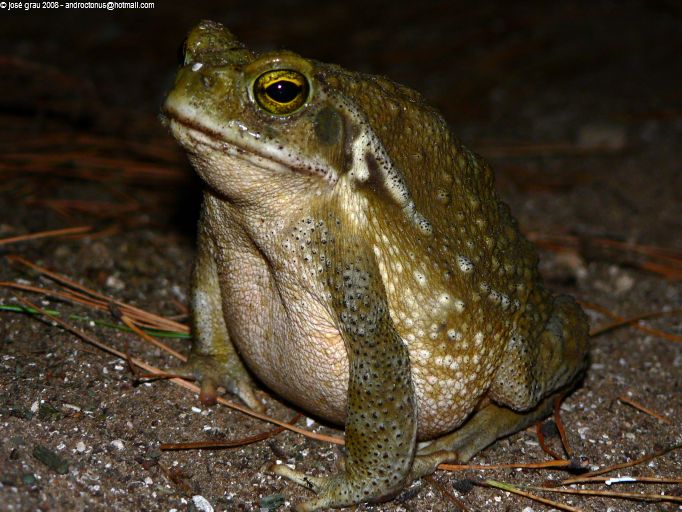 Argentine ToadRhinella arenarum
-
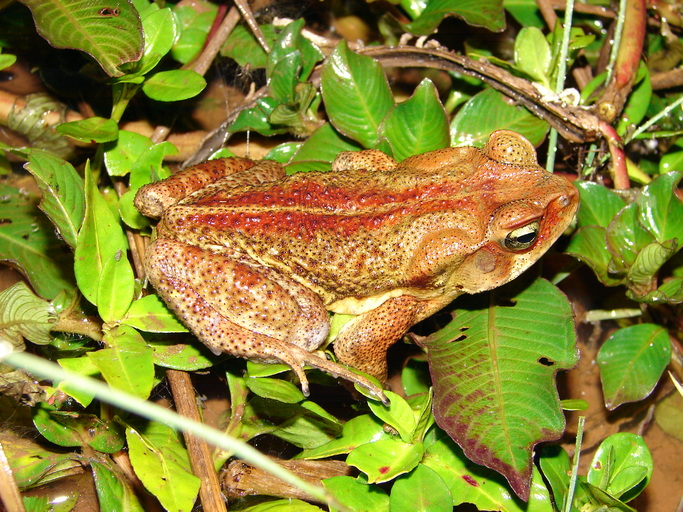 Ornate Forest ToadRhinella ornata
-
 Yellow Cururu ToadRhinella icterica
-
 South American Common ToadRhinella margaritifera
-
 Snouted ToadRhinella proboscidea
Compare
Questions and answers
What is the scientific name of the Friendly Toad?
The scientific name of the Friendly Toad is Rhinella amabilis. Written with its author, the full name is Rhinella amabilis (Pramuk & Kadivar, 2003).
Which family does the Friendly Toad belong to?
Rhinella amabilis belongs to the family Bufonidae, in the order Anura and the class Amphibia.
Where is the Friendly Toad found?
Checklists and occurrence records place Rhinella amabilis in 1 country: Ecuador.
What is the conservation status of the Friendly Toad?
The IUCN Red List category recorded for Rhinella amabilis is Critically Endangered (CR).
Sources
Passages the profile rests on
- Females have a snout–vent length ranging from 50 to 85 mm. Source passage: “females 50–85 mm (2.0–3.3 in) in snout–vent length.” — English Wikipedia
- The species has been collected in small pools and irrigation canals. Source passage: “The species has been collected in small pools and irrigation canals.” — English Wikipedia
- The species is active at night. Source passage: “It is active by night.” — English Wikipedia
- Breeding is presumed to occur in freshwater environments through larval development. Source passage: “breeding is presumed to take place in freshwater by larval development.” — English Wikipedia
- The species is endemic to Ecuador and occurs in a severely fragmented area smaller than 100 square kilometres. Source passage: “endemic to Ecuador, only occurring in a severely fragmented area less than 100 square kilometres (39 sq mi).” — English Wikipedia
- The species is classified as Critically Endangered because of its restricted and fragmented distribution and continuing deterioration of habitat. Source passage: “It is currently listed as Critically Endangered, in view of its small and fragmentary extent of occurrence and the fact that there is a continuing decline in the extent and quality of its habitat.” — English Wikipedia
- Agricultural expansion, urbanization, and regional development may have contributed to population declines in the Loja Basin. Source passage: “The apparent declines of this species might in part be due to the modification of much of the Loja basin area for agriculture, urbanization, and other regional development.” — English Wikipedia
- Human activities have severely affected populations around Provincia Loja. Source passage: “It appears that populations of this toad in the area surrounding Provincia Loja have been severely affected by human activities.” — English Wikipedia
- Disease has been suggested as a possible contributing factor to declines, but no confirming evidence is available. Source passage: “Disease might also be a factor but there is no evidence to confirm this.” — English Wikipedia
Data
- Catalogue of Life, 2026-10-16 XR cc by
- Global Biodiversity Information Facility CC BY 4.0
- Wikidata CC0
- GeoNames CC BY 4.0
- Within the Catalogue of Life, this name comes from The Integrated Taxonomic Information System cc0
This species in other databases
Page built on 28 November 2026. See how the catalog is made and all sources and licences.
Cite this page
ScientificNames.org. (2026). Rhinella amabilis (Friendly Toad). Retrieved November 28, 2026, from https://scientificnames.org/species/rhinella-amabilis
“Rhinella amabilis (Friendly Toad).” ScientificNames.org, 2026, scientificnames.org/species/rhinella-amabilis. Accessed 28 Nov. 2026.
ScientificNames.org. “Rhinella amabilis (Friendly Toad).” Accessed November 28, 2026. https://scientificnames.org/species/rhinella-amabilis.
@misc{scientificnames_rhinella_amabilis_friendly_toad,
  author = {{ScientificNames.org}},
  title = {Rhinella amabilis (Friendly Toad)},
  year = {2026},
  url = {https://scientificnames.org/species/rhinella-amabilis},
  note = {Accessed 2026-11-28}
}