Overview
Rhinella lindae has a long, pointed snout and an opaque black to dark brown upper body with light yellow or olive-green spots and dots.
Written 27 November 2026 from the sources listed below. Each statement was checked against the passage it cites; statements that could not be supported were removed.
Appearance
The species has a long, pointed snout and depressed, oval-shaped, inconspicuous parotoid glands. Its dorsal skin has minute granules extending to the eyelids, which bear a crest.[1][2][3]
Female specimens have a tympanic annulus, although their tympanic membrane is poorly differentiated. Male specimens lack a tympanic annulus.[4][5]
The fingers are approximately one-quarter webbed, while the toes are extensively webbed. The eyes are coffee-colored.[6][7][8]
The upper body is opaque black to dark brown with light yellow or olive-green spots and dots. The underside is yellow or olive green with brown or black spots.[9][10]
Habitat
The species is terrestrial and occurs in wet primary forest near creeks, at elevations between 1,400 and 1,800 metres above sea level. Its known localities are on the western slope of the Cordillera Occidental.[11][12][13]
Reproduction and life cycle
The reproductive biology of the species is unknown.[14]
Conservation
The species is considered rare and is threatened by habitat loss associated with agriculture. Its habitat in Las Orquídeas National Park is affected by logging.[15][16][17]
Classification of the Murri Beaked Toad
| Kingdom | Animalia |
|---|---|
| Phylum | Chordata |
| Subphylum | Vertebrata |
| Infraphylum | Gnathostomata |
| Parvphylum | Osteichthyes |
| Megaclass | Tetrapoda |
| Class | Amphibia (Amphibians) |
| Order | Anura (Frogs) |
| Family | Bufonidae (True Toad) |
| Genus | Rhinella (South American Toads) |
| Species | Rhinella lindae (Rivero & Castaño, 1990) |
Where the Murri Beaked Toad is found
Checklists and occurrence records place Rhinella lindae in 1 country. GBIF holds 4 georeferenced records of it.
Countries
A number beside a place is its count of GBIF occurrence records. A place without a number comes from a checklist alone. Records show where a species has been observed or collected, which can include escapes and vagrants.
Common names
English
- Murri Beaked Toad
Names in 1 other language
- Czech
- ropucha Lindina
Synonyms
One other scientific name has been used for this species and is now treated as a synonym of Rhinella lindae.
- Rhamphophryne lindae Rivero & Castaño, 1990
Related species
- Cane ToadRhinella marina
-
 Cane ToadRhinella horribilis
-
 Cope's ToadRhinella diptycha
-
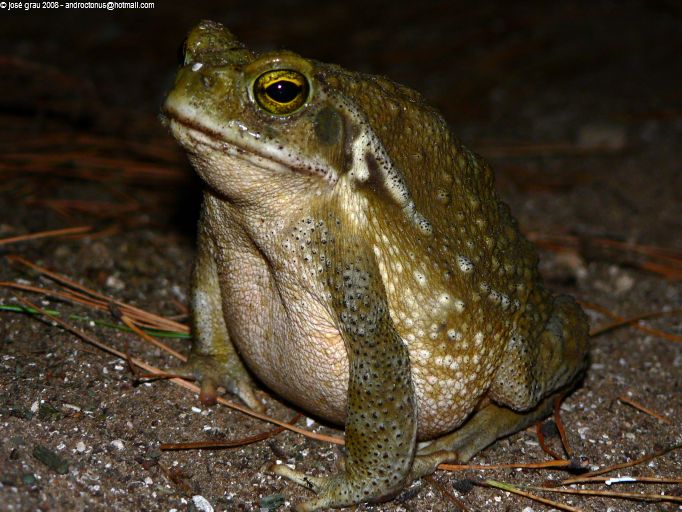 Argentine ToadRhinella arenarum
-
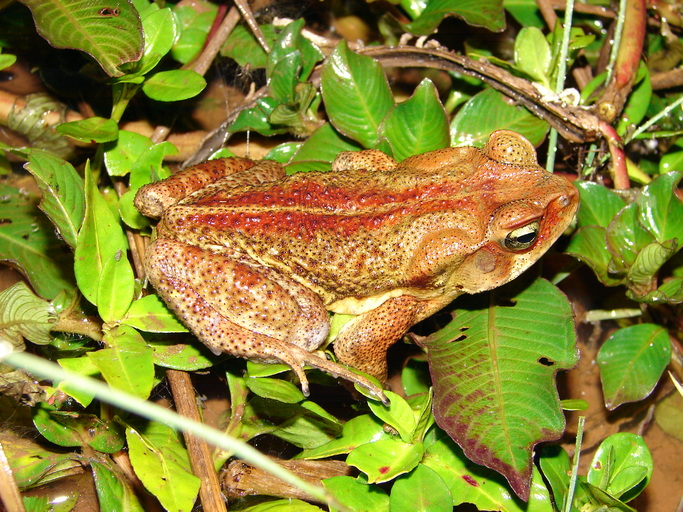 Ornate Forest ToadRhinella ornata
-
 Yellow Cururu ToadRhinella icterica
-
 South American Common ToadRhinella margaritifera
-
 Snouted ToadRhinella proboscidea
Compare
Questions and answers
What is the scientific name of the Murri Beaked Toad?
The scientific name of the Murri Beaked Toad is Rhinella lindae. Written with its author, the full name is Rhinella lindae (Rivero & Castaño, 1990).
Which family does the Murri Beaked Toad belong to?
Rhinella lindae belongs to the family Bufonidae, in the order Anura and the class Amphibia.
Where is the Murri Beaked Toad found?
Checklists and occurrence records place Rhinella lindae in 1 country: Colombia.
What is the conservation status of the Murri Beaked Toad?
The IUCN Red List category recorded for Rhinella lindae is Endangered (EN).
How large is the Murri Beaked Toad?
The adult female holotype measures 62 mm in snout–vent length. The male paratype measures 30 mm in snout–vent length, although its maturity status is unknown.[18][19]
What does the name lindae refer to?
The specific name lindae honors American herpetologist Linda Trueb.[20]
Sources
Passages the profile rests on
- The species has a long, pointed snout. Source passage: “The snout is long and acuminate.” — English Wikipedia
- The parotoid glands are depressed, oval-shaped, and inconspicuous. Source passage: “The parotoid glands are ovoid but depressed and not very conspicuous.” — English Wikipedia
- The dorsal skin has minute granules extending to the eyelids, which bear a crest. Source passage: “Dorsal skin is studded with minute granules extending to eyelids that show a crest.” — English Wikipedia
- Female specimens have a tympanic annulus, although their tympanic membrane is poorly differentiated. Source passage: “In the female, tympanic annulus is present but the tympanic membrane is poorly differentiated” — English Wikipedia
- Male specimens lack a tympanic annulus. Source passage: “in the male, no tympanic annulus is present.” — English Wikipedia
- The fingers are approximately one-quarter webbed. Source passage: “The fingers are one quarter webbed” — English Wikipedia
- The toes are extensively webbed. Source passage: “the toes are extensively webbed.” — English Wikipedia
- The eyes are coffee-colored. Source passage: “The eye is coffee-colored.” — English Wikipedia
- The upper body is opaque black to dark brown with light yellow or olive-green spots and dots. Source passage: “The upper parts are opaque black to dark brown with light yellow or olive green spots and dots.” — English Wikipedia
- The underside is yellow or olive green with brown or black spots. Source passage: “The venter is yellow or olive green with brown or black spots.” — English Wikipedia
- Its known localities are on the western slope of the Cordillera Occidental. Source passage: “both on the western slope of the Cordillera Occidental, Antioquia Department.” — English Wikipedia
- The species is terrestrial and occurs in wet primary forest near creeks. Source passage: “Rhinella lindae is a terrestrial frog occurring in wet primary forest by creeks” — English Wikipedia
- The species occurs at elevations between 1,400 and 1,800 metres above sea level. Source passage: “at elevations of 1,400–1,800 m (4,600–5,900 ft) above sea level.” — English Wikipedia
- The reproductive biology of the species is unknown. Source passage: “Reproduction is unknown.” — English Wikipedia
- The species is considered rare. Source passage: “It is a rare species” — English Wikipedia
- The species is threatened by habitat loss associated with agriculture. Source passage: “threatened by habitat loss caused by agriculture” — English Wikipedia
- The species' habitat in Las Orquídeas National Park is affected by logging. Source passage: “The Las Orquídeas National Park site is subject to logging.” — English Wikipedia
- The adult female holotype measures 62 mm in snout–vent length. Source passage: “The holotype, an adult female, measures 62 mm (2.4 in)” — English Wikipedia
- The male paratype measures 30 mm in snout–vent length, although its maturity status is unknown. Source passage: “the paratype male—of unknown maturity status—measures 30 mm (1.2 in) in snout–vent length.” — English Wikipedia
- The specific name lindae honors American herpetologist Linda Trueb. Source passage: “The specific name lindae honors Linda Trueb, an American herpetologist.” — English Wikipedia
Data
- Catalogue of Life, 2026-10-16 XR cc by
- Global Biodiversity Information Facility CC BY 4.0
- Wikidata CC0
- GeoNames CC BY 4.0
- Within the Catalogue of Life, this name comes from The Integrated Taxonomic Information System cc0
This species in other databases
Page built on 27 November 2026. See how the catalog is made and all sources and licences.
Cite this page
ScientificNames.org. (2026). Rhinella lindae (Murri Beaked Toad). Retrieved November 27, 2026, from https://scientificnames.org/species/rhinella-lindae
“Rhinella lindae (Murri Beaked Toad).” ScientificNames.org, 2026, scientificnames.org/species/rhinella-lindae. Accessed 27 Nov. 2026.
ScientificNames.org. “Rhinella lindae (Murri Beaked Toad).” Accessed November 27, 2026. https://scientificnames.org/species/rhinella-lindae.
@misc{scientificnames_rhinella_lindae_murri_beaked_toad,
  author = {{ScientificNames.org}},
  title = {Rhinella lindae (Murri Beaked Toad)},
  year = {2026},
  url = {https://scientificnames.org/species/rhinella-lindae},
  note = {Accessed 2026-11-27}
}