Species · Fishes
Rhinogobius nami
Rhinogobius nami has no English name on record in the checklists used here. It is a species of fish in the family Gobiidae (true gobies), order Gobiiformes. The name dates from 2024.
- Scientific name
- Rhinogobius nami Maeda, Kobayashi, Iida & Tran, 2024
- Genus
- Rhinogobius
- Family
- Gobiidae (True Gobies)
- Order
- Gobiiformes
- Class
- Teleostei
- Recorded in
- 1 country
- Name status
- provisionally accepted in the Catalogue of Life
Overview
Wikidata describes Rhinogobius nami as “taxon”.
Classification of Rhinogobius nami
| Kingdom | Animalia |
|---|---|
| Phylum | Chordata |
| Subphylum | Vertebrata |
| Infraphylum | Gnathostomata |
| Parvphylum | Osteichthyes |
| Gigaclass | Actinopterygii |
| Superclass | Actinopteri |
| Class | Teleostei (Teleost) |
| Order | Gobiiformes |
| Family | Gobiidae (True Gobies) |
| Subfamily | Gobionellinae |
| Genus | Rhinogobius (Rhinogobies) |
| Species | Rhinogobius nami Maeda, Kobayashi, Iida & Tran, 2024 |
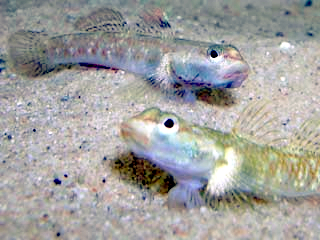
Origin of the name. Etymology. The specific name of the new species is dedicated to the late Chu Hoang Nam, who helped our surveys in Vietnam during 2018 and 2019. FIGURE 7. Rhinogobius nami immediately after fixation. a, NSMT-P 147890, holotype, male, 24.9 mm SL; b, OISTICH 282, paratype, female, 26.6 mm SL. FIGURE 8. Live images of Rhinogobius nami in aquarium (a) and in situ underwater footage from Da Nang City, Vietnam (b - d). a, male, 12 January 2013; b, male, 13 January 2013; c, d, females, 13 January 2013 (photo by K. Maeda). Comparison. Rhinogobius nami shares many morphological features with R. sangenloensis Chen & Miller, 2014 from Hainan, China. The coloration is nearly identical, including the longitudinal stripes on body and fin markings, but the male of new species has three reddish-brown or dusky-brown stripes on cheek (absent in R. sangenloensis; Chen & Miller 2014), and the mode count of pectoral-fin rays is also different (15 in R. nami vs. 17 in R. sangenloensis; Chen & Miller 2014). Both males and females of R. nami have a black, vertical rectangular or elliptical spot at the middle of caudal-fin base, while R. sangenloensis female has a black horizontal bar (Chen & Miller 2014). The three oblique stripes on the cheek of male specimens of R. nami is one of the features of the new species. Several Chinese and Vietnamese species of the genus also have oblique stripes on the cheek. The new species however differs from most of these species having a thinner and / or more numerous stripes (in R. changtinensis Huang & Chen, 2007, R. lingtongyanensis Chen, Wang, Chen & Shao, 2022, R. longyanensis Chen, Cheng & Shao, 2008, R. lungwoensis Huang & Chen, 2007, R. rubrolineatus Chen & Miller, 2008, R. sagittus Chen & Miller, 2008, and R. wangi Chen & Fang, 2006) (Chen & Fang 2006; Chen & Miller 2008; Chen et al. 2008, 2022 a; Huang & Chen 2007) (Table 8). TABLE 8. Various species of Rhinogobius with oblique stripes on cheeks. Number of stripes Stripe thickness Position of stripe Number of vertebrae (mode) R. nami n. sp. 3 Broad Limited to lower half of the cheek 26 R. lungwoensis 1 Slightly broad Limited to lower half of the cheek 28 R. rubrolineatus 2 Thin Reaching upper half of the cheek 26 R. changtinensis 3 Thin Reaching upper half of the cheek 27 R. longyanensis 3 Thin Limited to lower half of the cheek 27 R. lingtongyanensis 4 Thin Limited to lower half of the cheek 26 R. sagittus 4 - 5 Thin Reaching upper half of the cheek 26 R. wangi modally 7 Thin Reaching upper half of the cheek 27 R. sulcatus 3 - 4 Broad Reaching upper half of the cheek 27 R. duospilus 1 - 3 Thin or broad Reaching upper half of the cheek 27 R. ponkouensis 2 Broad Reaching upper half of the cheek 28 R. virgigena 1 - 3 Thin or broad Limited to lower half of the cheek 26 Male of R. sulcatus Chen & Kottelat, 2005 has three broad stripes similar to those of the new species, but the stripes are longer (often reaching upper half of cheek) (Fig. 9 a), and often branched and connected with each other, forming a reticulate pattern. Rhinogobius sulcatus also differs from the new species in lacking longitudinal, reddish-brown or dusky-brown stripes on sides of the body (Fig. 9 a, b) (five stripes in male and female of R. nami; Fig. 7 a, b), seven soft rays on anal fin (vs. usually eight in R. nami; Table 2), 16 pectoral-fin rays (vs. 15; Table 4), and 27 vertebrae (vs. 26; Table 1). Males of R. duospilus (Herre, 1935), R. ponkouensis Huang & Chen, 2007, and R. virgigena Chen & Kottelat, 2005, have two or three stripes on cheek, but lack the longitudinal stripes along sides of the body (Herre 1935 a; Wu & Ni 1986; Wu 1991; Chen & Kottelat 2005; Huang & Chen 2007; Wu & Zhong 2008; observation on R. virgigena in the present study; Fig. 9 e, f) (vs. five stripes in R. nami; Fig. 7 a, b), 27 and 28 vertebrae in R. duospilus and R. ponkouensis, respectively (Huang & Chen 2007) (vs. usually 26 in R. virgigena and R. nami; Table 1). Among species from central Vietnam described in the present study, R. nami is most similar to R. taenigena, sharing the same markings on fins, and the red and light bluish-grey patterns on opercular membrane, interopercle, and lower part of subopercle of the male (Figs. 7 a and 11 a, b). However, R. nami can be distinguished from R. taenigena in the presence of five longitudinal stripes on sides of the body (absent in R. taenigena), three oblique stripes on the male's cheek (vs. absent) and presence of 26 vertebrae (vs. 27; Table 1).
This name was added to the Catalogue of Life from a contributing dataset by automated merging and has not yet been reviewed by its editors.
Where Rhinogobius nami is found
Checklists and occurrence records place Rhinogobius nami in 1 country. GBIF holds 9 georeferenced records of it.
Countries
Regions and cities with the most records
- Bà Nà, Vietnam 9
- Hải Châu, Vietnam 9
- Đại Lộc, Vietnam 9
- Cẩm Lệ, Vietnam 7
- Da Nang, Vietnam 7
- Hòa Cường, Vietnam 7
- Sơn Trà, Vietnam 7
- Thanh Khê, Vietnam 7
- An Hải, Vietnam 3
A number beside a place is its count of GBIF occurrence records. A place without a number comes from a checklist alone. Records show where a species has been observed or collected, which can include escapes and vagrants.
Related species
-
 Lizard GobyRhinogobius flumineus
-
 Brown GobyRhinogobius brunneus
-
 Whitecheek GobyRhinogobius duospilus
-
 Barcheek GobyRhinogobius giurinus
-
 Zhou's Scarlet GobyRhinogobius zhoui
-
 Amur GobyRhinogobius similis
- Candidius GobyRhinogobius candidianus
-
 Rhinogobius mizunoi
Compare
Sources
Data
- Catalogue of Life, 2026-10-16 XR cc by
- Global Biodiversity Information Facility CC BY 4.0
- Wikidata CC0
- GeoNames CC BY 4.0
- Within the Catalogue of Life, this name comes from ZooBank DarwinCore Checklist Data cc0
References
- Maeda, Ken, Hirozumi Kobayashi, Midori Iida & Hau D. Tran. 2024. Taxonomy of freshwater gobies of the genus Rhinogobius (Oxudercidae, Gobiiformes) from central Vietnam, with descriptions of two new species. Zootaxa 5493(5): 507-541. Link where the name was published
This species in other databases
Page built on 26 November 2026. See how the catalog is made and all sources and licences.
Cite this page
ScientificNames.org. (2026). Rhinogobius nami. Retrieved November 26, 2026, from https://scientificnames.org/species/rhinogobius-nami
“Rhinogobius nami.” ScientificNames.org, 2026, scientificnames.org/species/rhinogobius-nami. Accessed 26 Nov. 2026.
ScientificNames.org. “Rhinogobius nami.” Accessed November 26, 2026. https://scientificnames.org/species/rhinogobius-nami.
@misc{scientificnames_rhinogobius_nami,
  author = {{ScientificNames.org}},
  title = {Rhinogobius nami},
  year = {2026},
  url = {https://scientificnames.org/species/rhinogobius-nami},
  note = {Accessed 2026-11-26}
}