Species · Mammals
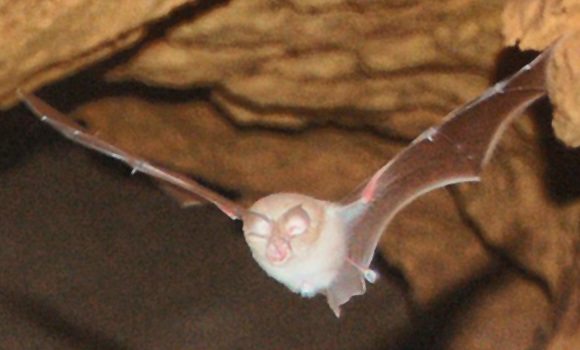
Intermediate Horseshoe Bat Rhinolophus affinis
The scientific name of the Intermediate Horseshoe Bat is Rhinolophus affinis. It is a species of mammal in the family Rhinolophidae (horseshoe bat), order Chiroptera. The name dates from 1823.
- Scientific name
- Rhinolophus affinis Horsfield, 1823
- Common name
- Intermediate Horseshoe Bat
- Genus
- Rhinolophus
- Family
- Rhinolophidae (Horseshoe Bat)
- Order
- Chiroptera
- Class
- Mammalia
- Red List category
- LC Least Concern
- Recorded in
- 12 countries
- Name status
- accepted in the Catalogue of Life

Overview
Rhinolophus affinis occurs across much of the Indian subcontinent, southern and central China, and Southeast Asia, with its easternmost range including the Indonesian Lesser Sunda Islands and Java.
Written 26 November 2026 from the sources listed below. Each statement was checked against the passage it cites; statements that could not be supported were removed.
Appearance
The Intermediate Horseshoe Bat exhibits variation in appearance across its geographic range. Its total body length is 58–63 mm, and its forearm measures 46–56 mm. Individuals weigh approximately 12–15 g.[1][2][3][4]
Habitat
The species occurs across much of the Indian subcontinent, southern and central China, and Southeast Asia. Its recorded distribution includes Bangladesh, Bhutan, Brunei, Cambodia, China, India, Indonesia, Malaysia, Myanmar, Nepal, Thailand, and Vietnam.[5][6]
Its easternmost geographic range includes the Indonesian Lesser Sunda Islands and Java. The species has been recorded at elevations between 290 and 2,000 m above sea level.[7][8]
Conservation
The Intermediate Horseshoe Bat is classified as Least Concern by the IUCN. It is considered common throughout its range and has no known major threats.[9][10]
Behaviour
Resting adult individuals emit echolocation calls. Call duration and peak frequency vary among colonies and between sexes.[11][12]
Males produce longer-duration echolocation calls with lower peak frequencies than females.[13][14]
Monthly mean precipitation is positively associated with the peak frequency of male echolocation calls. Monthly mean temperature is negatively associated with the peak frequency of female echolocation calls.[15][16]
Forearm length, altitude, and normalized difference vegetation index were not significantly associated with call duration or peak frequency in either sex.[17]
Classification of the Intermediate Horseshoe Bat
| Kingdom | Animalia |
|---|---|
| Phylum | Chordata |
| Subphylum | Vertebrata |
| Infraphylum | Gnathostomata |
| Parvphylum | Osteichthyes |
| Megaclass | Tetrapoda |
| Class | Mammalia (Mammal) |
| Subclass | Theria |
| Infraclass | Eutheria |
| Order | Chiroptera (Bat) |
| Suborder | Yinpterochiroptera |
| Superfamily | Rhinolophoidea |
| Family | Rhinolophidae (Horseshoe Bat) |
| Genus | Rhinolophus (Horseshoe Bat) |
| Species | Rhinolophus affinis Horsfield, 1823 |
Where the Intermediate Horseshoe Bat is found
Checklists and occurrence records place Rhinolophus affinis in 12 countries across Asia. GBIF holds 3,024 georeferenced records of it.
Countries
- Cambodia 11
- China 383
- Hong Kong 7
- India 74
- Indonesia 599
- Laos 50
- Malaysia 1,243
- Myanmar 50
- Nepal 20
- Sri Lanka 5
- Thailand 177
- Vietnam 405
Regions and cities with the most records
- Lampung, Indonesia 234
- Pahang, Malaysia 184
- Johor, Malaysia 146
- Kelantan, Malaysia 107
- Thừa Thiên Huế Province, Vietnam 104
- Guangxi, China 98
- Perak, Malaysia 84
- Bagan Serai, Malaysia 80
- Bandar Baharu, Malaysia 80
- Bukit Tambun, Malaysia 80
- Jawi, Malaysia 80
- Kuala Kurau, Malaysia 80
- Nibong Tebal, Malaysia 80
- Parit Buntar, Malaysia 80
- Selama, Malaysia 80
- Sungai Jawi, Malaysia 80
- Val Dor, Malaysia 80
- Ayer Itam, Malaysia 75
- Balik Pulau, Malaysia 75
- Batu Feringgi, Malaysia 75
- Bayan Lepas, Malaysia 75
- Bukit Gemuroh, Malaysia 75
- Butterworth, Malaysia 75
- George Town, Malaysia 75
- Glugor, Malaysia 75
- Jelutong, Malaysia 75
- Kampung Sungai Ara, Malaysia 75
- Kampung Sungai Glugur, Malaysia 75
- Kampung Teluk Kumbar, Malaysia 75
- Paya Terubong, Malaysia 75
- Perai, Malaysia 75
- Relau, Malaysia 75
- Pasir Puteh, Malaysia 72
- Kampung Teluk Air Tawar, Malaysia 68
- Permatang Kuching, Malaysia 68
- Kampung Batu Empat, Malaysia 65
Range as the checklists state it
Southern Asia
A number beside a place is its count of GBIF occurrence records. A place without a number comes from a checklist alone. Records show where a species has been observed or collected, which can include escapes and vagrants.
Common names
English
- Intermediate Horseshoe Bat
Synonyms
2 other scientific names have been used for this species and are now treated as synonyms of Rhinolophus affinis.
- Rhinolophus affinis Temm.
- Rhinolophus princeps Andersen, 1905
Subspecies and varieties
- Rhinolophus affinis affinis (Intermediate Horseshoe Bat) subspecies
- Rhinolophus affinis hainanus (Intermediate Horseshoe Bat) subspecies
- Rhinolophus affinis himalayanus (Intermediate Horseshoe Bat) subspecies
- Rhinolophus affinis macrurus (Intermediate Horseshoe Bat) subspecies
- Rhinolophus affinis nesites (Intermediate Horseshoe Bat) subspecies
- Rhinolophus affinis princeps (Intermediate Horseshoe Bat) subspecies
Related species
-
 Greater Horseshoe BatRhinolophus ferrumequinum
-
 Lesser Horseshoe BatRhinolophus hipposideros
-
 Mediterranean Horseshoe BatRhinolophus euryale
-
 Blasius's Horseshoe BatRhinolophus blasii
-
 Mehely's Horseshoe BatRhinolophus mehelyi
- Andaman Horseshoe BatRhinolophus cognatus
-
 Least Horseshoe BatRhinolophus pusillus
-
 Geoffroy's Horseshoe BatRhinolophus clivosus
Compare
Questions and answers
What is the scientific name of the Intermediate Horseshoe Bat?
The scientific name of the Intermediate Horseshoe Bat is Rhinolophus affinis. Written with its author, the full name is Rhinolophus affinis Horsfield, 1823.
Which family does the Intermediate Horseshoe Bat belong to?
Rhinolophus affinis belongs to the family Rhinolophidae, in the order Chiroptera and the class Mammalia.
Where is the Intermediate Horseshoe Bat found?
Checklists and occurrence records place Rhinolophus affinis in 12 countries, including Malaysia, Indonesia, Vietnam, China, Thailand and India.
What is the conservation status of the Intermediate Horseshoe Bat?
The IUCN Red List category recorded for Rhinolophus affinis is Least Concern (LC).
How rare are horseshoe bats?
The Intermediate Horseshoe Bat is considered common throughout its range and is classified as Least Concern by the IUCN.[9][10]
Where do horseshoe bats live?
The Intermediate Horseshoe Bat occurs across much of the Indian subcontinent, southern and central China, and Southeast Asia. Its recorded distribution includes Bangladesh, Bhutan, Brunei, Cambodia, China, India, Indonesia, Malaysia, Myanmar, Nepal, Thailand, and Vietnam. It has been recorded at elevations between 290 and 2,000 m above sea level.[5][6][8]
Sources
Passages the profile rests on
- The species exhibits variation in appearance across its geographic range. Source passage: “It varies in appearance and echolocation characteristics throughout its range” — English Wikipedia
- The intermediate horseshoe bat has a total body length of 58–63 mm. Source passage: “The intermediate horseshoe bat has a total length of 58–63 mm (2.3–2.5 in)” — English Wikipedia
- Its forearm measures 46–56 mm in length. Source passage: “with a forearm length of 46–56 mm (1.8–2.2 in).” — English Wikipedia
- Individuals of this species weigh approximately 12–15 g. Source passage: “Individuals weigh approximately 12–15 g (0.42–0.53 oz).” — English Wikipedia
- The species occurs across much of the Indian subcontinent, southern and central China, and Southeast Asia. Source passage: “very widespread throughout much of the Indian subcontinent, southern and central China and Southeast Asia.” — English Wikipedia
- Its recorded distribution includes Bangladesh, Bhutan, Brunei, Cambodia, China, India, Indonesia, Malaysia, Myanmar, Nepal, Thailand, and Vietnam. Source passage: “It is found in Bangladesh, Bhutan, Brunei, Cambodia, China, India, Indonesia, Malaysia, Myanmar, Nepal, Thailand, and Vietnam.” — English Wikipedia
- The easternmost extent of its geographic range includes the Indonesian Lesser Sunda Islands and Java. Source passage: “The easternmost extent of its range are the Indonesian Lesser Sunda Islands and Java.” — English Wikipedia
- The species has been recorded at elevations between 290 and 2,000 m above sea level. Source passage: “It is found at elevations from 290–2,000 m (950–6,560 ft) above sea level.” — English Wikipedia
- The intermediate horseshoe bat is classified as Least Concern by the IUCN. Source passage: “It is listed by IUCN as Least Concern” — English Wikipedia
- The species is considered common throughout its range and has no known major threats. Source passage: “as it is considered common where it occurs, without any known major threats.” — English Wikipedia
- Resting adult individuals of this species emit echolocation calls. Source passage: “We recorded echolocation calls emitted by 129 resting adult bats” — pmc.ncbi.nlm.nih.gov
- Echolocation call duration and peak frequency vary among colonies and between sexes. Source passage: “Our analyses showed that the duration and peak frequency of echolocation calls varied among colonies and between sexes.” — pmc.ncbi.nlm.nih.gov
- Male intermediate horseshoe bats produce longer-duration echolocation calls than females. Source passage: “Males produced echolocation calls of longer durations and lower peak frequencies relative to females.” — pmc.ncbi.nlm.nih.gov
- Male intermediate horseshoe bats produce echolocation calls with lower peak frequencies than females. Source passage: “Males produced echolocation calls of longer durations and lower peak frequencies relative to females.” — pmc.ncbi.nlm.nih.gov
- Monthly mean precipitation is positively associated with the peak frequency of male echolocation calls. Source passage: “Monthly mean precipitation was positively associated with the peak frequency of echolocation calls in males.” — pmc.ncbi.nlm.nih.gov
- Monthly mean temperature is negatively associated with the peak frequency of female echolocation calls. Source passage: “The monthly mean temperature was negatively associated with the peak frequency of echolocation calls in females.” — pmc.ncbi.nlm.nih.gov
- Forearm length, altitude, and normalized difference vegetation index were not significantly associated with call duration or peak frequency in either sex. Source passage: “In both males and females, call duration and peak frequency were not significantly affected by forearm length, altitude, or normalized difference vegetation index.” — pmc.ncbi.nlm.nih.gov
Data
- Catalogue of Life, 2026-10-16 XR cc by
- Global Biodiversity Information Facility CC BY 4.0
- Wikidata CC0
- GeoNames CC BY 4.0
- Wikimedia Commons per image; credit shown with each image
- Within the Catalogue of Life, this name comes from The Integrated Taxonomic Information System cc0
References
- Zool. Res. Java vol.6 p.pl. figs. a, b where the name was published
- Ellerman, J. R., and T. C. S. Morrison-Scott. (1951). Checklist of Palaearctic and Indian Mammals 1758 to 1946.
- Wilson, Don E., and DeeAnn M. Reeder, eds. (1993). Mammal Species of the World: A Taxonomic and Geographic Reference, 2nd Ed., 3rd Printing.
- Wilson, Don E., and F. Russell Cole. (2000). Common Names of Mammals of the World.
- Simmons, Nancy B. / Wilson, Don E., and DeeAnn M. Reeder, eds. (2005). Order Chiroptera. Mammal Species of the World: A Taxonomic and Geographic Reference, 3rd Ed., Vols. 1 & 2.
- Wilson, D. E., and R. A. Mittermeier, eds. (2019). Handbook of the Mammals of the World. Vol. 9: Bats.
This species in other databases
Page built on 28 November 2026. See how the catalog is made and all sources and licences.
Cite this page
ScientificNames.org. (2026). Rhinolophus affinis (Intermediate Horseshoe Bat). Retrieved November 28, 2026, from https://scientificnames.org/species/rhinolophus-affinis
“Rhinolophus affinis (Intermediate Horseshoe Bat).” ScientificNames.org, 2026, scientificnames.org/species/rhinolophus-affinis. Accessed 28 Nov. 2026.
ScientificNames.org. “Rhinolophus affinis (Intermediate Horseshoe Bat).” Accessed November 28, 2026. https://scientificnames.org/species/rhinolophus-affinis.
@misc{scientificnames_rhinolophus_affinis_intermediate_horseshoe_bat,
  author = {{ScientificNames.org}},
  title = {Rhinolophus affinis (Intermediate Horseshoe Bat)},
  year = {2026},
  url = {https://scientificnames.org/species/rhinolophus-affinis},
  note = {Accessed 2026-11-28}
}