Species · Mammals
Least Horseshoe Bat Rhinolophus pusillus
The scientific name of the Least Horseshoe Bat is Rhinolophus pusillus. It is a species of mammal in the family Rhinolophidae (horseshoe bat), order Chiroptera. The name dates from 1834.
- Scientific name
- Rhinolophus pusillus Temminck, 1834
- Common name
- Least Horseshoe Bat
- Genus
- Rhinolophus
- Family
- Rhinolophidae (Horseshoe Bat)
- Order
- Chiroptera
- Class
- Mammalia
- Red List category
- LC Least Concern
- Recorded in
- 12 countries
- Name status
- accepted in the Catalogue of Life

Overview
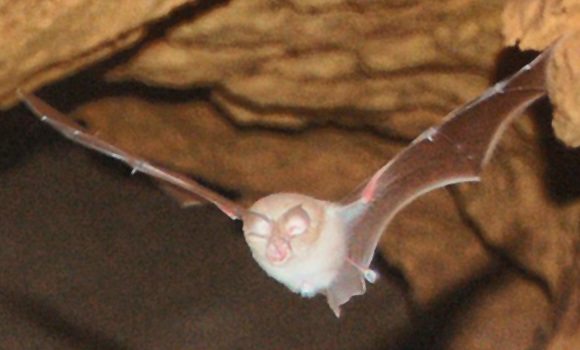
The species occurs in Cambodia, China, India, Indonesia, Laos, Malaysia, Myanmar, Nepal, Thailand and Vietnam. It is a very small horseshoe bat with a relatively wide horseshoe-shaped noseleaf.
Written 26 November 2026 from the sources listed below. Each statement was checked against the passage it cites; statements that could not be supported were removed.
Appearance
The bat has dark brown dorsal fur and white-grey ventral fur. Juveniles have greyer fur than adults.[1][2][3]
The species has a relatively wide horseshoe-shaped noseleaf. The sella narrows in its middle and gradually tapers to a broadly rounded tip.[4][5]
The sella has a concavity in lateral view, and its connecting process is triangular or horn-shaped. The lower lip has three mental grooves.[6][7]
Habitat
The species generally roosts in caves. It has also been recorded roosting in the roof of a bungalow in a forest.[8][9]
Behaviour
The species produces echolocation calls consisting of a long constant-frequency signal with brief frequency-modulated beginnings and endings. The strongest recorded call frequencies of hand-held individuals ranged from 102 to 111 kHz.[10][11]
Male echolocation calls had a mean frequency of 105.95 kHz, while female calls had a mean frequency of 108.48 kHz in the reported sample.[12][13]
Resting echolocation frequency differs significantly among populations across the species' range in mainland China. This variation is positively and significantly associated with climatic conditions, particularly environmental humidity, and is only weakly associated with geographical distance.[14][15][16]
The species adjusts its resting echolocation frequency in response to humidity. Differences in resting frequencies between males and females may contribute to sex recognition.[17][18]
Conservation
The species was assessed as Least Concern under the IUCN Red List category LR/lc in the 2006 assessment. No population-size estimate was available for the species in China, and it was not listed under China's 1989 Law on the Protection of Wildlife.[19][20][21]
Conservation efforts should protect caves and old buildings as roosting sites. They should also consider local climate changes and the effects of environmental noise.[22][23]
Uses
The species serves as a food source for the jawed land leech Sinospelaeobdella.[24]
Similar species
The species is morphologically similar to the European Rhinolophus hipposideros despite being phylogenetically distinct.[25]
Classification of the Least Horseshoe Bat
| Kingdom | Animalia |
|---|---|
| Phylum | Chordata |
| Subphylum | Vertebrata |
| Infraphylum | Gnathostomata |
| Parvphylum | Osteichthyes |
| Megaclass | Tetrapoda |
| Class | Mammalia (Mammal) |
| Subclass | Theria |
| Infraclass | Eutheria |
| Order | Chiroptera (Bat) |
| Suborder | Yinpterochiroptera |
| Superfamily | Rhinolophoidea |
| Family | Rhinolophidae (Horseshoe Bat) |
| Genus | Rhinolophus (Horseshoe Bat) |
| Species | Rhinolophus pusillus Temminck, 1834 |
Where the Least Horseshoe Bat is found
Checklists and occurrence records place Rhinolophus pusillus in 12 countries across Asia. GBIF holds 1,021 georeferenced records of it.
Countries
- Cambodia 12
- China 247
- Hong Kong 20
- India 27
- Indonesia 150
- Japan 6
- Laos 56
- Malaysia 87
- Myanmar 84
- Nepal 3
- Thailand 192
- Vietnam 137
Regions and cities with the most records
- Jiangsu, China 30
- Xiaolingwei, China 26
- Dong Nai, Vietnam 25
- Perak, Malaysia 20
- Lumut, Malaysia 19
- Seri Manjung, Malaysia 19
- Sitiawan, Malaysia 19
- Kachin State, Myanmar 18
- Myitkyina, Myanmar 18
- Nanjing, China 17
- Yogyakarta, Indonesia 16
- Ayer Itam, Malaysia 13
- Balik Pulau, Malaysia 13
- Batu Feringgi, Malaysia 13
- Bayan Lepas, Malaysia 13
- Bukit Gemuroh, Malaysia 13
- Butterworth, Malaysia 13
- George Town, Malaysia 13
- Glugor, Malaysia 13
- Jelutong, Malaysia 13
- Kampung Sungai Ara, Malaysia 13
- Kampung Sungai Glugur, Malaysia 13
- Kampung Teluk Kumbar, Malaysia 13
- Paya Terubong, Malaysia 13
- Perai, Malaysia 13
- Relau, Malaysia 13
- Pahang, Malaysia 12
- Pat Heung, Hong Kong 12
- Sham Tseng, Hong Kong 12
- Tai Po, Hong Kong 12
- Ting Kau, Hong Kong 12
- Tsing Yi Town, Hong Kong 12
- Chongqing, China 11
- City One, Hong Kong 11
- Discovery Park, Hong Kong 11
- Fairview Park, Hong Kong 11
Range as the checklists state it
Southern Asia
A number beside a place is its count of GBIF occurrence records. A place without a number comes from a checklist alone. Records show where a species has been observed or collected, which can include escapes and vagrants.
Common names
English
- Least Horseshoe Bat
- Least Horseshoe Bat.
Names in 11 other languages
- Chinese
- 小菊頭蝠
- Czech
- vrápenec Imaizumiův, vrápenec japonský, vrápenec nejmenší
- Finnish
- aasianpikkuherkko, japaninherkko, riukiusaartenherkko
- German
- Kleinste Hufeisennase, Zwerg-Hufeisennase
- Indonesian
- Prok-bruk Kecil
- Japanese
- オキナワコキクガシラコウモリ, コキクガシラコウモリ
- Korean
- 꼬마관박쥐
- Malay
- Kelawar Ladam Terkecil
- Polish
- Podkowiec drobny
- Russian
- Карликовый подковонос
- Thai
- ค้างคาวมงกุฎเล็ก
Synonyms
2 other scientific names have been used for this species and are now treated as synonyms of Rhinolophus pusillus.
- Rhinolophus minutus Miller, 1900
- Rhinolophus pusillus1 Temminck, 1834
Subspecies and varieties
- Rhinolophus pusillus blythi (Least Horseshoe Bat.) subspecies
- Rhinolophus pusillus calidus (Least Horseshoe Bat.) subspecies
- Rhinolophus pusillus gracilis (Least Horseshoe Bat.) subspecies
- Rhinolophus pusillus lakkhanae (Least Horseshoe Bat.) subspecies
- Rhinolophus pusillus minutillus (Least Horseshoe Bat.) subspecies
- Rhinolophus pusillus pagi (Least Horseshoe Bat.) subspecies
- Rhinolophus pusillus parcus (Least Horseshoe Bat.) subspecies
- Rhinolophus pusillus pusillus (Least Horseshoe Bat.) subspecies
- Rhinolophus pusillus szechwanus (Least Horseshoe Bat.) subspecies
Related species
-
 Greater Horseshoe BatRhinolophus ferrumequinum
-
 Lesser Horseshoe BatRhinolophus hipposideros
-
 Mediterranean Horseshoe BatRhinolophus euryale
-
 Intermediate Horseshoe BatRhinolophus affinis
-
 Blasius's Horseshoe BatRhinolophus blasii
-
 Mehely's Horseshoe BatRhinolophus mehelyi
- Andaman Horseshoe BatRhinolophus cognatus
-
 Geoffroy's Horseshoe BatRhinolophus clivosus
Compare
Questions and answers
What is the scientific name of the Least Horseshoe Bat?
The scientific name of the Least Horseshoe Bat is Rhinolophus pusillus. Written with its author, the full name is Rhinolophus pusillus Temminck, 1834.
Which family does the Least Horseshoe Bat belong to?
Rhinolophus pusillus belongs to the family Rhinolophidae, in the order Chiroptera and the class Mammalia.
Where is the Least Horseshoe Bat found?
Checklists and occurrence records place Rhinolophus pusillus in 12 countries, including China, Thailand, Indonesia, Vietnam, Malaysia and Myanmar.
What is the conservation status of the Least Horseshoe Bat?
The IUCN Red List category recorded for Rhinolophus pusillus is Least Concern (LC).
What other names does the Least Horseshoe Bat have?
Rhinolophus pusillus is also known in English as Least Horseshoe Bat..
Sources
Passages the profile rests on
- The bat has dark brown fur on its dorsal side. Source passage: “Dorsal fur is dark brown.” — bio.bris.ac.uk
- The bat has white-grey fur on its ventral side. Source passage: “Ventral fur is white-grey.” — bio.bris.ac.uk
- Juveniles have greyer fur than adults. Source passage: “Juveniles are greyer than adults.” — bio.bris.ac.uk
- The species has a relatively wide horseshoe-shaped noseleaf. Source passage: “The horseshoe is relatively wide.” — bio.bris.ac.uk
- The sella narrows in its middle and gradually tapers to a broadly rounded tip. Source passage: “The sella is constricted in the middle, gradually narrow to a widely rounded tip.” — bio.bris.ac.uk
- The sella has a concavity in lateral view, and its connecting process is triangular or horn-shaped. Source passage: “In lateral view the sella shows a concavity and the connecting process is triangular or horn-shaped.” — bio.bris.ac.uk
- The lower lip has three mental grooves. Source passage: “Lower lip has 3 mental grooves.” — bio.bris.ac.uk
- The species generally roosts in caves. Source passage: “Generally roosts in caves, often with other species.” — bio.bris.ac.uk
- The species has also been recorded roosting in the roof of a bungalow in a forest. Source passage: “Also recorded in the roof of bungalow in forest.” — bio.bris.ac.uk
- The species produces echolocation calls consisting of a long constant-frequency signal with brief frequency-modulated beginnings and endings. Source passage: “The echolocation call is a long constant frequency signal, with a brief frequency-modulated start and tail.” — bio.bris.ac.uk
- The strongest recorded echolocation-call frequencies of hand-held individuals ranged from 102 to 111 kHz. Source passage: “Frequencies with most energy recorded from hand-held bats ranged between 102-111 kHz” — bio.bris.ac.uk
- Male echolocation calls had a mean frequency of 105.95 kHz in the reported sample. Source passage: “Averages for males were 105.95 +/- 2.72 (SD) kHz” — bio.bris.ac.uk
- Female echolocation calls had a mean frequency of 108.48 kHz in the reported sample. Source passage: “females called with most energy at 108.48 +/- 2.57 kHz” — bio.bris.ac.uk
- The resting echolocation frequency differs significantly among populations across the species' range in mainland China. Source passage: “Significant differences in RF were observed among populations throughout the species range in Mainland China” — pmc.ncbi.nlm.nih.gov
- Resting-frequency variation among populations is positively and significantly associated with climatic conditions, particularly environmental humidity. Source passage: “this variation was positively and significantly related to climate conditions, especially environmental humidity” — pmc.ncbi.nlm.nih.gov
- Resting-frequency variation in this species is only weakly associated with geographical distance. Source passage: “the variability was only weakly associated with geographical distance.” — pmc.ncbi.nlm.nih.gov
- The species adjusts its resting echolocation frequency in response to humidity. Source passage: “bats adjusted resting frequency to humidity” — pmc.ncbi.nlm.nih.gov
- Differences in resting frequencies between males and females may contribute to sex recognition. Source passage: “Sex dimorphism in the RF of R. pusillus may imply that female and male might keep their frequencies within a narrow range for sex recognition.” — pmc.ncbi.nlm.nih.gov
- The species was assessed as Least Concern under the IUCN Red List category LR/lc in the 2006 assessment cited by the document. Source passage: “Least horseshoe bats are LR/lc, assessed by the Red List of Threatened Species (IUCN, 2006)” — bio.bris.ac.uk
- No population-size estimate was available for the species in China according to the document. Source passage: “There is no estimation of population size in China.” — bio.bris.ac.uk
- The species was not listed under China's 1989 Law on the Protection of Wildlife. Source passage: “The species is not listed in the Law of the People's Republic of China on the Protection of Wildlife in 1989.” — bio.bris.ac.uk
- The document recommends protecting caves and old buildings as roosting sites for the species. Source passage: “Caves and old buildings should be protected as roost sites.” — bio.bris.ac.uk
- Conservation efforts should consider local climate changes and the effects of environmental noise. Source passage: “conservation efforts should focus on changes in local climate and effects of environmental noise.” — pmc.ncbi.nlm.nih.gov
- The species serves as a food source for the jawed land leech Sinospelaeobdella. Source passage: “It is a food source of the parasite Sinospelaeobdella, a jawed land leech.” — English Wikipedia
- The species is morphologically similar to the European Rhinolophus hipposideros despite being phylogenetically distinct. Source passage: “The bats are phylogenetically distinct from the morphologically similar R. hipposideros from Europe” — bio.bris.ac.uk
- The species occurs in Cambodia, China, India, Indonesia, Laos, Malaysia, Myanmar, Nepal, Thailand and Vietnam. Source passage: “It is found in Cambodia, China, India, Indonesia, Laos, Malaysia, Myanmar, Nepal, Thailand and Vietnam.” — English Wikipedia
Data
- Catalogue of Life, 2026-10-16 XR cc by
- Global Biodiversity Information Facility CC BY 4.0
- Wikidata CC0
- GeoNames CC BY 4.0
- Wikimedia Commons per image; credit shown with each image
- Within the Catalogue of Life, this name comes from The Integrated Taxonomic Information System cc0
References
- Tijdschr. Nat. Gesch. Physiol. vol.1 p.29 where the name was published
- Ellerman, J. R., and T. C. S. Morrison-Scott. (1951). Checklist of Palaearctic and Indian Mammals 1758 to 1946.
- Wilson, Don E., and DeeAnn M. Reeder, eds. (1993). Mammal Species of the World: A Taxonomic and Geographic Reference, 2nd Ed., 3rd Printing.
- Wilson, Don E., and F. Russell Cole. (2000). Common Names of Mammals of the World.
- Simmons, Nancy B. / Wilson, Don E., and DeeAnn M. Reeder, eds. (2005). Order Chiroptera. Mammal Species of the World: A Taxonomic and Geographic Reference, 3rd Ed., Vols. 1 & 2.
- Wilson, D. E., and R. A. Mittermeier, eds. (2019). Handbook of the Mammals of the World. Vol. 9: Bats.
This species in other databases
Page built on 27 November 2026. See how the catalog is made and all sources and licences.
Cite this page
ScientificNames.org. (2026). Rhinolophus pusillus (Least Horseshoe Bat). Retrieved November 27, 2026, from https://scientificnames.org/species/rhinolophus-pusillus
“Rhinolophus pusillus (Least Horseshoe Bat).” ScientificNames.org, 2026, scientificnames.org/species/rhinolophus-pusillus. Accessed 27 Nov. 2026.
ScientificNames.org. “Rhinolophus pusillus (Least Horseshoe Bat).” Accessed November 27, 2026. https://scientificnames.org/species/rhinolophus-pusillus.
@misc{scientificnames_rhinolophus_pusillus_least_horseshoe_bat,
  author = {{ScientificNames.org}},
  title = {Rhinolophus pusillus (Least Horseshoe Bat)},
  year = {2026},
  url = {https://scientificnames.org/species/rhinolophus-pusillus},
  note = {Accessed 2026-11-27}
}