Species · Birds
Thick-billed Parrot Rhynchopsitta pachyrhyncha
The scientific name of the Thick-billed Parrot is Rhynchopsitta pachyrhyncha. It is a species of bird in the family Psittacidae (macaws), order Psittaciformes. The name dates from 1827.
- Scientific name
- Rhynchopsitta pachyrhyncha (Swainson, 1827)
- Common name
- Thick-billed Parrot
- Genus
- Rhynchopsitta
- Family
- Psittacidae (Macaws)
- Order
- Psittaciformes
- Class
- Aves
- Red List category
- EN Endangered
- Environment
- terrestrial
- Recorded in
- 2 countries
- Name status
- accepted in the Catalogue of Life

Overview
Rhynchopsitta pachyrhyncha is largely restricted to Mexico's Sierra Madre Occidental, occurring in Chihuahua and Durango, Mexico. It is distinguished by bright green plumage, a large black bill, and red markings on its forecrown, shoulders, and thighs.
Written 26 November 2026 from the sources listed below. Each statement was checked against the passage it cites; statements that could not be supported were removed.
Appearance
The Thick-billed Parrot has bright green plumage, a large black bill, and red markings on its forecrown, shoulders, and thighs. Adults have amber eyes, while juveniles have brown eyes.[1][2]
The species measures approximately 38 cm in length. Adults weigh between 315 and 370 g.[3][4]
Habitat
The Thick-billed Parrot inhabits temperate conifer forests at elevations between 1,200 and 3,600 metres. Quaking aspens, whether living or dead, are dominant nesting trees in some parts of its range.[5][6][7]
Diet
The Thick-billed Parrot primarily eats seeds from pine species. Mexican white pine seeds appear to be a preferred food.[8][9]
Its diet also includes seeds from Douglas fir, Apache pine, Chihuahua pine, and yellow pine. Acorns and pine buds are supplementary foods.[10][11]
The species depends strongly on the availability of conifer cones.[12]
Behaviour
The Thick-billed Parrot is highly social. Individuals sometimes feed one another using food stored in their crops and spend their free time preening one another.[13][14][15]
The species is nomadic and moves in response to changes in cone abundance. Historical records document groups exceeding 1,000 individuals at a single location.[16][17]
Thick-billed Parrots can climb upside-down beneath snow-covered branches to reach cones. They can also sustain flights between mountain ranges to reach feeding areas.[18][19]
The species manipulates food by holding it with one foot. Its vocalizations include harsh, rolling calls resembling human laughter.[20][21]
Reproduction and life cycle
The Thick-billed Parrot nests in tree cavities, particularly abandoned woodpecker holes. It breeds when pine seed production reaches its peak.[22][23]
The species is difficult to breed in captivity and has very low reproductive rates.[24]
Conservation
The Thick-billed Parrot is classified as Endangered on the IUCN Red List. It is included in Appendix I of CITES, which prohibits commercial international trade.[25][26]
The estimated wild population in Mexico was 1,700 individuals in 2018. A 2004 survey estimated that the population contained between 2,000 and 2,800 mature individuals.[27][28]
Illegal pet trading and logging-related habitat loss are principal threats to the species.[29][30]
Climate change threatens the species through rising temperatures, higher snow lines, and increased fire risks. Hawks and owls are identified as important predators threatening the species.[31][32]
Similar species
The Thick-billed Parrot resembles the military macaw, which is larger and has a proportionally longer tail, blue flight feathers, and a blue rump. The lilac-crowned amazon is another resembling species.[33][34]
Classification of the Thick-billed Parrot
| Kingdom | Animalia |
|---|---|
| Phylum | Chordata |
| Subphylum | Vertebrata |
| Infraphylum | Gnathostomata |
| Parvphylum | Osteichthyes |
| Megaclass | Tetrapoda |
| Class | Aves (Bird) |
| Order | Psittaciformes (Parrot) |
| Family | Psittacidae (Macaws) |
| Genus | Rhynchopsitta (Thick-billed Parrots) |
| Species | Rhynchopsitta pachyrhyncha (Swainson, 1827) |
Where the Thick-billed Parrot is found
Checklists and occurrence records place Rhynchopsitta pachyrhyncha in 2 countries across North America. GBIF holds 1,093 georeferenced records of it.
Countries
Regions and cities with the most records
- Chihuahua, Mexico 725
- Madera, Mexico 100
- Durango, Mexico 50
- Arizona, United States 41
- New Mexico, United States 26
- Chihuahua, Mexico 15
- Sinaloa, Mexico 15
- Veracruz, Mexico 15
- Coahuila, Mexico 11
- Sonora, Mexico 11
- Michoacán, Mexico 10
- Florida, United States 8
- Jalisco, Mexico 7
- Ciudad Mendoza, Mexico 5
- El Salto, Mexico 5
- Fortín de las Flores, Mexico 5
- Ixtaczoquitlán, Mexico 5
- Nogales, Mexico 5
- Orizaba, Mexico 5
- Perote, Mexico 5
- Río Blanco, Mexico 5
- Zacatecas, Mexico 4
- Ciudad Delicias, Mexico 3
- Pedro Meoqui, Mexico 3
- Victoria de Durango, Mexico 3
Range as the checklists state it
Middle America
A number beside a place is its count of GBIF occurrence records. A place without a number comes from a checklist alone. Records show where a species has been observed or collected, which can include escapes and vagrants.
Common names
English
- Thick-billed Parrot
- Snow Parrot
Names in 31 other languages
- Arabic
- ببغاء الثلج, ببغاء سميك المنقار
- Bulgarian
- Дебелоклюн папагал
- Catalan
- cotorra de Sierra Madre Occidental
- Chinese
- 厚嘴鸚哥, 厚嘴鹦哥
- Croatian
- krupnokljuna jandaja
- Czech
- arara zelený
- Danish
- Araparakit
- Dutch
- Araparkiet
- Esperanto
- dikbeka papago
- Estonian
- männipapagoi e. lääne-männipapagoi
- Finnish
- mäntyaratti
- French
- Conure à gros bec
- German
- Arasittich, Kiefernsittich
- Hungarian
- vastagcsőrű fenyőpapagáj, vastagcsőrű papagáj
- Italian
- Pappagallo beccospesso
- Japanese
- ハシブトインコ
- Lithuanian
- raudonkaktė storasnapė ara
- Norwegian
- tykknebbparakitt
- Polish
- meksykana czerwonoczelna
- Portuguese
- papagaio-de-bico-grosso, papagaio-de-testa-vermelha, papagaio-mexicano-de-testa-vermelha
- Russian
- Краснолобый толстоклювый ара, Толстоклювый ара, Толстоклювый арара
- Serbian
- Debelokljuni papagaj
- Slovak
- arara červenočelá
- Spanish
- Cotorra serrana occidental, Cotorra-serrana occidental, Loro Piquigordo, Periquito de Pico Grueso
- Swedish
- tjocknäbbad parakit
- Turkish
- Çam Papağanı
- Ukrainian
- ара товстодзьобий
- Welsh
- parot gylfinbraff
- mrj
- Кӹжгӹ нерӓн ара
- nav
- Naaléełchííʼ
- pnb
- موٹی چنجوالا طوطا
Synonyms
One other scientific name has been used for this species and is now treated as a synonym of Rhynchopsitta pachyrhyncha.
- Macrocercus pachyrhynchus Swainson, 1827
Related species
-
 Maroon-fronted ParrotRhynchopsitta terrisi
-
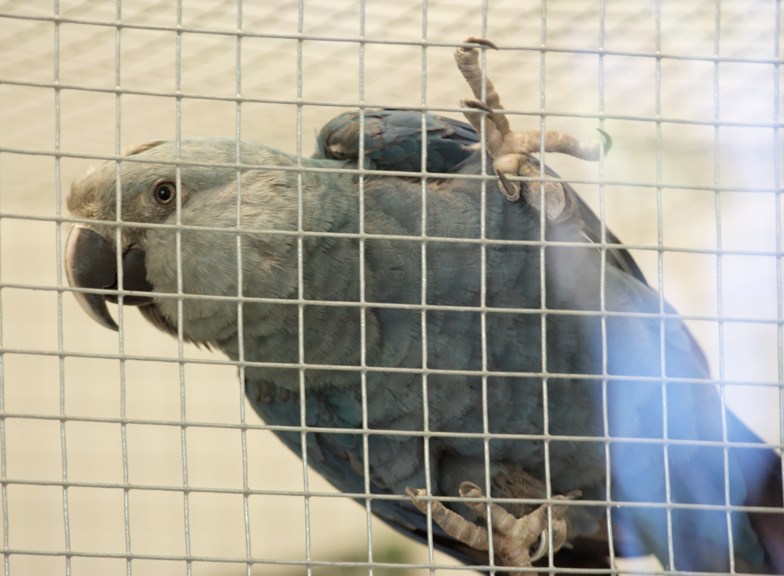 Spix's MacawCyanopsitta spixii
-
 Grey ParrotPsittacus erithacus
-
 Scarlet MacawAra macao
-
 Hyacinth MacawAnodorhynchus hyacinthinus
-
 Blue-and-yellow MacawAra ararauna
-
 Sun ConureAratinga solstitialis
-
 Green ParakeetPsittacara holochlorus
Compare
Questions and answers
What is the scientific name of the Thick-billed Parrot?
The scientific name of the Thick-billed Parrot is Rhynchopsitta pachyrhyncha. Written with its author, the full name is Rhynchopsitta pachyrhyncha (Swainson, 1827).
Which family does the Thick-billed Parrot belong to?
Rhynchopsitta pachyrhyncha belongs to the family Psittacidae, in the order Psittaciformes and the class Aves.
Where is the Thick-billed Parrot found?
Checklists and occurrence records place Rhynchopsitta pachyrhyncha in 2 countries: Mexico and United States.
What is the conservation status of the Thick-billed Parrot?
The IUCN Red List category recorded for Rhynchopsitta pachyrhyncha is Endangered (EN).
What other names does the Thick-billed Parrot have?
Rhynchopsitta pachyrhyncha is also known in English as Snow Parrot.
Is the thick-billed parrot endangered?
Yes. The Thick-billed Parrot is classified as Endangered on the IUCN Red List.[25]
Where does the thick-billed parrot live?
The Thick-billed Parrot is largely restricted to Mexico's Sierra Madre Occidental. It occurs in Chihuahua and Durango, Mexico, including northeastern Sonora, western Chihuahua, and southern and western Durango.[35][36][37]
Do thick-billed parrots talk?
Their vocalizations include harsh, rolling calls resembling human laughter.[21]
Sources
Passages the profile rests on
- The thick-billed parrot has bright green plumage, a large black bill, and red markings on its forecrown, shoulders, and thighs. Source passage: “The thick-billed parrot is a medium-sized, bright green parrot with a large black bill and red forecrown, shoulder and thighs.” — English Wikipedia
- Adult thick-billed parrots have amber eyes, whereas juveniles have brown eyes. Source passage: “Adult eyes are amber, while juveniles have brown eyes.” — English Wikipedia
- The thick-billed parrot measures approximately 38 cm in length. Source passage: “It is 38 cm (15 in) long” — English Wikipedia
- Adult thick-billed parrots weigh between 315 and 370 g. Source passage: “weighs 315–370 g (11.1–13.1 oz).” — English Wikipedia
- The species inhabits temperate conifer forests. Source passage: “The thick-billed parrot lives in temperate conifer, pine, mature pine-oak and fir forests” — English Wikipedia
- The thick-billed parrot occupies forests at elevations between 1,200 and 3,600 metres. Source passage: “at elevation of 1200–3600 meters.” — English Wikipedia
- Quaking aspens, whether living or dead, are dominant nesting trees in some parts of the species' range. Source passage: “In parts of its existing range, dead or living quaking aspens are the dominant tree selected for nesting.” — English Wikipedia
- The thick-billed parrot primarily eats seeds from pine species. Source passage: “It mainly feeds on seeds from various pine species.” — English Wikipedia
- Mexican white pine seeds appear to be a preferred food. Source passage: “Mexican white pine appears to be a preferred species” — English Wikipedia
- The species also consumes seeds from Douglas fir, Apache pine, Chihuahua pine, and yellow pine. Source passage: “the seeds of Douglas fir, Apache pine, Chihuahua pine, and yellow pine are also taken.” — English Wikipedia
- Acorns and pine buds are supplementary foods for the species. Source passage: “To a much lesser extent, they also feed upon acorns and pine buds.” — English Wikipedia
- The thick-billed parrot depends strongly on the availability of conifer cones. Source passage: “The species is strongly dependent on the supply of conifer cones” — English Wikipedia
- The thick-billed parrot is a highly social species. Source passage: “Highly social, they may feed each other food stored in their crop” — English Wikipedia
- Individuals sometimes feed one another using food stored in their crops. Source passage: “they may feed each other food stored in their crop (a pouch in the throat)” — English Wikipedia
- Thick-billed parrots spend their free time preening one another. Source passage: “spend their free time preening each other.” — English Wikipedia
- The species is nomadic and moves in response to changes in cone abundance. Source passage: “The species is nomadic, following the variations of cone abundance.” — English Wikipedia
- Historical records document groups exceeding 1,000 individuals at a single location. Source passage: “Groups of over 1,000 birds in one place are known from historical records.” — English Wikipedia
- Thick-billed parrots can climb upside-down beneath snow-covered branches to reach cones. Source passage: “They deal with deep snow by hanging upside-down and climbing on the bare underside of a snow-covered branch in order to access cones.” — English Wikipedia
- The species is capable of sustained flights between mountain ranges to reach feeding areas. Source passage: “crossing vast distances to feed in another mountain range each day.” — English Wikipedia
- The thick-billed parrot manipulates food by holding it with one foot. Source passage: “they manipulate their food by holding it with one foot.” — English Wikipedia
- Its vocalizations include harsh, rolling calls resembling human laughter. Source passage: “a variety of harsh, rolling calls described as similar to human laughter.” — English Wikipedia
- The thick-billed parrot nests in tree cavities, particularly abandoned woodpecker holes. Source passage: “nests in tree cavities, especially old woodpecker holes.” — English Wikipedia
- The species breeds when pine seed production reaches its peak. Source passage: “breeding at the peak of pine seed production.” — English Wikipedia
- The thick-billed parrot is difficult to breed in captivity and has very low reproductive rates. Source passage: “the species is nervous and difficult to breed in captivity, with very low reproduction rates.” — English Wikipedia
- The thick-billed parrot is classified as Endangered on the IUCN Red List. Source passage: “The species is listed as endangered on the IUCN Red List of Threatened Species” — English Wikipedia
- The species is included in Appendix I of CITES, which prohibits commercial international trade. Source passage: “is on Appendix I of CITES meaning that commercial international trade is prohibited.” — English Wikipedia
- The estimated wild population in Mexico was 1,700 individuals in 2018. Source passage: “In 2018, the estimated wild population in Mexico was 1,700.” — English Wikipedia
- A 2004 survey estimated that the population contained between 2,000 and 2,800 mature individuals. Source passage: “A 2004 BirdLife International survey suggested that there may be 2,000–2,800 mature individuals” — English Wikipedia
- Illegal pet trading is one of the principal threats to the thick-billed parrot. Source passage: “Principal threats to the thick-billed parrot are illegal pet trade” — English Wikipedia
- Logging-related habitat loss is a major threat to the species. Source passage: “habitat loss principally due to logging” — English Wikipedia
- Climate change threatens the species through rising temperatures, higher snow lines, and increased fire risks. Source passage: “climate change (hotter temperatures that raise the snow line and increasing fire threats)” — English Wikipedia
- Hawks and owls are identified as important predators threatening the species. Source passage: “predators especially hawks and owls.” — English Wikipedia
- The thick-billed parrot resembles the military macaw, which is larger and has a proportionally longer tail and blue flight feathers and rump. Source passage: “It is similar in appearance to the military macaw (Ara militaris), which is larger with a proportionally longer tail and blue flight feathers and rump” — English Wikipedia
- The lilac-crowned amazon is another species resembling the thick-billed parrot. Source passage: “and the lilac-crowned amazon (Amazona finschi).” — English Wikipedia
- The thick-billed parrot is largely restricted to Mexico's Sierra Madre Occidental. Source passage: “It is largely restricted to the Sierra Madre Occidental in Chihuahua and Durango, Mexico.” — English Wikipedia
- The species occurs in Chihuahua and Durango, Mexico. Source passage: “It is largely restricted to the Sierra Madre Occidental in Chihuahua and Durango, Mexico.” — English Wikipedia
- Its Mexican distribution includes northeastern Sonora, western Chihuahua, and southern and western Durango. Source passage: “in north-east Sonora, west Chihuahua, south and west Durango and ...” — datazone.birdlife.org
Data
- Catalogue of Life, 2026-10-16 XR cc by
- Global Biodiversity Information Facility CC BY 4.0
- Wikidata CC0
- GeoNames CC BY 4.0
- Wikimedia Commons per image; credit shown with each image
- Within the Catalogue of Life, this name comes from The Integrated Taxonomic Information System cc0
References
- Philos. Mag., new ser., 1: 439. 1827 where the name was published
- Banks, R. C., R. W. McDiarmid, and A. L. Gardner. (1987). Checklist of Vertebrates of the United States, the U.S. Territories, and Canada. Resource Publication, No. 166.
- Gill, Frank, & and Minturn Wright. (2006). Birds of the World: Recommended English Names.
- Dickinson, E. C., and L. Christidis, eds. (2014). The Howard and Moore Complete Checklist of the Birds of the World, 4th Edition, Vol. 2 Passerines.
This species in other databases
Page built on 29 November 2026. See how the catalog is made and all sources and licences.
Cite this page
ScientificNames.org. (2026). Rhynchopsitta pachyrhyncha (Thick-billed Parrot). Retrieved November 29, 2026, from https://scientificnames.org/species/rhynchopsitta-pachyrhyncha
“Rhynchopsitta pachyrhyncha (Thick-billed Parrot).” ScientificNames.org, 2026, scientificnames.org/species/rhynchopsitta-pachyrhyncha. Accessed 29 Nov. 2026.
ScientificNames.org. “Rhynchopsitta pachyrhyncha (Thick-billed Parrot).” Accessed November 29, 2026. https://scientificnames.org/species/rhynchopsitta-pachyrhyncha.
@misc{scientificnames_rhynchopsitta_pachyrhyncha_thick_billed_parrot,
  author = {{ScientificNames.org}},
  title = {Rhynchopsitta pachyrhyncha (Thick-billed Parrot)},
  year = {2026},
  url = {https://scientificnames.org/species/rhynchopsitta-pachyrhyncha},
  note = {Accessed 2026-11-29}
}