Species · Birds
Maroon-fronted Parrot Rhynchopsitta terrisi
The scientific name of the Maroon-fronted Parrot is Rhynchopsitta terrisi. It is a species of bird in the family Psittacidae (macaws), order Psittaciformes. The name dates from 1947.
- Scientific name
- Rhynchopsitta terrisi R. T. Moore, 1947
- Common name
- Maroon-fronted Parrot
- Genus
- Rhynchopsitta
- Family
- Psittacidae (Macaws)
- Order
- Psittaciformes
- Class
- Aves
- Red List category
- EN Endangered
- Environment
- terrestrial
- Recorded in
- 1 country
- Name status
- accepted in the Catalogue of Life

Overview
Rhynchopsitta terrisi is endemic to the Sierra Madre Oriental in Nuevo León, Coahuila, and Tamaulipas, Mexico. It has predominantly dark green plumage, a maroon forehead and eye-stripe, and a long, pointed tail.
Written 26 November 2026 from the sources listed below. Each statement was checked against the passage it cites; statements that could not be supported were removed.
Appearance
The Maroon-fronted Parrot has predominantly dark green plumage, a dark red shoulder, and a maroon forehead and eye-stripe. Adult birds have a dark maroon brow extending over the edge of the bare yellow skin surrounding their eyes.[1][2]
The species has brighter red plumage at the bend of its wings, blackish undersides to its wings, and a long, pointed tail.[3][4][5]
Juvenile birds have pale beaks and whitish eye-rings and lack the dark maroon stripe above each eye.[6]
The Maroon-fronted Parrot measures 40–45 cm in length and weighs 390–470 g.[7][8]
Habitat
The species inhabits mature pine forests, mixed-conifer forests, and pine-oak forests at elevations of 2,000–3,500 metres.[9][10][11]
It feeds in pine and pine-oak forests and in adjacent semiopen areas. It nests in limestone cliffs near moving water.[12][13]
The Maroon-fronted Parrot is endemic to northeastern Mexico and is restricted to the Sierra Madre Oriental in Nuevo León, Coahuila, and Tamaulipas, Mexico.[14][15]
Diet
Pine seeds are the main food source of the Maroon-fronted Parrot.[16]
Behaviour
The Maroon-fronted Parrot is social and forms large nesting colonies. It undertakes seasonal migrations over short distances.[17][18][19]
The species produces a high-pitched, rolling call described as cr-a ak. Groups sound similar to acorn woodpeckers when heard from a distance.[20][21]
Reproduction and life cycle
Breeding coincides with the fruiting of pine trees. The species lays between one and three eggs in July.[22][23][24]
Juveniles fledge around November.[25]
Conservation
The wild population is estimated at approximately 2,500–3,000 birds. According to BirdLife DataZone, the species has a population of no more than 5,000 individuals.[26][27]
The species is considered endangered because of overgrazing and habitat destruction.[28]
Environmental education and scientific research programs are conducted for the species' conservation in Cumbres de Monterrey National Park and Sierra de Arteaga.[29]
Classification of the Maroon-fronted Parrot
| Kingdom | Animalia |
|---|---|
| Phylum | Chordata |
| Subphylum | Vertebrata |
| Infraphylum | Gnathostomata |
| Parvphylum | Osteichthyes |
| Megaclass | Tetrapoda |
| Class | Aves (Bird) |
| Order | Psittaciformes (Parrot) |
| Family | Psittacidae (Macaws) |
| Genus | Rhynchopsitta (Thick-billed Parrots) |
| Species | Rhynchopsitta terrisi R. T. Moore, 1947 |
Where the Maroon-fronted Parrot is found
Checklists and occurrence records place Rhynchopsitta terrisi in 1 country across North America. GBIF holds 1,058 georeferenced records of it.
Countries
Regions and cities with the most records
- Nuevo León, Mexico 547
- Coahuila, Mexico 470
- Santiago, Mexico 82
- Saltillo, Mexico 61
- San Pedro Garza García, Mexico 54
- Santa Catarina, Mexico 49
- Ramos Arizpe, Mexico 18
- García, Mexico 13
- Mitras Poniente, Mexico 13
- Monterrey, Mexico 13
- Parque Industrial Ciudad Mitras, Mexico 13
- Ciudad de Allende, Mexico 12
- Guadalupe, Mexico 11
- San Nicolás de los Garza, Mexico 11
- Ciudad General Escobedo, Mexico 10
- Tamaulipas, Mexico 10
- Jardines de la Silla, Mexico 6
- Ciudad Apodaca, Mexico 4
- Ciudad Benito Juárez, Mexico 3
Range as the checklists state it
Middle America
A number beside a place is its count of GBIF occurrence records. A place without a number comes from a checklist alone. Records show where a species has been observed or collected, which can include escapes and vagrants.
Common names
English
- Maroon-fronted Parrot
Names in 27 other languages
- Arabic
- ببغاء كستنائي الجبهة
- Catalan
- cotorra de Sierra Madre Oriental
- Chinese
- 暗红额鹦哥, 栗額鸚哥
- Croatian
- tamnočela jandaja
- Czech
- arara hnědočelý
- Danish
- Brunpandet Araparakit
- Dutch
- Grote Araparkiet, Grote Dikbekpapegaai
- Esperanto
- brunfrunta papago
- Estonian
- ida-männipapagoi
- Finnish
- isomäntyaratti
- French
- Conure à front brun
- German
- Braunstirnsittich, Maronenstirnsittich
- Hungarian
- barnafejű ararapapagáj, barnahomlokú fenyőpapagáj
- Italian
- Pappagallo frontemarrone
- Japanese
- クリムネインコ
- Lithuanian
- juodakaktė storasnapė ara
- Norwegian
- furuparakitt
- Polish
- meksykana kasztanowoczelna
- Portuguese
- papagaio-de-fronte-castanha, papagaio-de-testa-castanha
- Russian
- Каштановолобый арара, Темнолобый толстоклювый ара
- Serbian
- Debelokljuni papagaj sa bordo čelom
- Slovak
- arara hnedočelá
- Spanish
- Cotorra serrana oriental, Cotorra-serrana oriental
- Swedish
- tallparakit
- Turkish
- Kahverengi Alınlı Papağan
- Ukrainian
- ара мексиканський
- Welsh
- parot talcen browngoch
Synonyms
One other scientific name has been used for this species and is now treated as a synonym of Rhynchopsitta terrisi.
- Rhynchopsitta pachyrhyncha terrisi Moore, RT, 1947
Related species
-
 Thick-billed ParrotRhynchopsitta pachyrhyncha
-
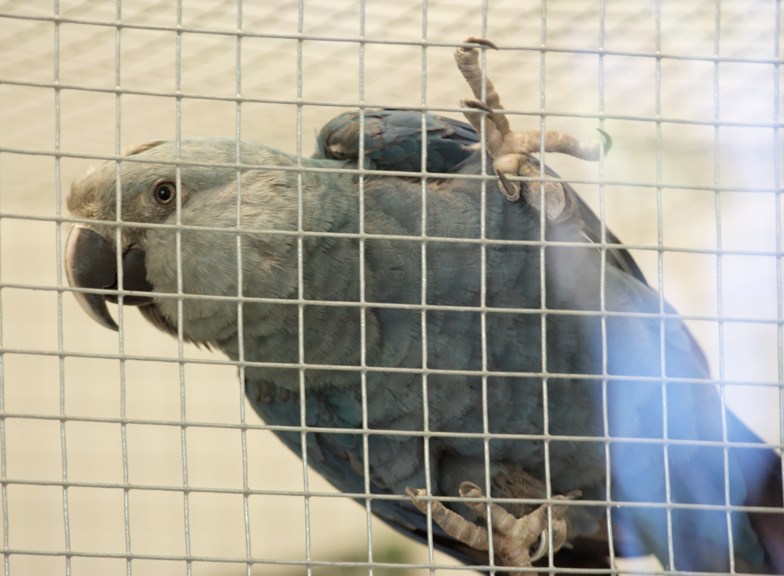 Spix's MacawCyanopsitta spixii
-
 Grey ParrotPsittacus erithacus
-
 Scarlet MacawAra macao
-
 Hyacinth MacawAnodorhynchus hyacinthinus
-
 Blue-and-yellow MacawAra ararauna
-
 Sun ConureAratinga solstitialis
-
 Green ParakeetPsittacara holochlorus
Compare
Questions and answers
What is the scientific name of the Maroon-fronted Parrot?
The scientific name of the Maroon-fronted Parrot is Rhynchopsitta terrisi. Written with its author, the full name is Rhynchopsitta terrisi R. T. Moore, 1947.
Which family does the Maroon-fronted Parrot belong to?
Rhynchopsitta terrisi belongs to the family Psittacidae, in the order Psittaciformes and the class Aves.
Where is the Maroon-fronted Parrot found?
Checklists and occurrence records place Rhynchopsitta terrisi in 1 country: Mexico.
What is the conservation status of the Maroon-fronted Parrot?
The IUCN Red List category recorded for Rhynchopsitta terrisi is Endangered (EN).
What type of habitat do parrots live in?
The Maroon-fronted Parrot inhabits mature pine, mixed-conifer, and pine-oak forests at elevations of 2,000–3,500 metres. It also feeds in adjacent semiopen areas and nests in limestone cliffs near moving water.[9][10][11][12][13]
What is the diet of parrots?
Pine seeds are the main food source of the Maroon-fronted Parrot.[16]
Sources
Passages the profile rests on
- The maroon-fronted parrot has predominantly dark green plumage, a dark red shoulder, and a maroon forehead and eye-stripe. Source passage: “It is dark green with a dark red shoulder and a maroon forehead and eye-stripe.” — English Wikipedia
- Adult birds have a dark maroon brow extending over the edge of the bare yellow skin surrounding their eyes. Source passage: “The adults have a dark maroon brow which extends over the rim of bare yellow skin that surrounds the eyes.” — English Wikipedia
- The species has brighter red plumage at the bend of its wings. Source passage: “They have a brighter red at the bend of the wing.” — English Wikipedia
- The maroon-fronted parrot has a long, pointed tail. Source passage: “The tail is long and pointed.” — English Wikipedia
- The underside of the wings is blackish. Source passage: “The underside of the wings are blackish.” — English Wikipedia
- Juvenile birds have pale beaks and whitish eye-rings and lack the dark maroon stripe above each eye. Source passage: “The juvenile has a pale beak, whitish eye-rings, and lack the dark maroon stripe over each eye.” — English Wikipedia
- The maroon-fronted parrot measures 40–45 cm in length. Source passage: “measures 40–45 cm (16–18 in) in length” — English Wikipedia
- The species weighs 390–470 g. Source passage: “weighs 390–470 g (14–17 oz).” — English Wikipedia
- The species inhabits mature pine forests at elevations of 2,000–3,500 metres. Source passage: “Maroon-fronted parrots live in mature pine, mixed conifer, and pine-oak forests from 2000 to 3500 meters.” — English Wikipedia
- The species inhabits mature mixed-conifer forests at elevations of 2,000–3,500 metres. Source passage: “Maroon-fronted parrots live in mature pine, mixed conifer, and pine-oak forests from 2000 to 3500 meters.” — English Wikipedia
- The species inhabits mature pine-oak forests at elevations of 2,000–3,500 metres. Source passage: “Maroon-fronted parrots live in mature pine, mixed conifer, and pine-oak forests from 2000 to 3500 meters.” — English Wikipedia
- The species feeds in pine and pine-oak forests and in adjacent semiopen areas. Source passage: “Feeds in pine and pine-oak forests and adjacent semiopen areas with” — ebird.org
- The species nests in limestone cliffs near moving water. Source passage: “They nest in limestone cliffs near moving water in large colonies.” — English Wikipedia
- The species is endemic to northeastern Mexico. Source passage: “The species is endemic to northeastern Mexico” — English Wikipedia
- The species is restricted to the Sierra Madre Oriental in Nuevo León, Coahuila, and Tamaulipas, Mexico. Source passage: “Rhynchopsitta terrisi is restricted to the Sierra Madre Oriental in Nuevo León, Coahuila and Tamaulipas, Mexico” — datazone.birdlife.org
- Pine seeds are the species' main food source. Source passage: “Breeding coincides with the fruition of pines, which is its main food source.” — English Wikipedia
- The maroon-fronted parrot forms large nesting colonies. Source passage: “They nest in limestone cliffs near moving water in large colonies.” — English Wikipedia
- The species undertakes seasonal migrations over short distances. Source passage: “They migrate over short distances seasonally.” — English Wikipedia
- The species is social. Source passage: “Very local, long-tailed, and social parrot of mountains endemic to northeast Mexico.” — ebird.org
- The species produces a high-pitched, rolling call described as cr-a ak. Source passage: “It makes a high, rolling cr-a ak sound.” — English Wikipedia
- Groups of maroon-fronted parrots sound similar to acorn woodpeckers when heard from a distance. Source passage: “Groups sound similar to the acorn woodpecker if they are heard from a distance.” — English Wikipedia
- Breeding coincides with the fruiting of pine trees. Source passage: “Breeding coincides with the fruition of pines, which is its main food source.” — English Wikipedia
- The species lays between one and three eggs. Source passage: “They lay one to three eggs in July and the juveniles fledge around November.” — English Wikipedia
- Egg laying takes place in July. Source passage: “They lay one to three eggs in July and the juveniles fledge around November.” — English Wikipedia
- Juveniles fledge around November. Source passage: “the juveniles fledge around November.” — English Wikipedia
- The wild population is estimated at approximately 2,500–3,000 birds. Source passage: “The species is endemic to northeastern Mexico, where only about 2500–3000 birds survive in the wild.” — English Wikipedia
- The species has a population of no more than 5,000 individuals according to BirdLife DataZone. Source passage: “where there is presently no more than 5,000 ...” — datazone.birdlife.org
- The species is considered endangered because of overgrazing and habitat destruction. Source passage: “This bird is considered endangered due to overgrazing and habitat destruction.” — English Wikipedia
- Environmental education and scientific research programs are conducted for the species' conservation in Cumbres de Monterrey National Park and Sierra de Arteaga. Source passage: “The ITESM Campus Monterrey carry out environmental education programs and science research in Cumbres de Monterrey National Park and Sierra de Arteaga for the conservation of maroon-fronted parrots.” — English Wikipedia
Data
- Catalogue of Life, 2026-10-16 XR cc by
- Global Biodiversity Information Facility CC BY 4.0
- Wikidata CC0
- GeoNames CC BY 4.0
- Wikimedia Commons per image; credit shown with each image
- Within the Catalogue of Life, this name comes from The Integrated Taxonomic Information System cc0
References
- Proc. Biol. Soc. Wash., 60: 27. 1947 where the name was published
- Gill, Frank, & and Minturn Wright. (2006). Birds of the World: Recommended English Names.
- Dickinson, E. C., and L. Christidis, eds. (2014). The Howard and Moore Complete Checklist of the Birds of the World, 4th Edition, Vol. 2 Passerines.
This species in other databases
Page built on 27 November 2026. See how the catalog is made and all sources and licences.
Cite this page
ScientificNames.org. (2026). Rhynchopsitta terrisi (Maroon-fronted Parrot). Retrieved November 27, 2026, from https://scientificnames.org/species/rhynchopsitta-terrisi
“Rhynchopsitta terrisi (Maroon-fronted Parrot).” ScientificNames.org, 2026, scientificnames.org/species/rhynchopsitta-terrisi. Accessed 27 Nov. 2026.
ScientificNames.org. “Rhynchopsitta terrisi (Maroon-fronted Parrot).” Accessed November 27, 2026. https://scientificnames.org/species/rhynchopsitta-terrisi.
@misc{scientificnames_rhynchopsitta_terrisi_maroon_fronted_parrot,
  author = {{ScientificNames.org}},
  title = {Rhynchopsitta terrisi (Maroon-fronted Parrot)},
  year = {2026},
  url = {https://scientificnames.org/species/rhynchopsitta-terrisi},
  note = {Accessed 2026-11-27}
}