Species · Reptiles
Three-toed Skink Saiphos equalis
The scientific name of the Three-toed Skink is Saiphos equalis. It is a species of reptile in the family Scincidae (skink), order Squamata. The name dates from 1825.

Overview
Saiphos equalis, commonly known as the yellow-bellied three-toed skink or simply three-toed skink, is a species of burrowing skink found in eastern Australia. It is the only species classified under the genus Saiphos.
Classification of the Three-toed Skink
| Kingdom | Animalia |
|---|---|
| Phylum | Chordata |
| Subphylum | Vertebrata |
| Infraphylum | Gnathostomata |
| Parvphylum | Osteichthyes |
| Megaclass | Tetrapoda |
| Class | Reptilia (Reptile) |
| Order | Squamata (Snakes) |
| Suborder | Autarchoglossa |
| Family | Scincidae (Skink) |
| Subfamily | Sphenomorphinae |
| Genus | Saiphos (Three-Toed Skinks) |
| Species | Saiphos equalis (Gray, 1825) |
Where the Three-toed Skink is found
Checklists and occurrence records place Saiphos equalis in 1 country across Oceania. GBIF holds 6,433 georeferenced records of it.
Countries
Regions and cities with the most records
- New South Wales, Australia 5,803
- Sydney, Australia 741
- Queensland, Australia 312
- Wollongong, Australia 149
- Central Coast, Australia 90
- Newcastle, Australia 77
- Coffs Harbour, Australia 59
- Gold Coast, Australia 27
- Port Macquarie, Australia 25
- Toowoomba, Australia 25
- Maitland, Australia 19
- Western Australia, Australia 4
Range as the checklists state it
Australia (New South Wales, SE Queensland)
A number beside a place is its count of GBIF occurrence records. A place without a number comes from a checklist alone. Records show where a species has been observed or collected, which can include escapes and vagrants.
Common names
English
- Three-toed Skink
- Three-toed Snake-Skink
- Yellow-bellied Snake-Skink
- Yellow-bellied Three-toed Skink
Names in 1 other language
- Russian
- Короткопалый саифос
Synonyms
2 other scientific names have been used for this species and are now treated as synonyms of Saiphos equalis.
- Anguis lacertina Gray, 1831
- Seps equalis Gray, 1825
Related species
-
 ShinglebackTiliqua rugosa
-
 Five-lined SkinkPlestiodon fasciatus
- Common Garden SkinkLampropholis guichenoti
-
 Blue-tailed Snake-eyed SkinkCryptoblepharus egeriae
-
 Red-eyed Crocodile SkinkTribolonotus gracilis
-
 Common BluetongueTiliqua scincoides
-
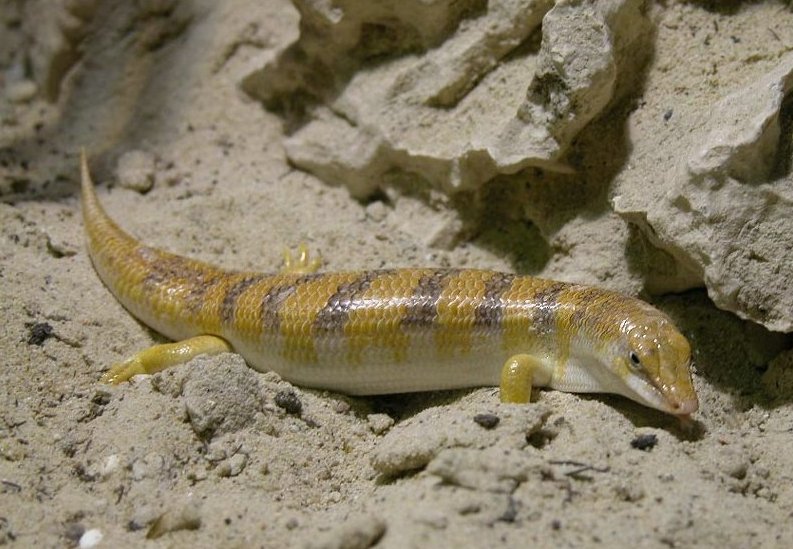 Sandfish SkinkScincus scincus
-
 Land MulletBellatorias major
Compare
Questions and answers
What is the scientific name of the Three-toed Skink?
The scientific name of the Three-toed Skink is Saiphos equalis. Written with its author, the full name is Saiphos equalis (Gray, 1825).
Which family does the Three-toed Skink belong to?
Saiphos equalis belongs to the family Scincidae, in the order Squamata and the class Reptilia.
Where is the Three-toed Skink found?
Checklists and occurrence records place Saiphos equalis in 1 country: Australia.
What is the conservation status of the Three-toed Skink?
The IUCN Red List category recorded for Saiphos equalis is Least Concern (LC).
What other names does the Three-toed Skink have?
Saiphos equalis is also known in English as Three-toed Snake-Skink, Yellow-bellied Snake-Skink and Yellow-bellied Three-toed Skink.
Sources
Data
- Catalogue of Life, 2026-10-16 XR cc by
- Global Biodiversity Information Facility CC BY 4.0
- Wikidata CC0
- English Wikipedia CC BY-SA 4.0
- GeoNames CC BY 4.0
- Wikimedia Commons per image; credit shown with each image
- Within the Catalogue of Life, this name comes from The Reptile Database cc by
References
- Gray, J. E. (1825). A synopsis of the genera of reptiles and Amphibia, with a description of some new species. Annals of Philosophy, 10:193—217.
- Gray, J. E. (1831). A synopsis of the species of Class Reptilia. In: Griffith, E & E. Pidgeon: The animal kingdom arranged in conformity with its organisation by the Baron Cuvier with additional descriptions of all the species hither named, and of many before noticed [Vol. 9]. Whittaker, Treacher and Co., London: 481 + 110 Pp. [1830].
- Gray, J. E. (1839). Catalogue of the slender-tongued saurians, with descriptions of many new genera and species. Ann. Mag. Nat. Hist. 2 (11): 331-337 [Continued from Page 293].
- Longman, H. A. (1915). Reptiles from Queensland and the Northern Territory. Memoirs of the Queensland Museum 3: 30-34.
- Murphy, Michael J. (1994). Reptiles and amphibians of Seven Mile Beach National park, NSW. Herpetofauna (Sydney) 24 (2): 24-30.
- Cogger, H. G. (2000). Reptiles and Amphibians of Australia, 6th ed. Ralph Curtis Publishing, Sanibel Island, 808 Pp.
- Johnson, R. (2002). A western range extension for the skink Saiphos equalis. Memoirs of the Queensland Museum 48(1): 92.
- Reeder, T. W. (2003). A phylogeny of the Australian Sphenomorphus group (Scincidae: Squamata) and the phylogenetic placement of the crocodile skinks (Tribolonotus): Bayesian approaches to assessing congruence and obtaining confidence in maximum likelihood inferred relationships. Molecular Phylogenetics and Evolution 27: 384–397.
- Greer, A.; David, P. & Teynié, A. (2006). The Southeast Asian scincid lizard Siaphos tridigitus Bourret, 1939 (Reptilia, Scincidae): a second specimen. Zoosystema 28 (3) : 785-790.
- Couper, P., Covacevich, J., Amey, A., & Baker, A. (2006). The genera of skinks (Family Scincidae) of Australia and its island territories: diversity, distribution and identification. in: Merrick, J.R., Archer, M., Hickey, G.M. & Lee, M.S.Y. (eds.). Evolution and Zoogeography of Australasian Vertebrates. Australian Scientific Publishing, Sydney, Pp. 367-384.
- Wu, Qiong; Parker, Scott L.; Thompson, Michael B. (2009). Selected body temperature, metabolic rate and activity pattern of the Australian fossorial skink, Saiphos equalis. The Herpetological Journal 19: 127-133.
- Parker, Scott L.; Christopher R. Murphy, and Michael B. Thompson. (2010). Uterine angiogenesis in squamate reptiles: Implications for the evolution of viviparity. Herp. Cons. Biol. 5 (2).
- Murphy, Michael J. (2010). ADDITIONS TO THE HERPETOFAUNA OF GORE CREEK RESERVE AND LANE COVE BUSHLAND PARK IN INNER SUBURBAN SYDNEY, NSW. Herpetofauna 40 (2): 103-110.
- Biazik, Joanna M.; Michael B. Thompson, and Christopher R. Murphy. (2010). Paracellular and transcellular transport across the squamate uterine epithelium. Herp. Cons. Biol. 5 (2).
- Stewart, J. R., Mathieson, A. N., Ecay, T. W., Herbert, J. F., Parker, S. L. and Thompson, M. B. (2010). Uterine and eggshell structure and histochemistry in a lizard with prolonged uterine egg retention (Lacertilia, Scincidae, Saiphos). Journal of Morphology Doi: 10.1002/Jmor.10877.
- Stewart, James R. and Tom W. Ecay. (2010). Patterns of maternal provision and embryonic mobilization of calcium in oviparous and viviparous squamate reptiles. Herp. Cons. Biol. 5 (2).
- Wilson, S., & Swan, G. (2010). A complete guide to reptiles of Australia, 3rd ed. Chatswood: New Holland, 558 Pp.
- Hugi, Jasmina; Mark N. Hutchinson, D. Koyabu, Marcelo R. Sánchez-Villagra. (2012). Heterochronic shifts in the ossification sequences of surface- and subsurface-dwelling skinks are correlated with the degree of limb reduction. Zoology 115 (3): 188-198.
- Cogger, H. G. (2014). Reptiles and Amphibians of Australia, 7th ed. CSIRO Publishing, Xxx + 1033 Pp.
- Mo, & Matthew. (2015). Herpetofaunal community of the constructed Lime Kiln Bay Wetland, south Sydney, New South Wales. Victorian Naturalist 132 (3): 64-72.
- Swan, G., Sadlier, R., & Shea, G. (2017). A field guide to reptiles of New South Wales. Reed New Holland, 328 Pp.
- Singhal, Sonal; Huateng Huang, Maggie R. Grundler, María R. Marchán-Rivadeneira, Iris Holmes, Pascal O. Title, Stephen C. Donnellan, and Daniel L. Rabosky. (2018). Does Population Structure Predict the Rate of Speciation? A Comparative Test across Australia’s Most Diverse Vertebrate Radiation. The American Naturalist 192 (4): 432-447.
- Laird, Melanie K.; Michael B. Thompson and Camilla M. Whittington. (2019). Facultative oviparity in a viviparous skink (Saiphos equalis). Biology Letters 15 (4):
- Laird, Melanie K.;Thompson, Michael B.and Whittington, Camilla M. (2019). Facultative oviparity in a viviparous skink (Saiphos equalis). Biology Letters, 15(4): 20180827.
- Foster, C.S., Thompson, M.B., Van Dyke, J.U., Brandley, M.C. and Whittington, C.M. (2020). Emergence of an evolutionary innovation: Gene expression differences associated with the transition between oviparity and viviparity. Mol Ecol.
This species in other databases
Page built on 25 November 2026. See how the catalog is made and all sources and licences.
Cite this page
ScientificNames.org. (2026). Saiphos equalis (Three-toed Skink). Retrieved November 25, 2026, from https://scientificnames.org/species/saiphos-equalis
“Saiphos equalis (Three-toed Skink).” ScientificNames.org, 2026, scientificnames.org/species/saiphos-equalis. Accessed 25 Nov. 2026.
ScientificNames.org. “Saiphos equalis (Three-toed Skink).” Accessed November 25, 2026. https://scientificnames.org/species/saiphos-equalis.
@misc{scientificnames_saiphos_equalis_three_toed_skink,
  author = {{ScientificNames.org}},
  title = {Saiphos equalis (Three-toed Skink)},
  year = {2026},
  url = {https://scientificnames.org/species/saiphos-equalis},
  note = {Accessed 2026-11-25}
}