Species · Birds
Siberian Stonechat Saxicola maurus
The scientific name of the Siberian Stonechat is Saxicola maurus. It is a species of bird in the family Muscicapidae (old world flycatcher), order Passeriformes. The name dates from 1773.
- Scientific name
- Saxicola maurus (Pallas, 1773)
- Common name
- Siberian Stonechat
- Genus
- Saxicola
- Family
- Muscicapidae (Old World Flycatcher)
- Order
- Passeriformes
- Class
- Aves
- Recorded in
- 66 countries
- Name status
- accepted in the Catalogue of Life

Overview
The Siberian Stonechat (Saxicola maurus) is a bird in the Old World flycatcher family Muscicapidae, order Passeriformes and class Aves. It breeds across the East Palearctic, from easternmost Europe across temperate Asia to the Himalaya and southwest China, and winters in the Old World tropics. It is distinguished by its white rump, pale underparts and full white collar.
Written 26 November 2026 from the sources listed below. Each statement was checked against the passage it cites; statements that could not be supported were removed.
Appearance
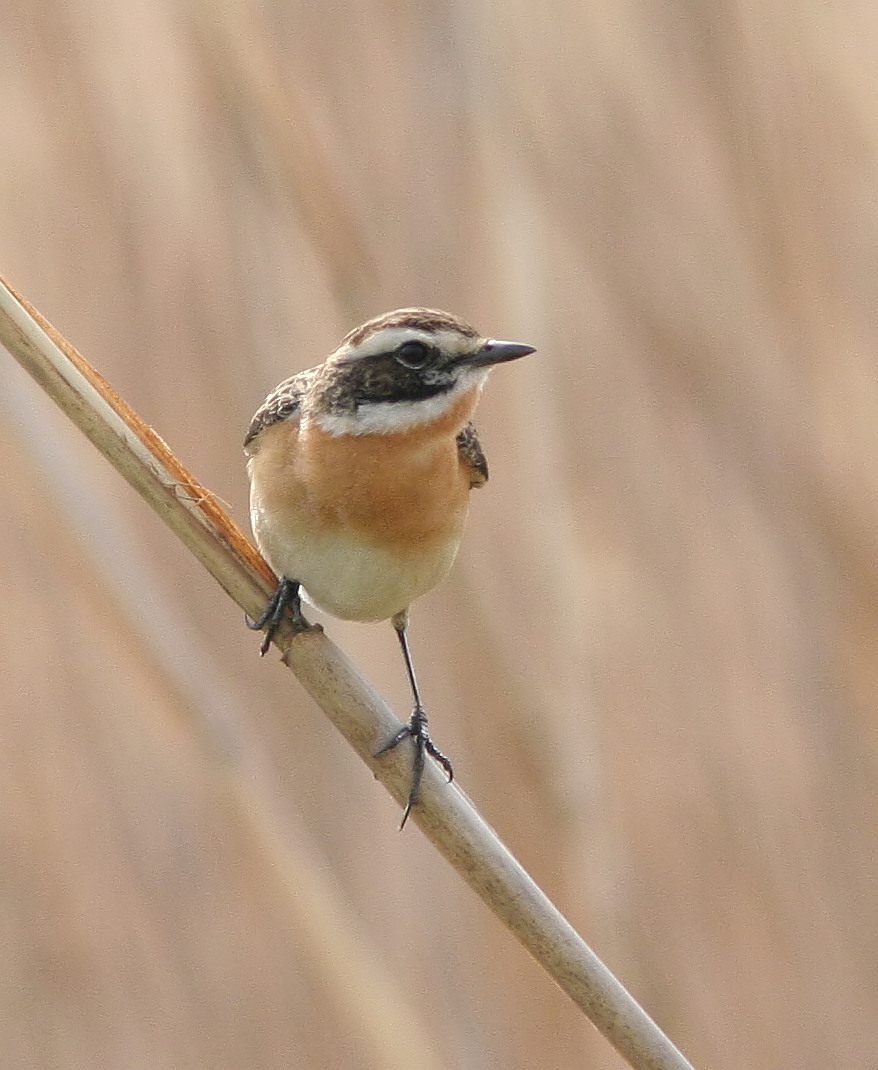
Breeding males have black upperparts and heads, a conspicuous white collar, a white scapular patch and rump, and a restricted orange throat area.[1]
Females have pale brown upperparts and heads, white neck patches, and pale, unstreaked pinkish-yellow rumps. Winter-plumaged males have intermediate coloration between breeding males and females.[2][3]
Winter males have a supercilium resembling that of the whinchat. The primary flight feathers are distinctly longer than those of the European stonechat.[4][5]
Habitat
The Siberian Stonechat breeds in open rough scrubland or rough grassland containing scattered shrubs. Its breeding habitat extends from sea level to approximately 4,000 metres above sea level or higher.[6][7]
Diet
The Siberian Stonechat is insectivorous.[8]
Behaviour
Male Siberian Stonechats produce a clicking call resembling two pebbles being knocked together. The species also produces a high, twittering song resembling that of the dunnock.[9][10]
The species migrates between its breeding and wintering ranges. It appears to avoid even cool temperate conditions and remains in northern regions only during the hot continental summer.[11][12]
Most migrants in the Himalayan foothills move farther south and to lower elevations to spend the winter in tropical regions.[13]
Similar species
The Siberian Stonechat closely resembles the European stonechat (Saxicola rubicola). It can be distinguished from the European stonechat and female stonechats by its full white collar.[14][15]
The Siberian Stonechat is the western sister species of the European stonechat within the Eurasian stonechat lineage. It also closely resembles the whinchat in the length of its primary flight feathers.[16][17]
Conservation
The Siberian Stonechat is widespread and common and is not considered threatened.[18]
Classification of the Siberian Stonechat
| Kingdom | Animalia |
|---|---|
| Phylum | Chordata |
| Subphylum | Vertebrata |
| Infraphylum | Gnathostomata |
| Parvphylum | Osteichthyes |
| Megaclass | Tetrapoda |
| Class | Aves (Bird) |
| Order | Passeriformes (Passerine) |
| Family | Muscicapidae (Old World Flycatcher) |
| Genus | Saxicola (Stonechats and Bush Chats) |
| Species | Saxicola maurus (Pallas, 1773) |
Where the Siberian Stonechat is found
Checklists and occurrence records place Saxicola maurus in 66 countries. GBIF holds 181,668 georeferenced records of it.
Countries
- Afghanistan 260
- Aland Islands 3
- Armenia 652
- Austria 11
- Azerbaijan 276
- Bahrain 68
- Bangladesh 1,238
- Belgium 298
- Bhutan 1,108
- Bulgaria 36
- Cambodia 6
- China 3,849
- Cyprus 134
- Denmark 502
- Estonia 29
- Finland 221
- France 160
- Georgia 1,825
- Germany 70
- Greece 67
- Hong Kong 172
- Hungary 11
- India 114,182
- Iran 960
- Iraq 322
- Ireland 5
- Israel 5,185
- Italy 39
- Japan 24
- Jordan 93
- Kazakhstan 2,199
- Kuwait 1,279
- Kyrgyzstan 719
- Laos 199
- Latvia 3
- Lebanon 3
- Mongolia 851
- Myanmar 287
- Nepal 10,561
- Norway 801
- Oman 318
- Pakistan 911
- Palestinian Territory 115
- Poland 56
- Portugal 10
- Qatar 229
- Romania 24
- Russia 15,370
- Saudi Arabia 691
- South Korea 3
- Spain 27
- Sri Lanka 49
- Sweden 3,897
- Switzerland 29
- Syria 25
- Taiwan 2,477
- Tajikistan 155
- Thailand 124
- The Netherlands 2,309
- Turkey 1,636
- Turkmenistan 37
- Ukraine 332
- United Arab Emirates 2,767
- United Kingdom 799
- Uzbekistan 518
- Vietnam 52
Regions and cities with the most records
- Maharashtra, India 21,712
- Gujarat, India 14,827
- Assam, India 11,522
- Madhya Pradesh, India 8,985
- Uttarakhand, India 7,861
- Rajasthan, India 6,769
- Karnataka, India 5,759
- West Bengal, India 5,517
- Haryana, India 4,487
- Kharghar, India 4,075
- Uttar Pradesh, India 3,992
- Roshanpura, India 3,823
- Najafgarh, India 3,820
- Gurugram, India 3,745
- Goa, India 3,499
- Mānesar, India 3,498
- Kerala, India 3,497
- Airoli, India 3,366
- Bādshāhpur, India 3,300
- Madhyapur Thimi, Nepal 3,273
- Kathmandu, Nepal 3,258
- Pātan, Nepal 3,201
- Ki̇̄rtipur, Nepal 3,175
- Virār, India 2,871
- Sopāra, India 2,863
- Panvel, India 2,829
- Ezhome, India 2,765
- Taleigao, India 2,760
- Dombivali, India 2,742
- Pariyāram, India 2,742
- Chimbel, India 2,727
- Cherukunnu, India 2,716
- Kalliyasshēri, India 2,712
- Taliparamba, India 2,709
- Kannapuram, India 2,706
- Kurumathur, India 2,705
7 more countries have a few records outside this range
These countries hold a few records of Saxicola maurus but lie outside the range the checklists give for it. Such records are often zoo or garden specimens, museum material or vagrants, so the species is not counted as occurring there.
A number beside a place is its count of GBIF occurrence records. A place without a number comes from a checklist alone. Records show where a species has been observed or collected, which can include escapes and vagrants.
Common names
English
- Siberian Stonechat
- Asian Stonechat
- Common Stonechat
- Eastern Stonechat
- Siberian Stonechat (maura)
Names in 49 other languages
- Arabic
- بِرْقَشٌ سَيْبِيرِيٌّ, ثرثار الصخور الآسيوي, ثرثار الصخور السيبيري, قليعي سيبيري
- Azerbaijani
- Sibir çəkçəkisi
- Bulgarian
- Сибирско ливадарче
- Catalan
- Bitxac comú siberià, bitxac siberià
- Chinese
- 西伯利亞石鵖, 西伯利亞石鶺, 黑喉石䳭, 黑喉石鵖
- Croatian
- sibirski batić
- Czech
- bramborníček sibiřský
- Danish
- Sibirisk Bynkefugl
- Dutch
- Aziatische Roodborsttapuit
- Esperanto
- siberia saksikolo
- Estonian
- niidu-kaelustäks
- Finnish
- sepeltasku
- French
- Tarier de Sibérie, Tarier oriental, Traquet de Sibérie
- Georgian
- შავთავა ოვსადი
- German
- Pallasschwarzkehlchen, Sibirisches Schwarzkehlchen
- Greek
- Ασιατικός Μαυρολαίμης, Σιβηρικός μαυρoλαίμης
- Gujarati
- મેંદીયો પીદ્દો
- Hebrew
- דוחל מזרחי
- Hungarian
- keleti cigánycsuk
- Icelandic
- Heiðaskvetta, Runnaskvetta
- Indonesian
- Decu batu
- Irish
- Caislín Sibéarach, Caislín Sibéireach
- Italian
- Saltimpalo siberiano
- Japanese
- シベリアノビタキ
- Kazakh
- Қарабас шақшақ
- Latvian
- Sibīrijas čakstīte
- Lithuanian
- Sibirinė kiauliukė, sibirinė juodagalvė kiauliukė
- Malayalam
- ചരൽക്കുരുവി
- Marathi
- सायबेरिया कंठी गोजा
- Mongolian
- Эгэл шулганаа
- Northern Sami
- Ásiačáhppesskilki
- Norwegian
- russesvartstrupe
- Norwegian Bokmål
- asiasvartstrupe
- Persian
- چک سیبری
- Polish
- kląskawka syberyjska
- Portuguese
- cartaxo-asiático, cartaxo-siberiano
- Romanian
- Mărăcinar siberian
- Russian
- Азиатский черноголовый чекан, Сибирский черноголовый чекан
- Scottish Gaelic
- Claghan ny gleigh Shibbeyragh
- Serbian
- Sibirska travarka
- Slovak
- pŕhľaviar kapucňový
- Spanish
- Tarabilla Siberiana, tarabilla asiática
- Swedish
- Sibirisk buskskvätta, vitgumpad buskskvätta
- Thai
- นกยอดหญ้าหัวดำ, นกยอดหญ้าไซบีเรีย
- Turkish
- Sibirya Taşkuşu
- Ukrainian
- Трав'янка білошия, трав’янка білошия
- Vietnamese
- Sẻ bụi đầu đen
- chm
- Сибирь шим вуян ӱдӹмгек
- chv
- Хура пуҫлӑ улӑх кайӑкӗ
Synonyms
4 other scientific names have been used for this species and are now treated as synonyms of Saxicola maurus.
- Motacilla maura Pallas, PS, 1773
- Muscicapa maura Pallas, PS, 1773
- Saxicola torquatus maurus Pallas, PS, 1773
- Sylvia maura Pallas, PS, 1773
Subspecies and varieties
- Saxicola maurus armenicus subspecies
- Saxicola maurus hemprichii (Caspian Stonechat) subspecies
- Saxicola maurus indicus subspecies
- Saxicola maurus maurus (West Siberian Stonechat) subspecies
- Saxicola maurus przewalskii (Przevalski's Stonechat) subspecies
- Saxicola maurus variegatus (Armenian Stonechat) subspecies
Related species
-
 European StonechatSaxicola rubicola
-
 WhinchatSaxicola rubetra
-
 Pied Bush ChatSaxicola caprata
-
 African StonechatSaxicola torquatus
-
 Grey Bush ChatSaxicola ferreus
-
 Réunion StonechatSaxicola tectes
-
 Canary Islands StonechatSaxicola dacotiae
-
 White-browed Bush ChatSaxicola macrorhynchus
Compare
Questions and answers
What is the scientific name of the Siberian Stonechat?
The scientific name of the Siberian Stonechat is Saxicola maurus. Written with its author, the full name is Saxicola maurus (Pallas, 1773).
Which family does the Siberian Stonechat belong to?
Saxicola maurus belongs to the family Muscicapidae, in the order Passeriformes and the class Aves.
Where is the Siberian Stonechat found?
Checklists and occurrence records place Saxicola maurus in 66 countries, including India, Russia, Nepal, Israel, Sweden and China.
What other names does the Siberian Stonechat have?
Saxicola maurus is also known in English as Asian Stonechat, Common Stonechat, Eastern Stonechat and Siberian Stonechat (maura).
How rare is a Stonechat?
The Siberian Stonechat is widespread and common and is not considered threatened.[18]
Where do Stonechat birds live?
The Siberian Stonechat breeds across the East Palearctic, including easternmost Europe, temperate Asia, Siberia, the Himalaya and southwest China. Its wintering range extends from southern Japan south to Thailand and India, and west to northeastern Africa.[19][20][21]
What is the main diet of birds?
The Siberian Stonechat is insectivorous.[8]
Sources
Passages the profile rests on
- Breeding males have black upperparts and heads, a conspicuous white collar, a white scapular patch and rump, and a restricted orange throat area. Source passage: “The male in breeding plumage has black upperparts and head (lacking the brownish tones of the European stonechat), a conspicuous white collar, scapular patch and rump, and a restricted area of orange on the throat.” — English Wikipedia
- Females have pale brown upperparts and heads, white neck patches, and pale, unstreaked pinkish-yellow rumps. Source passage: “The female has pale brown upperparts and head, white neck patches (not a full collar), and a pale, unstreaked pinkish-yellow rump.” — English Wikipedia
- Winter-plumaged males have intermediate coloration between breeding males and females. Source passage: “Males in winter plumage are intermediate between summer males and females” — English Wikipedia
- Winter males have a supercilium resembling that of the whinchat. Source passage: “with a supercilium resembling the whinchat (S. rubetra)” — English Wikipedia
- Its primary flight feathers are distinctly longer than those of the European stonechat. Source passage: “its primary remiges are distinctly longer than in S. rubicola.” — English Wikipedia
- The species breeds in open rough scrubland or rough grassland containing scattered shrubs. Source passage: “It breeds in open rough scrubland or rough grassland with scattered shrubs” — English Wikipedia
- Its breeding habitat extends from sea level to approximately 4,000 metres above sea level or higher. Source passage: “from sea level to about 4,000 m ASL or more.” — English Wikipedia
- The Siberian stonechat is insectivorous. Source passage: “The Siberian stonechat is insectivorous.” — English Wikipedia
- Male Siberian stonechats produce a clicking call resembling two pebbles being knocked together. Source passage: “The male has a clicking call, like two pebbles knocked together.” — English Wikipedia
- The species produces a high, twittering song resembling that of the dunnock. Source passage: “The song is high and twittering like the dunnock (Prunella modularis)” — English Wikipedia
- The species migrates between its breeding and wintering ranges. Source passage: “The wintering range of the migratory bird” — English Wikipedia
- The species appears to avoid even cool temperate conditions and remains in northern regions only during the hot continental summer. Source passage: “The birds seem to avoid even cool temperate conditions and stay up north only during the hot continental summer.” — English Wikipedia
- Most migrants in the Himalayan foothills move farther south and to lower elevations to spend the winter in tropical regions. Source passage: “but most move further down and south to winter in tropical regions.” — English Wikipedia
- The Siberian stonechat closely resembles the European stonechat (Saxicola rubicola). Source passage: “Siberian stonechat resembles its close relative relative the European stonechat (S. rubicola)” — English Wikipedia
- The species can be distinguished from the whinchat and female stonechats by its full white collar. Source passage: “from this species and the female it can be distinguished by the full white collar.” — English Wikipedia
- The Siberian stonechat is the western sister species of the European stonechat within the Eurasian stonechat lineage. Source passage: “The European stonechat is its western sister species in the Eurasian lineage of stonechats” — English Wikipedia
- The species closely resembles the whinchat in the length of its primary flight feathers. Source passage: “In this, it closely resembles the whinchat” — English Wikipedia
- The Siberian stonechat is widespread and common and is not considered threatened. Source passage: “it is widespread and common and would not be considered a threatened species.” — English Wikipedia
- The species breeds across the East Palearctic, including easternmost Europe, and winters in the Old World tropics. Source passage: “It breeds in the East Palearctic including in easternmost Europe and winters in the Old World tropics.” — English Wikipedia
- Its breeding range extends across temperate Asia from approximately 71 degrees north in Siberia south to the Himalaya and southwest China. Source passage: “The breeding range covers most of temperate Asia, from about latitude 71°N in Siberia south to the Himalaya and southwest China” — English Wikipedia
- Its wintering range extends from southern Japan south to Thailand and India, and west to northeastern Africa. Source passage: “The wintering range of the migratory bird is from southern Japan south to Thailand and India, and west to northeast Africa.” — English Wikipedia
Data
- Catalogue of Life, 2026-10-16 XR cc by
- Global Biodiversity Information Facility CC BY 4.0
- Wikidata CC0
- GeoNames CC BY 4.0
- Wikimedia Commons per image; credit shown with each image
- iNaturalist per image; credit shown with each image
- Within the Catalogue of Life, this name comes from The Integrated Taxonomic Information System cc0
This species in other databases
Page built on 27 November 2026. See how the catalog is made and all sources and licences.
Cite this page
ScientificNames.org. (2026). Saxicola maurus (Siberian Stonechat). Retrieved November 27, 2026, from https://scientificnames.org/species/saxicola-maurus
“Saxicola maurus (Siberian Stonechat).” ScientificNames.org, 2026, scientificnames.org/species/saxicola-maurus. Accessed 27 Nov. 2026.
ScientificNames.org. “Saxicola maurus (Siberian Stonechat).” Accessed November 27, 2026. https://scientificnames.org/species/saxicola-maurus.
@misc{scientificnames_saxicola_maurus_siberian_stonechat,
  author = {{ScientificNames.org}},
  title = {Saxicola maurus (Siberian Stonechat)},
  year = {2026},
  url = {https://scientificnames.org/species/saxicola-maurus},
  note = {Accessed 2026-11-27}
}