Species · Birds
Réunion Stonechat Saxicola tectes
The scientific name of the Réunion Stonechat is Saxicola tectes. It is a species of bird in the family Muscicapidae (old world flycatcher), order Passeriformes. The name dates from 1789.
- Scientific name
- Saxicola tectes (Gmelin, 1789)
- Common name
- Réunion Stonechat
- Genus
- Saxicola
- Family
- Muscicapidae (Old World Flycatcher)
- Order
- Passeriformes
- Class
- Aves
- Red List category
- LC Least Concern
- Recorded in
- 1 country
- Name status
- accepted in the Catalogue of Life

Overview
The Réunion Stonechat is a bird endemic to the French Indian Ocean island of Réunion. It inhabits forests, shrublands, gardens and plantations across Réunion, including clearings and open mountain bushlands, at elevations reaching 2,600 metres above sea level. Its white throat distinguishes it from the African stonechat.
Written 26 November 2026 from the sources listed below. Each statement was checked against the passage it cites; statements that could not be supported were removed.
Appearance
The Réunion Stonechat is a small, chunky, robin-like bird. Adult males have predominantly black upperparts and white underparts, with a white greater covert patch and an orange breast patch that varies in size between individuals.[1][2][3][4]
Male birds may have a white supercilium or eyebrow, although this feature is sometimes absent. The amount of rufous coloration also varies between individuals.[5][6][7]
Females have browner upperparts and more buff-toned underparts than males. They often lack the white greater covert patch.[8][9][10]
Habitat
The Réunion Stonechat inhabits forests, shrublands, gardens and plantations across Réunion. It commonly occurs in clearings and open mountain bushlands.[11][12][13]
The species occurs at elevations reaching 2,600 metres above sea level and in the plains surrounding Piton de la Fournaise.[14][15]
Similar species
The Réunion Stonechat belongs to the common stonechat superspecies. Its closest relative is the Madagascar stonechat (Saxicola sibilla), and the two species are described as insular derivatives of the African stonechat.[16][17][18]
The African stonechat has an entirely black head, including the throat and supercilium, whereas the Réunion Stonechat has a white throat.[19][20]
Conservation
The Réunion Stonechat was assessed by the IUCN on 12 June 2024.[21]
Classification of the Réunion Stonechat
| Kingdom | Animalia |
|---|---|
| Phylum | Chordata |
| Subphylum | Vertebrata |
| Infraphylum | Gnathostomata |
| Parvphylum | Osteichthyes |
| Megaclass | Tetrapoda |
| Class | Aves (Bird) |
| Order | Passeriformes (Passerine) |
| Family | Muscicapidae (Old World Flycatcher) |
| Genus | Saxicola (Stonechats and Bush Chats) |
| Species | Saxicola tectes (Gmelin, 1789) |
Where the Réunion Stonechat is found
Checklists and occurrence records place Saxicola tectes in 1 country. GBIF holds 8,183 georeferenced records of it.
Countries
Regions and cities with the most records
- Le Tampon, Reunion 3,078
- Sainte-Marie, Reunion 2,630
- Le Port, Reunion 2,465
- La Possession, Reunion 2,420
- Saint-Denis, Reunion 2,324
- Sainte-Suzanne, Reunion 2,002
- Saint-Louis, Reunion 1,968
- Saint-Paul, Reunion 1,958
- Saint-Joseph, Reunion 1,914
- Saint-Pierre, Reunion 1,805
- Piton Saint-Leu, Reunion 1,764
- Saint-Benoît, Reunion 1,738
- Saint-Leu, Reunion 1,689
- Saint-André, Reunion 1,653
1 more country has a few records outside this range
These countries hold a few records of Saxicola tectes but lie outside the range the checklists give for it. Such records are often zoo or garden specimens, museum material or vagrants, so the species is not counted as occurring there.
A number beside a place is its count of GBIF occurrence records. A place without a number comes from a checklist alone. Records show where a species has been observed or collected, which can include escapes and vagrants.
Common names
English
- Reunion Stonechat
- Réunion Stonechat
Names in 26 other languages
- Catalan
- bitxac de l'illa de la Reunió
- Chinese
- 留尼汪石䳭, 群聚石鵖
- Croatian
- reunionski batić
- Czech
- bramborníček réunionský
- Danish
- Réunion Bynkefugl
- Dutch
- Réunionroodborsttapuit
- Esperanto
- reunia saksikolo
- Estonian
- réunioni kaelustäks
- Finnish
- reunionintasku, réunionintasku
- French
- Tarier de La Réunion, Traquet de La Réunion
- German
- Réunion-Schmätzer, Réunion-Schwarzkehlchen, Réunionschmätzer, Réunionschwarzkehlchen
- Hungarian
- réunioni csuk
- Italian
- Saltimpalo della Riunione, Saltimpalo di Reunion
- Japanese
- レユニオンノビタキ
- Lithuanian
- reunioninė kiauliukė
- Norwegian
- reunionsvartstrupe
- Polish
- kląskawka białogardła
- Portuguese
- cartaxo-da-reunião
- Russian
- Реюньонский чекан
- Serbian
- Travarka sa ostrva Reunion
- Slovak
- pŕhľaviar réunionský
- Spanish
- Tarabilla de Reunión
- Swedish
- réunionbuskskvätta
- Turkish
- Reünyon Taşkuşu
- Ukrainian
- трав’янка реуньйонська, трав’янка реюньйонська
- rcf
- Tec-tec
Synonyms
4 other scientific names have been used for this species and are now treated as synonyms of Saxicola tectes.
- Muscicapa tectes Gmelin, 1789
- Saxicola borbonensis Sclater, WL, 1928
- Saxicola rubicola tectes Gmelin, JF, 1789
- Saxicola torquata tectes Gmelin, JF, 1789
Related species
-
 European StonechatSaxicola rubicola
-
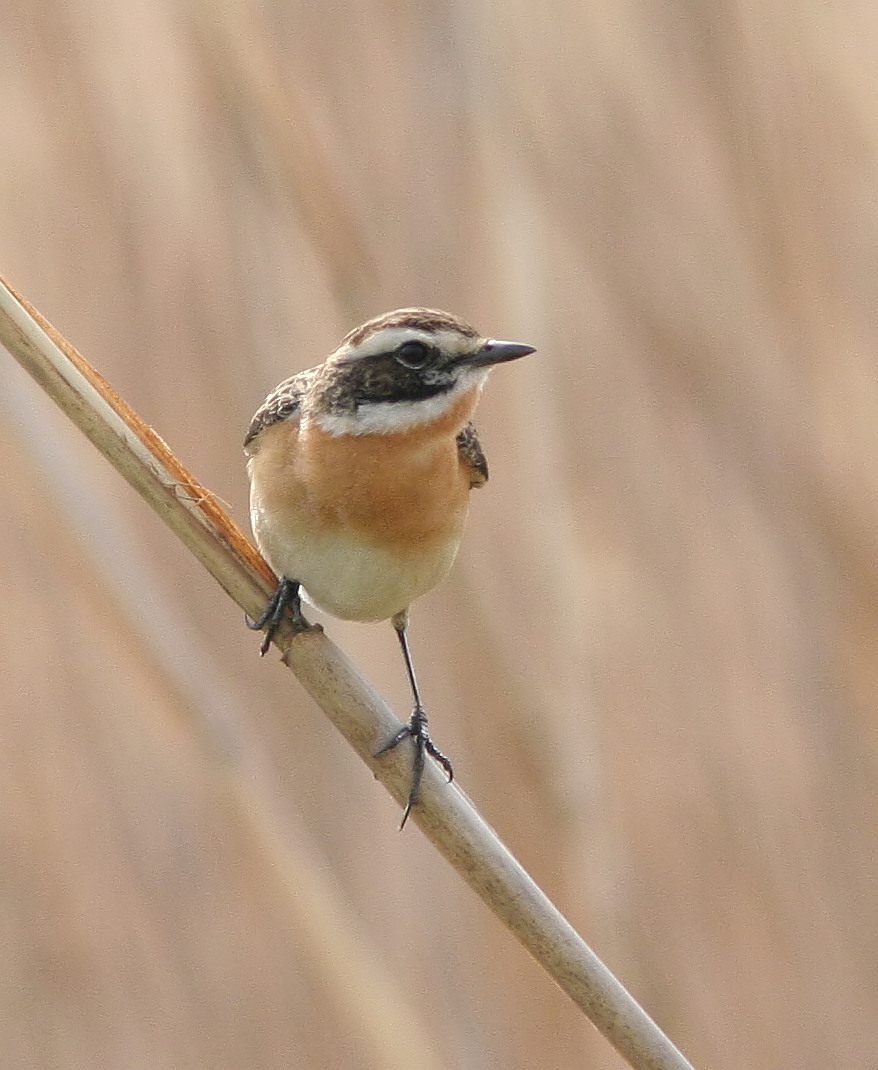 WhinchatSaxicola rubetra
-
 Siberian StonechatSaxicola maurus
-
 Pied Bush ChatSaxicola caprata
-
 African StonechatSaxicola torquatus
-
 Grey Bush ChatSaxicola ferreus
-
 Canary Islands StonechatSaxicola dacotiae
-
 White-browed Bush ChatSaxicola macrorhynchus
Compare
Questions and answers
What is the scientific name of the Réunion Stonechat?
The scientific name of the Réunion Stonechat is Saxicola tectes. Written with its author, the full name is Saxicola tectes (Gmelin, 1789).
Which family does the Réunion Stonechat belong to?
Saxicola tectes belongs to the family Muscicapidae, in the order Passeriformes and the class Aves.
Where is the Réunion Stonechat found?
Checklists and occurrence records place Saxicola tectes in 1 country: Reunion.
What is the conservation status of the Réunion Stonechat?
The IUCN Red List category recorded for Saxicola tectes is Least Concern (LC).
What other names does the Réunion Stonechat have?
Saxicola tectes is also known in English as Reunion Stonechat.
Sources
Passages the profile rests on
- Adult males are predominantly black on their upperparts and white on their underparts. Source passage: “Overall, the male is black above and white below” — English Wikipedia
- Male birds have a white greater covert patch. Source passage: “greater covert patch” — English Wikipedia
- Male birds have an orange breast patch whose size varies between individuals. Source passage: “a variable-sized orange patch on the breast.” — English Wikipedia
- The species is described as a small, chunky, robin-like bird. Source passage: “A small, chunky robin-like bird.” — ebird.org
- Male birds may have a white supercilium, although this feature is sometimes absent. Source passage: “a white supercilium (sometimes absent)” — English Wikipedia
- Male birds vary in whether they display a white eyebrow. Source passage: “sometimes having a white eyebrow” — ebird.org
- The amount of rufous coloration on male birds varies. Source passage: “showing a variable amount of rufous on” — ebird.org
- Females have browner upperparts than males. Source passage: “Females differ from males in being browner above” — English Wikipedia
- Females have more buff-toned underparts than males. Source passage: “more buff-toned below” — English Wikipedia
- Female birds often lack the white greater covert patch. Source passage: “often lacking the white greater covert patch.” — English Wikipedia
- The Réunion stonechat is endemic to the French Indian Ocean island of Réunion. Source passage: “endemic to the French Indian Ocean island of Réunion.” — English Wikipedia
- The species inhabits forests, shrublands, gardens and plantations across Réunion. Source passage: “It is found across the island in forests, shrublands and artificial environments such as gardens and plantations.” — English Wikipedia
- The species commonly occurs in clearings and open mountain bushlands. Source passage: “This small passerine bird is common in clearings and open mountain bushlands” — English Wikipedia
- The species occurs at elevations reaching 2,600 metres above sea level. Source passage: “up to 2600 metres above sea level” — English Wikipedia
- The species occurs in the plains surrounding Piton de la Fournaise. Source passage: “including in the plains around Piton de la Fournaise.” — English Wikipedia
- The Réunion stonechat belongs to the common stonechat superspecies. Source passage: “It is a member of the common stonechat superspecies” — English Wikipedia
- The Madagascar stonechat (Saxicola sibilla) is identified as the Réunion stonechat's closest relative. Source passage: “its closest relative the Madagascar stonechat S. sibilla” — English Wikipedia
- The Réunion stonechat and Madagascar stonechat are described as insular derivatives of the African stonechat. Source passage: “being insular derivatives of the African stonechat.” — English Wikipedia
- The species has a white throat that distinguishes it from the African stonechat. Source passage: “The white throat and (usually white) supercilium are the most prominent external differences from the African stonechat” — English Wikipedia
- The African stonechat differs from the Réunion stonechat by having an entirely black head, including the throat and supercilium. Source passage: “which has a wholly black head including the throat and supercilium.” — English Wikipedia
- The species was assessed by the IUCN on 12 June 2024. Source passage: “Date assessed. 12 June 2024” — iucnredlist.org
Data
- Catalogue of Life, 2026-10-16 XR cc by
- Global Biodiversity Information Facility CC BY 4.0
- Wikidata CC0
- GeoNames CC BY 4.0
- Wikimedia Commons per image; credit shown with each image
- Within the Catalogue of Life, this name comes from The Integrated Taxonomic Information System cc0
References
- Gill, Frank, & and Minturn Wright. (2006). Birds of the World: Recommended English Names.
This species in other databases
Page built on 27 November 2026. See how the catalog is made and all sources and licences.
Cite this page
ScientificNames.org. (2026). Saxicola tectes (Réunion Stonechat). Retrieved November 27, 2026, from https://scientificnames.org/species/saxicola-tectes
“Saxicola tectes (Réunion Stonechat).” ScientificNames.org, 2026, scientificnames.org/species/saxicola-tectes. Accessed 27 Nov. 2026.
ScientificNames.org. “Saxicola tectes (Réunion Stonechat).” Accessed November 27, 2026. https://scientificnames.org/species/saxicola-tectes.
@misc{scientificnames_saxicola_tectes_reunion_stonechat,
  author = {{ScientificNames.org}},
  title = {Saxicola tectes (Réunion Stonechat)},
  year = {2026},
  url = {https://scientificnames.org/species/saxicola-tectes},
  note = {Accessed 2026-11-27}
}