Species · Flowering plants
Chinese Magnolia-vine Schisandra chinensis
The scientific name of the Chinese Magnolia-vine is Schisandra chinensis. It is a species of flowering plant in the family Schisandraceae (magnolia-vine family), order Austrobaileyales.
- Scientific name
- Schisandra chinensis (Turcz.) Baill.
- Common name
- Chinese Magnolia-vine
- Genus
- Schisandra
- Family
- Schisandraceae (Magnolia-vine Family)
- Order
- Austrobaileyales
- Class
- Magnoliopsida
- Recorded in
- 6 countries
- Name status
- accepted in the Catalogue of Life
Overview
Schisandra chinensis produces smooth, shiny, spherical red berries that grow in dense hanging clusters.
Written 26 November 2026 from the sources listed below. Each statement was checked against the passage it cites; statements that could not be supported were removed.
Appearance
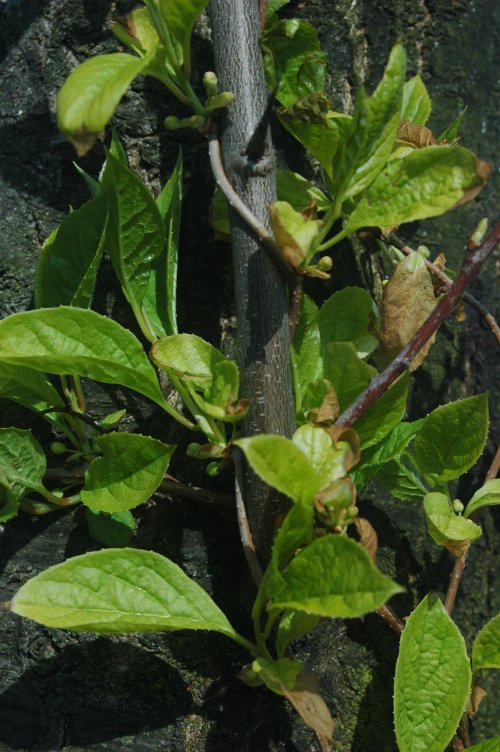
Chinese magnolia-vine has simple, oval-shaped leaves arranged alternately along its stems. Its leaves measure 5–11 centimetres long and 3–7 centimetres wide.[1][2]
Its female flowers are white or cream-coloured and become slightly reddish toward the end of the flowering season. The flowers have 5–12 spirally arranged tepals and 12–120 pistils.[3][4]
Its fruits are smooth, shiny, spherical red berries measuring 5–10 millimetres in diameter. The berries grow in dense hanging clusters approximately 6–8 centimetres long, and each usually contains one or two brownish-yellow, kidney-shaped seeds.[5][6][7][8][9]
The climbing vine grows from 0.5 to 25 metres tall. Its woody stems usually reach 8–9 metres in height but can grow up to 25 metres long and reach 1.5–2 centimetres in thickness.[10][11][12]
Habitat
Chinese magnolia-vine grows naturally in coniferous and mixed forests and along streams. Its natural habitats also include valleys and open forest spaces.[13][14]
It prefers moderate light and wet, humus-rich soil with a slightly acidic pH. Its optimal growing temperature is 20–25 °C, and it tolerates cold temperatures down to −30 °C.[15][16][17][18]
Behaviour
Chinese magnolia-vine climbs by spiralling its stems around tree trunks and neighbouring objects rather than using tendrils. It uses trees and shrubs as support to reach better light conditions.[19][20]
Reproduction and life cycle
Bees, beetles and small moths are among the pollinators of its flowers. Birds are the main agents of seed dispersal.[21][22]
Flowering normally begins between mid-May and early June. Fruits develop from June to July and ripen from August to September.[23][24]
Chinese magnolia-vine can be propagated by seeds, layering or semi-ripe cuttings. Plants grown from seed usually flower for the first time three years after sowing.[25][26]
Uses
The berries are used in traditional medicine and have been used in traditional Chinese medicine for approximately 1,000 years. The berries are consumed raw, dried or processed into syrups, juices and teas.[27][28][29]
The berries are used to flavour traditional dishes and drinks. Koreans prepare them into a cordial drink called omija-cha.[30][31]
The leaves can be used as a vegetable. The species is also cultivated as an ornamental plant for its fragrant flowers and attractive fruits.[32][33]
Extracts from Chinese magnolia-vine are incorporated into drinks, dietary supplements and cosmetic preparations.[34]
The species is cultivated mainly in China and the Republic of Korea. It is also cultivated in North America and Europe as an ornamental plant.[35][36]
Similar species
Schisandra sphenanthera has a biochemical profile similar to but different from that of Schisandra chinensis.[37]
Classification of the Chinese Magnolia-vine
| Kingdom | Plantae |
|---|---|
| Subkingdom | Pteridobiotina |
| Phylum | Tracheophyta |
| Class | Magnoliopsida |
| Order | Austrobaileyales |
| Family | Schisandraceae (Magnolia-vine Family) |
| Genus | Schisandra (Magnolia Vine) |
| Species | Schisandra chinensis (Turcz.) Baill. |
Where the Chinese Magnolia-vine is found
Checklists and occurrence records place Schisandra chinensis in 6 countries across Asia. GBIF holds 4,810 georeferenced records of it.
Countries
Regions and cities with the most records
- Primorye, Russia 738
- Gangwon-do, South Korea 513
- Nagano, Japan 204
- Hokkaido, Japan 187
- Gyeongsangbuk-do, South Korea 180
- Jilin, China 162
- Sakhalin Oblast, Russia 126
- T’aebaek, South Korea 123
- Khabarovsk, Russia 121
- Liaoning, China 107
- Amur Oblast, Russia 89
- Hebei, China 87
- Heilongjiang, China 65
- Gyeongsangnam-do, South Korea 64
- Jeollabuk-do, South Korea 63
- Tōmi, Japan 56
- Vladivostok, Russia 55
- Beijing, China 51
- Trudovoye, Russia 49
- Antu, China 48
- Miyota, Japan 47
- Shimosuwa, Japan 47
- Gyeonggi-do, South Korea 44
- Karuizawa, Japan 44
- Komoro, Japan 44
- Chino, Japan 43
- Matsumoto, Japan 39
- Okaya, Japan 39
- Shiojiri, Japan 38
- Ueda, Japan 38
- Gunma, Japan 37
- Jiangxi, China 36
- Kurye, South Korea 36
- Suwa, Japan 36
- Kamimaruko, Japan 34
- Nangen, South Korea 34
4 more countries have a few records outside this range
These countries hold a few records of Schisandra chinensis but lie outside the range the checklists give for it. Such records are often zoo or garden specimens, museum material or vagrants, so the species is not counted as occurring there.
Range as the checklists state it
Siberia [c]; Russian Far East (Upper Amur, Primorye, Sakhalin); China (Gansu, Hebei, Heilongjiang, Jilin, Liaoning, Nei Mongol, Ningxia, Shandong); North Korea; South Korea (incl. Cheju Isl.); Japan (Hokkaido, Honshu)
A number beside a place is its count of GBIF occurrence records. A place without a number comes from a checklist alone. Records show where a species has been observed or collected, which can include escapes and vagrants.
Common names
English
- Chinese Magnolia-vine
- Five-flavor-fruit
- Five-flavour Berry
- Magnolia-vine
- Schisandra
Names in 16 other languages
- Belarusian
- Лімоннік кітайскі
- Chinese
- wu wei zi, 五味子
- Czech
- schizandra čínská
- Finnish
- Palsamiköynnös, idänpalsamiköynnös
- German
- chinesisches Spaltkölbchen
- Hungarian
- Kínai kúszómagnólia
- Japanese
- チョウセンゴミシ
- Korean
- omija, 오미자, 오미자나무
- Latvian
- Citronliāna
- Lithuanian
- Kininis citrinvytis
- Polish
- cytryniec chiński
- Russian
- Лимонник китайский
- Slovak
- schizandra čínska
- Swedish
- fjärilsranka
- Turkish
- şizandra
- Ukrainian
- Лимонник китайський
Synonyms
13 other scientific names have been used for this species and are now treated as synonyms of Schisandra chinensis.
- Maximowiczia amurensis Rupr.
- Maximowiczia chinensis (Turcz.) Rupr.
- Maximowiczia japonica (A.Gray) K.Koch
- Maximowiczia sinensis Rob.
- Schisandra chinensis var. chinensis
- Schisandra chinensis var. glabrata Nakai ex T.Mori
- Schisandra chinensis var. leucocarpa P.H.Huang & L.H.Zhuo
- Schisandra chinensis var. typica Nakai
- Schisandra nigra f. viridicarpa (Y.N.Lee) M.Kim
- Schisandra repanda f. viridicarpa (Y.N.Lee) M.Kim
- Schisandra viridicarpa Y.N.Lee
- Sphaerostema japonicum A.Gray
- Kadsura chinensis Turcz. ambiguous synonym
Related species
-
 Bay-starvineSchisandra glabra
-
 LemonwoodSchisandra sphenanthera
- Schisandra elongata
- Schisandra henryi
- Schisandra grandiflora
- Schisandra repanda
- Schisandra arisanensis
- Schisandra propinqua
Compare
Questions and answers
What is the scientific name of the Chinese Magnolia-vine?
The scientific name of the Chinese Magnolia-vine is Schisandra chinensis. Written with its author, the full name is Schisandra chinensis (Turcz.) Baill..
Which family does the Chinese Magnolia-vine belong to?
Schisandra chinensis belongs to the family Schisandraceae, in the order Austrobaileyales and the class Magnoliopsida.
Where is the Chinese Magnolia-vine found?
Checklists and occurrence records place Schisandra chinensis in 6 countries: South Korea, Russia, China, Japan, North Korea and Vietnam.
What other names does the Chinese Magnolia-vine have?
Schisandra chinensis is also known in English as Five-flavor-fruit, Five-flavour Berry, Magnolia-vine and Schisandra.
Sources
Passages the profile rests on
- Its leaves are simple, oval-shaped and alternately arranged. Source passage: “The leaves are simple, oval-shaped (5–11 cm long and 3–7 cm wide) and alternating” — English Wikipedia
- Its leaves measure 5–11 centimetres long and 3–7 centimetres wide. Source passage: “The leaves are simple, oval-shaped (5–11 cm long and 3–7 cm wide)” — English Wikipedia
- Its female flowers are white or cream-coloured and become slightly reddish toward the end of the flowering season. Source passage: “The female flowers are white or cream-coloured and turn slightly reddish to the end of the flowering season.” — English Wikipedia
- Its female flowers have 5–12 spirally arranged tepals and 12–120 pistils. Source passage: “They have 5–12 waxy, spirally arranged tepals forming the perianth and 12–120 pistils.” — English Wikipedia
- Its fruits are smooth, shiny, spherical red berries. Source passage: “The fruits of Schisandra chinensis are red berries which are smooth and shiny, have a spherical shape” — English Wikipedia
- Its berries grow in dense hanging clusters. Source passage: “They grow in dense hanging clusters of 2–5 berries” — English Wikipedia
- Each berry usually contains one or two brownish-yellow, kidney-shaped seeds. Source passage: “Each berry usually contains 1–2 brownish yellow kidney-shaped seeds.” — English Wikipedia
- Its berries measure 5–10 millimetres in diameter. Source passage: “have a spherical shape and reach 5–10 mm in diameter.” — English Wikipedia
- Its berry clusters reach approximately 6–8 centimetres in length. Source passage: “which reach a length of about 6–8 cm.” — English Wikipedia
- The climbing vine grows from 0.5 to 25 metres tall. Source passage: “S. chinensis is a deciduous woody climbing vine growing from 0.5 to 25 m tall” — pmc.ncbi.nlm.nih.gov
- Its woody stems usually reach 8–9 metres in height but can grow up to 25 metres long. Source passage: “The prostrate woody stems usually grow 8–9 metres (26–30 ft) tall, but can reach a length of up to 25m.” — English Wikipedia
- Its woody stems can reach 1.5–2 centimetres in thickness. Source passage: “They are dark brown in colour and can reach 1.5–2 cm in thickness.” — English Wikipedia
- The species grows naturally in coniferous and mixed forests and along streams. Source passage: “It commonly grows in natural coniferous or mixed forests or along streams” — English Wikipedia
- Its natural habitats include mixed forests, valleys and open forest spaces. Source passage: “Wild plants of Schisandra chinensis mostly grow in mixed forests, valleys and open forest spaces.” — English Wikipedia
- Suitable habitats have wet, humus-rich soil with a slightly acidic pH. Source passage: “wet, humus-rich soil with a slightly acidic pH” — pmc.ncbi.nlm.nih.gov
- The species prefers moderate light and wet, humus-rich soil. Source passage: “moderate light and wet, humus-rich soil with a slightly acidic pH” — pmc.ncbi.nlm.nih.gov
- The species tolerates cold temperatures down to −30 °C. Source passage: “The plant can grow in wet environments and tolerates cold temperatures to −30 °C.” — English Wikipedia
- Its optimal growing temperature is 20–25 °C. Source passage: “Its optimal growing temperature is at 20–25 °C.” — English Wikipedia
- The vine climbs by spiralling its stems around tree trunks and neighbouring objects rather than using tendrils. Source passage: “It lacks tendrils and other specialised structures for climbing, but due to spiral stem growth, it wraps around the tree trunks” — pmc.ncbi.nlm.nih.gov
- Its climbing growth allows it to reach better light conditions by using trees and shrubs as support. Source passage: “climbs up other trees or shrubs to reach optimal light conditions.” — English Wikipedia
- Bees, beetles and small moths are among the pollinators of its flowers. Source passage: “The flowers of S. chinensis are important for various pollinators such as bees, beetles and small moths.” — English Wikipedia
- Birds are the main agents of seed dispersal. Source passage: “Distribution of seeds mainly occurs through birds.” — English Wikipedia
- Flowering normally begins between mid-May and early June. Source passage: “Normally, the plants start flowering from middle or late May to early June.” — English Wikipedia
- Its fruits develop from June to July and ripen from August to September. Source passage: “Starting from June to July the fruits develop and ripen from August to September.” — English Wikipedia
- The species can be propagated by seeds, layering or semi-ripe cuttings. Source passage: “Plants can be propagated by seed or by layering in spring or autumn, or in the summer time by using semi-ripe cuttings.” — English Wikipedia
- Plants grown from seed usually flower for the first time three years after sowing. Source passage: “Three years after sowing, the plants will blossom for the first time.” — English Wikipedia
- The berries are used in traditional medicine. Source passage: “Its berries are used in traditional medicine.” — English Wikipedia
- The fruits have been used in traditional Chinese medicine for approximately 1,000 years. Source passage: “S. chinensis fruits have been used in traditional Chinese medicine for 1000 years” — pmc.ncbi.nlm.nih.gov
- The berries are consumed raw, dried or processed into syrups, juices and teas. Source passage: “they can be eaten raw, dried or processed in the form of syrups, juices, teas” — pmc.ncbi.nlm.nih.gov
- The berries are used to flavour traditional dishes and drinks. Source passage: “In traditional cuisine, these berries are also used to flavour dishes and drinks” — pmc.ncbi.nlm.nih.gov
- Koreans prepare the berries into a cordial drink called omija-cha. Source passage: “Koreans make the berries, known as omija (Hangul: 오미자), into a cordial drink called omija-cha” — English Wikipedia
- The leaves can be used as a vegetable. Source passage: “When crushed, the leaves release a lemony smell and can be used as a vegetable.” — English Wikipedia
- The species is cultivated as an ornamental plant for its fragrant flowers and attractive fruits. Source passage: “as an ornamental plant for its fragrant white to pink flowers and attractive fruits.” — pmc.ncbi.nlm.nih.gov
- Its extracts are incorporated into drinks, dietary supplements and cosmetic preparations. Source passage: “Its extracts are added to drinks, supplements and cosmetic preparations” — pmc.ncbi.nlm.nih.gov
- The species is cultivated mainly in China and the Republic of Korea. Source passage: “It is cultivated mainly in China and the Republic of Korea” — pmc.ncbi.nlm.nih.gov
- The species is also cultivated in North America and Europe as an ornamental plant. Source passage: “as well as in North America and Europe, as an ornamental plant” — pmc.ncbi.nlm.nih.gov
- Schisandra sphenanthera has a biochemical profile similar to but different from that of Schisandra chinensis. Source passage: “Another species of schisandra berry, Schisandra sphenanthera, has a similar but different biochemical profile.” — English Wikipedia
Data
- Catalogue of Life, 2026-10-16 XR cc by
- Global Biodiversity Information Facility CC BY 4.0
- Wikidata CC0
- GeoNames CC BY 4.0
- Wikimedia Commons per image; credit shown with each image
- Within the Catalogue of Life, this name comes from Synonymic Checklists of the Vascular Plants of the World cc by
References
- Baill. (1868). Hist. Pl. [Baillon] 1: 148 (1868). where the name was published
This species in other databases
- Catalogue of Life 4V8HZ
- Wikidata Q900986
- iNaturalist 431608
- World Flora Online wfo-0000495099
- GRIN 70678
Page built on 28 November 2026. See how the catalog is made and all sources and licences.
Cite this page
ScientificNames.org. (2026). Schisandra chinensis (Chinese Magnolia-vine). Retrieved November 28, 2026, from https://scientificnames.org/species/schisandra-chinensis
“Schisandra chinensis (Chinese Magnolia-vine).” ScientificNames.org, 2026, scientificnames.org/species/schisandra-chinensis. Accessed 28 Nov. 2026.
ScientificNames.org. “Schisandra chinensis (Chinese Magnolia-vine).” Accessed November 28, 2026. https://scientificnames.org/species/schisandra-chinensis.
@misc{scientificnames_schisandra_chinensis_chinese_magnolia_vine,
  author = {{ScientificNames.org}},
  title = {Schisandra chinensis (Chinese Magnolia-vine)},
  year = {2026},
  url = {https://scientificnames.org/species/schisandra-chinensis},
  note = {Accessed 2026-11-28}
}