Species · Flowering plants
Lemonwood Schisandra sphenanthera
The scientific name of the Lemonwood is Schisandra sphenanthera. It is a species of flowering plant in the family Schisandraceae (magnolia-vine family), order Austrobaileyales.
- Scientific name
- Schisandra sphenanthera Rehder & E.H.Wilson
- Common name
- Lemonwood
- Genus
- Schisandra
- Family
- Schisandraceae (Magnolia-vine Family)
- Order
- Austrobaileyales
- Class
- Magnoliopsida
- Recorded in
- 2 countries
- Name status
- accepted in the Catalogue of Life

Overview
Schisandra sphenanthera grows in forests and thickets in north-central, south-central, and southeastern China, at elevations between 700 and 2,000 metres. It has papery leaves, pendulous yellow, orange, or red flowers, and scarlet-red berries.
Written 27 November 2026 from the sources listed below. Each statement was checked against the passage it cites; statements that could not be supported were removed.
Appearance
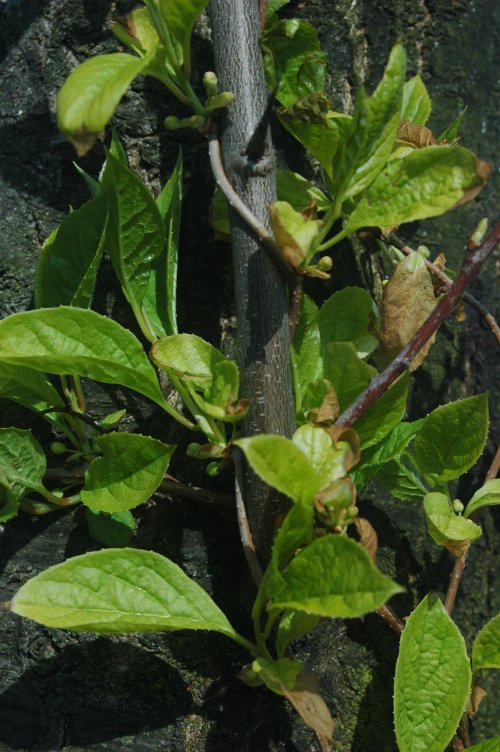
Lemonwood is a hairless climbing shrub with elongated leaf-bearing branches. Its leaves are elliptic, ovate, or obovate, with papery textures and finely toothed or serrated edges, although they are occasionally smooth.[1][2][3]
Its flowers are pendulous and have five to nine yellow, orange, or red tepals. Its fruits are scarlet-red berries.[4][5]
The shrub can grow to a height of 7 metres. Its leaf stems measure 1.5–3.5 centimetres long, its leaves measure 4–11 centimetres long and 2–6 centimetres wide, and its flowers are approximately 1.5 centimetres wide.[6][7][8][9]
Habitat
Lemonwood grows in forests and thickets at elevations between 700 and 2,000 metres. It grows in full sun or partial shade.[10][11][12]
It grows in well-drained chalk, clay, loam, or sandy soils.[13]
Reproduction and life cycle
Lemonwood is dioecious, with individual plants bearing either male or female flowers. The species is not self-fertile.[14][15]
Male flowers contain eleven to twenty-five stamens, while female flowers contain twenty-five to forty-five carpels. Male flower stems measure 0.8–5.4 centimetres long, and female flower stems measure 1.8–6.4 centimetres long.[16][17][18][19]
The species flowers between April and July and produces fruit between June and October. Its fruit stems measure 2–10 centimetres long, and its seeds are disc-shaped or resemble flattened kidney beans, with smooth cases.[20][21][22][23]
Uses
Lemonwood is cultivated as an ornamental plant and is used in Chinese medicine. Its fruits are edible.[24][25][26]
In China, its fruit is used to produce wine and vinegar. Oils extracted from its fruits and seeds are used to manufacture soap and lubricants.[27][28]
Similar species
Lemonwood is closely related to Schisandra neglecta, Schisandra arisanensis, and Schisandra elongata. Schisandra incarnata may be confused with lemonwood, although their male flowers differ.[29][30]
Classification of the Lemonwood
| Kingdom | Plantae |
|---|---|
| Subkingdom | Pteridobiotina |
| Phylum | Tracheophyta |
| Class | Magnoliopsida |
| Order | Austrobaileyales |
| Family | Schisandraceae (Magnolia-vine Family) |
| Genus | Schisandra (Magnolia Vine) |
| Species | Schisandra sphenanthera Rehder & E.H.Wilson |
Where the Lemonwood is found
Checklists and occurrence records place Schisandra sphenanthera in 2 countries across Asia. GBIF holds 1,240 georeferenced records of it.
Countries
Regions and cities with the most records
- Shaanxi, China 116
- Sichuan, China 112
- Zhejiang, China 99
- Anhui, China 87
- Jiangxi, China 87
- Hubei, China 75
- Henan, China 53
- Jiujiang, China 42
- Hunan, China 36
- Guizhou, China 31
- Chongqing, China 29
- Songbai, China 27
- Yunnan, China 25
- Gansu, China 23
- Guangxi, China 16
- Haiyang, China 16
- Huangshan, China 16
- Huicheng, China 15
- Wucheng, China 15
- Gecheng, China 14
- Nanyang, China 13
- Pingli, China 11
- Wenxian Chengguanzhen, China 11
- Shanxi, China 10
- Changning, China 9
- Xi’an, China 9
- Pingwu County, China 8
- Shiquan, China 8
- Anping, China 6
- Baidi, China 6
- Caotang, China 6
- Fenhe, China 6
- Fujian, China 6
- Haikou, China 6
- Hainan, China 6
- Jiangsu, China 6
3 more countries have a few records outside this range
These countries hold a few records of Schisandra sphenanthera but lie outside the range the checklists give for it. Such records are often zoo or garden specimens, museum material or vagrants, so the species is not counted as occurring there.
Range as the checklists state it
China (Anhui, Fujian, Gansu, Guizhou, Henan, Hubei, Hunan, Jiangsu, Jiangxi, Shaanxi, Shandong, Shanxi, Sichuan, NE-Yunnan, Zhejiang)
A number beside a place is its count of GBIF occurrence records. A place without a number comes from a checklist alone. Records show where a species has been observed or collected, which can include escapes and vagrants.
Common names
English
- Lemonwood
- Schisandra
Names in 3 other languages
- Chinese
- hua zhong wu wei zi, 南五味子, 華中五味子
- Czech
- schizandra oranžová
- Japanese
- ミナミゴミシ
Synonyms
2 other scientific names have been used for this species and are now treated as synonyms of Schisandra sphenanthera.
- Schisandra flaccidiramosa C.R.Sun
- Schisandra sphenanthera var. sphenanthera
Related species
-
 Chinese Magnolia-vineSchisandra chinensis
-
 Bay-starvineSchisandra glabra
- Schisandra elongata
- Schisandra henryi
- Schisandra grandiflora
- Schisandra repanda
- Schisandra arisanensis
- Schisandra propinqua
Compare
Questions and answers
What is the scientific name of the Lemonwood?
The scientific name of the Lemonwood is Schisandra sphenanthera. Written with its author, the full name is Schisandra sphenanthera Rehder & E.H.Wilson.
Which family does the Lemonwood belong to?
Schisandra sphenanthera belongs to the family Schisandraceae, in the order Austrobaileyales and the class Magnoliopsida.
Where is the Lemonwood found?
Checklists and occurrence records place Schisandra sphenanthera in 2 countries: China and Taiwan.
What other names does the Lemonwood have?
Schisandra sphenanthera is also known in English as Schisandra.
How tall does lemonwood grow?
Lemonwood can grow to a height of 7 metres.[6]
Sources
Passages the profile rests on
- The species is a hairless climbing wall shrub with elongated leaf-bearing branches. Source passage: “It lacks hairs. The leaf bearing branches are elongated.” — English Wikipedia
- Its leaves are elliptic, ovate, or obovate and have papery textures. Source passage: “The leaves are papery in texture, elliptic, ovate, or obovate in shape” — English Wikipedia
- Its leaves have finely toothed or serrated edges, although they are occasionally smooth. Source passage: “The leaf edges are finely toothed, serrated, or rarely smooth.” — English Wikipedia
- Its flowers are pendulous and have five to nine yellow, orange, or red tepals. Source passage: “The flowers are pendulous, and have five to nine tepals, which are yellow, orange, or red.” — English Wikipedia
- Its fruits are scarlet-red berries. Source passage: “The fruits are scarlet-red berries.” — English Wikipedia
- The shrub can grow to a height of 7 metres. Source passage: “can reach 7 metres (23 ft) high.” — English Wikipedia
- Its leaf stems measure 1.5–3.5 centimetres in length. Source passage: “The leaf stems are 1.5–3.5 centimetres (0.59–1.38 in) long.” — English Wikipedia
- Its leaves measure 4–11 centimetres long and 2–6 centimetres wide. Source passage: “4–11 centimetres (1.6–4.3 in) long, and 2–6 centimetres (0.79–2.36 in) wide.” — English Wikipedia
- Its flowers are approximately 1.5 centimetres wide. Source passage: “The flowers are around 1.5 centimetres (0.59 in) wide.” — English Wikipedia
- The species grows in forests and thickets. Source passage: “The species grows in forests and thickets, at elevations of 700–2,000 metres (2,300–6,600 ft).” — English Wikipedia
- It grows at elevations between 700 and 2,000 metres. Source passage: “at elevations of 700–2,000 metres (2,300–6,600 ft).” — English Wikipedia
- It grows in full sun or partial shade. Source passage: “It grows in full sun, or partial shade” — English Wikipedia
- It grows in well-drained chalk, clay, loam, or sandy soils. Source passage: “in well-drained chalk, clay, loam, or sand.” — English Wikipedia
- The species is dioecious, with individual plants bearing either male or female flowers. Source passage: “Schisandra sphenanthera is dioecious (each plant has only male or only female flowers)” — English Wikipedia
- The species is not self-fertile. Source passage: “and is not self-fertile.” — English Wikipedia
- Male flower stems measure 0.8–5.4 centimetres long. Source passage: “The stems of male flowers are 0.8–5.4 centimetres (0.31–2.13 in) long” — English Wikipedia
- Female flower stems measure 1.8–6.4 centimetres long. Source passage: “the stems of female flowers are 1.8–6.4 centimetres (0.71–2.52 in) long.” — English Wikipedia
- Male flowers contain eleven to twenty-five stamens. Source passage: “The male flowers have eleven to twenty-five stamens” — English Wikipedia
- Female flowers contain twenty-five to forty-five carpels. Source passage: “the female flowers have twenty-five to forty-five carpels.” — English Wikipedia
- Its fruit stems measure 2–10 centimetres in length. Source passage: “The fruit stems are 2–10 centimetres (0.79–3.94 in) long.” — English Wikipedia
- The species flowers between April and July. Source passage: “The plant flowers from April to July.” — English Wikipedia
- The species produces fruit between June and October. Source passage: “The plant fruits from June to October.” — English Wikipedia
- Its seeds are disc-shaped or resemble flattened kidney beans and have smooth cases. Source passage: “The seeds are disc-shaped or shaped like a flattened kidney bean, and have smooth cases.” — English Wikipedia
- The species is cultivated as an ornamental plant. Source passage: “Schisandra sphenanthera is cultivated as an ornamental plant.” — English Wikipedia
- The species is used in Chinese medicine. Source passage: “It is used in Chinese medicine.” — English Wikipedia
- Its fruits are edible. Source passage: “The plant produces edible fruit.” — English Wikipedia
- Its fruit is used to produce wine and vinegar in China. Source passage: “In China, the fruit is used in the production of wine and vinegar.” — English Wikipedia
- Oils extracted from its fruits and seeds are used to manufacture soap and lubricants. Source passage: “Oils from the fruits and seeds are used to make soap and lubricants.” — English Wikipedia
- Schisandra sphenanthera is closely related to Schisandra neglecta, Schisandra arisanensis, and Schisandra elongata. Source passage: “Schisandra sphenanthera is closely related to Schisandra neglecta, Schisandra arisanensis, and Schisandra elongata.” — English Wikipedia
- Schisandra incarnata may be confused with Schisandra sphenanthera, although their male flowers differ. Source passage: “Schisandra sphenanthera may be confused with Schisandra incarnata, though the male flowers differ.” — English Wikipedia
- The species is native to the temperate biome of north-central, south-central, and southeastern China. Source passage: “Schisandra sphenanthera is native to the temperate biome of north-central, south-central, and south-east China.” — English Wikipedia
- It occurs in Anhui, Gansu, Guizhou, Henan, Hubei, Hunan, Jiangsu, Shaanxi, Shanxi, Sichuan, northeastern Yunnan, and Zhejiang. Source passage: “It is present in Anhui, Gansu, Guizhou, Henan, Hubei, Hunan, Jiangsu, Shaanxi, Shanxi, Sichuan, north-east Yunnan, and Zhejiang.” — English Wikipedia
Data
- Catalogue of Life, 2026-10-16 XR cc by
- Global Biodiversity Information Facility CC BY 4.0
- Wikidata CC0
- GeoNames CC BY 4.0
- Wikimedia Commons per image; credit shown with each image
- Within the Catalogue of Life, this name comes from Synonymic Checklists of the Vascular Plants of the World cc by
References
- Rehder, & Wilson, E. H. (1913). Pl. Wilson. [Sargent] 1(3): 414-416 (1913). where the name was published
This species in other databases
- Catalogue of Life 4V8JZ
- Wikidata Q10905351
- iNaturalist 542546
- World Flora Online wfo-0000495082
- GRIN 70684
Page built on 28 November 2026. See how the catalog is made and all sources and licences.
Cite this page
ScientificNames.org. (2026). Schisandra sphenanthera (Lemonwood). Retrieved November 28, 2026, from https://scientificnames.org/species/schisandra-sphenanthera
“Schisandra sphenanthera (Lemonwood).” ScientificNames.org, 2026, scientificnames.org/species/schisandra-sphenanthera. Accessed 28 Nov. 2026.
ScientificNames.org. “Schisandra sphenanthera (Lemonwood).” Accessed November 28, 2026. https://scientificnames.org/species/schisandra-sphenanthera.
@misc{scientificnames_schisandra_sphenanthera_lemonwood,
  author = {{ScientificNames.org}},
  title = {Schisandra sphenanthera (Lemonwood)},
  year = {2026},
  url = {https://scientificnames.org/species/schisandra-sphenanthera},
  note = {Accessed 2026-11-28}
}