Species · Other invertebrates
Schistosoma intercalatum
Schistosoma intercalatum has no English name on record in the checklists used here. It is a species of animal in the family Schistosomatidae (bilharzia flukes), order Diplostomida. The name dates from 1934.
- Scientific name
- Schistosoma intercalatum Fisher, 1934
- Genus
- Schistosoma
- Family
- Schistosomatidae (Bilharzia Flukes)
- Order
- Diplostomida
- Class
- Trematoda
- Environment
- freshwater, terrestrial
- Recorded in
- 1 country
- Name status
- accepted in the Catalogue of Life
Overview
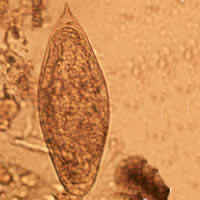
Schistosoma intercalatum is a cause of rectal schistosomiasis. This species occurs in parts of western and central Africa and develops in small streams and slow-moving bodies of water. Its eggs have a terminal spine and measure approximately 130 × 75 μm.
Written 26 November 2026 from the sources listed below. Each statement was checked against the passage it cites; statements that could not be supported were removed.
Appearance
The eggs have a terminal spine and measure approximately 130 × 75 μm. They stain red when exposed to the Ziehl–Neelsen technique.[1][2][3]
The egg surface has fewer integumental elevations than that of Schistosoma mansoni. Its eggs are intermediate in size between those of Schistosoma haematobium and Schistosoma bovis.[4][5]
Habitat
This species develops in small streams and slow-moving bodies of water. Its cercariae preferentially develop in small, forested areas containing streams.[6][7]
The species occurs in parts of western and central Africa and is associated with forested areas.[8][9]
Behaviour
Its cercariae form concentrated aggregates near the water surface following small temperature changes. They swim freely in water until they encounter a human host.[10][11]
The cercariae penetrate human skin and subsequently lose their tails.[12]
Reproduction and life cycle
Humans serve as the definitive host of this parasite. The parasite undergoes sporocyst development and multiplication inside its snail intermediate host.[13][14]
The Lower Guinea strain uses Bulinus forskalii as its intermediate host, while the Zaire strain uses Bulinus africanus. The species has two major strains, known as the Lower Guinea strain and the Zaire strain.[15][16][17]
Adult worms mate in the inferior mesenteric vein and produce thousands of eggs. The eggs migrate to the mesenteric venules of the colon and form polyps.[18][19]
Conservation
This species is considered at risk of endangerment because invasive species have been introduced into its native habitat. Its populations are declining partly because of hybridization with Schistosoma haematobium.[20][21]
Deforestation reduces the size of the habitats suitable for this species.[22]
Classification of Schistosoma intercalatum
| Kingdom | Animalia |
|---|---|
| Phylum | Platyhelminthes |
| Subphylum | Rhabditophora |
| Class | Trematoda |
| Subclass | Digenea |
| Order | Diplostomida |
| Suborder | Diplostomata |
| Superfamily | Schistosomatoidea |
| Family | Schistosomatidae (Bilharzia Flukes) |
| Subfamily | Schistosomatinae |
| Genus | Schistosoma (Blood-flukes) |
| Species | Schistosoma intercalatum Fisher, 1934 |
Where Schistosoma intercalatum is found
Checklists and occurrence records place Schistosoma intercalatum in 1 country. GBIF holds 5 georeferenced records of it.
Countries
A number beside a place is its count of GBIF occurrence records. A place without a number comes from a checklist alone. Records show where a species has been observed or collected, which can include escapes and vagrants.
Related species
-
 Schistosoma haematobium
-
 Intestinal Bilharzia FlukeSchistosoma mansoni
-
 Japanese Bilharzia FlukeSchistosoma japonicum
-
 Schistosoma mekongi
- Schistosoma spindale
- Schistosoma nasale
- Schistosoma malayensis
- Schistosoma indicum
Compare
Questions and answers
Sources
Passages the profile rests on
- The eggs of this species have a terminal spine. Source passage: “The eggs of Schistosoma intercalatum have a terminal spine” — English Wikipedia
- The eggs stain red when exposed to the Ziehl–Neelsen technique. Source passage: “These eggs are unique because they will stain red when exposed to the Ziehl–Neelsen technique” — English Wikipedia
- The eggs measure approximately 130 × 75 μm. Source passage: “The eggs of Schistosoma intercalatum have a terminal spine and tend to be moderately larger than those of S. haematobium (approximately 130 × 75 μm).” — English Wikipedia
- The egg surface has fewer integumental elevations than that of Schistosoma mansoni. Source passage: “the S. intercalatum's surface has a much lower amount of integumental elevations, or bosses, than S. mansoni.” — English Wikipedia
- Its eggs are intermediate in size between those of Schistosoma haematobium and Schistosoma bovis. Source passage: “The origin of the name 'intercalatum' is from the observation that their eggs are of an intermediate range between the smaller S. haematobium and larger S. bovis.” — English Wikipedia
- This species develops in small streams and slow-moving bodies of water. Source passage: “This mechanism for body heat detection of a potential host restricts the formation of viable cercariae to small streams and slow moving bodies of water” — English Wikipedia
- Its cercariae preferentially develop in small, forested areas containing streams. Source passage: “The cercariae are very particular over where they develop, needing small, forested areas with streams to infect their human host.” — English Wikipedia
- This species occurs in parts of western and central Africa. Source passage: “Schistosoma intercalatum is a parasitic worm found in parts of western and central Africa.” — English Wikipedia
- The species occurs in forested areas of Africa. Source passage: “There are two major strains of S. intercalatum, both living in forested areas of Africa.” — English Wikipedia
- Its cercariae form concentrated aggregates near the water surface following small temperature changes. Source passage: “If there is a small temperature change, the cercariae of S. intercalatum will form concentrated aggregates near the surface of the water.” — English Wikipedia
- Its cercariae swim freely in water until they encounter a human host. Source passage: “The cercariae are free-swimming in the surrounding water until they find their definitive host: a human.” — English Wikipedia
- The cercariae penetrate human skin and subsequently lose their tails. Source passage: “The cercariae penetrate through the human's skin and lose their tail, becoming schistosomulae.” — English Wikipedia
- Humans serve as the definitive host of this parasite. Source passage: “Humans are the definitive host” — English Wikipedia
- The parasite undergoes sporocyst development and multiplication inside its snail intermediate host. Source passage: “The miracidia penetrate the snail tissue, and inside they become sporocysts and multiply.” — English Wikipedia
- The Lower Guinea strain uses Bulinus forskalii as its intermediate host. Source passage: “Bulinus forskalii for the Lower Guinea strain” — English Wikipedia
- The Zaire strain uses Bulinus africanus as its intermediate host. Source passage: “Bulinus africanus for the Zaire strain.” — English Wikipedia
- This species has two major strains, known as the Lower Guinea strain and the Zaire strain. Source passage: “There are two strains: the Lower Guinea strain and the Zaire strain.” — English Wikipedia
- Adult worms mate in the inferior mesenteric vein and produce thousands of eggs. Source passage: “As adults, they make their way to the inferior mesenteric vein and mate, producing thousands of eggs.” — English Wikipedia
- Its eggs migrate to the mesenteric venules of the colon and form polyps. Source passage: “These eggs migrate down to the mesenteric venules of the colon and form polyps as the eggs attempt to cross into the lumen.” — English Wikipedia
- This species is considered at risk of endangerment because invasive species have been introduced into its native habitat. Source passage: “S. intercalatum is at risk of endangerment in large part due to the introduction of invasive species into its native habitat.” — English Wikipedia
- Populations of this species are declining partly because of hybridization with Schistosoma haematobium. Source passage: “Most hybrids will have a diluted genome that is more closely related to S. haematobium, helping to bring about a decline in S. intercalatum populations.” — English Wikipedia
- Deforestation reduces the size of the habitats suitable for this species. Source passage: “There are only a few of these regions in Africa, and they decrease in size every day due to deforestation.” — English Wikipedia
Data
- Catalogue of Life, 2026-10-16 XR cc by
- Global Biodiversity Information Facility CC BY 4.0
- Wikidata CC0
- GeoNames CC BY 4.0
- Wikimedia Commons per image; credit shown with each image
- Within the Catalogue of Life, this name comes from World Register of Marine Species cc by
References
- Fisher, A. (1934). A study of the schistosomiasis of the Stanleyville district of the Belgian Congo. Transactions of the Royal Society of Tropical Medicine and Hygiene, 28 (3): 277–306. https://doi.org/10.1016/s0035-9203(34)90066-3 Link where the name was published
This species in other databases
Page built on 28 November 2026. See how the catalog is made and all sources and licences.
Cite this page
ScientificNames.org. (2026). Schistosoma intercalatum. Retrieved November 28, 2026, from https://scientificnames.org/species/schistosoma-intercalatum
“Schistosoma intercalatum.” ScientificNames.org, 2026, scientificnames.org/species/schistosoma-intercalatum. Accessed 28 Nov. 2026.
ScientificNames.org. “Schistosoma intercalatum.” Accessed November 28, 2026. https://scientificnames.org/species/schistosoma-intercalatum.
@misc{scientificnames_schistosoma_intercalatum,
  author = {{ScientificNames.org}},
  title = {Schistosoma intercalatum},
  year = {2026},
  url = {https://scientificnames.org/species/schistosoma-intercalatum},
  note = {Accessed 2026-11-28}
}