Species · Fishes
Brown Meagre Sciaena umbra
The scientific name of the Brown Meagre is Sciaena umbra. It is a species of fish in the family Sciaenidae (drums), order Perciformes. The name dates from 1758.
- Scientific name
- Sciaena umbra Linnaeus, 1758
- Common name
- Brown Meagre
- Genus
- Sciaena
- Family
- Sciaenidae (Drums)
- Order
- Perciformes
- Class
- Teleostei
- Red List category
- NT Near Threatened
- Environment
- brackish, marine
- Recorded in
- 30 countries
- Name status
- accepted in the Catalogue of Life

Overview
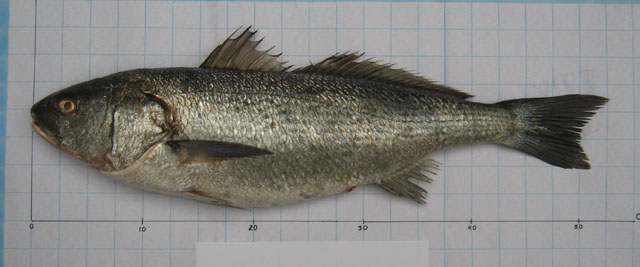
Sciaena umbra occurs in the eastern Atlantic Ocean, Mediterranean Sea, Black Sea and Sea of Azov. It has a laterally compressed grey body with golden and silver flashes and usually measures 30–40 cm in length.
Written 26 November 2026 from the sources listed below. Each statement was checked against the passage it cites; statements that could not be supported were removed.
Appearance
The Brown Meagre has a laterally compressed body, a flat belly and a strongly arched back. Its body is grey with golden and silver flashes.[1][2]
Its mouth is large and horizontal, extends to the level of the eye and contains villiform teeth. Its nape and flank scales are ctenoid, while its head scales are cycloid.[3][4][5]
Its anal and pelvic fins are black with white anterior margins. Its dorsal and caudal fins are yellow with black margins, and its caudal fin is usually truncate.[6][7][8]
The Brown Meagre usually measures 30–40 cm in length and can reach a maximum length of 60 cm.[9][10]
Habitat
The species occurs at depths of 5–200 m and inhabits mainly rocky and sandy substrates. Juveniles also enter estuarine environments.[11][12][13]
It can shelter among seagrass beds and on rocky bottoms near caves or large crevices.[14]
Diet
The Brown Meagre feeds on small fishes, crustaceans and algae.[15]
Behaviour
The Brown Meagre is predominantly nocturnal. It can occasionally be found among seagrass beds and on rocky bottoms during daylight.[16][17]
Individuals live socially in small groups. They produce sounds using muscles beneath the swim bladder, allowing them to communicate with one another.[18][19][20]
The species has very good hearing ability and can regulate its buoyancy effectively.[21][22]
Reproduction and life cycle
In the Mediterranean, the spawning period extends from March to August. During spawning, Brown Meagre form large aggregations near estuaries.[23][24]
Conservation
The IUCN Red List assessment published in 2014 classified the Brown Meagre as Near Threatened.[25]
Overexploitation is a concern, particularly because of fishing during spawning aggregations.[26]
Uses
The Brown Meagre is harvested for human consumption, particularly in the Mediterranean, and is commercially fished throughout the Mediterranean basin. It is caught mainly using spearfishing, trammel nets and gill nets.[27][28][29]
In Turkey, Brown Meagre is sold fresh or frozen in fish markets. Some local people use powdered Brown Meagre otoliths as a traditional treatment for urinary tract infections.[30][31]
Classification of the Brown Meagre
| Kingdom | Animalia |
|---|---|
| Phylum | Chordata |
| Subphylum | Vertebrata |
| Infraphylum | Gnathostomata |
| Parvphylum | Osteichthyes |
| Gigaclass | Actinopterygii |
| Superclass | Actinopteri |
| Class | Teleostei (Teleost) |
| Order | Perciformes |
| Suborder | Percoidei |
| Family | Sciaenidae (Drums) |
| Genus | Sciaena (Black Drums) |
| Species | Sciaena umbra Linnaeus, 1758 |
Where the Brown Meagre is found
Checklists and occurrence records place Sciaena umbra in 30 countries. GBIF holds 5,106 georeferenced records of it.
Countries
- Albania 3
- Algeria 13
- Benin 10
- Cabo Verde 4
- Cameroon 43
- Croatia 26
- Cyprus 3
- Democratic Republic of the Congo 11
- Equatorial Guinea 19
- France 3,100
- Gabon 77
- Ghana 75
- Greece 51
- Guinea 35
- Guinea-Bissau 22
- Italy 192
- Ivory Coast 83
- Liberia 63
- Malta 6
- Mauritania 85
- Monaco 15
- Nigeria 119
- Republic of the Congo 11
- Russia 9
- Sierra Leone 41
- Slovenia 5
- Spain 918
- Togo 12
- Tunisia 15
- Ukraine 40
Regions and cities with the most records
- Marseille 09, France 369
- Marseille 08, France 358
- Marseille 07, France 348
- Marseille 06, France 331
- Marseille 02, France 323
- Marseille 10, France 323
- Marseille, France 320
- Corsica, France 319
- Marseille 01, France 318
- Marseille 03, France 313
- Marseille 05, France 312
- Marseille 04, France 302
- Marseille 11, France 290
- Marseille 12, France 284
- Palafrugell, Spain 281
- Marseille 13, France 275
- Ajaccio, France 254
- Marseille 14, France 250
- Catalonia, Spain 245
- Provence-Alpes-Côte d'Azur, France 223
- Mandelieu-la-Napoule, France 211
- Allauch, France 209
- La Ciotat, France 201
- Roses, Spain 168
- Cannes, France 151
- Le Cannet, France 150
- Vallauris, France 148
- Mougins, France 146
- Saint-Raphaël, France 146
- Fréjus, France 145
- Juan-les-Pins, France 145
- Marseille 16, France 129
- Aubagne, France 105
- Marseille 15, France 98
- Hyères, France 97
- Antibes, France 96
4 more countries have a few records outside this range
These countries hold a few records of Sciaena umbra but lie outside the range the checklists give for it. Such records are often zoo or garden specimens, museum material or vagrants, so the species is not counted as occurring there.
A number beside a place is its count of GBIF occurrence records. A place without a number comes from a checklist alone. Records show where a species has been observed or collected, which can include escapes and vagrants.
Common names
English
- Brown Meagre
- Sea Raven
Names in 24 other languages
- Albanian
- Korb i zi, korbi i zi
- Arabic
- Ghourâb
- Asturian
- corvina prieta
- Catalan
- Corball, Corball de roca
- Chinese
- 弓背石首魚
- Croatian
- Kavala, Konj, Krap, Skoumpri
- Czech
- smuha tmavá
- Danish
- Brun ørnefisk
- Dutch
- zeeraaf, zwarte ombervis
- Finnish
- rummuttaja
- French
- Corb Commun, Corb Noir, Corb du Cameroun, Vieille Noire, corb, maigre
- German
- Meerrabe, Seebarsch
- Greek
- Skaros, Syaki, Σκιός
- Hebrew
- אוכם גדול-קוץ
- Italian
- Acula, Aculotta, Aloca, Corbaglio, Corbello, Corbo, Corbo falso, Corveddu
- Maltese
- Gharab, Gharbi, Gurbell, Gurbell tork, Toriki
- Polish
- Kulbak czarny, kulbin czarny
- Portuguese
- Roncadeira, Roncadeira-preta
- Russian
- Teleskop-kardinalfisk, Temnyi Gorbyl, Горбыль темный, Тёмный горбыль, Чёрный горбыль
- Slovenian
- Kaval
- Spanish
- Corvallo, Verrugato
- Swedish
- Korpfisk
- Turkish
- Eşkina, Eşkine, Eşkine baliği, Işkine baliği, Mavruşkil, iskine, kaya levregi
- Ukrainian
- Горбань темний, Мелакопія темна
Synonyms
7 other scientific names have been used for this species and are now treated as synonyms of Sciaena umbra.
- Bairdiella umbra (Linnaeus, 1758)
- Coracinus chalcis Pallas, 1814
- Corvina canariensis Cuvier, 1830
- Corvina umbra (Linnaeus, 1758)
- Johnius umbra (Linnaeus, 1758)
- Corvina nigra (Bloch, 1792) misapplied
- Sciaena nigra Bloch, 1792 ambiguous synonym
Related species
-
 Lorna DrumSciaena deliciosa
-
 Callao DrumSciaena callaensis
- Sciaena cappa
- Sciaena lepisma
- Sciaena mulloides
-
 Red DrumSciaenops ocellatus
-
 TotoabaTotoaba macdonaldi
-
 Freshwater DrumAplodinotus grunniens
Compare
Questions and answers
What is the scientific name of the Brown Meagre?
The scientific name of the Brown Meagre is Sciaena umbra. Written with its author, the full name is Sciaena umbra Linnaeus, 1758.
Which family does the Brown Meagre belong to?
Sciaena umbra belongs to the family Sciaenidae, in the order Perciformes and the class Teleostei.
Where is the Brown Meagre found?
Checklists and occurrence records place Sciaena umbra in 30 countries, including France, Spain, Italy, Nigeria, Mauritania and Ivory Coast.
What is the conservation status of the Brown Meagre?
The IUCN Red List category recorded for Sciaena umbra is Near Threatened (NT).
What other names does the Brown Meagre have?
Sciaena umbra is also known in English as Sea Raven.
Sources
Passages the profile rests on
- The brown meagre has a laterally compressed body with a flat belly and a strongly arched back. Source passage: “It has a flat belly and a strongly arched back, giving it an easily recognizable shape. The body is laterally compressed” — English Wikipedia
- Its body is grey with golden and silver flashes. Source passage: “The background color of the body is grey, with flashes of gold and silver.” — English Wikipedia
- Its mouth is large, horizontal and extends to the level of the eye. Source passage: “the large, horizontal mouth reaches the level of the eye” — English Wikipedia
- Its mouth contains villiform teeth. Source passage: “contains villiform teeth.” — English Wikipedia
- Its nape and flank scales are ctenoid, whereas its head scales are cycloid. Source passage: “The scales are ctenoid on the nape and the flanks while the head scales are cycloid.” — English Wikipedia
- Its anal and pelvic fins are black with white anterior margins. Source passage: “The anal and pelvic fins are black with the anterior margins being white.” — English Wikipedia
- Its dorsal and caudal fins are yellow with black margins. Source passage: “the dorsal and the caudal fins are yellow with a black margin.” — English Wikipedia
- Its caudal fin is usually truncate. Source passage: “The caudal fin is usually truncate.” — English Wikipedia
- The brown meagre usually measures 30–40 cm in length. Source passage: “The brown meagre is usually between 30–40 cm (12–16 in) in length” — English Wikipedia
- The brown meagre can reach a maximum length of 60 cm. Source passage: “but may grow to 60 cm (24 in).” — English Wikipedia
- The species occurs at depths of 5–200 m. Source passage: “The brown meagre is found at depths between 5–200 m (16–656 ft)” — English Wikipedia
- The brown meagre inhabits mainly rocky and sandy substrates. Source passage: “mainly over rocky and sandy substrates.” — English Wikipedia
- Juvenile brown meagre also enter estuarine environments. Source passage: “Juveniles also enter estuarine environments.” — English Wikipedia
- The species can shelter among seagrass beds and on rocky bottoms near caves or large crevices. Source passage: “among beds of seagrass and on rocky bottoms in the vicinity of caves or large crevices (where it can shelter).” — English Wikipedia
- The brown meagre feeds on small fishes, crustaceans and algae. Source passage: “it feeds off small fishes, crustaceans and algae.” — English Wikipedia
- The brown meagre is predominantly nocturnal. Source passage: “The brown meagre is a rather nocturnal fish” — English Wikipedia
- The species can occasionally be found among seagrass beds and on rocky bottoms during daylight. Source passage: “but it can occasionally be found during the day among beds of seagrass and on rocky bottoms” — English Wikipedia
- Brown meagre individuals live socially in small groups. Source passage: “This species is social and lives in small groups” — English Wikipedia
- The brown meagre can produce sounds using muscles beneath its swim bladder. Source passage: “capable of creating sound using some of the muscles under their well-developed swim bladder.” — English Wikipedia
- Sound production allows brown meagre individuals to communicate with one another. Source passage: “This allows individuals to communicate with each other” — English Wikipedia
- The species has very good hearing ability. Source passage: “since this species has a very good hearing ability.” — English Wikipedia
- The brown meagre can regulate its buoyancy effectively. Source passage: “The brown meagre can manage its buoyancy very well.” — English Wikipedia
- In the Mediterranean, the spawning period extends from March to August. Source passage: “The spawning period is from March to August in the Mediterranean” — English Wikipedia
- During spawning, brown meagre form large aggregations near estuaries. Source passage: “during this time, this species forms large spawning aggregations near estauries.” — English Wikipedia
- The IUCN Red List assessment published in 2014 classified the brown meagre as Near Threatened. Source passage: “Brown Meagre Sciaena umbra has most recently been assessed for The IUCN Red List of Threatened Species in 2014. Sciaena umbra is listed as Near Threatened.” — iucnredlist.org
- Overexploitation of the brown meagre is a concern, particularly because of fishing during spawning aggregations. Source passage: “It is especially heavily fished when it forms spawning aggregations near estuaries, and overexploitation is a concern.” — English Wikipedia
- The brown meagre is harvested for human consumption, particularly in the Mediterranean. Source passage: “It is harvested for human consumption, especially in the Mediterranean.” — English Wikipedia
- The species is commercially fished throughout the Mediterranean basin. Source passage: “The brown meagre is a commercial species throughout the Mediterranean basin” — English Wikipedia
- Brown meagre are caught mainly using spearfishing, trammel nets and gill nets. Source passage: “is fished mainly by spear fishing, trammel nets, and gill nets.” — English Wikipedia
- In Turkey, brown meagre is sold fresh or frozen in fish markets. Source passage: “The brown meagre is sold fresh or frozen across fish markets in Turkey.” — English Wikipedia
- In Turkey, some local people use powdered brown meagre otoliths as a traditional treatment for urinary tract infections. Source passage: “local people sometimes use the otolith of the brown meagre (after having ground them to powder) to treat urinary tract infections.” — English Wikipedia
Data
- Catalogue of Life, 2026-10-16 XR cc by
- Global Biodiversity Information Facility CC BY 4.0
- Wikidata CC0
- GeoNames CC BY 4.0
- Wikimedia Commons per image; credit shown with each image
- Within the Catalogue of Life, this name comes from World Register of Marine Species cc by
References
- Linnaeus, C. (1758). Systema Naturae per regna tria naturae, secundum classes, ordines, genera, species, cum characteribus, differentiis, synonymis, locis. Tomus I. Editio decima, reformata. Laurentii Salvii. Holmiae [Stockholm]. [iii] + 824 pp. https://doi.org/10.5962/bhl.title.542 Link where the name was published
This species in other databases
- Catalogue of Life 4VH83
- Wikidata Q1383737
- iNaturalist 118683
- WoRMS urn:lsid:marinespecies.org:taxname:127010
- ITIS 169330
Page built on 29 November 2026. See how the catalog is made and all sources and licences.
Cite this page
ScientificNames.org. (2026). Sciaena umbra (Brown Meagre). Retrieved November 29, 2026, from https://scientificnames.org/species/sciaena-umbra
“Sciaena umbra (Brown Meagre).” ScientificNames.org, 2026, scientificnames.org/species/sciaena-umbra. Accessed 29 Nov. 2026.
ScientificNames.org. “Sciaena umbra (Brown Meagre).” Accessed November 29, 2026. https://scientificnames.org/species/sciaena-umbra.
@misc{scientificnames_sciaena_umbra_brown_meagre,
  author = {{ScientificNames.org}},
  title = {Sciaena umbra (Brown Meagre)},
  year = {2026},
  url = {https://scientificnames.org/species/sciaena-umbra},
  note = {Accessed 2026-11-29}
}