Species · Reptiles
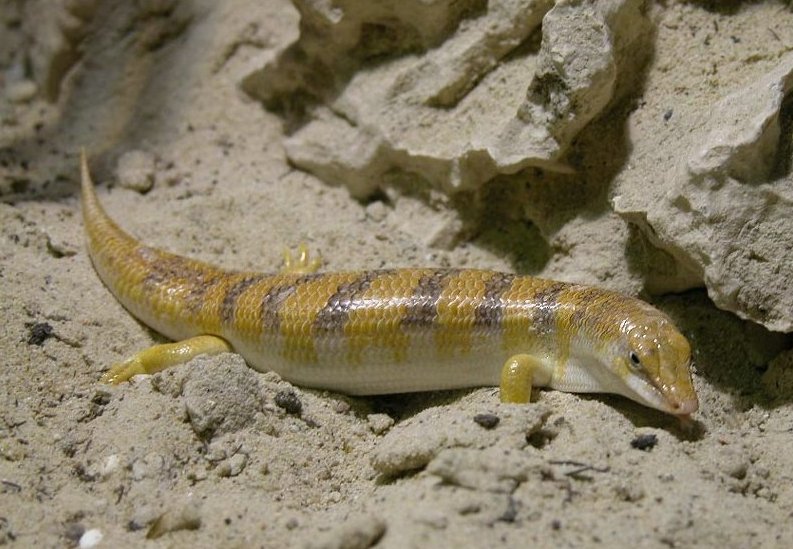
Arabian Sandfish Scincus hemprichii
The scientific name of the Arabian Sandfish is Scincus hemprichii. It is a species of reptile in the family Scincidae (skink), order Squamata. The name dates from 1837.
- Scientific name
- Scincus hemprichii Wiegmann, 1837
- Common name
- Arabian Sandfish
- Genus
- Scincus
- Family
- Scincidae (Skink)
- Order
- Squamata
- Class
- Reptilia
- Red List category
- LC Least Concern
- Recorded in
- 2 countries
- Name status
- accepted in the Catalogue of Life
Overview
Scincus hemprichii occurs in the Tihama coastal region of the southwestern Arabian Peninsula, from Sabya in Saudi Arabia through western Yemen to Aden. It spends most of its time beneath the sand surface searching for small arthropods.
Written 27 November 2026 from the sources listed below. Each statement was checked against the passage it cites; statements that could not be supported were removed.
Habitat
Vegetation in the studied habitat includes Artimisia abyssinica and Panicum turgidum.[1]
Diet
The Arabian Sandfish feeds on arthropods. Two beetle species in the family Dermestidae and three types of dipteran larvae together account for 76% of the total food volume.[2][3]
The studied population fed during eleven months of the year. Foraging success was highest during the warm spring and lowest during winter, and specimens collected in January had empty stomachs.[4][5][6]
Behaviour
The Arabian Sandfish is terrestrial and nocturnal. It is also described as diurnal.[7][8]
It spends most of its time beneath the sand surface searching for small arthropods. Individuals have been collected by excavating them from their burrows.[9][10]
It consumes insect prey around midday during cold days and in the early morning or afternoon during warm days.[11]
Classification of the Arabian Sandfish
| Kingdom | Animalia |
|---|---|
| Phylum | Chordata |
| Subphylum | Vertebrata |
| Infraphylum | Gnathostomata |
| Parvphylum | Osteichthyes |
| Megaclass | Tetrapoda |
| Class | Reptilia (Reptile) |
| Order | Squamata (Snakes) |
| Suborder | Autarchoglossa |
| Family | Scincidae (Skink) |
| Subfamily | Scincinae |
| Genus | Scincus (Sandfishes) |
| Species | Scincus hemprichii Wiegmann, 1837 |
Where the Arabian Sandfish is found
Checklists and occurrence records place Scincus hemprichii in 2 countries across Asia. GBIF holds 62 georeferenced records of it.
Countries
Regions and cities with the most records
- Jazan Region, Saudi Arabia 16
- Jizan, Saudi Arabia 12
- Laḩij, Yemen 11
- Laḩij, Yemen 11
- Ḑamad, Saudi Arabia 8
- Abū ‘Arīsh, Saudi Arabia 6
- Şabyā, Saudi Arabia 6
Range as the checklists state it
Yemen, SW Saudi Arabia
A number beside a place is its count of GBIF occurrence records. A place without a number comes from a checklist alone. Records show where a species has been observed or collected, which can include escapes and vagrants.
Common names
English
- Arabian Sandfish
- Arabian Sandfish Skink
- Hemprich's Sandfish
- Hemprich's Skink
Names in 4 other languages
- Czech
- scink jemenský
- Japanese
- イエメンジャイアントサンドフィッシュスキンク
- Russian
- Аравийский сцинк
- Thai
- จิ้งเหลนทรายอาหรับ
Related species
-
 Sandfish SkinkScincus scincus
- Eastern SkinkScincus mitranus
-
 Sandfish SkinkScincus conirostris
-
 Western SandfishScincus albifasciatus
-
 ShinglebackTiliqua rugosa
-
 Five-lined SkinkPlestiodon fasciatus
- Common Garden SkinkLampropholis guichenoti
-
 Blue-tailed SkinkCryptoblepharus egeriae
Compare
Questions and answers
What is the scientific name of the Arabian Sandfish?
The scientific name of the Arabian Sandfish is Scincus hemprichii. Written with its author, the full name is Scincus hemprichii Wiegmann, 1837.
Which family does the Arabian Sandfish belong to?
Scincus hemprichii belongs to the family Scincidae, in the order Squamata and the class Reptilia.
Where is the Arabian Sandfish found?
Checklists and occurrence records place Scincus hemprichii in 2 countries: Yemen and Saudi Arabia.
What is the conservation status of the Arabian Sandfish?
The IUCN Red List category recorded for Scincus hemprichii is Least Concern (LC).
What other names does the Arabian Sandfish have?
Scincus hemprichii is also known in English as Arabian Sandfish Skink, Hemprich's Sandfish and Hemprich's Skink.
Sources
Passages the profile rests on
- Vegetation in the studied habitat includes Artimisia abyssinica and Panicum turgidum. Source passage: “The habitat was dominated by Artimisia abyssinica, a green shrub and Panicum turgidum, a perennial desert grasses.” — pmc.ncbi.nlm.nih.gov
- The species feeds on arthropods. Source passage: “Analysis of the contents of 60 stomachs revealed that the diet of S. hemprichii in the study area consisted of arthropods,” — pmc.ncbi.nlm.nih.gov
- Two beetle species in the family Dermestidae and three types of dipteran larvae together account for 76% of the total food volume. Source passage: “with two species of beetles of the family Dermestidae (Dermestis vulpinus and Dermestis maculates) and three type of dipteran larvae, accounting for 76% of the total volume of the food items.” — pmc.ncbi.nlm.nih.gov
- The species fed during eleven months of the year in the studied population. Source passage: “S. hemprichii individuals fed during eleven months of the year.” — pmc.ncbi.nlm.nih.gov
- The highest foraging success occurred during the warm spring, while the lowest occurred during winter. Source passage: “The mass of food in the stomachs indicated that a high degree of foraging success occurred during the warm spring while the lowest was during winter” — pmc.ncbi.nlm.nih.gov
- Specimens collected in January had empty stomachs. Source passage: “Specimens collected during January had empty stomachs.” — pmc.ncbi.nlm.nih.gov
- The species is terrestrial and nocturnal. Source passage: “S. hemprichii is terrestrial and nocturnal.” — English Wikipedia
- The species is diurnal. Source passage: “S. hemprichii is a diurnal species” — pmc.ncbi.nlm.nih.gov
- The species spends most of its time beneath the sand surface searching for small arthropods. Source passage: “It spends most of its time under the surface of the sand searching for small arthropods.” — pmc.ncbi.nlm.nih.gov
- Individuals of the species were collected by excavating them from their burrows. Source passage: “Lizards were collected by excavating them from their burrows” — pmc.ncbi.nlm.nih.gov
- The species consumes insect prey around midday during cold days and in the early morning or afternoon during warm days. Source passage: “They feed on their insect prey at mid-noon in cold days or at early morning and the afternoons on warm days” — pmc.ncbi.nlm.nih.gov
Data
- Catalogue of Life, 2026-10-16 XR cc by
- Global Biodiversity Information Facility CC BY 4.0
- Wikidata CC0
- GeoNames CC BY 4.0
- Within the Catalogue of Life, this name comes from The Reptile Database cc by
References
- Wiegmann, A. F. A. (1837). Herpetologische Notizen. Archiv Für Naturgeschichte 3: 123-136.
- Peters, W. C. H. (1864). Die Eidechsenfamilie der Scincoiden, insbesondere über die Schneider’schen, Wiegmann’schen und neue Arten des zoologischen Museums. Monatsber. K. Akad. Wiss. Berlin, 1864: 44-58.
- Boettger, O. (1892). Mitteilung über eine Reptiliensendung von Aden in Süd-Arabien. Ber. Tät. Offenb. Ver. Nat., Offenbach, 29 - 32: 61-63.
- Tornier, G. (1899). Reptilia. In: Carlgren,O., Hilgendorf,F., Martens, E. von, Matschie, P., Tornier, G., & Weltner, W. (eds.). Symbolae physicae seu icones adhuc ineditae corporum naturalium novorum aut minus cognitorum quae ex itineribus per Libyam, Aegyptum, Nubiam,k Dongalam, Syriam, Arabiam et Habessiniam publico institutis sumptu F.G. Hemprich et C.G. Ehrenberg. Zoologica 1, Amphibia. G. Reimer, Berlin.
- Anderson, & John. (1901). A list of the reptiles and batrachians obtained by Mr. A. Blayney Percival in southern Arabia. Proc. Zool. Soc. London 1901 (2): 137-152.
- Steindachner, & Franz. (1903). Batrachier und Reptilien von Südarabien und Sokotra, gesammelt während der südarabischen Expedition der kaiserlichen Akademie der Wissenschaften. Sitzungsb. Akad. Wiss. Wien, Math.-Naturwiss. Kl., 112, Abt. 1: 7-14.
- Arnold, Edwin Nicholas & Leviton, Alan E. (1977). A revision of the lizard genus Scincus (Reptilia: Scincidae). Bulletin of the British Museum (Natural History) 31 (5): 187-248.
- Arnold E N. (1986). A key and annotated checklist to the lizards and amphisbaenians of Arabia. Fauna of Saudi Arabia 8: 385-435.
- Fritz, J. P., & Schütte, F. (1988). Skinke aus der Arabischen Republik Jemen. Salamandra 24 (1): 41-52.
- Schätti, B., & Gasperetti, J. (1994). A contribution to the herpetofauna of Southwest Arabia. Fauna of Saudi Arabia 14: 348-423.
- Griffith, H., A. Ngo & R. W. Murphy. (2000). A cladistic evaluation of the cosmopolitan genus Eumeces Wiegmann (Reptilia, Squamata, Scincidae). Russ. J. Herpetol. 7 (1): 1-16.
- Schätti, B., & Günther, R. (2001). Type localities opf amphibian and reptile species collected by Hemprich and Ehrenberg in sothwestern Arabia and Eritrea. Mitt. Mus. Naturk. Berlin Zool. Reihe 77: 153-156.
- Sindaco, R., & Jeremcenko, V. K. (2008). The reptiles of the Western Palearctic. Edizioni Belvedere, Latina (Italy), 579 Pp.
- Beolens, B., & Michael Watkins, a. M. G. (2011). The Eponym Dictionary of Reptiles. Johns Hopkins University Press, Baltimore, USA.
- Sindaco, R., & Riccardo Nincheri, B. L. (2014). Catalogue of Arabian reptiles in the collections of the “La Specola” Museum, Florence. Scripta Herpetologica. Studies on Amphibians and Reptiles in Honour of Benedetto Lanza: Pp. 137-164.
- Paray, Bilal A.; Abdul Rahman Al-Mfarij, Mohammed K. Al-Sadoon. (2017). Food Habits of the Arabian skink, Scincus hemprichii Wiegmann, 1837, (Sauria: Scincidae), in the Southwest Saudi Arabia. Saudi Journal of Biological Sciences.
- Khayrah, Y. & Fathy, Samah M. (2022). Biodiversity and Distribution of Lizards in Jazan area, Kingdom of Saudi Arabia. Egyptian Academic Journal of Biological Sciences, B. Zoology 14(1): 249-259.
- Seufer, Hermann; Thomas Kowalski, Berd-Michael Zwanzig & Wolfgang Grossmann. (2022). Ein bisher übersehener Fundort von Scincus conirostris Blanford, 1881 im Sultanat Oman. [A hitherto overlooked locality of Scincus conirostris Blanford, 1881 in the Sultanate of Oman]. Sauria 44 (4): 43-48.
This species in other databases
Page built on 27 November 2026. See how the catalog is made and all sources and licences.
Cite this page
ScientificNames.org. (2026). Scincus hemprichii (Arabian Sandfish). Retrieved November 27, 2026, from https://scientificnames.org/species/scincus-hemprichii
“Scincus hemprichii (Arabian Sandfish).” ScientificNames.org, 2026, scientificnames.org/species/scincus-hemprichii. Accessed 27 Nov. 2026.
ScientificNames.org. “Scincus hemprichii (Arabian Sandfish).” Accessed November 27, 2026. https://scientificnames.org/species/scincus-hemprichii.
@misc{scientificnames_scincus_hemprichii_arabian_sandfish,
  author = {{ScientificNames.org}},
  title = {Scincus hemprichii (Arabian Sandfish)},
  year = {2026},
  url = {https://scientificnames.org/species/scincus-hemprichii},
  note = {Accessed 2026-11-27}
}