Species · Insects
Beet Moth Scrobipalpa ocellatella
The scientific name of the Beet Moth is Scrobipalpa ocellatella. It is a species of insect in the family Gelechiidae (gelechiid moths), order Lepidoptera. The name dates from 1858.
- Scientific name
- Scrobipalpa ocellatella (Boyd, 1858)
- Common name
- Beet Moth
- Genus
- Scrobipalpa
- Family
- Gelechiidae (Gelechiid Moths)
- Order
- Lepidoptera
- Class
- Insecta
- Environment
- terrestrial
- Recorded in
- 19 countries
- Name status
- accepted in the Catalogue of Life

Overview
Scrobipalpa ocellatella occurs on Madeira and the Canary Islands and is distributed across North Africa, most of Europe, the Middle East, Iran, and other recorded areas. Its larvae feed on sea beet and cultivated beet, and its adult moth has a wingspan of 12–14 mm.
Written 27 November 2026 from the sources listed below. Each statement was checked against the passage it cites; statements that could not be supported were removed.
Appearance
The forewings have four costal patches and an additional apical patch. Their stigmata are black and sometimes surrounded by pale markings.[1][2]
The larva is pale yellowish-green with irregular crimson blotches arranged transversely on each segment, blackish dots, and a pale brown head. Its body may also be grey-green with indistinct reddish-brown longitudinal lines and a light brown head.[3][4]
The adult moth has a wingspan of 12–14 mm.[5]
Habitat
The species occurs on Madeira and the Canary Islands and is distributed across North Africa and most of Europe.[6][7]
Its recorded distribution includes the Middle East and Iran. It occurs from southern European Russia to the Caucasus, and its distribution also includes Ukraine, Moldova, Georgia, and Turkmenistan.[8][9][10]
Diet
The larvae feed on sea beet (Beta maritima) and cultivated beet (Beta vulgaris).[11]
Behaviour
Young larvae bore into the leaf midrib. They initially scrape the leaf parenchyma before webbing central leaves and feeding through holes along the middle vein and grooves on the petioles.[12][13]
Older larvae mine leaves beneath a web spun over the leaf surface. On mature beet plants, they shelter beneath curled leaf edges, inside leaf cuttings, or within passages in the root-crop head.[14][15]
Larval damage can occur throughout the growing season, from the appearance of two to three pairs of true leaves until harvest. The pest becomes more dangerous during the second half of summer as populations increase in the second and subsequent generations.[16][17]
Adult moths are active during the evening, night, and morning. They do not require additional food but may suck dew droplets during dry periods.[18][19]
Larvae are hygrophilic and experience mass mortality during hot, dry weather. They pass through five developmental stages over approximately 25–30 days.[20][21]
After feeding, larvae pupate in oval silken cocoons buried 2–5 cm below the soil surface. Caterpillars overwintering in leaf tops usually die during winter, while those overwintering in root-crop heads left in the field survive.[22][23][24]
Reproduction and life cycle
Females lay two to three eggs per laying site on leaf undersides, aerial parts of root crops, plant remains, and soil clods. A female produces approximately 100–150 eggs.[25][26]
The eggs hatch after approximately 5–8 days. The emergence of adults from overwintered pupae coincides with the appearance of sugar beet sprouts.[27][28]
Adult moths live for approximately 12–18 days.[29]
Conservation
More than 50 species of predators and parasites reduce Beet Moth populations. Its larvae are attacked by parasitoids belonging to the family Eulophidae.[30][31]
Classification of the Beet Moth
| Kingdom | Animalia |
|---|---|
| Phylum | Arthropoda |
| Subphylum | Hexapoda |
| Class | Insecta (Insect) |
| Order | Lepidoptera |
| Superfamily | Gelechioidea |
| Family | Gelechiidae (Gelechiid Moths) |
| Subfamily | Gelechiinae |
| Tribe | Gnorimoschemini |
| Genus | Scrobipalpa |
| Species | Scrobipalpa ocellatella (Boyd, 1858) |
Where the Beet Moth is found
Checklists and occurrence records place Scrobipalpa ocellatella in 19 countries. GBIF holds 2,309 georeferenced records of it.
Countries
- Austria 60
- Belgium 83
- Cyprus 8
- Denmark 36
- France 119
- Germany 270
- Hungary 17
- Italy 16
- Luxembourg 12
- Norway 60
- Portugal 53
- Russia 3
- Serbia 85
- Spain 9
- Sweden 59
- Switzerland 186
- The Netherlands 195
- Ukraine 29
- United Kingdom 1,009
Regions and cities with the most records
- England, United Kingdom 997
- Newark on Trent, United Kingdom 379
- Bowthorpe, United Kingdom 119
- Norwich, United Kingdom 117
- Leicester, United Kingdom 112
- Braunstone, United Kingdom 110
- Great Yarmouth, United Kingdom 110
- Glen Parva, United Kingdom 108
- Earl Shilton, United Kingdom 101
- Humberstone, United Kingdom 98
- Hinckley, United Kingdom 89
- Lower Earley, United Kingdom 85
- Wokingham, United Kingdom 85
- Reading, United Kingdom 79
- Evington, United Kingdom 78
- Oadby, United Kingdom 78
- Nuneaton, United Kingdom 77
- Wigston Magna, United Kingdom 77
- Schaffhausen, Switzerland 75
- Singen, Germany 73
- North Rhine-Westphalia, Germany 71
- Maidenhead, United Kingdom 70
- Schaffhausen, Switzerland 70
- Marlow, United Kingdom 69
- Mountsorrel, United Kingdom 69
- Ascot, United Kingdom 68
- Bracknell, United Kingdom 68
- Coalville, United Kingdom 68
- Bedworth, United Kingdom 67
- Windsor, United Kingdom 66
- Camberley, United Kingdom 65
- Crowthorne, United Kingdom 65
- Sandhurst, United Kingdom 65
- Uxbridge, United Kingdom 64
- Egham, United Kingdom 63
- Tadley, United Kingdom 63
A number beside a place is its count of GBIF occurrence records. A place without a number comes from a checklist alone. Records show where a species has been observed or collected, which can include escapes and vagrants.
Common names
English
- Beet Moth
Names in 10 other languages
- Czech
- makadlovka řepná
- Dutch
- Bietzandvleugeltje
- Finnish
- juurikasjäytäjäkoi
- German
- Rüben-Palpenmotte, Rübenmotte
- Hebrew
- עשבחנין הסלק
- Hungarian
- Répaaknázó sarlósmoly
- Russian
- Моль свекловичная
- Slovak
- psota repová
- Swedish
- ögonsmåstävmal
- Welsh
- Daearwyfyn Betys, Daearwyfynod Betys
Synonyms
11 other scientific names have been used for this species and are now treated as synonyms of Scrobipalpa ocellatella.
- Gelechia atriplicella var. clarella Caradja, 1920
- Gelechia horticolella Rössler, [1867]
- Gelechia ocellatella Stainton, 1859
- Gelechia ocellatella Boyd, 1858
- Gnorimoschema ocellatellum orientale Gregor & Povolný, 1954
- Lita ocellatella obscurior Rebel, 1927
- Lita semiluteella Heinemann, 1870
- Lita submisella Meess, 1910
- Lita submissella (Stainton, 1859)
- Gelechia portosanctana ambiguous synonym
- Gelechia submissella Stainton, 1859 ambiguous synonym
Related species
-
 Buck's-horn GroundlingScrobipalpa samadensis
-
 Saltern GroundlingScrobipalpa instabilella
-
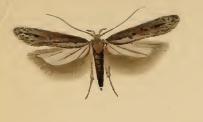 Thyme MothScrobipalpa artemisiella
-
 Goosefoot GroundlingScrobipalpa atriplicella
-
 Pointed GroundlingScrobipalpa acuminatella
-
 Rock GroundlingScrobipalpa murinella
-
 Summer GroundlingScrobipalpa obsoletella
- Scrobipalpa abai
Compare
Questions and answers
What is the scientific name of the Beet Moth?
The scientific name of the Beet Moth is Scrobipalpa ocellatella. Written with its author, the full name is Scrobipalpa ocellatella (Boyd, 1858).
Which family does the Beet Moth belong to?
Scrobipalpa ocellatella belongs to the family Gelechiidae, in the order Lepidoptera and the class Insecta.
Where is the Beet Moth found?
Checklists and occurrence records place Scrobipalpa ocellatella in 19 countries, including United Kingdom, Germany, The Netherlands, Switzerland, France and Serbia.
Sources
Passages the profile rests on
- The forewings have four costal patches and an additional apical patch. Source passage: “four costal patches, and an apical patch” — English Wikipedia
- The forewing stigmata are black and sometimes surrounded by pale markings. Source passage: “stigmata black, sometimes ringed with pale” — English Wikipedia
- The larva is pale yellowish-green with irregular crimson blotches arranged transversely on each segment, blackish dots, and a pale brown head. Source passage: “Larva pale yellowish - green; each segment with a transverse series of irregular crimson blotches; dots blackish; head pale brown.” — English Wikipedia
- The larval body may be grey-green with indistinct reddish-brown longitudinal lines and a light brown head. Source passage: “The larvae have a grey green body with vague reddish-brown length lines and a light brown head.” — English Wikipedia
- The adult moth has a wingspan of 12–14 mm. Source passage: “The wingspan is 12–14 mm (0.47–0.55 in).” — English Wikipedia
- The species occurs on Madeira and the Canary Islands. Source passage: “It is found on Madeira and the Canary Islands” — English Wikipedia
- The species is distributed across North Africa and most of Europe. Source passage: “and in North Africa, most of Europe” — English Wikipedia
- Its recorded distribution includes the Middle East and Iran. Source passage: “the Middle East, Iran” — English Wikipedia
- The species occurs from southern European Russia to the Caucasus. Source passage: “from the southern part of European Russia to the Caucasus” — English Wikipedia
- Its distribution also includes Ukraine, Moldova, Georgia, and Turkmenistan. Source passage: “as well as in Ukraine, Moldova, Georgia and Turkmenistan.” — English Wikipedia
- The larvae feed on sea beet (Beta maritima) and cultivated beet (Beta vulgaris). Source passage: “The larvae feed on Beta maritima and Beta vulgaris.” — English Wikipedia
- Young larvae bore into the leaf midrib. Source passage: “Young larvae bore in the midrib.” — English Wikipedia
- Larvae initially scrape the leaf parenchyma before webbing central leaves and feeding through holes along the middle vein and grooves on the petioles. Source passage: “first scrape the parenchyma, then braid the central leaves with cobwebs and eat through holes along the middle vein of the leaf and groove on the petioles.” — English Wikipedia
- Older larvae mine leaves beneath a web they spin over the leaf surface. Source passage: “Later, they mine the leaf from a web spun over of the leaf.” — English Wikipedia
- On mature beet plants, larvae shelter beneath curled leaf edges, inside leaf cuttings, or within passages in the root-crop head. Source passage: “On adult beet plants they are under the swirling edges of the leaves and inside the cuttings or in the passages inside the head of the root crop.” — English Wikipedia
- Larval damage can occur throughout the growing season, from the appearance of two to three pairs of true leaves until harvest. Source passage: “Damage is noted throughout the season, beginning with the appearance of two to three pairs of real leaves before harvesting.” — English Wikipedia
- The pest becomes more dangerous during the second half of summer as populations increase in the second and subsequent generations. Source passage: “The danger increases in the second half of summer due to the increase in pest numbers in the second and subsequent generations.” — English Wikipedia
- Adult moths are active during the evening, night, and morning. Source passage: “They are active in the evening, night and morning hours.” — English Wikipedia
- Adult moths do not require additional food but may suck dew droplets during dry periods. Source passage: “The moths do not need additional nutrition, however, during drier periods, dew drops are sucked out.” — English Wikipedia
- Larvae are hygrophilic and experience mass mortality during hot, dry weather. Source passage: “They are hygrophilic, therefore, in a dry and hot weather, their mass death is observed.” — English Wikipedia
- Larvae pass through five developmental stages over approximately 25–30 days. Source passage: “Caterpillars pass through five ages during the 25–30 days of development.” — English Wikipedia
- After feeding, larvae pupate in oval silken cocoons buried 2–5 cm below the soil surface. Source passage: “After completing nutrition they pupate in oval spider cocoons in the soil at a depth of 2–5 cm” — English Wikipedia
- Caterpillars overwintering in leaf tops usually die during winter. Source passage: “During the winter, the caterpillars that are in the leaf-tops usually die.” — English Wikipedia
- Caterpillars overwintering in root-crop heads left in the field survive. Source passage: “Those that were in the heads of root crops, which remain in the field, survive.” — English Wikipedia
- Females lay two to three eggs per laying site on leaf undersides, aerial parts of root crops, plant remains, and soil clods. Source passage: “Females lay two to three eggs on the underside of the leaves, the aerial part of the root crops, plant remains and lumps of soil.” — English Wikipedia
- A female produces approximately 100–150 eggs. Source passage: “Fertility is 100-150 eggs.” — English Wikipedia
- The eggs hatch after approximately 5–8 days. Source passage: “The caterpillars born after 5–8 days” — English Wikipedia
- The emergence of adults from overwintered pupae coincides with the appearance of sugar beet sprouts. Source passage: “The output of moths from pupae that have wintered, and at the same time pupation of caterpillars of V age, coincides with the appearance of sprouts of sugar beet.” — English Wikipedia
- Adult moths live for approximately 12–18 days. Source passage: “The life expectancy of moths is 12–18 days.” — English Wikipedia
- More than 50 species of predators and parasites reduce populations of the beet moth. Source passage: “The number of beet miner moths reduces more than 50 species of predators and parasites.” — English Wikipedia
- Larvae are attacked by parasitoids belonging to the family Eulophidae. Source passage: “Caterpillars infect parasites from the family of Eulophidae.” — English Wikipedia
Data
- Catalogue of Life, 2026-10-16 XR cc by
- Global Biodiversity Information Facility CC BY 4.0
- Wikidata CC0
- GeoNames CC BY 4.0
- Wikimedia Commons per image; credit shown with each image
- Within the Catalogue of Life, this name comes from Catalogue of World Gelechiidae cc0
This species in other databases
Page built on 27 November 2026. See how the catalog is made and all sources and licences.
Cite this page
ScientificNames.org. (2026). Scrobipalpa ocellatella (Beet Moth). Retrieved November 27, 2026, from https://scientificnames.org/species/scrobipalpa-ocellatella
“Scrobipalpa ocellatella (Beet Moth).” ScientificNames.org, 2026, scientificnames.org/species/scrobipalpa-ocellatella. Accessed 27 Nov. 2026.
ScientificNames.org. “Scrobipalpa ocellatella (Beet Moth).” Accessed November 27, 2026. https://scientificnames.org/species/scrobipalpa-ocellatella.
@misc{scientificnames_scrobipalpa_ocellatella_beet_moth,
  author = {{ScientificNames.org}},
  title = {Scrobipalpa ocellatella (Beet Moth)},
  year = {2026},
  url = {https://scientificnames.org/species/scrobipalpa-ocellatella},
  note = {Accessed 2026-11-27}
}