Species · Insects
Buck's-horn Groundling Scrobipalpa samadensis
The scientific name of the Buck's-horn Groundling is Scrobipalpa samadensis. It is a species of insect in the family Gelechiidae (gelechiid moths), order Lepidoptera. The name dates from 1870.
- Scientific name
- Scrobipalpa samadensis (Pfaffenzeller, 1870)
- Common name
- Buck's-horn Groundling
- Genus
- Scrobipalpa
- Family
- Gelechiidae (Gelechiid Moths)
- Order
- Lepidoptera
- Class
- Insecta
- Environment
- terrestrial
- Recorded in
- 14 countries
- Name status
- accepted in the Catalogue of Life

Overview
Buck's-horn Groundling is an insect in the family Gelechiidae, order Lepidoptera, and class Insecta. The species occurs across most of Europe and in Russia as far as the southern Urals. The adult moth has brown forewings with grey-whitish markings and a wingspan of 13–15 mm.
Written 26 November 2026 from the sources listed below. Each statement was checked against the passage it cites; statements that could not be supported were removed.
Appearance
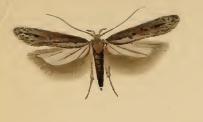
The adult moth has a grey head and a whitish face. Its forewings are brown with grey-whitish veins and costa, and dark fuscous speckling. The hindwings are pale grey.[1][2][3]
The adult moth has a wingspan of 13–15 mm.[4]
The larva is dull yellowish with black dots, a brown head, and a black plate on the second segment.[5]
Habitat
The species occurs across most of Europe and in Russia as far as the southern Urals.[6]
Diet
The larvae feed on Plantago coronopus, Plantago lanceolata, and Plantago maritima.[7][8][9]
Behaviour
Adult moths have been recorded flying between June and August. Young larvae mine the leaves of their host plants.[10][11]
Classification of the Buck's-horn Groundling
| Kingdom | Animalia |
|---|---|
| Phylum | Arthropoda |
| Subphylum | Hexapoda |
| Class | Insecta (Insect) |
| Order | Lepidoptera |
| Superfamily | Gelechioidea |
| Family | Gelechiidae (Gelechiid Moths) |
| Subfamily | Gelechiinae |
| Tribe | Gnorimoschemini |
| Genus | Scrobipalpa |
| Species | Scrobipalpa samadensis (Pfaffenzeller, 1870) |
Where the Buck's-horn Groundling is found
Checklists and occurrence records place Scrobipalpa samadensis in 14 countries. GBIF holds 889 georeferenced records of it.
Countries
- Aland Islands 23
- Austria 22
- Denmark 52
- Estonia 24
- Finland 136
- France 39
- Germany 3
- Iceland 33
- Italy 24
- North Macedonia 4
- Norway 314
- Sweden 65
- Ukraine 9
- United Kingdom 141
Regions and cities with the most records
- Rogaland, Norway 106
- Scotland, United Kingdom 60
- Time, Norway 45
- England, United Kingdom 43
- Sandnes, Norway 43
- Provence-Alpes-Côte d'Azur, France 35
- Arendal, Norway 31
- Grimstad, Norway 30
- Sola, Norway 28
- Heysham, United Kingdom 26
- Lancaster, United Kingdom 26
- Morecambe, United Kingdom 26
- Kristiansand, Norway 25
- Fleetwood, United Kingdom 22
- Fylde, United Kingdom 22
- South Denmark, Denmark 22
- Thornton-Cleveleys, United Kingdom 22
- Poulton-le-Fylde, United Kingdom 19
- Västra Götaland, Sweden 19
- Burgenland, Austria 18
- Kungsbacka, Sweden 18
- Mariehamn, Aland Islands 18
- Wales, United Kingdom 17
- Sopron, Hungary 16
- Halland, Sweden 14
- Colwyn Bay, United Kingdom 13
- Llandudno, United Kingdom 13
- Kalmar, Sweden 12
- Nordland, Norway 10
- Capital Region, Iceland 9
- Hafnarfjörður, Iceland 9
- Kópavogur, Iceland 9
- Reykjavík, Iceland 9
- Tønder, Denmark 9
- Capital Region, Denmark 8
- Kharkiv, Ukraine 8
A number beside a place is its count of GBIF occurrence records. A place without a number comes from a checklist alone. Records show where a species has been observed or collected, which can include escapes and vagrants.
Common names
English
- Buck's-horn Groundling
Names in 5 other languages
- Dutch
- Schorzandvleugeltje
- Finnish
- punajäytäjäkoi
- Hungarian
- szikhagyma-sarlósmoly
- Slovak
- psota samadenská
- Swedish
- gulkämpesmåstävmal
Synonyms
11 other scientific names have been used for this species and are now treated as synonyms of Scrobipalpa samadensis.
- Gelechia echo Meyrick, 1937
- Gelechia petrophilella Frey, 1867
- Gelechia plantaginella Stainton, 1883
- Gelechia samadensis Pfaffenzeller, 1870
- Lita brunhildae Schawerda, 1921
- Lita plantaginella var. mariae Zimmermann, 1926
- Lita testacella Rebel, 1935
- Lita zimmermanni Zimmermann, 1923
- Scrobipalpa huemeri G. Leraut, 2020
- Scrobipalpa plantaginella (Stainton, 1883)
- Scrobipalpa samadensis plantaginella (Stainton, 1883)
Subspecies and varieties
- Scrobipalpa samadensis samadensis subspecies
Related species
-
 Beet MothScrobipalpa ocellatella
-
 Saltern GroundlingScrobipalpa instabilella
-
 Thyme MothScrobipalpa artemisiella
-
 Goosefoot GroundlingScrobipalpa atriplicella
-
 Pointed GroundlingScrobipalpa acuminatella
-
 Rock GroundlingScrobipalpa murinella
-
 Summer GroundlingScrobipalpa obsoletella
- Scrobipalpa abai
Compare
Questions and answers
What is the scientific name of the Buck's-horn Groundling?
The scientific name of the Buck's-horn Groundling is Scrobipalpa samadensis. Written with its author, the full name is Scrobipalpa samadensis (Pfaffenzeller, 1870).
Which family does the Buck's-horn Groundling belong to?
Scrobipalpa samadensis belongs to the family Gelechiidae, in the order Lepidoptera and the class Insecta.
Where is the Buck's-horn Groundling found?
Checklists and occurrence records place Scrobipalpa samadensis in 14 countries, including Norway, United Kingdom, Finland, Sweden, Denmark and France.
Sources
Passages the profile rests on
- The adult moth has a grey head and a whitish face. Source passage: “The head is grey, face whitish.” — English Wikipedia
- The forewings are brown with grey-whitish veins and costa, and dark fuscous speckling. Source passage: “Forewings brown; veins and costa grey-whitish, suffusedly irrorated withdark fuscous” — English Wikipedia
- The hindwings are pale grey. Source passage: “Hindwings 1, pale grey.” — English Wikipedia
- The adult moth has a wingspan of 13–15 mm. Source passage: “The wingspan is 13–15 mm (0.51–0.59 in).” — English Wikipedia
- The larva is dull yellowish with black dots, a brown head, and a black plate on the second segment. Source passage: “The larva dull yellowish; dorsal, subdorsal, and spiracular lines sometimes faintly pinkish; dots black; head brown; plate of 2 black.” — English Wikipedia
- The species occurs across most of Europe and in Russia as far as the southern Urals. Source passage: “It is found in most of Europe and Russia (the southern Urals).” — English Wikipedia
- The larvae feed on Plantago coronopus. Source passage: “The larvae feed on Plantago coronopus, Plantago lanceolata and Plantago maritima.” — English Wikipedia
- The larvae feed on Plantago lanceolata. Source passage: “The larvae feed on Plantago coronopus, Plantago lanceolata and Plantago maritima.” — English Wikipedia
- The larvae feed on Plantago maritima. Source passage: “The larvae feed on Plantago coronopus, Plantago lanceolata and Plantago maritima.” — English Wikipedia
- Adult moths have been recorded flying between June and August. Source passage: “Adults have been recorded on wing from June to August.” — English Wikipedia
- Young larvae mine the leaves of their host plants. Source passage: “The young larvae mine the leaves of their host plant.” — English Wikipedia
Data
- Catalogue of Life, 2026-10-16 XR cc by
- Global Biodiversity Information Facility CC BY 4.0
- Wikidata CC0
- GeoNames CC BY 4.0
- Wikimedia Commons per image; credit shown with each image
- Within the Catalogue of Life, this name comes from Catalogue of World Gelechiidae cc0
This species in other databases
Page built on 29 November 2026. See how the catalog is made and all sources and licences.
Cite this page
ScientificNames.org. (2026). Scrobipalpa samadensis (Buck's-horn Groundling). Retrieved November 29, 2026, from https://scientificnames.org/species/scrobipalpa-samadensis
“Scrobipalpa samadensis (Buck's-horn Groundling).” ScientificNames.org, 2026, scientificnames.org/species/scrobipalpa-samadensis. Accessed 29 Nov. 2026.
ScientificNames.org. “Scrobipalpa samadensis (Buck's-horn Groundling).” Accessed November 29, 2026. https://scientificnames.org/species/scrobipalpa-samadensis.
@misc{scientificnames_scrobipalpa_samadensis_bucks_horn_groundling,
  author = {{ScientificNames.org}},
  title = {Scrobipalpa samadensis (Buck's-horn Groundling)},
  year = {2026},
  url = {https://scientificnames.org/species/scrobipalpa-samadensis},
  note = {Accessed 2026-11-29}
}