Species · Fishes
Shortspine Thornyhead Sebastolobus alascanus
The scientific name of the Shortspine Thornyhead is Sebastolobus alascanus. It is a species of fish in the family Sebastidae (rockfishes), order Perciformes. The name dates from 1890.
- Scientific name
- Sebastolobus alascanus Bean, 1890
- Common name
- Shortspine Thornyhead
- Genus
- Sebastolobus
- Family
- Sebastidae (Rockfishes)
- Order
- Perciformes
- Class
- Teleostei
- Red List category
- EN Endangered
- Environment
- marine
- Recorded in
- 4 countries
- Name status
- accepted in the Catalogue of Life
Overview
Sebastolobus alascanus occurs in the northern and northeastern Pacific Ocean, inhabiting depths from 17 to 1,600 meters.
Written 26 November 2026 from the sources listed below. Each statement was checked against the passage it cites; statements that could not be supported were removed.
Appearance
Its dorsal fin has 15 to 17 spines and 8 to 9 soft rays, while its anal fin has three spines and four to five soft rays. Its pectoral fin has a deep notch, and its caudal fin is rounded.[1][2][3][4]
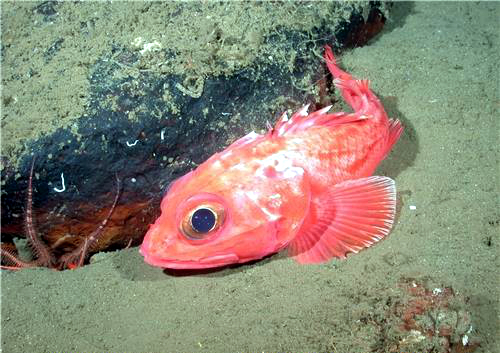
Underwater, its coloration can include orange-red tones and white patches on the sides, back, cheeks, and dorsal fin tips. Its fins may have black patches, while its sides can show dark spots or speckles.[5][6]
The species can reach a maximum length of 80 centimeters. Females grow larger than males.[7][8]
Habitat
Shortspine Thornyhead is a demersal fish inhabiting depths from 17 to 1,600 meters. It is more commonly found at depths below 100 meters and between 55 and 465 meters.[9][10][11]
Adult shortspine thornyheads predominantly inhabit oxygen minimum zones.[12]
The species occurs in the northern and northeastern Pacific Ocean. Its distribution extends from the Sea of Okhotsk northward to Navarin Canyon in the Bering Sea, and east and south from Stalemate Bank and Ulm Plateau in the Aleutian Islands to Cedros Island in Baja California.[13][14][15]
Diet
Shortspine Thornyhead feeds on shrimp, crabs, zooplankton, amphipods, and other benthic invertebrates.[16]
Behaviour
Shortspine Thornyheads grow slowly. They increase their ventilation frequency when exposed to progressively hypoxic conditions.[17][18]
Reproduction and life cycle
Females reach sexual maturity at approximately 18 centimeters in length and generally between eight and ten years of age. They are fertilized internally and release fertilized eggs in gelatinous pelagic masses.[19][20][21][22]
Spawning takes place between December and May along the Pacific coasts of the contiguous United States. In the Gulf of Alaska, spawning occurs between April and May.[23][24]
Young fish migrate into deeper water as they mature.[25]
Conservation
The Pacific Coast stock was assessed as not overfished in the 2023 stock assessment. It was not subject to overfishing based on 2022 catch data.[26][27]
The IUCN listed Shortspine Thornyhead as Endangered based on an assessment conducted in 2000. That assessment estimated a 53 percent biomass reduction between the 1960s and 1998.[28][29]
The species may live for as long as 80 to 100 years. A FishBase estimate gives it a median longevity of approximately 47.8 years.[30][31]
Uses
The species is occasionally caught in recreational fisheries but is not frequently targeted.[32]
Classification of the Shortspine Thornyhead
| Kingdom | Animalia |
|---|---|
| Phylum | Chordata |
| Subphylum | Vertebrata |
| Infraphylum | Gnathostomata |
| Parvphylum | Osteichthyes |
| Gigaclass | Actinopterygii |
| Superclass | Actinopteri |
| Class | Teleostei (Teleost) |
| Order | Perciformes |
| Suborder | Scorpaenoidei |
| Family | Sebastidae (Rockfishes) |
| Subfamily | Sebastolobinae |
| Genus | Sebastolobus |
| Species | Sebastolobus alascanus Bean, 1890 |
Where the Shortspine Thornyhead is found
Checklists and occurrence records place Sebastolobus alascanus in 4 countries. GBIF holds 65,781 georeferenced records of it.
Countries
Regions and cities with the most records
- Vancouver, Canada 36
- West Vancouver, Canada 34
- Richmond, Canada 33
- Riley Park, Canada 29
- Victoria-Fraserview, Canada 25
- Alaska, United States 22
- North Vancouver, Canada 22
- California, United States 18
- Pacific Grove, United States 18
- Monterey, United States 17
- Coronado, United States 15
- San Diego, United States 15
- Seaside, United States 13
- Rancho Palos Verdes, United States 12
- Encinitas, United States 11
- Burnaby, Canada 10
- Lomita, United States 9
- Nanaimo, Canada 9
- Laguna Beach, United States 8
- Laguna Niguel, United States 8
- Long Beach, United States 8
- Redondo Beach, United States 8
- Aliso Viejo, United States 7
- British Columbia, Canada 7
- Carson, United States 7
- Dana Point, United States 7
- Hermosa Beach, United States 7
- Newport Beach, United States 7
- San Juan Capistrano, United States 7
- Torrance, United States 7
- West Carson, United States 7
- Costa Mesa, United States 6
- Laguna Hills, United States 6
- Laguna Woods, United States 6
- Seal Beach, United States 6
- Gardena, United States 5
2 more countries have a few records outside this range
These countries hold a few records of Sebastolobus alascanus but lie outside the range the checklists give for it. Such records are often zoo or garden specimens, museum material or vagrants, so the species is not counted as occurring there.
A number beside a place is its count of GBIF occurrence records. A place without a number comes from a checklist alone. Records show where a species has been observed or collected, which can include escapes and vagrants.
Common names
English
- Shortspine Thornyhead
Names in 6 other languages
- Czech
- okouník krátkotrnný
- French
- sébastolobe à courtes épines
- Japanese
- アラスカキチジ
- Polish
- karmazynek alaskański
- Russian
- Аляскинский шипощек (морской ерш), Аляскинский шипощёк
- Spanish
- chancharro alacrán
Synonyms
2 other scientific names have been used for this species and are now treated as synonyms of Sebastolobus alascanus.
- Sebastes (Sebastodes) alascanus (Bean, 1890)
- Sebastodes alascanus (Bean, 1890)
Related species
-
 Broadbanded ThornyheadSebastolobus macrochir
-
 Longspine ThornyheadSebastolobus altivelis
-
 Atlantic RedfishSebastes norvegicus
-
 Rougheye RockfishSebastes aleutianus
-
 Acadian RedfishSebastes fasciatus
-
 Pacific Ocean PerchSebastes alutus
-
 Yelloweye RockfishSebastes ruberrimus
-
 Blackbelly RosefishHelicolenus dactylopterus
Compare
Questions and answers
What is the scientific name of the Shortspine Thornyhead?
The scientific name of the Shortspine Thornyhead is Sebastolobus alascanus. Written with its author, the full name is Sebastolobus alascanus Bean, 1890.
Which family does the Shortspine Thornyhead belong to?
Sebastolobus alascanus belongs to the family Sebastidae, in the order Perciformes and the class Teleostei.
Where is the Shortspine Thornyhead found?
Checklists and occurrence records place Sebastolobus alascanus in 4 countries: Canada, United States, Mexico and Costa Rica.
What is the conservation status of the Shortspine Thornyhead?
The IUCN Red List category recorded for Sebastolobus alascanus is Endangered (EN).
Sources
Passages the profile rests on
- Its dorsal fin has 15 to 17 spines and 8 to 9 soft rays. Source passage: “The dorsal fin has 15 to 17 spines and 8 to 9 soft rays” — English Wikipedia
- Its anal fin has three spines and four to five soft rays. Source passage: “the anal fin has 3 spines and 4 to 5 soft rays.” — English Wikipedia
- Its pectoral fin has a deep notch. Source passage: “There is a deep notch in the pectoral fin” — English Wikipedia
- Its caudal fin is rounded. Source passage: “the caudal fin is rounded.” — English Wikipedia
- Underwater, its coloration can include orange-red tones and white patches on the sides, back, cheeks, and dorsal fin tips. Source passage: “They are bright red or orange red in color, and often have white patches on their sides, backs, cheeks and spiny dorsal fin tips when seen underwater.” — fisheries.noaa.gov
- Its fins may have black patches, while its sides can show dark spots or speckles. Source passage: “Their fins can have black patches and there may be dark spots or speckles on their sides.” — fisheries.noaa.gov
- The species can reach a maximum length of 80 centimeters. Source passage: “which grows to a maximum length of 80 cm (31 in).” — English Wikipedia
- Females grow larger than males. Source passage: “Females grow larger than males” — fisheries.noaa.gov
- The shortspine thornyhead is a demersal fish inhabiting depths from 17 to 1,600 meters. Source passage: “It is a demersal fish with a depth range which is between 17 and 1,600 m (56 and 5,249 ft)” — English Wikipedia
- The species is more commonly found at depths below 100 meters according to the first document. Source passage: “but it is more usually found at depths less than 100 metres (330 ft).” — English Wikipedia
- It is more commonly found at depths between 55 and 465 meters according to NOAA Fisheries. Source passage: “though they are more commonly found between 55 and 465 meters.” — fisheries.noaa.gov
- Adult shortspine thornyheads predominantly inhabit oxygen minimum zones. Source passage: “As adults they live predominantly in the oxygen minimum zone (OMZ)” — English Wikipedia
- The species occurs in the northern and northeastern Pacific Ocean. Source passage: “It is found in the northern and northeastern Pacific Ocean.” — English Wikipedia
- Its distribution extends from the Sea of Okhotsk northward to Navarin Canyon in the Bering Sea. Source passage: “from the Sea of Okhotsk north as far as the Navarin Canyon in the Bering Sea” — English Wikipedia
- Its range extends east and south from Stalemate Bank and Ulm Plateau in the Aleutian Islands to Cedros Island in Baja California. Source passage: “from Stalemate Bank and Ulm Plateau in the Aleutian Islands east and south to Cedros Island in Baja California.” — English Wikipedia
- The species feeds on shrimp, crabs, zooplankton, amphipods, and other benthic invertebrates. Source passage: “These fishes are predators of shrimp, crabs, zooplankton, amphipods, and other benthic invertebrates.” — English Wikipedia
- Shortspine thornyheads grow slowly. Source passage: “Shortspine thornyhead grow slowly” — English Wikipedia
- The species increases its ventilation frequency when exposed to progressively hypoxic conditions. Source passage: “Allowing for an increased ventilation frequency during exposure to progressively hypoxic conditions” — English Wikipedia
- Females reach sexual maturity at approximately 18 centimeters in length. Source passage: “reaching sexual maturity at approximately 18 cm (7.1 in)” — English Wikipedia
- Females generally reach sexual maturity between eight and ten years of age. Source passage: “or when they are 8 to 10 years old.” — English Wikipedia
- Females are fertilized internally. Source passage: “The females are fertilized internally” — English Wikipedia
- Females release fertilized eggs in gelatinous pelagic masses. Source passage: “extrude the fertilised eggs in pelagic, gelatinous masses.” — English Wikipedia
- Spawning takes place between December and May along the Pacific coasts of the contiguous United States. Source passage: “Spawning occurs between December and May along the Pacific coasts of contiguous United States” — English Wikipedia
- In the Gulf of Alaska, spawning occurs between April and May. Source passage: “between April and May in the Gulf of Alaska.” — English Wikipedia
- Young fish migrate into deeper water as they mature. Source passage: “The young fish migrate to deeper water as they mature” — English Wikipedia
- The Pacific Coast stock was assessed as not overfished in the 2023 stock assessment. Source passage: “The Pacific Coast stock is not overfished (2023 stock assessment)” — fisheries.noaa.gov
- The Pacific Coast stock was not subject to overfishing based on 2022 catch data. Source passage: “and not subject to overfishing based on 2022 catch data.” — fisheries.noaa.gov
- The IUCN listed the species as Endangered based on an assessment conducted in 2000. Source passage: “The IUCN status is listed as "Endangered" based on an assessment conducted in 2000” — English Wikipedia
- The 2000 IUCN assessment estimated a 53 percent biomass reduction between the 1960s and 1998. Source passage: “estimating a biomass reduction of 53% between the 1960s and 1998.” — English Wikipedia
- The species may live for as long as 80 to 100 years. Source passage: “have long lives of possibly up to 80 or 100 years.” — English Wikipedia
- A FishBase estimate gives the species a median longevity of approximately 47.8 years. Source passage: “47.8 ( na - na) years. Estimated as median ln(3)/K based on 1 growth studies.” — fishbase.se
- The species is occasionally caught in recreational fisheries but is not frequently targeted. Source passage: “Thornyheads are occasionally caught in recreational fisheries but are not often targeted” — fisheries.noaa.gov
Data
- Catalogue of Life, 2026-10-16 XR cc by
- Global Biodiversity Information Facility CC BY 4.0
- Wikidata CC0
- GeoNames CC BY 4.0
- Wikimedia Commons per image; credit shown with each image
- Within the Catalogue of Life, this name comes from World Register of Marine Species cc by
References
- Bean, T. H. (1890). Scientific results of explorations by the U. S. Fish Commission steamer Albatross. No. XI. New fishes collected off the coast of Alaska and the adjacent region southward. Proceedings of the United States National Museum, 13 (795): 37–45. https://doi.org/10.5479/si.00963801.13-795.37 Link where the name was published
This species in other databases
- Catalogue of Life 4W7ZL
- Wikidata Q2908215
- iNaturalist 112423
- WoRMS urn:lsid:marinespecies.org:taxname:282740
- ITIS 166783
Page built on 27 November 2026. See how the catalog is made and all sources and licences.
Cite this page
ScientificNames.org. (2026). Sebastolobus alascanus (Shortspine Thornyhead). Retrieved November 27, 2026, from https://scientificnames.org/species/sebastolobus-alascanus
“Sebastolobus alascanus (Shortspine Thornyhead).” ScientificNames.org, 2026, scientificnames.org/species/sebastolobus-alascanus. Accessed 27 Nov. 2026.
ScientificNames.org. “Sebastolobus alascanus (Shortspine Thornyhead).” Accessed November 27, 2026. https://scientificnames.org/species/sebastolobus-alascanus.
@misc{scientificnames_sebastolobus_alascanus_shortspine_thornyhead,
  author = {{ScientificNames.org}},
  title = {Sebastolobus alascanus (Shortspine Thornyhead)},
  year = {2026},
  url = {https://scientificnames.org/species/sebastolobus-alascanus},
  note = {Accessed 2026-11-27}
}