Species · Fishes
Longspine Thornyhead Sebastolobus altivelis
The scientific name of the Longspine Thornyhead is Sebastolobus altivelis. It is a species of fish in the family Sebastidae (rockfishes), order Perciformes. The name dates from 1896.
- Scientific name
- Sebastolobus altivelis Gilbert, 1896
- Common name
- Longspine Thornyhead
- Genus
- Sebastolobus
- Family
- Sebastidae (Rockfishes)
- Order
- Perciformes
- Class
- Teleostei
- Environment
- marine
- Recorded in
- 3 countries
- Name status
- accepted in the Catalogue of Life

Overview
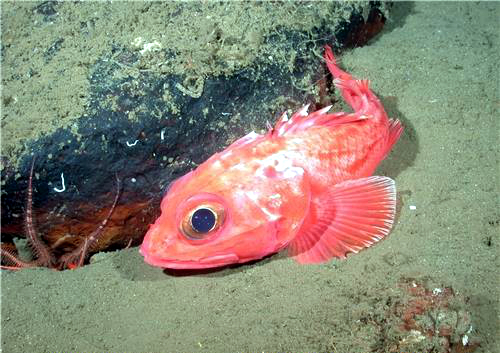
The longspine thornyhead is a fish in the family Sebastidae, order Perciformes and class Teleostei. It is distinguished by its elongated third dorsal-fin spine, large closely spaced eyes and strongly developed head spines.
Written 27 November 2026 from the sources listed below. Each statement was checked against the passage it cites; statements that could not be supported were removed.
Appearance
The longspine thornyhead has a moderately compressed, elongated body and a relatively large, pointed head. Its head bears strongly developed nasal, preocular, supraocular, postocular, tympanic, parietal and nuchal spines.[1][2]
Its eyes are large, closely spaced and positioned on top of the head. The dorsal fin typically has 15 strong venomous spines and 8–9 soft rays, with the third spine substantially taller than the fourth.[3][4][5]
The anal fin has three spines and four to six soft rays, with the second spine being the longest. The caudal fin has a straight or square rear edge, and the lateral line has 28–32 pored scales.[6][7][8]
Adult fish have orange to orange-red bodies with dark markings and prominent white blotches. Juveniles have silvery-red bodies and black fins.[9][10]
Habitat
The longspine thornyhead inhabits depths ranging from 201 to 1,757 metres and occurs primarily at depths greater than 600 metres. It commonly inhabits depths between 500 and 1,300 metres.[11][12][13]
It typically occupies soft substrates and can also occur along reef edges on harder substrates. It lives on muddy bottoms in small depressions or among small rocks and sponges.[14][15][16]
Diet
The longspine thornyhead preys on other fishes and invertebrates, including amphipods and shrimp. Its recorded prey include octopuses, squids, cuttlefish, bony fishes, mobile benthic crustaceans and echinoderms.[17][18]
Juveniles feed on krill.[19]
Behaviour
The longspine thornyhead is solitary and typically remains motionless on the seabed for extended periods.[20]
Reproduction and life cycle
Fertilization is internal. During spring, females release fertilized eggs in a floating gelatinous mass, and the eggs hatch at the ocean surface.[21][22][23]
Larvae and juveniles remain pelagic for up to six months. Young fish gradually move into deeper waters as they mature and settle after approximately one year.[24][25][26]
Uses
The longspine thornyhead is commercially harvested off the Washington coast using otter trawls and occasionally longline gear. It has been harvested in commercial fisheries, with peak catches occurring during the 1980s and 1990s.[27][28]
Similar species
The longspine thornyhead resembles the shortspine thornyhead but grows to a smaller size and typically inhabits deeper water. It can be distinguished by its elongated third dorsal spine, mostly black gill chamber and typically 15 dorsal spines.[29][30]
Classification of the Longspine Thornyhead
| Kingdom | Animalia |
|---|---|
| Phylum | Chordata |
| Subphylum | Vertebrata |
| Infraphylum | Gnathostomata |
| Parvphylum | Osteichthyes |
| Gigaclass | Actinopterygii |
| Superclass | Actinopteri |
| Class | Teleostei (Teleost) |
| Order | Perciformes |
| Suborder | Scorpaenoidei |
| Family | Sebastidae (Rockfishes) |
| Subfamily | Sebastolobinae |
| Genus | Sebastolobus |
| Species | Sebastolobus altivelis Gilbert, 1896 |
Where the Longspine Thornyhead is found
Checklists and occurrence records place Sebastolobus altivelis in 3 countries. GBIF holds 10,130 georeferenced records of it.
Countries
Regions and cities with the most records
- Pacific Grove, United States 29
- Monterey, United States 27
- Rancho Palos Verdes, United States 18
- Seaside, United States 10
- Newport Beach, United States 8
- Dana Point, United States 7
- Huntington Beach, United States 7
- Laguna Niguel, United States 7
- San Juan Capistrano, United States 7
- Aliso Viejo, United States 6
- Laguna Beach, United States 6
- San Clemente, United States 6
- Costa Mesa, United States 5
- Laguna Woods, United States 5
- Lomita, United States 5
- West Carson, United States 5
- California, United States 4
- Carson, United States 4
- Laguna Hills, United States 4
- Seal Beach, United States 4
- Torrance, United States 4
- Hermosa Beach, United States 3
- Ladera Ranch, United States 3
- Long Beach, United States 3
- Redondo Beach, United States 3
1 more country has a few records outside this range
These countries hold a few records of Sebastolobus altivelis but lie outside the range the checklists give for it. Such records are often zoo or garden specimens, museum material or vagrants, so the species is not counted as occurring there.
A number beside a place is its count of GBIF occurrence records. A place without a number comes from a checklist alone. Records show where a species has been observed or collected, which can include escapes and vagrants.
Common names
English
- Longspine Thornyhead
Names in 5 other languages
- Czech
- okouník dlouhotrnný
- French
- sébastolobe à longues épines
- Japanese
- ヒレナガキチジ
- Russian
- Длинноиглый шипощёк
- Spanish
- chancharro espinoso
Synonyms
One other scientific name has been used for this species and is now treated as a synonym of Sebastolobus altivelis.
- Sebastodes altivelis Gilbert, 1896
Related species
-
 Shortspine ThornyheadSebastolobus alascanus
-
 Broadbanded ThornyheadSebastolobus macrochir
-
 Atlantic RedfishSebastes norvegicus
-
 Rougheye RockfishSebastes aleutianus
-
 Acadian RedfishSebastes fasciatus
-
 Pacific Ocean PerchSebastes alutus
-
 Yelloweye RockfishSebastes ruberrimus
-
 Blackbelly RosefishHelicolenus dactylopterus
Compare
Questions and answers
What is the scientific name of the Longspine Thornyhead?
The scientific name of the Longspine Thornyhead is Sebastolobus altivelis. Written with its author, the full name is Sebastolobus altivelis Gilbert, 1896.
Which family does the Longspine Thornyhead belong to?
Sebastolobus altivelis belongs to the family Sebastidae, in the order Perciformes and the class Teleostei.
Where is the Longspine Thornyhead found?
Checklists and occurrence records place Sebastolobus altivelis in 3 countries: Canada, United States and Mexico.
What is the maximum size of the longspine thornyhead?
It reaches a maximum total length of 39 cm.[31]
How long does the longspine thornyhead live?
The species may live for up to 45 years and has a maximum recorded age of at least 45 years.[32][33]
What does the scientific name altivelis mean?
The specific name altivelis combines Latin terms meaning high and sail, referring to the taller dorsal-fin spines compared with Sebastolobus macrochir.[34]
Sources
Passages the profile rests on
- The species has a moderately compressed, elongated body and a relatively large, pointed head. Source passage: “has a moderately compressed, elongate body with a relatively large, pointed head” — English Wikipedia
- Its head bears strongly developed nasal, preocular, supraocular, postocular, tympanic, parietal and nuchal spines. Source passage: “The spiny head is armed with strong nasal, preocular, supraocular, postocular, tympanic, parietal and nuchal spines” — English Wikipedia
- The species has large, closely spaced eyes positioned on top of its head. Source passage: “It has large eyes which are closely set and sit on the top of the head” — English Wikipedia
- Its dorsal fin typically has 15 strong venomous spines and 8–9 soft rays. Source passage: “There are 15–17, typically 15, strong, venomous spines and 8-9 soft rays.” — English Wikipedia
- The third dorsal-fin spine is substantially taller than the fourth. Source passage: “The third dorsal fin spine is much higher than the fourth.” — English Wikipedia
- Its anal fin has three spines, with the second being the longest, and four to six soft rays. Source passage: “The anal fin has 3 spines, the second spine being the longest, and 4-6 soft rays” — English Wikipedia
- Its caudal fin has a straight or square rear edge. Source passage: “tail fin edge straight” — biogeodb.stri.si.edu
- Its lateral line has 28–32 pored scales. Source passage: “lateral line with 28-32 pored scales” — biogeodb.stri.si.edu
- Adult fish have orange to orange-red bodies with dark markings and prominent white blotches. Source passage: “Adults with orange to orange-red bodies, often with dark dots and large white blotches” — biogeodb.stri.si.edu
- Juveniles have silvery-red bodies and black fins. Source passage: “Young fish silvery red, with black fins.” — biogeodb.stri.si.edu
- The species inhabits depths ranging from 201 to 1,757 metres. Source passage: “Its depth range is between 201 and 1,757 m (659 and 5,764 ft)” — English Wikipedia
- The species occurs primarily at depths greater than 600 metres. Source passage: “it primarily occurs deeper than 600 metres (2,000 ft).” — English Wikipedia
- It commonly inhabits depths between 500 and 1,300 metres. Source passage: “but are most common between 500 and 1,300 m (1,815-4,290 ft).” — wdfw.wa.gov
- The species typically occupies soft substrates and can also occur along reef edges on harder substrates. Source passage: “It is typically found over soft substrates biu may be found at the edges of reefs on harder substrates.” — English Wikipedia
- It lives on muddy bottoms in small depressions or among small rocks and sponges. Source passage: “They live on mud bottoms in small depressions or among small rocks and sponges.” — wdfw.wa.gov
- Its recorded habitat categories include mud, rocks and reef-associated environments. Source passage: “Mud Rocks Soft bottom (mud/sand/gravel/beach/estuary/mangrove/seagrass) Reef associated” — biogeodb.stri.si.edu
- The species preys on other fishes and invertebrates, including amphipods and shrimp. Source passage: “This species preys on other fish and invertebrates such as amphipods and shrimp.” — English Wikipedia
- Its recorded prey categories include octopuses, squids, cuttlefish, bony fishes, mobile benthic crustaceans and echinoderms. Source passage: “Octopus/squid/cuttlefish Data Bony fishes Mobile benthic crustacea (shrimps/crabs) Sea-stars/cucumbers/urchins” — biogeodb.stri.si.edu
- Juveniles feed on krill. Source passage: “Juveniles feed on krill.” — English Wikipedia
- The species is solitary and typically remains motionless on the seabed for extended periods. Source passage: “is a solitary species which typically lies motionless on the seabed for long periods of time.” — English Wikipedia
- Fertilization in this species is internal. Source passage: “Fertilization is internal” — English Wikipedia
- Females release fertilized eggs in a floating gelatinous mass during spring. Source passage: “the females release the fertilized eggs in a floating, gelatinous mass in the Spring.” — English Wikipedia
- The eggs hatch at the ocean surface. Source passage: “The eggs hatch at the surface” — English Wikipedia
- Larvae and juveniles remain pelagic for up to six months. Source passage: “the larvae and juveniles remain pelagic for up to 6 months.” — English Wikipedia
- Young fish gradually move into deeper waters as they mature. Source passage: “As the juveniles mature they gradually move into deeper waters” — English Wikipedia
- Young fish settle after approximately one year. Source passage: “After a year the young adults they settle.” — English Wikipedia
- The species is commercially harvested off the Washington coast using otter trawls and occasionally longline gear. Source passage: “Commonly caught off the Washington coast by commercial harvesters using otter-trawls and occasionally by commercial harvesters using longline gear.” — wdfw.wa.gov
- Longspine thornyhead has been harvested in commercial fisheries, with peak catches occurring during the 1980s and 1990s. Source passage: “Both shortspine and longspine thornyhead have been harvested in commercial fisheries with the period of peak catches occurring in the 1980s and 1990s.” — English Wikipedia
- The longspine thornyhead resembles the shortspine thornyhead but grows to a smaller size and typically inhabits deeper water. Source passage: “Longspine thornyhead are similar in appearance to shortspine thornyhead though they don't grow as large and are typically found in deeper water.” — English Wikipedia
- The species can be distinguished from shortspine thornyheads by its elongated third dorsal spine, mostly black gill chamber and typically 15 dorsal spines. Source passage: “distinguished by an elongated third dorsal spine, a mostly black gill chamber, and usually 15 dorsal spines.” — wdfw.wa.gov
- The species reaches a maximum total length of 39 cm. Source passage: “This species attains a maximum total length of 39 cm (15 in).” — English Wikipedia
- The species has a maximum recorded age of at least 45 years. Source passage: “Maximum age is at least 45 years.” — wdfw.wa.gov
- The species may live for up to 45 years. Source passage: “It is a long lived species which may live for up to 45 years.” — English Wikipedia
- The specific name altivelis combines Latin terms meaning high and sail, referring to the taller dorsal-fin spines compared with Sebastolobus macrochir. Source passage: “The specific name altivelis is a compound of altus which means "high" and velum meaning"sail", an allusion to the taller dorsal fin spines than S. macrochir.” — English Wikipedia
Data
- Catalogue of Life, 2026-10-16 XR cc by
- Global Biodiversity Information Facility CC BY 4.0
- Wikidata CC0
- GeoNames CC BY 4.0
- Wikimedia Commons per image; credit shown with each image
- Within the Catalogue of Life, this name comes from World Register of Marine Species cc by
References
- Gilbert, C. H. (1896). The ichthyological collections of the steamer Albatross during the years 1890 and 1891. United States Commission of Fish and Fisheries, Report of the Commissioner, v. 19 (for 1893) (art. 6): 393–476, Pls. 20–35. where the name was published
This species in other databases
- Catalogue of Life 4W7ZM
- Wikidata Q1235581
- iNaturalist 230765
- WoRMS urn:lsid:marinespecies.org:taxname:282741
- ITIS 166784
Page built on 27 November 2026. See how the catalog is made and all sources and licences.
Cite this page
ScientificNames.org. (2026). Sebastolobus altivelis (Longspine Thornyhead). Retrieved November 27, 2026, from https://scientificnames.org/species/sebastolobus-altivelis
“Sebastolobus altivelis (Longspine Thornyhead).” ScientificNames.org, 2026, scientificnames.org/species/sebastolobus-altivelis. Accessed 27 Nov. 2026.
ScientificNames.org. “Sebastolobus altivelis (Longspine Thornyhead).” Accessed November 27, 2026. https://scientificnames.org/species/sebastolobus-altivelis.
@misc{scientificnames_sebastolobus_altivelis_longspine_thornyhead,
  author = {{ScientificNames.org}},
  title = {Sebastolobus altivelis (Longspine Thornyhead)},
  year = {2026},
  url = {https://scientificnames.org/species/sebastolobus-altivelis},
  note = {Accessed 2026-11-27}
}