Species · Insects
Semanopterus kingstoni
Semanopterus kingstoni has no English name on record in the checklists used here. It is a species of insect in the family Scarabaeidae (dung beetles), order Coleoptera. The name dates from 2023.
- Scientific name
- Semanopterus kingstoni Reid & Tees, 2023
- Genus
- Semanopterus
- Family
- Scarabaeidae (Dung Beetles)
- Order
- Coleoptera
- Class
- Insecta
- Name status
- accepted in the Catalogue of Life
Classification of Semanopterus kingstoni
| Kingdom | Animalia |
|---|---|
| Phylum | Arthropoda |
| Subphylum | Hexapoda |
| Class | Insecta (Insect) |
| Order | Coleoptera (Beetle) |
| Suborder | Polyphaga |
| Series | Staphyliniformia |
| Superfamily | Scarabaeoidea |
| Family | Scarabaeidae (Dung Beetles) |
| Subfamily | Dynastinae |
| Tribe | Pentodontini |
| Subtribe | Cheiroplatina |
| Genus | Semanopterus |
| Species | Semanopterus kingstoni Reid & Tees, 2023 |
Origin of the name. Etymology. Named for Tim Kingston, the collector of this species. Notes. The new species is placed in Semanopterus because it best fits most of the diagnostic features of this genus, as described by Carne (1957), Endrodi (1985), and Weir et al. (2019): body reddish brown to black; frontoclypeal suture armed with low tubercle; clypeus broadly triangular or trapezoidal, with sides straight and anterior edge upturned; head without vertically flattened area; mandibles strongly exposed beside and beyond clypeus; apical maxillary palpomere not enlarged; maxillae with galeae strongly developed, conspicuously toothed; apical labial palp cylindrical; mentum not dilated, not covering bases of maxillary palpi; elytra with odd numbered intervals costate; elytra without tubercle near scutellum; protibia tridentate; apex of metatibia truncate, with many spiniform setae; metatarsomere 1 without distinct longitudinal external carina; propygidium not enlarged, without stridulatory ridges; last ventrite of female with transverse sulcus. Semanopterus kingstoni differs from all other species of this genus by: convex body; distinct frontoclypeal suture; antennae with 9 antennomeres; pronotal disc with single fovea, in basal half; pronotal basal angles rounded and basal border absent medially; epipleura indistinct apically and with setae confined to base; protibiae bluntly tridentate; metatibia with a single oblique setose ridge. This combination of characters easily distinguishes S. kingstoni from all other species in the genus. It might, therefore, be argued that S. kingstoni should be placed in a new genus. However, the convexity, loss of anterior pronotal fovea and loss or reduction of borders and margins on pronotum and elytra, may all be linked to loss of flight. Furthermore, variation in the number of antennomeres is not regarded as significant at generic rank in the Dynastinae and is widespread in dynastine genera as currently understood (Carne 1957).
Where Semanopterus kingstoni is found
Range as the checklists state it
Australian(Lord Howe Island)
A number beside a place is its count of GBIF occurrence records. A place without a number comes from a checklist alone. Records show where a species has been observed or collected, which can include escapes and vagrants.
Related species
- Semanopterus subcostatus
- Semanopterus leai
- Semanopterus tricostatus
- Semanopterus rectangulus
- Semanopterus angustatus
- Semanopterus calabyi
- Semanopterus solidus
-
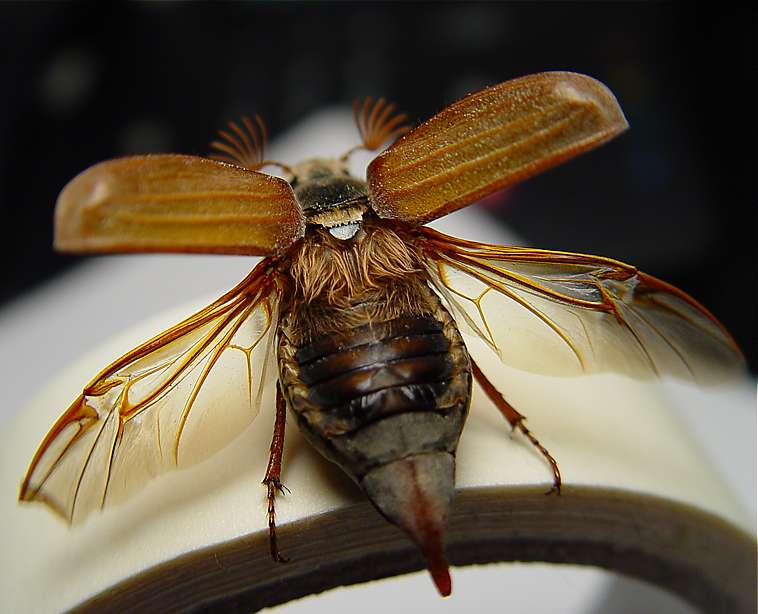 CockchaferMelolontha melolontha
Compare
Sources
Data
- Catalogue of Life, 2026-10-16 XR cc by
- Within the Catalogue of Life, this name comes from World Scarabaeidae Database cc by
References
- Reid, C. A. M., & Tees, N. A. (2023). A new, but possibly extinct, species of Semanopterus Hope, 1847 from Lord Howe Island, in the southwestern Pacific Ocean (Coleoptera: Scarabaeidae: Dynastinae). Zootaxa 5306(5):563-570. https://doi.org/10.11646/zootaxa.5306.5.4 Link where the name was published
This species in other databases
Page built on 28 November 2026. See how the catalog is made and all sources and licences.
Cite this page
ScientificNames.org. (2026). Semanopterus kingstoni. Retrieved November 28, 2026, from https://scientificnames.org/species/semanopterus-kingstoni
“Semanopterus kingstoni.” ScientificNames.org, 2026, scientificnames.org/species/semanopterus-kingstoni. Accessed 28 Nov. 2026.
ScientificNames.org. “Semanopterus kingstoni.” Accessed November 28, 2026. https://scientificnames.org/species/semanopterus-kingstoni.
@misc{scientificnames_semanopterus_kingstoni,
  author = {{ScientificNames.org}},
  title = {Semanopterus kingstoni},
  year = {2026},
  url = {https://scientificnames.org/species/semanopterus-kingstoni},
  note = {Accessed 2026-11-28}
}