Species · Flowering plants
Small-flowered Tongue-orchid Serapias parviflora
The scientific name of the Small-flowered Tongue-orchid is Serapias parviflora. It is a species of flowering plant in the family Orchidaceae (orchid), order Asparagales.
- Scientific name
- Serapias parviflora Parl.
- Common name
- Small-flowered Tongue-orchid
- Genus
- Serapias
- Family
- Orchidaceae (Orchid)
- Order
- Asparagales
- Class
- Liliopsida
- Recorded in
- 19 countries
- Name status
- accepted in the Catalogue of Life

Overview
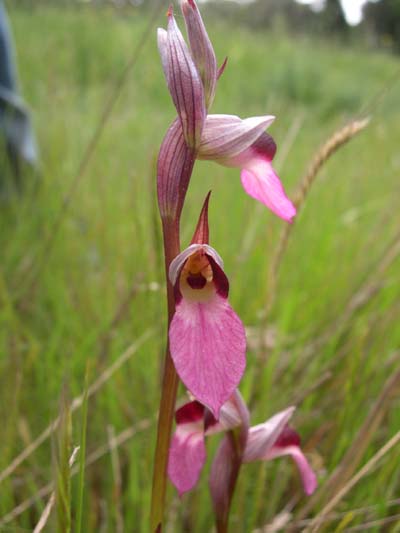
The species is native to the Mediterranean Basin, the Atlantic coast of Europe and the Canary Islands. It produces spikes typically bearing three to eight flowers, with greyish-pink sepals and petals forming a hood over the column and lip.
Written 27 November 2026 from the sources listed below. Each statement was checked against the passage it cites; statements that could not be supported were removed.
Appearance
The plant has greyish-pink sepals and petals that form a hood over its column and lip. It produces linear leaves with keeled surfaces and additional bract-like leaves higher up its stem.[1][2][3]
Its flowers are arranged in spikes, typically bearing between three and eight flowers, with occasional spikes bearing up to twelve.[4][5]
The plant typically grows between 10 and 30 centimetres tall, occasionally reaching 40 centimetres. Its flower lip is typically between 14 and 19 millimetres long.[6][7]
Habitat
The species is native to the Mediterranean Basin, with its Mediterranean distribution extending from the Iberian Peninsula to the Aegean Sea. It is also native to the Atlantic coast of Europe and the Canary Islands.[8][9][10]
The species occurs along the Atlantic coast of France. It was discovered at Rame Head in Cornwall, United Kingdom, in 1989.[11][12]
Sixteen plants were discovered on the biodiverse green roof of Nomura International's office building in the City of London in 2021. The population increased to more than 29 individuals in 2022 and exceeded 300 individual plants by early 2024.[13][14][15]
Conservation
The colony discovered at Rame Head disappeared approximately 20 years after its discovery.[12][16]
Wind-blown seeds carried during weather events such as Saharan dust storms are considered the most plausible explanation for the arrival of the London colony. Its arrival has not yet been conclusively explained.[17][18]
Researchers are investigating the London colony in collaboration with Kew Science laboratories and mycologists.[19]
Classification of the Small-flowered Tongue-orchid
| Kingdom | Plantae |
|---|---|
| Subkingdom | Pteridobiotina |
| Phylum | Tracheophyta |
| Class | Liliopsida |
| Order | Asparagales |
| Family | Orchidaceae (Orchid) |
| Genus | Serapias (Tongue Orchids) |
| Species | Serapias parviflora Parl. |
Where the Small-flowered Tongue-orchid is found
Checklists and occurrence records place Serapias parviflora in 19 countries across Africa, Asia and Europe. GBIF holds 13,065 georeferenced records of it.
Countries where it is native or its origin is not stated
- Albania 10
- Algeria 83
- Croatia 83
- Cyprus 20
- France 5,358
- Gibraltar 6
- Greece 258
- Italy 1,128
- Kosovo
- Malta 35
- Montenegro 2
- Morocco 28
- North Macedonia
- Portugal 3,090
- Serbia
- Spain 2,881
- Tunisia 8
- Turkey 10
Countries where it has been introduced
Regions and cities with the most records
- Corsica, France 2,733
- Provence-Alpes-Côte d'Azur, France 765
- Hyères, France 718
- Lisbon, Portugal 653
- Carnaxide, Portugal 637
- Alfragide, Portugal 635
- Buraca, Portugal 634
- Alfornelos, Portugal 627
- Damaia, Portugal 625
- Amadora, Portugal 623
- Queluz, Portugal 621
- Benfica, Portugal 620
- Algés, Portugal 618
- Linda-a-Velha, Portugal 616
- Massamá, Portugal 614
- Olival, Portugal 613
- Pontinha, Portugal 613
- Belas, Portugal 608
- Falagueira, Portugal 606
- Cacém, Portugal 598
- Carnide, Portugal 598
- Paço de Arcos, Portugal 597
- Campo Grande, Portugal 584
- Sete Rios, Portugal 583
- Belém, Portugal 582
- Alvalade, Portugal 579
- Oeiras, Portugal 579
- Areeiro, Portugal 574
- Amora, Portugal 567
- Carcavelos, Portugal 567
- Charneca de Caparica, Portugal 567
- Lisbon, Portugal 564
- Caparica, Portugal 562
- Lumiar, Portugal 561
- Arrentela, Portugal 559
- São Domingos de Rana, Portugal 553
A number beside a place is its count of GBIF occurrence records. A place without a number comes from a checklist alone. Records show where a species has been observed or collected, which can include escapes and vagrants.
Common names
English
- Small-flowered Tongue-orchid
- Lesser Tongue-orchid
Names in 13 other languages
- Catalan
- Gallets
- Czech
- serapie malokvětá
- Dutch
- Kleine tongorchis
- Finnish
- suppukirkiö
- French
- Sérapias à petites fleurs
- German
- Kleinblütiger Zungenstendel
- Hungarian
- kisvirágú nyelvorchidea
- Italian
- Serapide minore
- Portuguese
- Erva-língua-menor
- Russian
- Серапиас мелкоцветковый
- Slovak
- serapias malokvetý
- Slovenian
- drobnocvetni ralovec
- Spanish
- Serapias de flor pequeña
Synonyms
20 other scientific names have been used for this species and are now treated as synonyms of Serapias parviflora.
- Serapias ausoniae Gennaio & Pellegrino
- Serapias columnae Aurnier
- Serapias elongata Tod.
- Serapias laxiflora var. parviflora (Parl.) Rchb.f.
- Serapias lingua subsp. occultata (J.Gay ex Cavalier) Bonnier & Layens
- Serapias lingua var. parviflora (Parl.) Kraenzl.
- Serapias longipetala var. parviflora (Parl.) Lindl.
- Serapias occultata J.Gay ex Cavalier
- Serapias occultata f. albiflora E.G.Camus
- Serapias occultata f. knochei E.G.Camus
- Serapias occultata var. parviflora (Parl.) Willk.
- Serapias parviflora f. albiflora (E.G.Camus) Soó
- Serapias parviflora f. knochei (E.G.Camus) Soó
- Serapias parviflora f. lutescens Renz
- Serapias parviflora f. sulphurea Lanza ex G.Keller
- Serapias parviflora subsp. occultata (J.Gay ex Cavalier) Maire & Weiller
- Serapias parviflora var. ausoniae (Gennaio & Pellegrino) Kreutz
- Serapias parviflora var. lutescens (Renz) Kalop.
- Serapiastrum parviflorum (Parl.) A.A.Eaton
- Serapias laxiflora Rchb.f. ambiguous synonym
Subspecies and varieties
- Serapias parviflora subsp. parviflora subspecies
Related species
-
 Tongue-orchidSerapias lingua
-
 Long-lipped Tongue-orchidSerapias vomeracea
-
 Neglected SerapiasSerapias neglecta
-
 Eastern Tongue OrchidSerapias orientalis
-
 Greek PlowshareSerapias bergonii
-
 Sérapias de la NurraSerapias nurrica
-
 Politis' Tongue OrchidSerapias politisii
-
 Narrow-Flowered Tongue OrchidSerapias strictiflora
Compare
Questions and answers
What is the scientific name of the Small-flowered Tongue-orchid?
The scientific name of the Small-flowered Tongue-orchid is Serapias parviflora. Written with its author, the full name is Serapias parviflora Parl..
Which family does the Small-flowered Tongue-orchid belong to?
Serapias parviflora belongs to the family Orchidaceae, in the order Asparagales and the class Liliopsida.
Where is the Small-flowered Tongue-orchid found?
Checklists and occurrence records place Serapias parviflora in 19 countries, including France, Portugal, Spain, Italy, Greece and Algeria.
What other names does the Small-flowered Tongue-orchid have?
Serapias parviflora is also known in English as Lesser Tongue-orchid.
Sources
Passages the profile rests on
- The plant has greyish-pink sepals and petals that form a hood over its column and lip. Source passage: “The greyish-pink sepals and petals form a hood over the column and the lip” — English Wikipedia
- The species produces linear leaves with keeled surfaces. Source passage: “there are 4–7 keeled, linear leaves” — English Wikipedia
- The plant has additional bract-like leaves higher up its stem. Source passage: “1–3 bract-like leaves further up the stem.” — English Wikipedia
- Its flowers are arranged in a spike. Source passage: “The 3–8 flowers (rarely up to 12) are arranged in a spike.” — English Wikipedia
- The species typically produces between three and eight flowers per spike, with occasional spikes bearing up to twelve. Source passage: “The 3–8 flowers (rarely up to 12) are arranged in a spike.” — English Wikipedia
- The plant typically grows between 10 and 30 centimetres tall, occasionally reaching 40 centimetres. Source passage: “Serapias parviflora grows to around 10–30 centimetres (4–12 in) high (occasionally up to 40 cm or 16 in).” — English Wikipedia
- The lip of the flower is typically between 14 and 19 millimetres long. Source passage: “the lip, which is typically 14–19 mm (0.55–0.75 in) long.” — English Wikipedia
- The species is native to the Mediterranean Basin and the Atlantic coast of Europe. Source passage: “is a species of orchid native to the Mediterranean Basin and the Atlantic coast of Europe.” — English Wikipedia
- Its native Mediterranean distribution extends from the Iberian Peninsula to the Aegean Sea. Source passage: “from the Iberian Peninsula to the Aegean Sea” — English Wikipedia
- The species is native to the Canary Islands. Source passage: “as well as in the Canary Islands” — English Wikipedia
- The species occurs along the Atlantic coast of France. Source passage: “along the Atlantic coast of France.” — English Wikipedia
- The species was discovered at Rame Head in Cornwall, United Kingdom, in 1989. Source passage: “It was discovered in 1989 at Rame Head in Cornwall (United Kingdom)” — English Wikipedia
- Sixteen plants were discovered on the biodiverse green roof of Nomura International's office building in the City of London in 2021. Source passage: “in 2021, 16 plants were discovered growing on the 11th-floor biodiverse green roof at Nomura International's office building in the City of London.” — English Wikipedia
- The London rooftop population increased to more than 29 individuals in 2022. Source passage: “The population of Orchids at NOMURA increased to over 29 individuals in 2022” — English Wikipedia
- The London rooftop colony exceeded 300 individual plants by early 2024. Source passage: “By early 2024 the Nomura colony had increased to over 300 individual plants” — English Wikipedia
- A colony discovered at Rame Head disappeared approximately 20 years after its discovery. Source passage: “That colony disappeared after 20 years” — English Wikipedia
- Wind-blown seeds carried during weather events such as Saharan dust storms are considered the most plausible explanation for the London colony's arrival. Source passage: “The most plausible explanation for their arrival is wind blown seed on a weather phenomenon such as those which frequently bring Saharan dust storms to the city in spring.” — English Wikipedia
- The London colony's arrival has not yet been conclusively explained. Source passage: “hope to shed further light on their arrival in the future.” — English Wikipedia
- Researchers are investigating the London colony in collaboration with Kew Science laboratories and mycologists. Source passage: “NOMURA are working with Kew Science laboratories and mycologists to study the orchids” — English Wikipedia
Data
- Catalogue of Life, 2026-10-16 XR cc by
- Global Biodiversity Information Facility CC BY 4.0
- Wikidata CC0
- GeoNames CC BY 4.0
- Wikimedia Commons per image; credit shown with each image
- Within the Catalogue of Life, this name comes from The World Checklist of Vascular Plants (WCVP) cc by
References
- Giorn. Sci. Sicilia 59: 66 (1837) where the name was published
This species in other databases
Page built on 29 November 2026. See how the catalog is made and all sources and licences.
Cite this page
ScientificNames.org. (2026). Serapias parviflora (Small-flowered Tongue-orchid). Retrieved November 29, 2026, from https://scientificnames.org/species/serapias-parviflora
“Serapias parviflora (Small-flowered Tongue-orchid).” ScientificNames.org, 2026, scientificnames.org/species/serapias-parviflora. Accessed 29 Nov. 2026.
ScientificNames.org. “Serapias parviflora (Small-flowered Tongue-orchid).” Accessed November 29, 2026. https://scientificnames.org/species/serapias-parviflora.
@misc{scientificnames_serapias_parviflora_small_flowered_tongue_orchid,
  author = {{ScientificNames.org}},
  title = {Serapias parviflora (Small-flowered Tongue-orchid)},
  year = {2026},
  url = {https://scientificnames.org/species/serapias-parviflora},
  note = {Accessed 2026-11-29}
}