Species · Flowering plants
Long-lipped Tongue-orchid Serapias vomeracea
The scientific name of the Long-lipped Tongue-orchid is Serapias vomeracea. It is a species of flowering plant in the family Orchidaceae (orchid), order Asparagales.
- Scientific name
- Serapias vomeracea (Burm.f.) Briq.
- Common name
- Long-lipped Tongue-orchid
- Genus
- Serapias
- Family
- Orchidaceae (Orchid)
- Order
- Asparagales
- Class
- Liliopsida
- Recorded in
- 24 countries
- Name status
- accepted in the Catalogue of Life

Overview
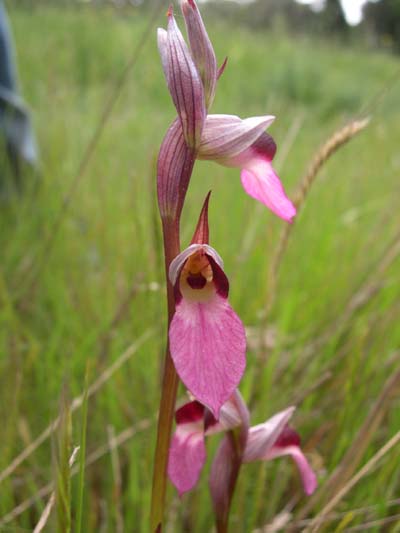
Serapias vomeracea grows in dry and wet meadows, pastures, thickets, clearings, and scrubland, frequently on clayey substrates. It is distinguished by its elongated flower spike and large, hairy, brick-red labellum.
Written 27 November 2026 from the sources listed below. Each statement was checked against the passage it cites; statements that could not be supported were removed.
Appearance
The species varies considerably in coloration and shape. Its green stem bears two membranous basal leaves and six to eight glossy lanceolate upper leaves, which may be green or reddish.[1][2]
The inflorescence consists of an elongated, narrow spike bearing three to ten flowers. The lanceolate floral bracts are substantially longer than the tepals and are red-purple with darker longitudinal veins.[3][4]
The erect outer tepals form a helmet-like structure and are purple-red or pinkish with darker veins. The internal lateral tepals are brownish-purple and almost completely concealed by this structure.[5][6]
The labellum is brick red, trilobed, and larger than the other tepals. Its concave basal portion is enclosed within the floral helmet and has two raised, hairy lateral lobes.[7][8]
The apical portion of the labellum is triangular-lanceolate, usually purple-red, and quite hairy.[9]
The plant typically reaches 20–40 centimetres in height and can grow to a maximum of 60 centimetres.[10]
Habitat
The species occurs in dry and wet meadows and inhabits pastures, thickets, clearings, and scrubland. It frequently grows on clayey substrates.[11][12][13]
It grows in conditions ranging from full light to partial shade and occurs at elevations between sea level and 1,200 metres.[14][15]
Reproduction and life cycle
The species flowers between March and June. It is pollinated by insects but does not produce nectar as a floral reward.[16][17]
Its flower shape attracts pollinators by providing a small tubular shelter. Insects acquire pollen on their bodies while using the flowers as shelters and transfer pollen to other flowers when they leave.[18][19][20]
The species is mainly pollinated by beetles belonging to the Oedemeridae and Lymexylidae families. Bees belonging to the genera Ceratina, Eucera, and Osmia also pollinate it.[21][22]
The species disperses its seeds through the wind.[23]
Classification of the Long-lipped Tongue-orchid
| Kingdom | Plantae |
|---|---|
| Subkingdom | Pteridobiotina |
| Phylum | Tracheophyta |
| Class | Liliopsida |
| Order | Asparagales |
| Family | Orchidaceae (Orchid) |
| Genus | Serapias (Tongue Orchids) |
| Species | Serapias vomeracea (Burm.f.) Briq. |
Where the Long-lipped Tongue-orchid is found
Checklists and occurrence records place Serapias vomeracea in 24 countries across Africa, Asia and Europe. GBIF holds 24,879 georeferenced records of it.
Countries
- Albania 38
- Algeria 3
- Austria 13
- Bulgaria 20
- Croatia 98
- Cyprus 50
- France 20,616
- Georgia 25
- Germany 5
- Greece 372
- Israel 44
- Italy 2,157
- Lebanon 32
- Montenegro 54
- Morocco 4
- Portugal 17
- Russia 24
- Slovenia 22
- Spain 479
- Switzerland 675
- Syria 20
- The Netherlands 14
- Turkey 94
- United Kingdom 3
Regions and cities with the most records
- Occitanie, France 12,488
- Provence-Alpes-Côte d'Azur, France 3,520
- Toulouse, France 1,317
- Blagnac, France 1,303
- Colomiers, France 1,302
- Balma, France 1,257
- Cugnaux, France 1,239
- Tournefeuille, France 1,212
- Plaisance-du-Touch, France 1,169
- Muret, France 1,123
- Auvergne-Rhône-Alpes, France 1,032
- Fréjus, France 883
- Carcassonne, France 878
- Castelnau-le-Lez, France 783
- Mandelieu-la-Napoule, France 774
- Lunel, France 751
- Saint-Raphaël, France 713
- La Valette-du-Var, France 674
- Mauguio, France 670
- Montpellier, France 648
- Draguignan, France 638
- La Crau, France 637
- Mougins, France 637
- Toulon, France 624
- Ticino, Switzerland 620
- Grasse, France 609
- Cannes, France 605
- Le Cannet, France 602
- La Garde, France 581
- Avignon, France 570
- Locarno, Switzerland 552
- Villeneuve-sur-Lot, France 515
- Bellinzona, Switzerland 506
- Sorgues, France 489
- Lattes, France 486
- Hyères, France 484
A number beside a place is its count of GBIF occurrence records. A place without a number comes from a checklist alone. Records show where a species has been observed or collected, which can include escapes and vagrants.
Common names
English
- Long-lipped Tongue-orchid
- Long-lipped Serapias
Names in 12 other languages
- Catalan
- Gall llengut
- Czech
- serapie nachová
- Danish
- Langlæbet Serapias
- Dutch
- Lange tongorchis
- Finnish
- kehtokirkiö
- French
- Sérapias en soc, Sérapias à labelle allongé, Sérapias à labelle alongé à longs pétales, Sérapias à labelle long
- German
- Pflugschar-Zungenstendel
- Italian
- Serapide maggiore
- Russian
- Серапиас сошниковый
- Slovenian
- velecvetni ralovec
- Spanish
- Serapias de labio alargado
- Turkish
- Sağırkulağı
Synonyms
29 other scientific names have been used for this species and are now treated as synonyms of Serapias vomeracea.
- Helleborine longipetala Ten.
- Helleborine pseudocordigera Sebast.
- Helleborine pseudorordigera Sebast.
- Lonchitis longipetala Bubani
- Orchis vomeracea Burm.f.
- Serapias artemisiae (W.Hahn, Kreutz & Passin) Kreutz
- Serapias cordigera subsp. vomeracea (Burm.f.) H.Sund.
- Serapias cordigera var. longipetala Bertol.
- Serapias guadarramica (Kreutz) Kreutz
- Serapias hirsuta Lapeyr.
- Serapias lancifera St.-Amans
- Serapias longipetala (Ten.) Pollini
- Serapias longipetala var. pallidiflora Tod.
- Serapias orientalis var. cordigeroides E.Nelson
- Serapias pseudocordigera (Sebast.) Moric.
- Serapias pseudocordigera subsp. pallidiflora (Tod.) Arcang.
- Serapias vomeracea f. artemisiae (W.Hahn, Kreutz & Passin) P.Delforge
- Serapias vomeracea f. stenopetala Vierh.
- Serapias vomeracea lusus heldreichii Soó
- Serapias vomeracea subsp. artemisiae W.Hahn, Kreutz & Passin
- Serapias vomeracea subsp. flava Balayer
- Serapias vomeracea subsp. guadarramica Kreutz
- Serapias vomeracea subsp. longipetala (Ten.) H.Baumann & Künkele
- Serapias vomeracea var. cordigeroides (E.Nelson) N.R.Campb. & A.K.Campb.
- Serapias vomeracea var. guadarramica (Kreutz) P.Delforge
- Serapias vomeracea var. longipetala (Ten.) Kreutz
- Serapiastrum longipetalum (Ten.) A.A.Eaton
- Serapiastrum vomeraceum (Burm.f.) Schinz & Thell.
- Orchis lingua All. ambiguous synonym
Subspecies and varieties
- Serapias vomeracea subsp. vomeracea subspecies
Related species
-
 Tongue-orchidSerapias lingua
-
 Small-flowered Tongue-orchidSerapias parviflora
-
 Neglected SerapiasSerapias neglecta
-
 Eastern Tongue OrchidSerapias orientalis
-
 Greek PlowshareSerapias bergonii
-
 Sérapias de la NurraSerapias nurrica
-
 Politis' Tongue OrchidSerapias politisii
-
 Narrow-Flowered Tongue OrchidSerapias strictiflora
Compare
Questions and answers
What is the scientific name of the Long-lipped Tongue-orchid?
The scientific name of the Long-lipped Tongue-orchid is Serapias vomeracea. Written with its author, the full name is Serapias vomeracea (Burm.f.) Briq..
Which family does the Long-lipped Tongue-orchid belong to?
Serapias vomeracea belongs to the family Orchidaceae, in the order Asparagales and the class Liliopsida.
Where is the Long-lipped Tongue-orchid found?
Checklists and occurrence records place Serapias vomeracea in 24 countries, including France, Italy, Switzerland, Spain, Greece and Croatia.
What other names does the Long-lipped Tongue-orchid have?
Serapias vomeracea is also known in English as Long-lipped Serapias.
Sources
Passages the profile rests on
- The species varies considerably in its coloration and shape. Source passage: “This species is highly variable in color and shape.” — English Wikipedia
- Its green stem bears two membranous basal leaves and six to eight glossy lanceolate upper leaves that may be green or reddish. Source passage: “The stem is green, with two membranous basal leaves and 6-8 upper leaves, lanceolate and glossy green or reddish.” — English Wikipedia
- Its inflorescence consists of an elongated, narrow spike bearing three to ten flowers. Source passage: “The inflorescence is composed by a narrow and elongated spike, with three to ten flowers.” — English Wikipedia
- The floral bracts are lanceolate, substantially longer than the tepals, and red-purple with darker longitudinal veins. Source passage: “The relevant bracts are lanceolate and much longer than the tepals. Their color is red-purple, with darker longitudinal venation.” — English Wikipedia
- The erect outer tepals form a helmet-like structure and are purple-red or pinkish with darker veins. Source passage: “The outer tepals are lanceolate and erect, forming a helmet-like structure. Their color is purple-red or pinkish, with veins of darker color.” — English Wikipedia
- The internal lateral tepals are brownish-purple and almost completely concealed by the helmet-like structure. Source passage: “The internal lateral tepals are brownish-purple and almost entirely hidden by the helmet.” — English Wikipedia
- The labellum is brick red, trilobed, and larger than the other tepals. Source passage: “The labellum is brick red, trilobed and larger than the other tepals.” — English Wikipedia
- The basal portion of the labellum is concave, enclosed within the floral helmet, and has two raised, hairy lateral lobes. Source passage: “The basal portion (hypochile) of the labellum is concave and enclosed in the helmet, with two raised and hairy lateral lobes.” — English Wikipedia
- The apical portion of the labellum is triangular-lanceolate, usually purple-red, and quite hairy. Source passage: “The apical portion of the labellum (epichile) is triangular-lanceolate, usually purple-red and quite hairy.” — English Wikipedia
- The plant typically reaches 20–40 centimetres in height and can grow to a maximum of 60 centimetres. Source passage: “It reaches a height of 20–40 centimetres (7.9–15.7 in), with a maximum of 60 centimetres (24 in).” — English Wikipedia
- The species occurs in dry and wet meadows. Source passage: “This orchid prefers dry and wet meadows, pastures, thickets, clearings and scrubland” — English Wikipedia
- The species inhabits pastures, thickets, clearings, and scrubland. Source passage: “pastures, thickets, clearings and scrubland” — English Wikipedia
- The species frequently grows on clayey substrates. Source passage: “frequently on clayey substrate” — English Wikipedia
- The species grows in conditions ranging from full light to partial shade. Source passage: “from full light to partial shade” — English Wikipedia
- The species occurs at elevations between sea level and 1,200 metres. Source passage: “at an altitude of 0–1,200 metres (0–3,937 ft) above sea level.” — English Wikipedia
- The species flowers between March and June. Source passage: “The flowering period extends from March to June.” — English Wikipedia
- The species is pollinated by insects but does not produce nectar as a floral reward. Source passage: “Serapias vomeracea is an entomophilous plant, but cannot offer floral rewards to pollinators as it does not produce nectar.” — English Wikipedia
- Its flower shape attracts pollinators by providing a small tubular shelter. Source passage: “Therefore, pollinators are just attracted by the shape of the flower, forming a small tube used by insects to rest by night or as a refuge against the rain.” — English Wikipedia
- Insects acquire pollen on their bodies while using the flowers as shelters. Source passage: “In this process pollen gets stuck to the pollinators' bodies.” — English Wikipedia
- Pollinators transfer pollen to other flowers when they leave their shelters. Source passage: “Once they leave their shelter, they will deposit the pollen on other flowers and fertilize them.” — English Wikipedia
- The species is mainly pollinated by beetles belonging to the Oedemeridae and Lymexylidae families. Source passage: “These orchids are mainly pollinated by some beetles (families Oedemeridae and Lymexylidae)” — English Wikipedia
- Bees belonging to the genera Ceratina, Eucera, and Osmia also pollinate the species. Source passage: “and by bees (genera Ceratina, Eucera and Osmia).” — English Wikipedia
- The species disperses its seeds through the wind. Source passage: “Seeds are dispersed by the wind (anemochory).” — English Wikipedia
Data
- Catalogue of Life, 2026-10-16 XR cc by
- Global Biodiversity Information Facility CC BY 4.0
- Wikidata CC0
- GeoNames CC BY 4.0
- Wikimedia Commons per image; credit shown with each image
- Within the Catalogue of Life, this name comes from The World Checklist of Vascular Plants (WCVP) cc by
References
- Prodr. Fl. Corse 1: 378 (1910) where the name was published
This species in other databases
Page built on 28 November 2026. See how the catalog is made and all sources and licences.
Cite this page
ScientificNames.org. (2026). Serapias vomeracea (Long-lipped Tongue-orchid). Retrieved November 28, 2026, from https://scientificnames.org/species/serapias-vomeracea
“Serapias vomeracea (Long-lipped Tongue-orchid).” ScientificNames.org, 2026, scientificnames.org/species/serapias-vomeracea. Accessed 28 Nov. 2026.
ScientificNames.org. “Serapias vomeracea (Long-lipped Tongue-orchid).” Accessed November 28, 2026. https://scientificnames.org/species/serapias-vomeracea.
@misc{scientificnames_serapias_vomeracea_long_lipped_tongue_orchid,
  author = {{ScientificNames.org}},
  title = {Serapias vomeracea (Long-lipped Tongue-orchid)},
  year = {2026},
  url = {https://scientificnames.org/species/serapias-vomeracea},
  note = {Accessed 2026-11-28}
}