Species · Fishes
Queenfish Seriphus politus
The scientific name of the Queenfish is Seriphus politus. It is a species of fish in the family Sciaenidae (drums), order Perciformes. The name dates from 1860.
- Scientific name
- Seriphus politus Ayres, 1860
- Common name
- Queenfish
- Genus
- Seriphus
- Family
- Sciaenidae (Drums)
- Order
- Perciformes
- Class
- Teleostei
- Red List category
- LC Least Concern
- Environment
- marine
- Recorded in
- 2 countries
- Name status
- accepted in the Catalogue of Life

Overview
Seriphus politus inhabits coastal marine waters, including bays, sloughs, sandy bottoms, and tidal lagoons. It has an elongated, laterally compressed body, blue-grey to tan upper coloration, a silver belly, and a dark horizontal line along its body.
Written 26 November 2026 from the sources listed below. Each statement was checked against the passage it cites; statements that could not be supported were removed.
Similar species
Seriphus lavenbergi is a fossil relative of Queenfish.[1]
Appearance
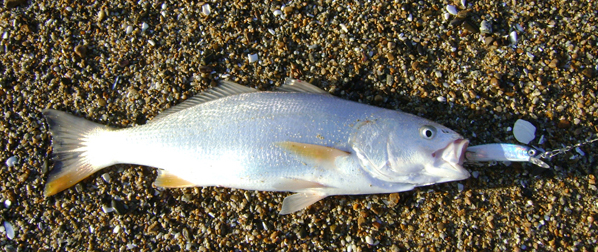
Queenfish has an elongated, laterally compressed body. Its upper body ranges from blue-grey to tan, and its belly is bright silver.[2][3]
A dark horizontal line extends along the length of its body, and additional dark lines run along its scale rows. Its pectoral fin is dark, especially at the base, while the other fins are yellowish.[4][5][6][7]
Its mouth is large, slightly oblique, and opens at the front, with a slightly projecting lower jaw. It contains one or two rows of pointed teeth but has no large canine teeth.[8][9][10]
The forehead profile is straight to slightly concave. The chin has two pores, and the species lacks barbels.[11][12]
Queenfish has 25–27 moderately long, slender gill rakers. The preopercle border ranges from smooth to serrated.[13][14]
The first dorsal fin is short and separated from the soft dorsal portion by a large gap. The anal fin has a long base and short, thin spines, and the tail is slightly concave.[15][16][17]
Its body scales are rough, while its head scales are smooth. The soft dorsal and anal fins are completely scaled, and it has 59–64 lateral-line scales.[18][19][20]
The maximum reported length is 30 centimetres.[21]
Habitat
Queenfish inhabits coastal marine waters, including bays and sloughs. Its habitat includes sandy bottoms, bays, and tidal lagoons.[22][23]
It moves into deeper waters at night.[24]
Diet
Queenfish feeds on marine invertebrates and small fish. Adults feed on Californian anchovy (Engraulis mordax).[25][26]
Juveniles consume planktonic crustaceans, including copepods.[27]
Behaviour
Queenfish forms schools.[28]
Reproduction and life cycle
The estimated annual fecundity is 300,000 eggs.[29]
Conservation
Queenfish is not considered threatened. Population information for the species is limited.[30][31]
Uses
Queenfish is commonly caught in sport fishing from Southern California piers.[32]
Classification of the Queenfish
| Kingdom | Animalia |
|---|---|
| Phylum | Chordata |
| Subphylum | Vertebrata |
| Infraphylum | Gnathostomata |
| Parvphylum | Osteichthyes |
| Gigaclass | Actinopterygii |
| Superclass | Actinopteri |
| Class | Teleostei (Teleost) |
| Order | Perciformes |
| Suborder | Percoidei |
| Family | Sciaenidae (Drums) |
| Genus | Seriphus |
| Species | Seriphus politus Ayres, 1860 |
Where the Queenfish is found
Checklists and occurrence records place Seriphus politus in 2 countries. GBIF holds 4,460 georeferenced records of it.
Countries
Regions and cities with the most records
- Dana Point, United States 1,011
- San Clemente, United States 1,007
- San Juan Capistrano, United States 955
- Torrance, United States 945
- Redondo Beach, United States 919
- Gardena, United States 902
- Hermosa Beach, United States 895
- Manhattan Beach, United States 885
- El Segundo, United States 884
- Lawndale, United States 879
- Hawthorne, United States 872
- West Carson, United States 828
- Lomita, United States 825
- Inglewood, United States 818
- Lennox, United States 818
- Westmont, United States 816
- Carson, United States 812
- Rancho Palos Verdes, United States 776
- Willowbrook, United States 698
- Newport Beach, United States 601
- Huntington Beach, United States 579
- Compton, United States 575
- Seal Beach, United States 573
- Fountain Valley, United States 567
- California, United States 560
- Westminster, United States 546
- Garden Grove, United States 519
- Costa Mesa, United States 517
- Santa Monica, United States 461
- Florence-Graham, United States 456
- Irvine, United States 441
- Santa Ana, United States 399
- East Rancho Dominguez, United States 398
- Lynwood, United States 329
- Port Hueneme, United States 329
- Oxnard, United States 328
A number beside a place is its count of GBIF occurrence records. A place without a number comes from a checklist alone. Records show where a species has been observed or collected, which can include escapes and vagrants.
Common names
English
- Queenfish
- Drum
- Queen Croaker
Names in 5 other languages
- Czech
- smuha uhlazená
- French
- Courbine Reine, tambour royal
- Portuguese
- Corvina-rainha
- Russian
- Кинфиш
- Spanish
- Corvina Reina, corvineta reina
Related species
-
 Red DrumSciaenops ocellatus
-
 TotoabaTotoaba macdonaldi
-
 Freshwater DrumAplodinotus grunniens
-
 Atlantic CroakerMicropogonias undulatus
-
 MeagreArgyrosomus regius
-
 MullowayArgyrosomus japonicus
-
 Black DrumPogonias cromis
-
 Corvina DrumCilus gilberti
Compare
Questions and answers
What is the scientific name of the Queenfish?
The scientific name of the Queenfish is Seriphus politus. Written with its author, the full name is Seriphus politus Ayres, 1860.
Which family does the Queenfish belong to?
Seriphus politus belongs to the family Sciaenidae, in the order Perciformes and the class Teleostei.
Where is the Queenfish found?
Checklists and occurrence records place Seriphus politus in 2 countries: United States and Mexico.
What is the conservation status of the Queenfish?
The IUCN Red List category recorded for Seriphus politus is Least Concern (LC).
What other names does the Queenfish have?
Seriphus politus is also known in English as Drum and Queen Croaker.
What is a queenfish?
Queenfish is Seriphus politus Ayres, 1860, a fish in the family Sciaenidae. It is the only extant species in the genus Seriphus.[33]
Sources
Passages the profile rests on
- Seriphus lavenbergi is a fossil relative of this species. Source passage: “A fossil relative, S. lavenbergi, is known from the Late Miocene-aged Puente Formation of the Los Angeles Basin.” — English Wikipedia
- The species has an elongated, laterally compressed body. Source passage: “It has an elongated, compressed body.” — English Wikipedia
- Its upper body is blue-grey to tan, and its belly is bright silver. Source passage: “Blue grey to tan upper body; belly bright silver;” — biogeodb.stri.si.edu
- A dark horizontal line extends along the length of its body. Source passage: “a dark horizontal line running the length of the body.” — English Wikipedia
- The pectoral fin is dark, while the other fins are yellowish. Source passage: “The pectoral fin is dark and the other fins are yellowish.” — English Wikipedia
- Its sides have dark lines running along the scale rows. Source passage: “sides with dark lines along scale rows;” — biogeodb.stri.si.edu
- Its pectoral fin is dark, with especially dark coloration at the base. Source passage: “pectoral dark, darker on base;” — biogeodb.stri.si.edu
- Its mouth contains one or two rows of pointed teeth. Source passage: “The mouth contains one or two rows of pointed teeth.” — English Wikipedia
- Its mouth is large, slightly oblique, and opens at the front, with a slightly projecting lower jaw. Source passage: “mouth large, slightly oblique, opens at front, lower jaw slightly projecting;” — biogeodb.stri.si.edu
- The species has no large canine teeth. Source passage: “teeth pointed, 1-2 rows, no large canines;” — biogeodb.stri.si.edu
- The forehead profile is straight to slightly concave. Source passage: “forehead profile straight to slightly concave;” — biogeodb.stri.si.edu
- It has two pores on its chin and lacks barbels. Source passage: “2 pores on chin, no barbels;” — biogeodb.stri.si.edu
- It has 25–27 moderately long, slender gill rakers. Source passage: “25-27 gill rakers, moderately long, slender;” — biogeodb.stri.si.edu
- The preopercle border ranges from smooth to serrated. Source passage: “preopercle border smooth to serrated;” — biogeodb.stri.si.edu
- The first dorsal fin is short and separated from the soft dorsal portion by a large gap. Source passage: “1st dorsal short, separated from soft part (18-21) by large gap;” — biogeodb.stri.si.edu
- The anal fin has a long base and short, thin spines. Source passage: “anal base long, spines short, thin;” — biogeodb.stri.si.edu
- Its tail is slightly concave. Source passage: “tail slightly concave;” — biogeodb.stri.si.edu
- Its body scales are rough, whereas its head scales are smooth. Source passage: “scales rough on body, smooth on head;” — biogeodb.stri.si.edu
- The soft dorsal and anal fins are completely scaled. Source passage: “soft dorsal and anal entirely scaled;” — biogeodb.stri.si.edu
- The species has 59–64 lateral-line scales. Source passage: “59-64 lateral line scales.” — biogeodb.stri.si.edu
- The species reaches a maximum reported length of 30 centimetres. Source passage: “This species is up to 30 centimetres (12 in) long.” — English Wikipedia
- The species inhabits coastal marine waters, including bays and sloughs. Source passage: “This marine fish occurs in coastal waters, such as bays and sloughs,” — English Wikipedia
- Its habitat includes sandy bottoms, bays, and tidal lagoons. Source passage: “Habitat: sandy bottoms, bays and tidal lagoons.” — biogeodb.stri.si.edu
- The species moves into deeper waters at night. Source passage: “moving to deeper waters at night.” — English Wikipedia
- The species feeds on marine invertebrates and small fish. Source passage: “It feeds on marine invertebrates and small fish.” — English Wikipedia
- Adults feed on Californian anchovy (Engraulis mordax). Source passage: “Adults also feed on Californian anchovy (Engraulis mordax).” — English Wikipedia
- Juveniles consume planktonic crustaceans, including copepods. Source passage: “It eats planktonic crustaceans such as copepods when it is a juvenile.” — English Wikipedia
- The species forms schools. Source passage: “This species forms schools.” — English Wikipedia
- The estimated annual fecundity is 300,000 eggs. Source passage: “Annual fecundity = 300,000.” — fishbase.se
- The species is not considered threatened. Source passage: “it is not considered to be threatened.” — English Wikipedia
- Population information for the species is limited. Source passage: “Little population information is available for this species,” — English Wikipedia
- The species is commonly caught in sport fishing from Southern California piers. Source passage: “This is a common sport fishing catch on Southern California fishing piers.” — English Wikipedia
- Seriphus politus is the only extant species in the genus Seriphus. Source passage: “This is the only extant species in the monotypic genus Seriphus.” — English Wikipedia
Data
- Catalogue of Life, 2026-10-16 XR cc by
- Global Biodiversity Information Facility CC BY 4.0
- Wikidata CC0
- GeoNames CC BY 4.0
- Wikimedia Commons per image; credit shown with each image
- Within the Catalogue of Life, this name comes from World Register of Marine Species cc by
References
- Ayres, W. O. (1860). [Description of fishes.]. Proceedings of the California Academy of Sciences(Series 1), v. 2 (1858–1862): 77–81, 81–86. [Pp. 77–81 read at meeting of 5 Nov. 1860, pp. 81–86 on 3 Dec. 1860; assume published in 1860]. where the name was published
This species in other databases
- Catalogue of Life 4WVK6
- Wikidata Q1796044
- iNaturalist 112485
- WoRMS urn:lsid:marinespecies.org:taxname:282761
- ITIS 169362
Page built on 29 November 2026. See how the catalog is made and all sources and licences.
Cite this page
ScientificNames.org. (2026). Seriphus politus (Queenfish). Retrieved November 29, 2026, from https://scientificnames.org/species/seriphus-politus
“Seriphus politus (Queenfish).” ScientificNames.org, 2026, scientificnames.org/species/seriphus-politus. Accessed 29 Nov. 2026.
ScientificNames.org. “Seriphus politus (Queenfish).” Accessed November 29, 2026. https://scientificnames.org/species/seriphus-politus.
@misc{scientificnames_seriphus_politus_queenfish,
  author = {{ScientificNames.org}},
  title = {Seriphus politus (Queenfish)},
  year = {2026},
  url = {https://scientificnames.org/species/seriphus-politus},
  note = {Accessed 2026-11-29}
}