Species · Reptiles
Blue-speckled Forest Skink Silvascincus murrayi
The scientific name of the Blue-speckled Forest Skink is Silvascincus murrayi. It is a species of reptile in the family Scincidae (skink), order Squamata. The name dates from 1887.
- Scientific name
- Silvascincus murrayi (Boulenger, 1887)
- Common name
- Blue-speckled Forest Skink
- Genus
- Silvascincus
- Family
- Scincidae (Skink)
- Order
- Squamata
- Class
- Reptilia
- Recorded in
- 1 country
- Name status
- accepted in the Catalogue of Life

Overview
Silvascincus murrayi occurs in northeastern New South Wales and southeastern Queensland. Its flanks are black with yellow dots and fine bluish-white speckles.
Written 27 November 2026 from the sources listed below. Each statement was checked against the passage it cites; statements that could not be supported were removed.
Appearance
The dorsal coloration ranges from golden brown to coppery brown, with black scale edges and black flecks. The flanks are black and feature yellow dots and fine bluish-white speckles.[1][2]
The ventral coloration is pale yellow. Adults have an average snout-to-vent length of approximately 11 cm.[3][4]
Habitat
The species' preferred natural habitat is forest.[5]
Reproduction and life cycle
The species has been described as viviparous and ovoviviparous. Litter sizes range from three to five neonates.[6][7][8]
Classification of the Blue-speckled Forest Skink
| Kingdom | Animalia |
|---|---|
| Phylum | Chordata |
| Subphylum | Vertebrata |
| Infraphylum | Gnathostomata |
| Parvphylum | Osteichthyes |
| Megaclass | Tetrapoda |
| Class | Reptilia (Reptile) |
| Order | Squamata (Snakes) |
| Suborder | Autarchoglossa |
| Family | Scincidae (Skink) |
| Subfamily | Sphenomorphinae |
| Genus | Silvascincus (Silvascincus Forest Skinks) |
| Species | Silvascincus murrayi (Boulenger, 1887) |
Where the Blue-speckled Forest Skink is found
Checklists and occurrence records place Silvascincus murrayi in 1 country across Oceania. GBIF holds 2,762 georeferenced records of it.
Countries
Regions and cities with the most records
- New South Wales, Australia 2,030
- Queensland, Australia 706
- Coffs Harbour, Australia 62
- Taree, Australia 11
- Sunshine Coast, Australia 8
- Caloundra, Australia 4
Range as the checklists state it
Australia (New South Wales, Queensland)
A number beside a place is its count of GBIF occurrence records. A place without a number comes from a checklist alone. Records show where a species has been observed or collected, which can include escapes and vagrants.
Common names
English
- Blue-speckled Forest Skink
- Blue-speckled Forest-skink
- Murray's Skink
Synonyms
6 other scientific names have been used for this species and are now treated as synonyms of Silvascincus murrayi.
- Concinnia murrayi (Boulenger, 1887)
- Eulamprus murrayi (Boulenger, 1887)
- Karma murrayi (Boulenger, 1887)
- Lygosoma (Hinulia) tenuis intermedius Kinghorn, 1932
- Lygosoma murrayi Boulenger, 1887
- Lygosoma tamburinense Lönnberg & Andersson, 1915
Related species
- Border Ranges Blue-spectacled SkinkSilvascincus tryoni
-
 ShinglebackTiliqua rugosa
-
 Five-lined SkinkPlestiodon fasciatus
- Common Garden SkinkLampropholis guichenoti
-
 Blue-tailed SkinkCryptoblepharus egeriae
-
 Red-eyed Crocodile SkinkTribolonotus gracilis
-
 Common Blue-tongued SkinkTiliqua scincoides
-
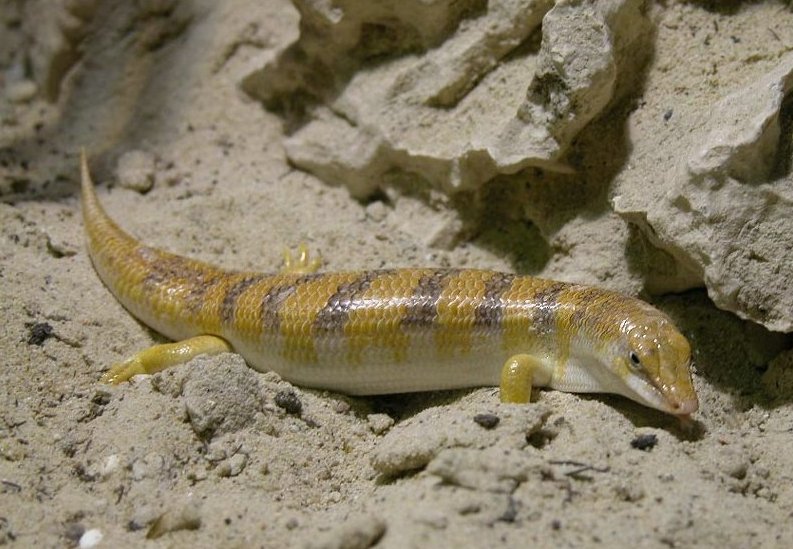 Sandfish SkinkScincus scincus
Compare
Questions and answers
What is the scientific name of the Blue-speckled Forest Skink?
The scientific name of the Blue-speckled Forest Skink is Silvascincus murrayi. Written with its author, the full name is Silvascincus murrayi (Boulenger, 1887).
Which family does the Blue-speckled Forest Skink belong to?
Silvascincus murrayi belongs to the family Scincidae, in the order Squamata and the class Reptilia.
Where is the Blue-speckled Forest Skink found?
Checklists and occurrence records place Silvascincus murrayi in 1 country: Australia.
What other names does the Blue-speckled Forest Skink have?
Silvascincus murrayi is also known in English as Blue-speckled Forest-skink and Murray's Skink.
What habitats do skinks live in?
The Blue-speckled Forest Skink's preferred natural habitat is forest.[5]
Sources
Passages the profile rests on
- The dorsal coloration ranges from golden brown to coppery brown, with black scale edges and black flecks. Source passage: “Dorsally, it is golden brown to coppery brown, with black scale edges and black flecks.” — English Wikipedia
- The flanks are black and feature yellow dots and fine bluish-white speckles. Source passage: “The flanks are black with yellow dots and fine bluish white speckles.” — English Wikipedia
- The ventral coloration is pale yellow. Source passage: “Ventrally, it is pale yellow.” — English Wikipedia
- Adults have an average snout-to-vent length of approximately 11 cm. Source passage: “Adults of Silvascincus murrayi have an average snout-to-vent length (SVL) of about 11 cm (4.3 in).” — English Wikipedia
- The species' preferred natural habitat is forest. Source passage: “The preferred natural habitat of Silvascincus murrayi is forest.” — English Wikipedia
- The species has been described as viviparous. Source passage: “The mode of reproduction of Silvacincus murrayi has been described as viviparous and as ovoviviparous.” — English Wikipedia
- The species has also been described as ovoviviparous. Source passage: “The mode of reproduction of Silvacincus murrayi has been described as viviparous and as ovoviviparous.” — English Wikipedia
- Litter sizes range from three to five neonates. Source passage: “Litter size is three to five neonates.” — English Wikipedia
Data
- Catalogue of Life, 2026-10-16 XR cc by
- Global Biodiversity Information Facility CC BY 4.0
- Wikidata CC0
- GeoNames CC BY 4.0
- Wikimedia Commons per image; credit shown with each image
- Within the Catalogue of Life, this name comes from The Reptile Database cc by
References
- Boulenger, G. A. (1887). Catalogue of the lizards in the British Museum (Nat. Hist.) III. Lacertidae, Gerrhosauridae, Scincidae, Anelytropsidae, Dibamidae, Chamaeleontidae. London: 575 Pp.
- Lönnberg, E., & Andersson, G. L. (1915). Results of Dr. E. Mjöberg’s Swedish Scientific Expeditions to Australia 1910-1913. VII. Reptiles collected in northern Queensland. Kungl. Svenska Vetensk. -Akad. Hand]. 52 (7): 1-9.
- Kinghorn, J. R. (1932). Herpetological notes 4. Rec. Austral. Mus. 18: 335-363.
- Cogger, H. G. (2000). Reptiles and Amphibians of Australia, 6th ed. Ralph Curtis Publishing, Sanibel Island, 808 Pp.
- Reeder, T. W. (2003). A phylogeny of the Australian Sphenomorphus group (Scincidae: Squamata) and the phylogenetic placement of the crocodile skinks (Tribolonotus): Bayesian approaches to assessing congruence and obtaining confidence in maximum likelihood inferred relationships. Molecular Phylogenetics and Evolution 27: 384–397.
- Couper, P., Covacevich, J., Amey, A., & Baker, A. (2006). The genera of skinks (Family Scincidae) of Australia and its island territories: diversity, distribution and identification. in: Merrick, J.R., Archer, M., Hickey, G.M. & Lee, M.S.Y. (eds.). Evolution and Zoogeography of Australasian Vertebrates. Australian Scientific Publishing, Sydney, Pp. 367-384.
- Wells, R. W. (2009). Some taxonomic and nomenclatural considerations on the class Reptilia in Australia. A review of the genera Eulamprus and Glaphyromorphus (Scincidae), including the description of new genera and species. Australian Biodiversity Record (3): 1–96.
- Wilson, S., & Swan, G. (2010). A complete guide to reptiles of Australia, 3rd ed. Chatswood: New Holland, 558 Pp.
- Beolens, B., & Michael Watkins, a. M. G. (2011). The Eponym Dictionary of Reptiles. Johns Hopkins University Press, Baltimore, USA.
- Skinner, Adam; Mark N. Hutchinson, Michael S.Y. Lee. (2013). Phylogeny and Divergence Times of Australian Sphenomorphus Group Skinks (Scincidae, Squamata). Molecular Phylogenetics and Evolution 69 (3): 906–918.
- Cogger, H. G. (2014). Reptiles and Amphibians of Australia, 7th ed. CSIRO Publishing, Xxx + 1033 Pp.
- Swan, G., Sadlier, R., & Shea, G. (2017). A field guide to reptiles of New South Wales. Reed New Holland, 328 Pp.
- Singhal, Sonal; Huateng Huang, Maggie R. Grundler, María R. Marchán-Rivadeneira, Iris Holmes, Pascal O. Title, Stephen C. Donnellan, and Daniel L. Rabosky. (2018). Does Population Structure Predict the Rate of Speciation? A Comparative Test across Australia’s Most Diverse Vertebrate Radiation. The American Naturalist 192 (4): 432-447.
- Shea, G. M. (2019). Current status of the genera Karma and Magmellia Wells, 2009 (Scincidae: Lygosominae: Sphenomorphini) with a morphological character to distinguish the two genera. Memoirs of the Queensland Museum – Nature 61: 187–191.
- Hutchinson, M. N., Couper, P., Amey, A., & Worthington-Wilmer, J. (2021). Diversity and Systematics of Limbless Skinks (Anomalopus) from Eastern Australia and the Skeletal Changes that Accompany the Substrate Swimming Body Form. Journal of Herpetology 55 (4): 361-384.
- Uetz, P. H., Patel, M., Gbadamosi, Z., Nguyen, A., & Shoope, S. (2024). A Reference Database of Reptile Images. Taxonomy 4: 723–732.
This species in other databases
Page built on 28 November 2026. See how the catalog is made and all sources and licences.
Cite this page
ScientificNames.org. (2026). Silvascincus murrayi (Blue-speckled Forest Skink). Retrieved November 28, 2026, from https://scientificnames.org/species/silvascincus-murrayi
“Silvascincus murrayi (Blue-speckled Forest Skink).” ScientificNames.org, 2026, scientificnames.org/species/silvascincus-murrayi. Accessed 28 Nov. 2026.
ScientificNames.org. “Silvascincus murrayi (Blue-speckled Forest Skink).” Accessed November 28, 2026. https://scientificnames.org/species/silvascincus-murrayi.
@misc{scientificnames_silvascincus_murrayi_blue_speckled_forest_skink,
  author = {{ScientificNames.org}},
  title = {Silvascincus murrayi (Blue-speckled Forest Skink)},
  year = {2026},
  url = {https://scientificnames.org/species/silvascincus-murrayi},
  note = {Accessed 2026-11-28}
}