Species · Flowering plants
Yacón Smallanthus sonchifolius
The scientific name of the Yacón is Smallanthus sonchifolius. It is a species of flowering plant in the family Asteraceae (composite), order Asterales.
- Scientific name
- Smallanthus sonchifolius (Poepp. & Endl.) H.Rob.
- Common name
- Yacón
- Genus
- Smallanthus
- Family
- Asteraceae (Composite)
- Order
- Asterales
- Class
- Magnoliopsida
- Recorded in
- 8 countries
- Name status
- accepted in the Catalogue of Life
Overview
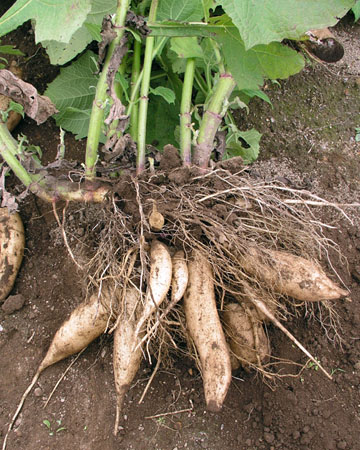
Yacón grows traditionally on the eastern slopes of the Andes toward the Amazon and is cultivated across the northern and central Andes, from Colombia to northern Argentina. Yacón is distinguished by its starchy, sweet, fruit-like storage roots, which are crunchy and contain fructooligosaccharides.
Written 26 November 2026 from the sources listed below. Each statement was checked against the passage it cites; statements that could not be supported were removed.
Appearance
Yacón is a perennial herb with cylindrical to angular stems that become hollow at maturity. Its aerial stems generally grow between two and 2.5 metres tall, and the plants can reach a height of 2.5 metres.[1][2][3]
Yacón has opposite, deltoid leaves with hairy upper surfaces. Its underground root system includes branching rhizomes and as many as 20 tuberous storage roots.[4][5]
Yacón storage roots can reach 25 centimetres in length and 10 centimetres in width, with skin colours ranging from white through pink to brown. They vary in shape and size and have a crunchy texture resembling that of an apple.[6][7][8][9]
The female ray florets are yellow or orange and can reach 12 millimetres in length. The male disc florets are yellow-brown and approximately 7 millimetres long.[10][11]
Habitat
Yacón grows traditionally at mid-elevations on the eastern slopes of the Andes toward the Amazon. It grows well in mild climates with long growing seasons and grows optimally at temperatures between 18 and 25 degrees Celsius.[12][13][14]
Yacón is traditionally cultivated across the northern and central Andes, from Colombia to northern Argentina. Its cultivation has expanded to Kathmandu, southern Australia, Tasmania, and New Zealand.[15][16]
Yacón was introduced to Japan during the 1980s, followed by cultivation in South Korea, China, and the Philippines.[17]
Yacón is cultivated in Argentina, Bolivia, Brazil, the Czech Republic, Ecuador, Italy, Japan, Korea, New Zealand, Peru, and the United States.[18]
Behaviour
Yacón rhizomes continuously produce leafy shoots. Freezing temperatures kill the above-ground parts, but the rhizomes can produce new growth when temperature and moisture conditions become favourable.[19][20]
Reproduction and life cycle
Flowering generally begins six to seven months after planting under favourable environmental conditions. Seeds develop inside dark brown achenes measuring approximately 2.2–3.7 millimetres.[21][22]
Seed production is generally low, and some yacón ecotypes produce no seeds because of pollen sterility. Plants grown from seeds take longer to mature than plants propagated from tubers or rhizomes.[23][24]
Diet
Yacón roots are commonly consumed raw and have a sweet taste. They generally contain more than 70 percent water by fresh weight.[25][26]
Yacón fructooligosaccharides resist enzymatic digestion in the upper gastrointestinal tract and reach the colon intact.[27]
Uses
Yacón tubers can be consumed raw, boiled, dehydrated, or roasted. They can also be processed into beverages, jams, syrup, vinegar, flour, chips, and juice.[28]
Yacón roots are traditionally used in Andean folk medicine for liver and kidney diseases. In Bolivia, yacón is traditionally used to address diabetes and digestive problems.[29][30]
Yacón leaves have demonstrated radical-scavenging, cytoprotective, and antihyperglycemic activities.[31]
Similar species
Yacón is sometimes mistaken for the unrelated legume Pachyrhizus erosus because it is commonly called jicama in Ecuador. It is closely related to sunflower and Jerusalem artichoke.[32][33]
Classification of the Yacón
| Kingdom | Plantae |
|---|---|
| Subkingdom | Pteridobiotina |
| Phylum | Tracheophyta |
| Class | Magnoliopsida |
| Order | Asterales |
| Family | Asteraceae (Composite) |
| Subfamily | Asteroideae |
| Tribe | Millerieae |
| Subtribe | Milleriinae |
| Genus | Smallanthus |
| Species | Smallanthus sonchifolius (Poepp. & Endl.) H.Rob. |
Where the Yacón is found
Checklists and occurrence records place Smallanthus sonchifolius in 8 countries across Asia and South America. GBIF holds 310 georeferenced records of it.
Countries where it is native or its origin is not stated
Countries where it has been introduced
Regions and cities with the most records
- Bogota D.C., Colombia 28
- Cota, Colombia 26
- Funza, Colombia 25
- Bogotá, Colombia 24
- Mosquera, Colombia 20
- Soacha, Colombia 18
- Cajamarca Department, Peru 17
- Paraná, Brazil 16
- Ancash, Peru 12
- Chía, Colombia 12
- Antioquia, Colombia 11
- Bosconia, Colombia 11
- Cajicá, Colombia 11
- Cochabamba, Bolivia 10
- Madrid, Colombia 10
- Cundinamarca, Colombia 9
- Boyacá, Colombia 8
- Loja, Ecuador 8
- Pichincha, Ecuador 8
- Ciudad del Este, Paraguay 7
- Foz do Iguaçu, Brazil 7
- Galápagos, Ecuador 7
- Presidente Franco, Paraguay 7
- Puerto Iguazú, Argentina 7
- Catamayo, Ecuador 6
- Marinilla, Colombia 6
- Quito, Ecuador 6
- Rionegro, Colombia 6
- Santa Cruz Department, Bolivia 6
- Santa Terezinha de Itaipu, Brazil 6
- Atuntaqui, Ecuador 5
- Imbabura, Ecuador 5
- Nariño, Colombia 5
- Otavalo, Ecuador 5
- Pasco, Peru 5
- Pomasqui, Ecuador 5
7 more countries have a few records outside this range
These countries hold a few records of Smallanthus sonchifolius but lie outside the range the checklists give for it. Such records are often zoo or garden specimens, museum material or vagrants, so the species is not counted as occurring there.
Range as the checklists state it
China [I] (Fujian [I], Guizhou [I], Hebei [I], Hubei [I], Hunan [I], Hainan [I], Shandong [I], Yunnan [I], Zhejiang [I]); Taiwan [I]; Colombia (Boyacá, Cauca, Cundinamarca); Ecuador; Peru; Bolivia (Cochabamba, La Paz, Santa Cruz, Tarija)
A number beside a place is its count of GBIF occurrence records. A place without a number comes from a checklist alone. Records show where a species has been observed or collected, which can include escapes and vagrants.
Common names
English
- Yacon
Names in 7 other languages
- Chinese
- 菊薯, 雪蓮果
- Czech
- jakon
- French
- poire de terre
- Japanese
- ヤーコン
- Portuguese
- Batata-yacon
- Slovak
- smalant mliečolistý
- Spanish
- jiquimilla, jícama, jíquima, llacón, yacón
Synonyms
3 other scientific names have been used for this species and are now treated as synonyms of Smallanthus sonchifolius.
- Polymnia edulis Wedd.
- Silphium edule Baill.
- Polymnia sonchifolia Poepp. & Endl. ambiguous synonym
Related species
-
 Hairy LeafcupSmallanthus uvedalia
- Smallanthus pyramidalis
- Smallanthus maculatus
- Smallanthus connatus
- Smallanthus oaxacanus
- Smallanthus riparius
- Smallanthus siegesbeckius
- Smallanthus fruticosus
Compare
Questions and answers
What is the scientific name of the Yacón?
The scientific name of the Yacón is Smallanthus sonchifolius. Written with its author, the full name is Smallanthus sonchifolius (Poepp. & Endl.) H.Rob..
Which family does the Yacón belong to?
Smallanthus sonchifolius belongs to the family Asteraceae, in the order Asterales and the class Magnoliopsida.
Where is the Yacón found?
Checklists and occurrence records place Smallanthus sonchifolius in 8 countries, including Colombia, Peru, Brazil, Ecuador, Bolivia and Argentina.
What does yacon do for the body?
Yacón fructooligosaccharides resist enzymatic digestion in the upper gastrointestinal tract and reach the colon intact. Yacón leaves have demonstrated radical-scavenging, cytoprotective, and antihyperglycemic activities.[27][31]
Is yacon good for the kidneys?
Yacón roots are traditionally used in Andean folk medicine for kidney diseases.[29]
Can you grow yacon in the USA?
Yacón is cultivated in the United States.[18]
Is yacon a fruit or vegetable?
Yacón is a perennial flowering herb. Its underground storage roots are starchy and fruit-like.[1][5][8]
Sources
Passages the profile rests on
- Yacon is a perennial herb with cylindrical to angular stems that become hollow at maturity. Source passage: “The stem is cylindrical to angular and hollow when the plant is mature.” — English Wikipedia
- Yacon plants can reach a height of 2.5 metres. Source passage: “Yacón is a perennial herb that grows up to 2.5 metres (8 feet) tall.” — English Wikipedia
- Yacon aerial stems generally grow between two and 2.5 metres tall. Source passage: “aerial stems about 2 to 2.5 m high.” — pmc.ncbi.nlm.nih.gov
- Yacon has opposite, deltoid leaves with hairy upper surfaces. Source passage: “Leaves are opposite and deltoid. Their upper surface is hairy.” — English Wikipedia
- The underground root system includes branching rhizomes and as many as 20 tuberous storage roots. Source passage: “Underground tubers consist of branching rhizomes and up to 20 tuberous storage roots.” — English Wikipedia
- Yacon storage roots can reach 25 centimetres in length and 10 centimetres in width. Source passage: “The storage roots are up to 25 centimetres (10 inches) long, 10 cm (4 in) wide” — English Wikipedia
- Yacon storage roots vary in skin colour from white through pink to brown. Source passage: “The colour depends on the variety, and ranges from white to pink to brown.” — English Wikipedia
- Yacon produces starchy, fruit-like roots that vary in shape and size. Source passage: “Yacon yields starchy, fruit-like roots of different shapes and sizes” — pmc.ncbi.nlm.nih.gov
- Yacon roots are crunchy and have a texture resembling that of an apple. Source passage: “Their crunchy texture very much resembles that of an apple.” — pmc.ncbi.nlm.nih.gov
- The female ray florets are yellow or orange and can reach 12 millimetres in length. Source passage: “The yellow or orange ray florets are female and up to 12 mm long” — English Wikipedia
- The male disc florets are yellow-brown and approximately 7 millimetres long. Source passage: “the yellow-brown disc florets are male and about 7 mm long.” — English Wikipedia
- Yacon grows traditionally at mid-elevations on the eastern slopes of the Andes toward the Amazon. Source passage: “Traditionally, yacón roots are grown by farmers at mid-elevations on the eastern slopes of the Andes descending toward the Amazon.” — English Wikipedia
- Yacon grows well in mild climates with long growing seasons. Source passage: “where the climate is mild and the growing season long.” — English Wikipedia
- Yacon grows optimally at temperatures between 18 and 25 degrees Celsius. Source passage: “The optimal growing temperature range is 18–25 °C.” — English Wikipedia
- Yacon is traditionally cultivated across the northern and central Andes, from Colombia to northern Argentina. Source passage: “traditionally grown in the northern and central Andes from Colombia to northern Argentina” — English Wikipedia
- Yacon cultivation has expanded to Kathmandu, southern Australia, Tasmania, and New Zealand. Source passage: “It grows well in Kathmandu, Nepal, southern Australia (including Tasmania) and in New Zealand” — English Wikipedia
- Yacon was introduced to Japan during the 1980s, followed by cultivation in South Korea, China, and the Philippines. Source passage: “The plant was introduced to Japan in the 1980s, and from there its cultivation spread to other Asian countries, notably South Korea, China, and the Philippines” — English Wikipedia
- Yacon is cultivated in Argentina, Bolivia, Brazil, the Czech Republic, Ecuador, Italy, Japan, Korea, New Zealand, Peru, and the United States. Source passage: “Yacon is currently cultivated in Argentina, Bolívia, Brazil, the Czech Republic, Ecuador, Italy, Japan, Korea, New Zealand, Peru and the United States [4].” — pmc.ncbi.nlm.nih.gov
- Yacon rhizomes continuously produce leafy shoots. Source passage: “The rhizomes continually produce leafy shoots” — English Wikipedia
- Freezing temperatures kill the above-ground parts of yacon, but its rhizomes can produce new growth when temperature and moisture conditions become favourable. Source passage: “Freezing temperatures cause the above-ground parts to die back; the plant will re-sprout from the rhizome under favourable temperature and moisture conditions.” — English Wikipedia
- Flowering generally begins six to seven months after planting under favourable environmental conditions. Source passage: “If environmental conditions are favourable, flowering begins 6–7 months after planting” — English Wikipedia
- Yacon seeds develop inside dark brown achenes measuring approximately 2.2–3.7 millimetres. Source passage: “The seeds are stored inside dark brown achenes averaging 2.2–3.7 mm in length.” — English Wikipedia
- Seed production is generally low, and some yacon ecotypes produce no seeds because of pollen sterility. Source passage: “In general, seed production is rather low; some ecotypes do not produce any seeds at all, due to pollen sterility.” — English Wikipedia
- Plants grown from seeds take longer to mature than plants propagated from tubers or rhizomes. Source passage: “Plants produced from seed take longer to mature than do those grown from the tubers or rhizomes.” — English Wikipedia
- Yacon roots generally contain more than 70 percent water by fresh weight. Source passage: “Yacon roots’ water content usually exceeds 70% of the fresh weight” — pmc.ncbi.nlm.nih.gov
- Yacon roots are commonly consumed raw and have a sweet taste. Source passage: “usually consumed raw and taste sweet.” — pmc.ncbi.nlm.nih.gov
- Yacon fructooligosaccharides resist enzymatic digestion in the upper gastrointestinal tract and reach the colon intact. Source passage: “FOS are able to escape enzymatic digestion in the upper gastrointestinal tract, reaching the colon intact before undergoing microbial fermentation.” — pmc.ncbi.nlm.nih.gov
- Yacon tubers can be consumed raw, boiled, dehydrated, roasted, or processed into beverages, jams, syrup, vinegar, flour, chips, and juice. Source passage: “The tubers can be eaten raw, boiled, dehydrated, roasted or processed into beverages, jams, syrup, vinegar, flour, chips and juice.” — English Wikipedia
- Yacon roots are traditionally used in Andean folk medicine for liver and kidney diseases. Source passage: “In Andean folk medicine, yacón is used against liver and kidney disease” — English Wikipedia
- Yacon is traditionally used in Bolivia to address diabetes and digestive problems. Source passage: “whereas, in Bolivia, it is used against diabetes and digestive problems.” — English Wikipedia
- Yacon leaves have demonstrated radical-scavenging, cytoprotective, and antihyperglycemic activities. Source passage: “The leaves have been shown to be radical scavenging, cytoprotective and anti-hyperglycemic active.” — English Wikipedia
- Yacon is sometimes mistaken for the unrelated legume Pachyrhizus erosus because it is commonly called jicama in Ecuador. Source passage: “Yacón is sometimes confused with the unrelated Pachyrhizus erosus (jícama), which is a legume, as yacón is commonly called jícama in Ecuador.” — English Wikipedia
- Yacon is closely related to sunflower and Jerusalem artichoke. Source passage: “Yacón, in contrast, is a close relative of the sunflower and Jerusalem artichoke.” — English Wikipedia
Data
- Catalogue of Life, 2026-10-16 XR cc by
- Global Biodiversity Information Facility CC BY 4.0
- Wikidata CC0
- GeoNames CC BY 4.0
- Wikimedia Commons per image; credit shown with each image
- Within the Catalogue of Life, this name comes from Synonymic Checklists of the Vascular Plants of the World cc by
References
- H.Rob. (1978). Phytologia 39(1): 51 (1978). where the name was published
This species in other databases
- Catalogue of Life 4XV8X
- Wikidata Q1075177
- iNaturalist 327644
- World Flora Online wfo-0000081552
- GRIN 402296
Page built on 27 November 2026. See how the catalog is made and all sources and licences.
Cite this page
ScientificNames.org. (2026). Smallanthus sonchifolius (Yacón). Retrieved November 27, 2026, from https://scientificnames.org/species/smallanthus-sonchifolius
“Smallanthus sonchifolius (Yacón).” ScientificNames.org, 2026, scientificnames.org/species/smallanthus-sonchifolius. Accessed 27 Nov. 2026.
ScientificNames.org. “Smallanthus sonchifolius (Yacón).” Accessed November 27, 2026. https://scientificnames.org/species/smallanthus-sonchifolius.
@misc{scientificnames_smallanthus_sonchifolius_yacon,
  author = {{ScientificNames.org}},
  title = {Smallanthus sonchifolius (Yacón)},
  year = {2026},
  url = {https://scientificnames.org/species/smallanthus-sonchifolius},
  note = {Accessed 2026-11-27}
}