Species · Flowering plants
Bear's-foot Smallanthus uvedalia
The scientific name of the Bear's-foot is Smallanthus uvedalia. It is a species of flowering plant in the family Asteraceae (composite), order Asterales.
- Scientific name
- Smallanthus uvedalia (L.) Mack. ex Small
- Common name
- Bear's-foot
- Genus
- Smallanthus
- Family
- Asteraceae (Composite)
- Order
- Asterales
- Class
- Magnoliopsida
- Recorded in
- 8 countries
- Name status
- accepted in the Catalogue of Life

Overview
Smallanthus uvedalia, known as hairy leafcup, bear's foot, and yellow flower leafcup, is a herbaceous perennial native to the Central and Eastern United States. It is a member of the family Asteraceae.
Classification of the Bear's-foot
| Kingdom | Plantae |
|---|---|
| Subkingdom | Pteridobiotina |
| Phylum | Tracheophyta |
| Class | Magnoliopsida |
| Order | Asterales |
| Family | Asteraceae (Composite) |
| Subfamily | Asteroideae |
| Tribe | Millerieae |
| Subtribe | Milleriinae |
| Genus | Smallanthus |
| Species | Smallanthus uvedalia (L.) Mack. ex Small |
Where the Bear's-foot is found
Checklists and occurrence records place Smallanthus uvedalia in 8 countries across Asia and North America. GBIF holds 11,885 georeferenced records of it.
Countries where it is native or its origin is not stated
Countries where it has been introduced
Regions and cities with the most records
- North Carolina, United States 1,373
- Virginia, United States 1,191
- Tennessee, United States 1,039
- Georgia, United States 824
- Florida, United States 574
- Alabama, United States 572
- Texas, United States 508
- Arkansas, United States 496
- South Carolina, United States 434
- Durham, United States 394
- Carrboro, United States 390
- Chapel Hill, United States 389
- Kentucky, United States 347
- Maryland, United States 318
- Springfield, United States 315
- Franconia, United States 307
- Rose Hill, United States 306
- Woodlawn, United States 303
- West Springfield, United States 302
- Fort Hunt, United States 299
- Hybla Valley, United States 299
- Lorton, United States 296
- Annandale, United States 278
- Baileys Crossroads, United States 278
- Brookhaven, United States 275
- Lincolnia, United States 274
- Chamblee, United States 271
- Fort Washington, United States 262
- Dunwoody, United States 259
- West Falls Church, United States 258
- Arlington, United States 257
- Sandy Springs, United States 257
- North Druid Hills, United States 245
- Idylwood, United States 242
- Merrifield, United States 241
- Foggy Bottom, United States 239
1 more country has a few records outside this range
These countries hold a few records of Smallanthus uvedalia but lie outside the range the checklists give for it. Such records are often zoo or garden specimens, museum material or vagrants, so the species is not counted as occurring there.
Range as the checklists state it
China [I] (Anhui [I], Jiangsu [I]); USA (Alabama, Arkansas, Delaware, District of Columbia, Florida, Georgia, Illinois, Indiana, Kansas, Kentucky, Louisiana, Maryland, Michigan, Mississippi, Missouri, New Jersey, New York, North Carolina, Ohio, Oklahoma, Pennsylvania, South Carolina, Tennessee, Texas, Virginia, West Virginia); Bermuda [I]; Mexico (Sonora, Oaxaca, Nuevo León, Coahuila, etc.); Belize; Costa Rica
A number beside a place is its count of GBIF occurrence records. A place without a number comes from a checklist alone. Records show where a species has been observed or collected, which can include escapes and vagrants.
Common names
English
- Bear's-foot
- Hairy Leafcup
- Bear's Foot
- Yellow Bear's-foot
- Yellow Leaf-cup
- Yellow-flower Leaf-cup
Names in 1 other language
- Spanish
- Pata de oso
Synonyms
7 other scientific names have been used for this species and are now treated as synonyms of Smallanthus uvedalia.
- Osteospermum uvedalia L.
- Polymnia macrophylla Raf.
- Polymnia uvedalia (L.) L.
- Polymnia uvedalia var. densipilis S.F.Blake
- Polymnia uvedalia var. floridana S.F.Blake
- Polymnia uvedalia var. uvedalia
- Polymniastrum uvedalia (L.) Small
Related species
-
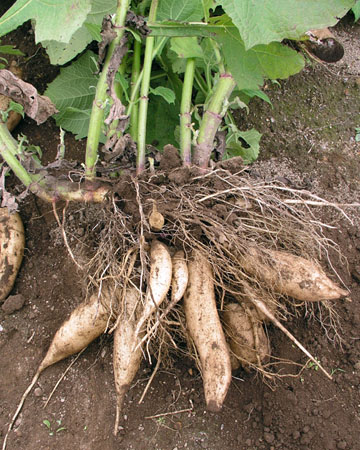 YacónSmallanthus sonchifolius
- Smallanthus pyramidalis
- Smallanthus maculatus
- Smallanthus connatus
- Smallanthus oaxacanus
- Smallanthus riparius
- Smallanthus siegesbeckius
- Smallanthus fruticosus
Compare
Questions and answers
What is the scientific name of the Bear's-foot?
The scientific name of the Bear's-foot is Smallanthus uvedalia. Written with its author, the full name is Smallanthus uvedalia (L.) Mack. ex Small.
Which family does the Bear's-foot belong to?
Smallanthus uvedalia belongs to the family Asteraceae, in the order Asterales and the class Magnoliopsida.
Where is the Bear's-foot found?
Checklists and occurrence records place Smallanthus uvedalia in 8 countries, including United States, Mexico, Costa Rica, Belize, Guatemala and Panama.
What other names does the Bear's-foot have?
Smallanthus uvedalia is also known in English as Hairy Leafcup, Bear's Foot, Yellow Bear's-foot, Yellow Leaf-cup and Yellow-flower Leaf-cup.
Sources
Data
- Catalogue of Life, 2026-10-16 XR cc by
- Global Biodiversity Information Facility CC BY 4.0
- Wikidata CC0
- English Wikipedia CC BY-SA 4.0
- GeoNames CC BY 4.0
- Wikimedia Commons per image; credit shown with each image
- Within the Catalogue of Life, this name comes from Synonymic Checklists of the Vascular Plants of the World cc by
References
- Mack. ex Small. Man. S.E. Fl. [Small] 1406 (1933). where the name was published
This species in other databases
- Catalogue of Life 9KGB5
- Wikidata Q15565321
- iNaturalist 200075
- World Flora Online wfo-0000017896
- GRIN 413450
Page built on 26 November 2026. See how the catalog is made and all sources and licences.
Cite this page
ScientificNames.org. (2026). Smallanthus uvedalia (Bear's-foot). Retrieved November 26, 2026, from https://scientificnames.org/species/smallanthus-uvedalia
“Smallanthus uvedalia (Bear's-foot).” ScientificNames.org, 2026, scientificnames.org/species/smallanthus-uvedalia. Accessed 26 Nov. 2026.
ScientificNames.org. “Smallanthus uvedalia (Bear's-foot).” Accessed November 26, 2026. https://scientificnames.org/species/smallanthus-uvedalia.
@misc{scientificnames_smallanthus_uvedalia_bears_foot,
  author = {{ScientificNames.org}},
  title = {Smallanthus uvedalia (Bear's-foot)},
  year = {2026},
  url = {https://scientificnames.org/species/smallanthus-uvedalia},
  note = {Accessed 2026-11-26}
}