Species · Flowering plants
Alexanders Smyrnium olusatrum
The scientific name of the Alexanders is Smyrnium olusatrum. It is a species of flowering plant in the family Apiaceae (umbellifer), order Apiales.
- Scientific name
- Smyrnium olusatrum L.
- Common name
- Alexanders
- Genus
- Smyrnium
- Family
- Apiaceae (Umbellifer)
- Order
- Apiales
- Class
- Magnoliopsida
- Recorded in
- 36 countries
- Name status
- accepted in the Catalogue of Life

Overview
Alexanders (Smyrnium olusatrum L.) is a biennial flowering plant in the family Apiaceae, order Apiales and class Magnoliopsida. It grows on waste ground, field margins, hedges and coastal habitats in Europe, particularly near the sea.
Written 26 November 2026 from the sources listed below. Each statement was checked against the passage it cites; statements that could not be supported were removed.
Appearance
Its broadly diamond-shaped compound leaves are divided two or three times in a ternate pattern. The leaflets are dark green on the upper surface and pale green underneath, with lobed and serrated margins.[1][2]
Its compound flower umbels measure 6–7 cm in diameter. The flowers have five yellowish petals and five small green sepals.[3][4]
Its tuberous taproot can reach 60 cm in length.[5]
Habitat
Alexanders grows on waste ground and in hedges in Mediterranean and Atlantic coastal regions of Europe. It commonly occurs on field margins and waste ground, particularly near the sea.[6][7]
In France, Alexanders is characteristic of seasonally dry river valleys containing chaste tree scrub. In Britain, it has been recorded at elevations no higher than 290 m.[8][9]
Uses
Its stems can be cooked like asparagus when collected before the flowers open. The young foliage has a flavour intermediate between celery and parsley.[10][11]
The seeds have an acrid, peppery taste.[12]
Alexanders is also used as livestock feed. During the nineteenth century, bundles of its stalks were used as fuel on Steep Holm.[13][14]
Similar species
Alexanders can be confused with hemlock water-dropwort and wild celery, both of which have white flowers.[15]
Behaviour
Once established, Alexanders can become dominant enough to suppress most other vegetation.[16]
Reproduction and life cycle
Alexanders is a biennial plant. A single plant can produce between 3,000 and 9,000 seeds in one year.[17][18]
The mature schizocarp separates into two single-seeded mericarps. The terminal flower umbel generally contains exclusively bisexual flowers, whereas lateral umbels also contain male-only flowers.[19][20]
Its fragrant flowers attract a wide variety of insect visitors. The species has a chromosome number of 2n = 22.[21][22]
Conservation
Alexanders is classified as Least Concern in Britain and France. The species is not considered threatened in any region, although it is rare in some countries, including Belgium.[23][24]
Classification of the Alexanders
| Kingdom | Plantae |
|---|---|
| Subkingdom | Pteridobiotina |
| Phylum | Tracheophyta |
| Class | Magnoliopsida |
| Order | Apiales |
| Family | Apiaceae (Umbellifer) |
| Subfamily | Apioideae |
| Tribe | Smyrnieae |
| Genus | Smyrnium (Alexanders) |
| Species | Smyrnium olusatrum L. |
Where the Alexanders is found
Checklists and occurrence records place Smyrnium olusatrum in 36 countries across Africa, Asia and Europe. GBIF holds 83,672 georeferenced records of it.
Countries where it is native or its origin is not stated
- Albania 10
- Algeria 162
- Austria 4
- Belgium 350
- Chad
- Croatia 87
- Cyprus 238
- Denmark 7
- France 16,207
- Gibraltar 42
- Greece 653
- Guernsey 69
- Isle of Man 1,155
- Israel 815
- Italy 3,154
- Jersey 75
- Jordan 5
- Lebanon 11
- Libya 10
- Malta 103
- Monaco 10
- Montenegro 6
- Morocco 93
- Palestinian Territory 9
- San Marino 8
- Spain 4,622
- Switzerland 5
- Syria 14
- The Netherlands 3,964
- Tunisia 42
- Turkey 303
Countries where it has been introduced
Regions and cities with the most records
- England, United Kingdom 38,552
- Redruth, United Kingdom 3,733
- Truro, United Kingdom 3,658
- Camborne, United Kingdom 3,581
- Provence-Alpes-Côte d'Azur, France 3,354
- Occitanie, France 3,198
- Falmouth, United Kingdom 3,140
- Newquay, United Kingdom 3,100
- St Austell, United Kingdom 2,703
- Penzance, United Kingdom 2,699
- Bodmin, United Kingdom 2,666
- Wales, United Kingdom 2,490
- Den Helder, The Netherlands 2,344
- Julianadorp, The Netherlands 2,090
- Lowestoft, United Kingdom 1,673
- Newton Abbot, United Kingdom 1,588
- La Valette-du-Var, France 1,539
- La Crau, France 1,497
- La Garde, France 1,490
- Saltash, United Kingdom 1,489
- Torquay, United Kingdom 1,452
- Plymstock, United Kingdom 1,448
- Paignton, United Kingdom 1,436
- Toulon, France 1,435
- Pays de la Loire, France 1,429
- Plymouth, United Kingdom 1,428
- Nailsea, United Kingdom 1,306
- Exmouth, United Kingdom 1,299
- Portishead, United Kingdom 1,268
- Hyères, France 1,240
- Great Yarmouth, United Kingdom 1,236
- Bristol, United Kingdom 1,211
- Brixham, United Kingdom 1,204
- Clevedon, United Kingdom 1,188
- Ipswich, United Kingdom 1,152
- La Rochelle, France 1,141
5 more countries have a few records outside this range
These countries hold a few records of Smyrnium olusatrum but lie outside the range the checklists give for it. Such records are often zoo or garden specimens, museum material or vagrants, so the species is not counted as occurring there.
Range as the checklists state it
England [I] (England [I], Wales [I], Isle of Man [I], Scotland [I], Isles of Scilly [I]); Ireland [I] (Ireland [I], Northern Ireland [I]); Netherlands [I]; Germany [I]; Portugal; Spain; Gibraltar; Baleares (Ibiza, Mallorca, Menorca); France; Monaco; Channel Isl. (Alderney, Guernsey, Jersey, Sark); Corsica; Sardinia; Italy; Sicily; Pantelleria; Isole Pelagie (Lampedusa); Malta; San Marino; Croatia; Albania; European Turkey; Greece (widespread in lowlands); Crete; Crimea [I]; Morocco; Algeria; Tunisia; Libya; Azores (Sao Miguel Isl., Faial); Madeira [I] (Madeira Isl. [I]); Canary Isl. (Tenerife, Hierro); Chad; East Aegaean Isl. (widespread, incl. Rhodos); Turkey (N-Anatolia, NW-Anatolia: Bithynia, S-Anatolia, SSW-Anatolia, SW-Anatolia, W-Anatolia); Cyprus (C-Mountains, E-Cyprus, N-Cyprus, S-Cyprus); Lebanon (Antilebanon, C-Lebanon, coastal W-Lebanon); Syria (coastal W-Syria, NW-Syria); Israel (coastal W-Israel, Rift Valley, N-Israel); Jordania (W-Jordania)
A number beside a place is its count of GBIF occurrence records. A place without a number comes from a checklist alone. Records show where a species has been observed or collected, which can include escapes and vagrants.
Common names
English
- Alexanders
- Alisanders
- Horse Parsley
- Black-lovage
- Horse-parsley
Names in 18 other languages
- Catalan
- aleixandri
- Chinese
- 美味芹
- Dutch
- Zwartmoeskervel
- Finnish
- aleksanterinsiipiputki
- French
- maceron
- German
- Gespenst-Gelbdolde
- Greek
- Αγριοσέλινο, Σμύρνιο το Μελανοσέλινο
- Hebrew
- מורית גדולה
- Irish
- Lusrán grándubh
- Italian
- Corinoli comune, Smirnio comune
- Polish
- przewłoka warzywna
- Portuguese
- Aipo-dos-cavalos
- Russian
- Смирния европейская
- Slovak
- smyrnium čiernoplodé
- Spanish
- Apio caballar
- Swedish
- alexanderloka
- Turkish
- Yabani Kereviz, delikereviz
- Welsh
- Alisantr, Alisantr y Ddulys, Alisantri, Bwydlys y Mynachod, Dulys, Dulys Cyffredin, Elisandyr, Gauhelogan
Synonyms
2 other scientific names have been used for this species and are now treated as synonyms of Smyrnium olusatrum.
- Smyrnium maritimum Salisb.
- Smyrnium vulgare Gray
Related species
-
 Perfoliate AlexandersSmyrnium perfoliatum
- Cretan AlexandersSmyrnium creticum
- Smyrnium connatum
- Smyrnium cordifolium
-
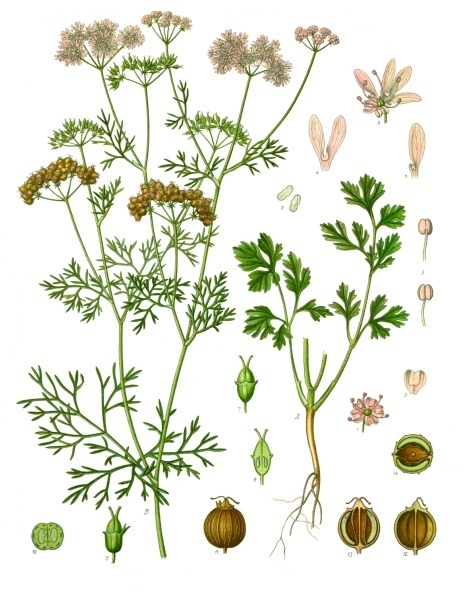 CorianderCoriandrum sativum
-
 Poison HemlockConium maculatum
-
 FennelFoeniculum vulgare
-
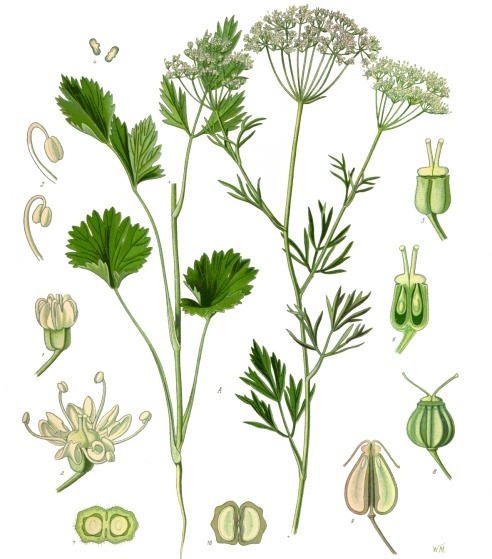 AnisePimpinella anisum
Compare
Questions and answers
What is the scientific name of the Alexanders?
The scientific name of the Alexanders is Smyrnium olusatrum. Written with its author, the full name is Smyrnium olusatrum L..
Which family does the Alexanders belong to?
Smyrnium olusatrum belongs to the family Apiaceae, in the order Apiales and the class Magnoliopsida.
Where is the Alexanders found?
Checklists and occurrence records place Smyrnium olusatrum in 36 countries, including France, Spain, The Netherlands, Italy, Isle of Man and Israel.
What other names does the Alexanders have?
Smyrnium olusatrum is also known in English as Alisanders, Horse Parsley, Black-lovage and Horse-parsley.
What are Alexanders good for?
Alexanders has been used as a pot herb and early-season vegetable. Its stems can be cooked like asparagus, its young shoots and leaves can be eaten cooked or fresh, and its roots can also be eaten. It is also used as livestock feed.[25][10][26][27][28][13]
Sources
Passages the profile rests on
- The plant has broadly diamond-shaped compound leaves divided two or three times in a ternate pattern. Source passage: “The compound leaves are broadly diamond-shaped, 2- or 3-times ternately” — English Wikipedia
- Its leaflets are dark green on the upper surface and pale green underneath, with lobed and serrated margins. Source passage: “The individual leaflets are dark green above, pale green below, flat, lobed and serrated” — English Wikipedia
- Its compound flower umbels measure 6–7 cm in diameter. Source passage: “the former 6–7 cm in diameter” — English Wikipedia
- Its flowers have five yellowish petals and five small green sepals. Source passage: “with 5 yellowish petals and 5 tiny, green sepals” — English Wikipedia
- Its tuberous taproot can reach 60 cm in length. Source passage: “It has a tuberous taproot which can be 60 cm long” — English Wikipedia
- The species grows on waste ground and in hedges in Mediterranean and Atlantic coastal regions of Europe. Source passage: “which grows on waste ground and in hedges around the Mediterranean and Atlantic coastal regions of Europe.” — English Wikipedia
- The species commonly occurs on field margins and waste ground, particularly near the sea. Source passage: “It is common on waste ground and field margins, especially near the sea” — English Wikipedia
- In France, the species is characteristic of seasonally dry river valleys containing chaste tree scrub. Source passage: “In France it is considered a characteristic species of seasonally dry river valleys with chaste tree scrub in the Mediterranean region.” — English Wikipedia
- In Britain, the species has been recorded at elevations no higher than 290 m. Source passage: “In Britain, it is recorded no higher than 290 m, at Davidstow Airfield in Cornwall.” — English Wikipedia
- Its stems can be cooked like asparagus when collected before the flowers open. Source passage: “The plant is best collected before the flowers open and the stems can be cooked like asparagus.” — English Wikipedia
- The young foliage has a flavour intermediate between celery and parsley. Source passage: “The young foliage is intermediate in flavor between celery and parsley” — English Wikipedia
- The seeds have an acrid, peppery taste. Source passage: “the seeds have an acrid, peppery taste.” — English Wikipedia
- Alexanders is also used as livestock feed. Source passage: “It is also fed to livestock.” — English Wikipedia
- Bundles of alexanders stalks were used as fuel on Steep Holm during the nineteenth century. Source passage: “bundles of alexanders stalks from Steep Holm were used for fuel in the 19th century.” — English Wikipedia
- Alexanders can be confused with hemlock water-dropwort and wild celery, both of which have white flowers. Source passage: “Amongst wild plants, it could possibly be confused with hemlock water-dropwort or wild celery but those species have white flowers.” — English Wikipedia
- Once established, the plant can become dominant enough to suppress most other vegetation. Source passage: “once established it can be so dominant as to suppress most other plants.” — English Wikipedia
- A single plant can produce between 3,000 and 9,000 seeds in one year. Source passage: “A single plant may produce between 3,000 and 9,000 seeds in a single year.” — English Wikipedia
- The plant is biennial. Source passage: “Smyrnium olusatrum is a stout, glabrous (hairless) biennial” — English Wikipedia
- The mature schizocarp separates into two single-seeded mericarps. Source passage: “which splits into two single-seeded mericarps” — English Wikipedia
- The terminal flower umbel generally contains exclusively bisexual flowers, whereas lateral umbels also contain male-only flowers. Source passage: “Generally, it is only the terminal umbel that has 100% bisexual flowers; the lateral ones have both bisexual and male-only flowers” — English Wikipedia
- The species has a chromosome number of 2n = 22. Source passage: “Its chromosome number is 2n = 22.” — English Wikipedia
- Its fragrant flowers attract a wide variety of insect visitors. Source passage: “The unspecialised flowers of alexanders are fragrant and are visited by a wide variety of insects.” — English Wikipedia
- Alexanders is classified as Least Concern in Britain and France. Source passage: “The conservation status of alexanders in Britain and France is Least Concern” — English Wikipedia
- The species is not considered threatened in any region, although it is rare in some countries, including Belgium. Source passage: “and it is not considered to be threatened in any region, although it is rare in some countries, such as Belgium.” — English Wikipedia
- The plant was formerly widely cultivated as a pot herb. Source passage: “It was formerly widely grown as a pot herb” — English Wikipedia
- The plant was historically valued as an early-season vegetable in northern Europe because it could be eaten in February or March. Source passage: “one of the few fresh plants that can be eaten in February or March.” — English Wikipedia
- In Turkey, young shoots and leaves are cooked with yoghurt or eaten fresh as salad. Source passage: “the young shoots and leaves are cooked and eaten with yoghurt, or eaten fresh as a salad” — English Wikipedia
- The roots are eaten either cooked or fresh in Turkey. Source passage: “while the roots are also eaten, either cooked or fresh.” — English Wikipedia
Data
- Catalogue of Life, 2026-10-16 XR cc by
- Global Biodiversity Information Facility CC BY 4.0
- Wikidata CC0
- GeoNames CC BY 4.0
- Wikimedia Commons per image; credit shown with each image
- Within the Catalogue of Life, this name comes from Synonymic Checklists of the Vascular Plants of the World cc by
References
- L. (1753). Sp. Pl. [Linnaeus] 1: 262 (1753). where the name was published
This species in other databases
- Catalogue of Life 4XY7Y
- Wikidata Q628360
- iNaturalist 68007
- World Flora Online wfo-0000431292
- GRIN 102147
Page built on 27 November 2026. See how the catalog is made and all sources and licences.
Cite this page
ScientificNames.org. (2026). Smyrnium olusatrum (Alexanders). Retrieved November 27, 2026, from https://scientificnames.org/species/smyrnium-olusatrum
“Smyrnium olusatrum (Alexanders).” ScientificNames.org, 2026, scientificnames.org/species/smyrnium-olusatrum. Accessed 27 Nov. 2026.
ScientificNames.org. “Smyrnium olusatrum (Alexanders).” Accessed November 27, 2026. https://scientificnames.org/species/smyrnium-olusatrum.
@misc{scientificnames_smyrnium_olusatrum_alexanders,
  author = {{ScientificNames.org}},
  title = {Smyrnium olusatrum (Alexanders)},
  year = {2026},
  url = {https://scientificnames.org/species/smyrnium-olusatrum},
  note = {Accessed 2026-11-27}
}