Species · Flowering plants
Oppositeleaf Russian Thistle Soda inermis
The scientific name of the Oppositeleaf Russian Thistle is Soda inermis. It is a species of flowering plant in the family Amaranthaceae (amaranth family), order Caryophyllales.
- Scientific name
- Soda inermis (Moench) Fourr.
- Common name
- Oppositeleaf Russian Thistle
- Genus
- Soda
- Family
- Amaranthaceae (Amaranth Family)
- Order
- Caryophyllales
- Class
- Magnoliopsida
- Recorded in
- 37 countries
- Name status
- accepted in the Catalogue of Life
Overview
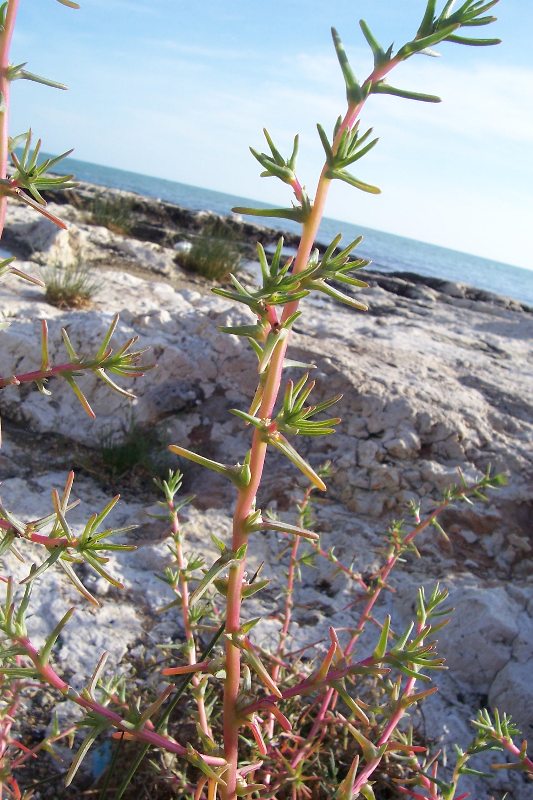
Soda inermis typically grows in coastal regions and can grow in highly saline soils.
Written 26 November 2026 from the sources listed below. Each statement was checked against the passage it cites; statements that could not be supported were removed.
Appearance
Oppositeleaf Russian thistle is a succulent annual plant with fleshy green leaves and green or red stems. It can reach a height of 0.7 metres.[1][2]
Its flowers are tiny and develop in inflorescences emerging from the leaf bases near the stem.[3]
Habitat
Oppositeleaf Russian thistle typically grows in coastal regions and can grow in highly saline soils. It can also grow without saltwater irrigation.[4][5][6]
It can be irrigated with seawater containing approximately 40 grams per litre of dissolved sodium chloride and other salts.[7]
Reproduction and life cycle
Oppositeleaf Russian thistle seeds have a standard germination rate of approximately 30–40%.[8]
Uses
It continues to be cultivated as an edible vegetable. Its edible leaves are commonly known in English by the Italian name agretti.[9][10]
It is commonly harvested in bunches when small and most commonly boiled and eaten as a leafy vegetable. Its leaves can also be eaten raw.[11][12][13]
Oppositeleaf Russian thistle has been studied as a companion plant for improving crop growth in saline soils.[14]
Behaviour
Oppositeleaf Russian thistle can be cropped regularly to encourage new growth when mature.[15]
Classification of the Oppositeleaf Russian Thistle
| Kingdom | Plantae |
|---|---|
| Subkingdom | Pteridobiotina |
| Phylum | Tracheophyta |
| Class | Magnoliopsida |
| Order | Caryophyllales |
| Family | Amaranthaceae (Amaranth Family) |
| Subfamily | Salsoloideae |
| Tribe | Salsoleae |
| Genus | Soda |
| Species | Soda inermis (Moench) Fourr. |
Where the Oppositeleaf Russian Thistle is found
Checklists and occurrence records place Soda inermis in 37 countries across Africa, Asia, Europe, North America and South America. GBIF holds 5,220 georeferenced records of it.
Countries where it is native or its origin is not stated
- Albania 2
- Algeria 10
- Armenia
- Azerbaijan 9
- Bulgaria 2
- China 18
- Croatia 115
- Cyprus 1
- France 2,126
- Georgia 4
- Greece 103
- Hungary 23
- Iran 1
- Israel 273
- Italy 211
- Japan 20
- Kazakhstan 30
- Malta 17
- Moldova 1
- Montenegro 1
- Morocco 12
- Poland 4
- Portugal 171
- Qatar
- Romania 3
- Russia 185
- Slovenia 9
- Spain 900
- The Netherlands 3
- Tunisia 3
- Turkey 12
- Ukraine 316
Countries where it has been introduced
Regions and cities with the most records
- Occitanie, France 596
- Provence-Alpes-Côte d'Azur, France 532
- California, United States 514
- Narbonne, France 321
- San Pablo, United States 276
- Richmond, United States 273
- Albany, United States 259
- Qiryat Ata, Israel 256
- El Cerrito, United States 254
- Qiryat Bialik, Israel 253
- Shefar‘am, Israel 252
- Qiryat Motsqin, Israel 249
- Qiryat Yam, Israel 246
- Tamra, Israel 244
- San Francisco, United States 241
- Haifa, Israel 238
- Acre, Israel 237
- Rekhasim, Israel 234
- San Rafael, United States 234
- Nesher, Israel 231
- Judeida Makr, Israel 228
- Kafr Mandā, Israel 207
- Hyères, France 201
- Yirkā, Israel 198
- Majd el Kurūm, Israel 196
- Nahariyya, Israel 196
- Northern District, Israel 188
- Berkeley, United States 181
- Fos-sur-Mer, France 173
- Karmi’el, Israel 173
- La Crau, France 172
- Port-de-Bouc, France 172
- Catalonia, Spain 171
- Martigues, France 169
- La Garde, France 160
- Tirat Karmel, Israel 160
Range as the checklists state it
Germany [I]; Hungary; Portugal; Spain; Baleares; France; Corsica; Sardinia; Italy; Sicily; Pantelleria; Isole Pelagie (Lampedusa); Malta; San Marino [I]; Slovenia; Croatia; Montenegro; Albania; Romania; Bulgaria; European Turkey; Greece (coastal, incl. many islands); E-European Russia; Moldova; Ukraine; Crimea; Morocco; Algeria; Tunisia; Siberia (Altay); Kazakhstan; Northern Caucasus; Georgia [Caucasus]; Armenia; Azerbaijan; East Aegaean Isl. (Lesvos, Chios, Ikaria, Samos, Lipsi, Kos, Tilos, Rhodos, Kastellorhizo Isl.); Turkey (NW-Anatolia: Bithynia, W-Anatolia, WN-Anatolia); Iran (N-Iran, Iranian Aserbaijan); Cyprus (S-Cyprus); Israel (coastal W-Israel); Qatar; China (Xinjiang); Canada [I] (New Brunswick [I], Newfoundland [I], Nova Scotia [I], Prince Edward Isl. [I], Quebec [I]); St. Pierre and Miquelon [I]; USA [I] (Connecticut [I], Delaware [I], Maine [I], Maryland [I], Massachusetts [I], New Hampshire [I], New Jersey [I], New York [I], North Carolina [I], Pennsylvania [I], Rhode Island [I], South Carolina [I], Virginia [I]); Argentina [I]
A number beside a place is its count of GBIF occurrence records. A place without a number comes from a checklist alone. Records show where a species has been observed or collected, which can include escapes and vagrants.
Common names
English
- Oppositeleaf Russian Thistle
Names in 9 other languages
- Catalan
- Salicorn fi
- Chinese
- 碱猪毛菜, 蘇打豬毛菜
- French
- Soude commune, Soude kali
- Greek
- Αλμύρα
- Italian
- barba di frate, riscolo
- Persian
- شور (گیاه)
- Romanian
- Săricică
- Russian
- Солянка содоносная
- Slovenian
- solinska solinka
Synonyms
5 other scientific names have been used for this species and are now treated as synonyms of Soda inermis.
- Kali inerme Moench
- Salsola soda L.
- Salsola soda var. soda
- Kali soda (L.) Scop. ambiguous synonym
- Salsola longifolia Lam. ambiguous synonym
Related species


Questions and answers
What is the scientific name of the Oppositeleaf Russian Thistle?
The scientific name of the Oppositeleaf Russian Thistle is Soda inermis. Written with its author, the full name is Soda inermis (Moench) Fourr..
Which family does the Oppositeleaf Russian Thistle belong to?
Soda inermis belongs to the family Amaranthaceae, in the order Caryophyllales and the class Magnoliopsida.
Where is the Oppositeleaf Russian Thistle found?
Checklists and occurrence records place Soda inermis in 37 countries, including France, Spain, Ukraine, Israel, Italy and Russia.
Sources
Passages the profile rests on
- Soda inermis is a succulent annual plant with fleshy green leaves and green or red stems. Source passage: “It has fleshy green leaves with either green or red stems.” — English Wikipedia
- Soda inermis can reach a height of 0.7 metres. Source passage: “This annual, succulent plant can grow into small shrubs up to 0.7 m tall” — English Wikipedia
- The flowers of Soda inermis are tiny and develop in inflorescences emerging from the leaf bases near the stem. Source passage: “The tiny flowers develop from inflorescences that grow out of the base of the leaves near the stem.” — English Wikipedia
- Soda inermis typically grows in coastal regions. Source passage: “It is a halophyte (a salt-tolerant plant) that typically grows in coastal regions” — English Wikipedia
- Soda inermis can grow in highly saline soils. Source passage: “A high concentration of sodium carbonate in the ashes of S. soda occurs if the plant is grown in highly saline soils” — English Wikipedia
- Soda inermis can grow without saltwater irrigation. Source passage: “Though the plant is often grown in saltwater-irrigated land in the Mediterranean Basin, it will grow without salt water.” — English Wikipedia
- Soda inermis can be irrigated with seawater containing approximately 40 grams per litre of dissolved sodium chloride and other salts. Source passage: “S. soda can be irrigated with sea water, which contains about 40 g/L of dissolved sodium chloride and other salts.” — English Wikipedia
- Soda inermis seeds have a standard germination rate of approximately 30–40%. Source passage: “The seed is notorious for poor germination at about 30 to 40% standard” — English Wikipedia
- Soda inermis continues to be cultivated as an edible vegetable. Source passage: “S. soda is still cultivated as a vegetable that enjoys considerable popularity in Greece, Italy and with gourmets around the world.” — English Wikipedia
- The edible leaves of Soda inermis are commonly known in English by the Italian name agretti. Source passage: “The Italian name agretti is commonly used in English to refer to the edible leaves of S. soda;” — English Wikipedia
- Soda inermis is commonly harvested in bunches when small. Source passage: “S. soda is harvested in bunches when small” — English Wikipedia
- Soda inermis is most commonly boiled and eaten as a leafy vegetable. Source passage: “It is most commonly boiled and eaten as a leafy vegetable;” — English Wikipedia
- Soda inermis leaves can also be eaten raw. Source passage: “It can also be eaten raw;” — English Wikipedia
- Soda inermis has been studied as a companion plant for improving crop growth in saline soils. Source passage: “Salsola soda has also been studied as a bioremediation "biodesalinating companion plant" for crops such as tomatoes and peppers when they are grown in saline soils.” — English Wikipedia
- Soda inermis can be cropped regularly to encourage new growth when mature. Source passage: “or cropped regularly to encourage new growth when mature.” — English Wikipedia
Data
- Catalogue of Life, 2026-10-16 XR cc by
- Global Biodiversity Information Facility CC BY 4.0
- Wikidata CC0
- GeoNames CC BY 4.0
- Wikimedia Commons per image; credit shown with each image
- Within the Catalogue of Life, this name comes from Synonymic Checklists of the Vascular Plants of the World cc by
References
- Fourr. (1869). Ann. Soc. Linn. Lyon, Sér. 2, 17: 145 (1869). where the name was published
This species in other databases
Page built on 26 November 2026. See how the catalog is made and all sources and licences.
Cite this page
ScientificNames.org. (2026). Soda inermis (Oppositeleaf Russian Thistle). Retrieved November 26, 2026, from https://scientificnames.org/species/soda-inermis
“Soda inermis (Oppositeleaf Russian Thistle).” ScientificNames.org, 2026, scientificnames.org/species/soda-inermis. Accessed 26 Nov. 2026.
ScientificNames.org. “Soda inermis (Oppositeleaf Russian Thistle).” Accessed November 26, 2026. https://scientificnames.org/species/soda-inermis.
@misc{scientificnames_soda_inermis_oppositeleaf_russian_thistle,
  author = {{ScientificNames.org}},
  title = {Soda inermis (Oppositeleaf Russian Thistle)},
  year = {2026},
  url = {https://scientificnames.org/species/soda-inermis},
  note = {Accessed 2026-11-26}
}