Species · Flowering plants
Soda rosmarinus
Soda rosmarinus has no English name on record in the checklists used here. It is a species of flowering plant in the family Amaranthaceae (amaranth family), order Caryophyllales.
- Scientific name
- Soda rosmarinus (Bunge ex Boiss.) Akhani
- Genus
- Soda
- Family
- Amaranthaceae (Amaranth Family)
- Order
- Caryophyllales
- Class
- Magnoliopsida
- Recorded in
- 17 countries
- Name status
- accepted in the Catalogue of Life

Overview
The species is endemic to the lower Jordan Valley along the Dead Sea, in Israel and Jordan, and also occurs in the Syrian desert, central Iraq near Najaf, coastal regions of Saudi Arabia, and the islands of Bahrain and Qatar. The plant has opposite, fleshy leaves, almost completely joined leaf bases, and dense tufts of white hairs in the leaf axils.
Written 26 November 2026 from the sources listed below. Each statement was checked against the passage it cites; statements that could not be supported were removed.
Appearance
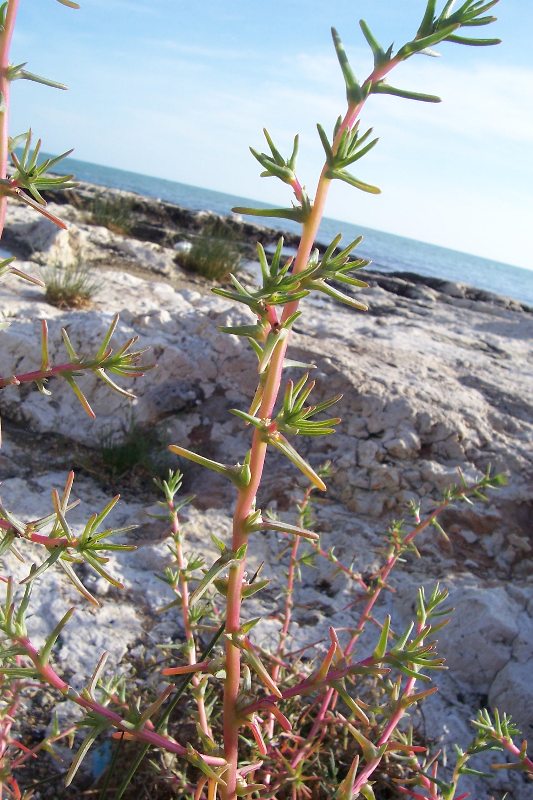
The plant has opposite, fleshy leaves whose bases are almost completely joined at the nodes. Each leaf axil contains a dense tuft of white hairs.[1][2][3]
Habitat
The plant grows mainly in salt flats with hard soil surfaces. It also grows along riverine gulches and in drainage runnels.[4][5]
The species grows in alkaline and saline soils and thrives in silty soil that becomes slippery and muddy when wet. It can also grow on hummocks in silty terrain.[6][7][8]
Behaviour
The species is classified as a xerophyte adapted to environments with little water. It accumulates substantial quantities of sodium and chloride in its leaves.[9][10]
Reproduction and life cycle
The species blossoms in late March, April, and early May.[11]
Uses
Bedouins often use the plant as a soap substitute for cleaning. The species has historically been used to produce nabulsi soap, potash, alkali soap, and cleaning agents.[12][13][14][15]
The plant was historically used as an electuary in preparations of theriac intended to treat scorpion stings. It has also been used as a source of potassium for medicinal purposes.[16][17]
A preparation described in historical medical literature as derived from the plant was used to address tooth decay and bleeding gums. A preparation associated with the plant was also reportedly used to remove bad breath.[18][19]
Classification of Soda rosmarinus
| Kingdom | Plantae |
|---|---|
| Subkingdom | Pteridobiotina |
| Phylum | Tracheophyta |
| Class | Magnoliopsida |
| Order | Caryophyllales |
| Family | Amaranthaceae (Amaranth Family) |
| Subfamily | Salsoloideae |
| Tribe | Salsoleae |
| Genus | Soda |
| Species | Soda rosmarinus (Bunge ex Boiss.) Akhani |
Where Soda rosmarinus is found
Checklists and occurrence records place Soda rosmarinus in 17 countries across Africa and Asia. GBIF holds 506 georeferenced records of it.
Countries
- Afghanistan 1
- Bahrain 5
- Egypt 4
- Iran 58
- Iraq 82
- Israel 210
- Jordan 38
- Kuwait 21
- Oman 1
- Palestinian Territory 16
- Qatar 8
- Saudi Arabia 39
- Syria 4
- Tajikistan
- Turkmenistan 9
- United Arab Emirates 1
- Uzbekistan 9
Regions and cities with the most records
- Southern District, Israel 151
- Safi, Jordan 75
- Jericho, Palestinian Territory 48
- West Bank, Palestinian Territory 46
- Arad, Israel 26
- Eilat, Israel 21
- Aqaba, Jordan 18
- Ma‘ale Adummim, Palestinian Territory 13
- Eastern Province, Saudi Arabia 10
- Zarqa, Jordan 10
- Al Jubayl, Saudi Arabia 8
- Surxondaryo Region, Uzbekistan 7
- Balqa, Jordan 6
- Kerman, Iran 6
- Karak, Jordan 5
- Tabuk Region, Saudi Arabia 5
- South Khorasan Province, Iran 4
- Al Baţţālīyah, Saudi Arabia 3
- Qīr Moāv, Jordan 3
- ‘Izrā, Jordan 3
- Balkh, Afghanistan
- Farah, Afghanistan
- Helmand, Afghanistan
- Nimroz, Afghanistan
- Samangan, Afghanistan
1 more country has a few records outside this range
These countries hold a few records of Soda rosmarinus but lie outside the range the checklists give for it. Such records are often zoo or garden specimens, museum material or vagrants, so the species is not counted as occurring there.
Range as the checklists state it
Egypt (NE-Egypt); Abd-al-Kuri Isl.; Turkmenistan; Uzbekistan; Tajikistan; Iraq (NW-Iraq, S-Iraq); Iran (EC-Iran, E-Iran, NE-Iran: Mts., N-Iran, S-Iran, W-Iran); Afghanistan (Balkh, Farah, Helmand, Nimroz, Qunduz, Samangan); Syria (C-Syrian Desert, Jazira); Israel (Rift Valley, Negev Desert); Sinai peninsula (C-Sinai, S-Sinai); Jordania (S-Jordania); Saudi Arabia (C-Saudi Arabia, Dahana, NE-Saudi Arabia, Hejaz, Rub al Khali, Asir, Nejd Desert); Kuwait; Bahrain; Qatar; United Arab Emirates; Oman
A number beside a place is its count of GBIF occurrence records. A place without a number comes from a checklist alone. Records show where a species has been observed or collected, which can include escapes and vagrants.
Synonyms
5 other scientific names have been used for this species and are now treated as synonyms of Soda rosmarinus.
- Salsola lanigera Post ex Dinsm.
- Salsola rosmarinus (Bunge ex Boiss.) Eig
- Seidlitzia lanigera Post
- Seidlitzia rosmarinus Boiss.
- Suaeda rosmarinus (Bunge) Ehrenb. ex Boiss.
Related species
-
 Oppositeleaf Russian ThistleSoda inermis
-
 Soda stocksii
-
 Soda oppositifolia
- Soda schimperi
- Soda zygophylloides
-
 Soda schweinfurthii
- Soda florida
- Soda foliosa
Compare
Questions and answers
What are the common names of the species?
The plant is commonly known in Arabic as ʾušnān and šenān. It is also known historically as green ushnan and launderers' potash.[20][21]
What is the species called in Neo-Aramaic languages?
It is known by forms derived from ʾuḥlā.[22]
When does the species blossom?
It blossoms in late March, April, and early May.[11]
Where was the plant historically imported from?
A tenth-century physician reported that the plant was imported into Palestine and Egypt from riverine gulches near Amman in Transjordan.[23]
Sources
Passages the profile rests on
- The plant has opposite, fleshy leaves. Source passage: “has opposite fleshy leaves” — English Wikipedia
- The leaf bases are almost completely joined at the nodes. Source passage: “this species has leaf bases almost completely joined at the nodes” — English Wikipedia
- The plant has a dense tuft of white hairs in the axil of each leaf. Source passage: “It also contains a dense tuft of white hairs in the axil of each leaf.” — English Wikipedia
- The plant grows mainly in salt flats with hard soil surfaces. Source passage: “The plant grows mainly in salt flats (Arabic: sabkha) in hard soil surfaces” — English Wikipedia
- The species also grows along riverine gulches and in drainage runnels. Source passage: “can also be found growing along riverine gulches (Arabic: wadi) and in drainage runnels” — English Wikipedia
- The plant grows in alkaline and saline soils. Source passage: “that have alkaline and saline soils” — English Wikipedia
- The species thrives in silty soil that becomes slippery and muddy when wet. Source passage: “It thrives in silty soil which is very slippery and muddy when wet” — English Wikipedia
- The plant can grow on hummocks in silty terrain. Source passage: “can especially be seen growing on hummocks in such terrain.” — English Wikipedia
- The species is classified as a xerophyte adapted to environments with little water. Source passage: “The plant is classified as a xerophyte, having adapted itself to places with little water.” — English Wikipedia
- The plant accumulates substantial quantities of sodium and chloride in its leaves. Source passage: “subsequently accumulating in its leaves a high quantity of sodium and chloride (chlorine ions).” — English Wikipedia
- The species blossoms in late March, April, and early May. Source passage: “It blossoms in late March, April, and early May.” — English Wikipedia
- Bedouins often use the plant as a soap substitute for cleaning. Source passage: “It is often used by Bedouins for cleaning as a soap substitute.” — English Wikipedia
- The species has historically been used to produce nabulsi soap. Source passage: “having been used since time immemorial to produce nabulsi soap” — English Wikipedia
- The plant has historically been used to produce potash. Source passage: “The species has been used in antiquity for the production of potash” — English Wikipedia
- The plant has been used to manufacture alkali soap and cleaning agents. Source passage: “used in the production of an alkali soap (Arabic: غاسول = ġāsūl) and of cleaning agents.” — English Wikipedia
- The plant has historically been used as an electuary in preparations of theriac intended to treat scorpion stings. Source passage: “as an electuary in compounding theriac for use in treating scorpion stings” — English Wikipedia
- The plant has been used as a source of potassium for medicinal purposes. Source passage: “as well as for extracting potassium for other medicinal uses.” — English Wikipedia
- A preparation described in historical medical literature as derived from the plant was used to address tooth decay and bleeding gums. Source passage: “said to prevent tooth decay, as well as in assuaging blood loss from the gums.” — English Wikipedia
- A preparation associated with the plant was also reportedly used to remove bad breath. Source passage: “It is also said to be useful in removing halitosis.” — English Wikipedia
- The plant is commonly known in Arabic as ʾušnān and šenān. Source passage: “commonly known in Arabic by the names ʾušnān (Arabic: أشنان) and šenān” — English Wikipedia
- The species is also known historically as green ushnan and launderers' potash. Source passage: “In medieval Arabic literature, it is also known by the names of "green ushnan" and "launderers' potash"” — English Wikipedia
- The species is known in Neo-Aramaic languages by forms derived from ʾuḥlā. Source passage: “in the Neo-Aramaic languages by reflexes of ʾuḥlā.” — English Wikipedia
- A tenth-century physician reported that the plant was imported into Palestine and Egypt from riverine gulches near Amman in Transjordan. Source passage: “being imported into Palestine, Egypt, and other regions from the riverine gulches around the vicinity of Amman, in Transjordan” — English Wikipedia
Data
- Catalogue of Life, 2026-10-16 XR cc by
- Global Biodiversity Information Facility CC BY 4.0
- Wikidata CC0
- GeoNames CC BY 4.0
- Wikimedia Commons per image; credit shown with each image
- Within the Catalogue of Life, this name comes from Synonymic Checklists of the Vascular Plants of the World cc by
References
- Akhani. (2020). Frontiers Pl. Sci. (Online journal) 11-546518: 30 (2020). where the name was published
This species in other databases
Page built on 27 November 2026. See how the catalog is made and all sources and licences.
Cite this page
ScientificNames.org. (2026). Soda rosmarinus. Retrieved November 27, 2026, from https://scientificnames.org/species/soda-rosmarinus
“Soda rosmarinus.” ScientificNames.org, 2026, scientificnames.org/species/soda-rosmarinus. Accessed 27 Nov. 2026.
ScientificNames.org. “Soda rosmarinus.” Accessed November 27, 2026. https://scientificnames.org/species/soda-rosmarinus.
@misc{scientificnames_soda_rosmarinus,
  author = {{ScientificNames.org}},
  title = {Soda rosmarinus},
  year = {2026},
  url = {https://scientificnames.org/species/soda-rosmarinus},
  note = {Accessed 2026-11-27}
}