Species · Mammals
Greater Blind Mole-rat Spalax microphthalmus
The scientific name of the Greater Blind Mole-rat is Spalax microphthalmus. It is a species of mammal in the family Spalacidae (spalacids), order Rodentia. The name dates from 1770.
- Scientific name
- Spalax microphthalmus Guldenstaedt, 1770
- Common name
- Greater Blind Mole-rat
- Genus
- Spalax
- Family
- Spalacidae (Spalacids)
- Order
- Rodentia
- Class
- Mammalia
- Red List category
- LC Least Concern
- Recorded in
- 3 countries
- Name status
- accepted in the Catalogue of Life

Overview
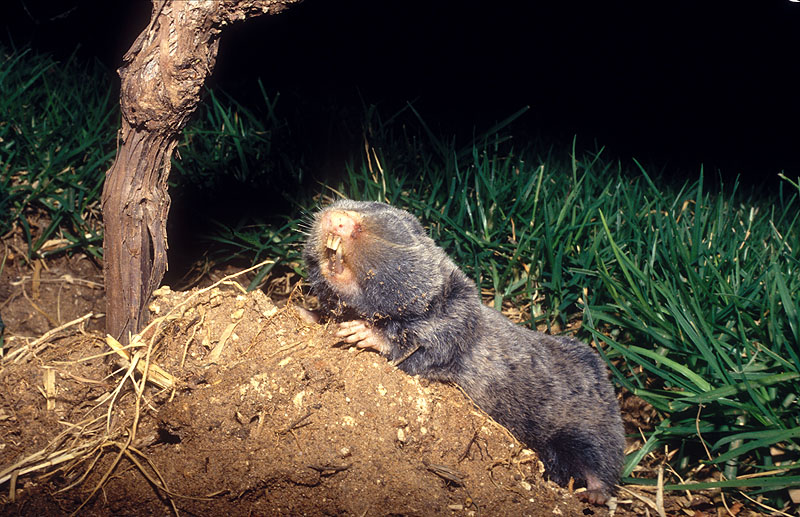
The Greater Blind Mole-rat (Spalax microphthalmus Guldenstaedt, 1770) is a mammal in the family Spalacidae and order Rodentia. It occurs in Russia and Ukraine, including the Ukrainian steppes and southern Russia between the Dnieper and Volga rivers. It is a fossorial species that is completely blind and digs using its prominent incisor teeth.
Written 26 November 2026 from the sources listed below. Each statement was checked against the passage it cites; statements that could not be supported were removed.
Appearance
The Greater Blind Mole-rat has no tail. Its eyes are covered by a membrane of skin and have atrophied lens cells enclosed in a vesicle and a retinal layer.[1][2][3]
It has prominent incisor teeth adapted for burrowing. Its fur is greyish, although its coloration can vary.[4][5]
Its body length can reach 31 cm, and individuals can weigh as much as 570 g.[6][7]
Habitat
The species favours lowland habitats with black-earth soils and avoids sandy and loamy soils. Its habitats include steppes and forest steppes.[8][9][10]
It also occupies agricultural land, plantations, orchards and gardens.[11]
Diet
Its diet includes dandelion roots. It approaches its plant food from underground.[12][13]
The species collects surplus food and stores it in its burrow. Its food stores can reach 14 kg.[14][15]
Behaviour
The Greater Blind Mole-rat is a fossorial species that generally remains underground. It is completely blind because its eyes are atrophied.[16][17]
It digs using its incisor teeth rather than modified digging paws.[18]
Reproduction and life cycle
The species breeds once annually. Young are born in March, and a typical litter contains between two and five offspring.[19][20][21]
Conservation
The Greater Blind Mole-rat is generally considered a common species, although its distribution is somewhat patchy. The IUCN classifies the species as Least Concern.[22][23][24]
Classification of the Greater Blind Mole-rat
| Kingdom | Animalia |
|---|---|
| Phylum | Chordata |
| Subphylum | Vertebrata |
| Infraphylum | Gnathostomata |
| Parvphylum | Osteichthyes |
| Megaclass | Tetrapoda |
| Class | Mammalia (Mammal) |
| Subclass | Theria |
| Infraclass | Eutheria |
| Order | Rodentia (Rodent) |
| Suborder | Myomorpha (Mice) |
| Superfamily | Muroidea |
| Family | Spalacidae (Spalacids) |
| Subfamily | Spalacinae |
| Genus | Spalax (Greater Blind Mole Rats) |
| Species | Spalax microphthalmus Guldenstaedt, 1770 |
Where the Greater Blind Mole-rat is found
Checklists and occurrence records place Spalax microphthalmus in 3 countries. GBIF holds 3,666 georeferenced records of it.
Countries
Regions and cities with the most records
- Luhansk, Ukraine 2,857
- Samara Oblast, Russia 192
- Kharkiv, Ukraine 154
- Rostov, Russia 113
- Kursk Oblast, Russia 68
- Sumy, Ukraine 62
- Zhigulëvsk, Russia 51
- Svatove, Ukraine 50
- Starobilsk, Ukraine 46
- Belgorod Oblast, Russia 38
- Kursk, Russia 36
- Gubkin, Russia 33
- Donetsk, Ukraine 27
- Staryy Oskol, Russia 27
- Poltava, Ukraine 24
- Derhachi, Ukraine 17
- Kharkiv, Ukraine 17
- Slobozhanske, Ukraine 17
- Sumy, Ukraine 16
- Pisochyn, Ukraine 14
- Zlatopil, Ukraine 12
- Alchevsk, Ukraine 10
- Izyum, Ukraine 10
- Perevalsk, Ukraine 10
- Slovyansk, Ukraine 10
- Lutuhyne, Ukraine 9
- Kalmykiya Republic, Russia 8
- Merefa, Ukraine 8
- Dnipropetrovsk, Ukraine 7
- Elista, Russia 7
- Lyman, Ukraine 7
- Volgograd Oblast, Russia 7
- Chernivtsi, Ukraine 6
- Chernivtsi, Ukraine 6
- Krasnodar Krai, Russia 6
- Voronezh Oblast, Russia 6
2 more countries have a few records outside this range
These countries hold a few records of Spalax microphthalmus but lie outside the range the checklists give for it. Such records are often zoo or garden specimens, museum material or vagrants, so the species is not counted as occurring there.
Range as the checklists state it
Europe & Northern Asia (excluding China)
A number beside a place is its count of GBIF occurrence records. A place without a number comes from a checklist alone. Records show where a species has been observed or collected, which can include escapes and vagrants.
Common names
English
- Greater Blind Mole-rat
- Greater Blind Mole Rat
- Greater Mole Rat
- Greater Mole-rat
- Russian Mole Rat
Names in 15 other languages
- Czech
- slepec obecný
- Dutch
- Oostelijke Blinde Muis
- Finnish
- arosokkomyllikäs
- French
- Spalax microphtalme
- German
- Ostblindmaus
- Greek
- Μεγάλος τυφλοπόντικας
- Hungarian
- keleti földikutya
- Italian
- Spalace maggiore
- Japanese
- ロシアメクラネズミ
- Norwegian Bokmål
- Østlig Blindmus
- Polish
- ślepiec stepowy
- Russian
- Обыкновенный слепыш
- Slovenian
- vzhodna slepa miš
- Spanish
- Rata topo grande
- Ukrainian
- Сліпак звичайний
Synonyms
2 other scientific names have been used for this species and are now treated as synonyms of Spalax microphthalmus.
- Mus typhlus Pallus, 1779
- Spalax pallasii Nordmann, 1839
Related species
-
 Lesser Blind Mole-ratSpalax leucodon
-
 Middle East Blind Mole-ratSpalax ehrenbergi
-
 Giant Blind Mole-ratSpalax giganteus
-
 Sandy Blind Mole-ratSpalax arenarius
- Mehely's Blind Mole-ratSpalax antiquus
- Bukovina Blind Mole-ratSpalax graecus
-
 Podolsk Blind Mole-ratSpalax zemni
- Kazakhstan Blind Mole-ratSpalax uralensis
Compare
Questions and answers
What is the scientific name of the Greater Blind Mole-rat?
The scientific name of the Greater Blind Mole-rat is Spalax microphthalmus. Written with its author, the full name is Spalax microphthalmus Guldenstaedt, 1770.
Which family does the Greater Blind Mole-rat belong to?
Spalax microphthalmus belongs to the family Spalacidae, in the order Rodentia and the class Mammalia.
Where is the Greater Blind Mole-rat found?
Checklists and occurrence records place Spalax microphthalmus in 3 countries: Ukraine, Russia and Romania.
What is the conservation status of the Greater Blind Mole-rat?
The IUCN Red List category recorded for Spalax microphthalmus is Least Concern (LC).
What other names does the Greater Blind Mole-rat have?
Spalax microphthalmus is also known in English as Greater Blind Mole Rat, Greater Mole Rat, Greater Mole-rat and Russian Mole Rat.
Are mole-rats blind, yes or no?
Yes. The Greater Blind Mole-rat is completely blind because its eyes are atrophied.[17]
What does Spalax eat?
The Greater Blind Mole-rat's diet includes dandelion roots.[12]
What do blind mole-rats eat?
The Greater Blind Mole-rat eats plant food, including dandelion roots.[12][13]
Where do blind mole-rats live?
The Greater Blind Mole-rat occurs in Russia and Ukraine. Its known range includes the Ukrainian steppes and southern Russia between the Dnieper and Volga rivers.[25][26]
What do molerats eat?
The Greater Blind Mole-rat's diet includes dandelion roots.[12]
Sources
Passages the profile rests on
- The greater blind mole-rat has no tail. Source passage: “The greater blind mole-rat is tailless.” — English Wikipedia
- Its eyes are covered by a membrane of skin. Source passage: “The eyes are covered by a membrane of skin” — English Wikipedia
- Its eyes have atrophied lens cells enclosed in a vesicle and a retinal layer. Source passage: “have atrophied lens cells enclosed in a vesicle and a retinal layer.” — English Wikipedia
- It has prominent incisor teeth adapted for burrowing. Source passage: “It has prominent incisor teeth, which are used for burrowing.” — English Wikipedia
- Its fur is greyish, although its coloration can vary. Source passage: “The fur is greyish, but can vary in color.” — English Wikipedia
- The species can reach 31 cm in body length. Source passage: “It can grow to a size of 31 cm (12 in)” — English Wikipedia
- Individuals can weigh as much as 570 g. Source passage: “weigh up to 570 g (20 oz).” — English Wikipedia
- The species favours lowland habitats with black-earth soils. Source passage: “It favours lowland habitats with black earth” — English Wikipedia
- It avoids sandy and loamy soils. Source passage: “avoiding sandy or loamy soils.” — English Wikipedia
- Its habitats include steppes and forest steppes. Source passage: “It inhabits steppes and forest steppes” — English Wikipedia
- The species also occupies agricultural land, plantations, orchards and gardens. Source passage: “agricultural land, plantations, orchards and gardens” — English Wikipedia
- Its diet includes dandelion roots. Source passage: “feeds on the roots of such plants as dandelions” — English Wikipedia
- The species approaches its plant food from underground. Source passage: “approaching them from underneath.” — English Wikipedia
- It collects surplus food and stores it in its burrow. Source passage: “It gathers excess food and stores it in its burrow” — English Wikipedia
- Its food stores can reach 14 kg. Source passage: “sometimes as much as 14 kg (30 lb) being collected.” — English Wikipedia
- The greater blind mole-rat is a fossorial species that generally remains underground. Source passage: “The greater blind mole-rat is a fossorial species that stays underground except when dispersing to new territories as juveniles” — English Wikipedia
- The species is completely blind because its eyes are atrophied. Source passage: “Due to its atrophied eyes it is totally blind.” — English Wikipedia
- It digs using its incisor teeth rather than modified digging paws. Source passage: “The paws are not modified like the ones of the moles; it digs with its incisor teeth instead.” — English Wikipedia
- The species breeds once annually. Source passage: “Breeding takes place once a year” — English Wikipedia
- Young are born in March. Source passage: “with a litter of two to five young being born in March.” — English Wikipedia
- A typical litter contains between two and five offspring. Source passage: “a litter of two to five young” — English Wikipedia
- The greater blind mole-rat is generally considered a common species. Source passage: “In general the greater blind mole-rat is a common species” — English Wikipedia
- Its distribution is somewhat patchy. Source passage: “but somewhat patchily distributed.” — English Wikipedia
- The IUCN classifies the species as Least Concern. Source passage: “The International Union for Conservation of Nature has rated its conservation status as being of "least concern".” — English Wikipedia
- The species occurs in Russia and Ukraine. Source passage: “It is found in Russia and Ukraine.” — English Wikipedia
- Its known range includes the Ukrainian steppes and southern Russia between the Dnieper and Volga rivers. Source passage: “The greater blind mole-rat is known from the steppes of Ukraine and from southern Russia between the Dnieper and the Volga rivers.” — English Wikipedia
Data
- Catalogue of Life, 2026-10-16 XR cc by
- Global Biodiversity Information Facility CC BY 4.0
- Wikidata CC0
- GeoNames CC BY 4.0
- Wikimedia Commons per image; credit shown with each image
- Within the Catalogue of Life, this name comes from The Integrated Taxonomic Information System cc0
References
- Nova Comm. Acad. Sci. Petropoli vol.14 p.1 where the name was published
- Ellerman, J. R., and T. C. S. Morrison-Scott. (1966). Checklist of Palaearctic and Indian Mammals 1758 to 1946, 2nd Edition.
- Wilson, Don E., and DeeAnn M. Reeder, eds. (1993). Mammal Species of the World: A Taxonomic and Geographic Reference, 2nd Ed., 3rd Printing.
- Wilson, Don E., and F. Russell Cole. (2000). Common Names of Mammals of the World.
- Musser, Guy G., and Michael D. Carleton / Wilson, Don E., and DeeAnn M. Reeder, eds. (2005). Superfamily Muroidea. Mammal Species of the World: A Taxonomic and Geographic Reference, 3rd Ed., Vol. 2.
This species in other databases
Page built on 28 November 2026. See how the catalog is made and all sources and licences.
Cite this page
ScientificNames.org. (2026). Spalax microphthalmus (Greater Blind Mole-rat). Retrieved November 28, 2026, from https://scientificnames.org/species/spalax-microphthalmus
“Spalax microphthalmus (Greater Blind Mole-rat).” ScientificNames.org, 2026, scientificnames.org/species/spalax-microphthalmus. Accessed 28 Nov. 2026.
ScientificNames.org. “Spalax microphthalmus (Greater Blind Mole-rat).” Accessed November 28, 2026. https://scientificnames.org/species/spalax-microphthalmus.
@misc{scientificnames_spalax_microphthalmus_greater_blind_mole_rat,
  author = {{ScientificNames.org}},
  title = {Spalax microphthalmus (Greater Blind Mole-rat)},
  year = {2026},
  url = {https://scientificnames.org/species/spalax-microphthalmus},
  note = {Accessed 2026-11-28}
}