Species · Molluscs
Plated Snail Spermodea lamellata
The scientific name of the Plated Snail is Spermodea lamellata. It is a species of mollusc in the family Valloniidae (grass snails). The name dates from 1830.
- Scientific name
- Spermodea lamellata (Jeffreys, 1830)
- Common name
- Plated Snail
- Genus
- Spermodea
- Family
- Valloniidae (Grass Snails)
- Class
- Gastropoda
- Red List category
- VU Vulnerable
- Environment
- terrestrial
- Recorded in
- 9 countries
- Name status
- accepted in the Catalogue of Life

Overview
The species lives in ancient woodland. It is distinguished by its semispherical, yellow shell with fine radial ribs that give it a silky appearance.
Written 27 November 2026 from the sources listed below. Each statement was checked against the passage it cites; statements that could not be supported were removed.
Appearance
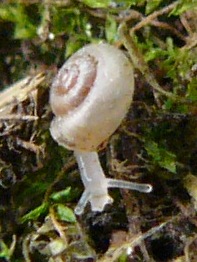
The shell has a characteristic semispherical shape resembling a bee skep basket. It has six convex whorls that increase gradually in size, with very fine, regular radial ribs and deep sutures.[1][2][3][4]
The radial ribs act as a diffraction grating, giving the yellow shell a silky appearance. The apertural margin is simple and breaks easily, and the aperture has no internal folds.[5][6][7]
The shell has a narrow umbilicus and measures 2–2.2 mm in both height and width. Juveniles have paler shells with weaker ribs on the lower side.[8][9][10]
Habitat
The Plated Snail lives in ancient woodland.[11]
Classification of the Plated Snail
| Kingdom | Animalia |
|---|---|
| Phylum | Mollusca |
| Class | Gastropoda (Gastropod) |
| Subclass | Heterobranchia |
| Infraclass | Euthyneura |
| Subterclass | Tectipleura |
| Superorder | Eupulmonata |
| Infraorder | Pupilloidei |
| Family | Valloniidae (Grass Snails) |
| Genus | Spermodea |
| Species | Spermodea lamellata (Jeffreys, 1830) |
Where the Plated Snail is found
Checklists and occurrence records place Spermodea lamellata in 9 countries. GBIF holds 2,404 georeferenced records of it.
Countries
- Belgium 3
- Denmark 27
- Germany 17
- Ireland 231
- Isle of Man 4
- Norway 11
- Sweden 749
- The Netherlands 23
- United Kingdom 1,339
Regions and cities with the most records
- England, United Kingdom 512
- Scotland, United Kingdom 474
- Skåne, Sweden 355
- Halland, Sweden 148
- Wales, United Kingdom 135
- Northern Ireland, United Kingdom 118
- Västra Götaland, Sweden 80
- Guisborough, United Kingdom 72
- Kendal, United Kingdom 64
- Redcar, United Kingdom 64
- Kristianstad, Sweden 59
- Blekinge, Sweden 52
- Scarborough, United Kingdom 49
- Middlesbrough, United Kingdom 46
- Thornaby-on-Tees, United Kingdom 37
- Ängelholm, Sweden 37
- Bonnyrigg, United Kingdom 35
- Billingham, United Kingdom 33
- Halmstad, Sweden 33
- Penicuik, United Kingdom 33
- Edinburgh, United Kingdom 32
- Hässleholm, Sweden 32
- Yarm, United Kingdom 32
- Jämtland, Sweden 31
- Stockton-on-Tees, United Kingdom 31
- Hartlepool, United Kingdom 30
- Karlshamn, Sweden 30
- Lancaster, United Kingdom 30
- Morecambe, United Kingdom 30
- Musselburgh, United Kingdom 30
- Heysham, United Kingdom 25
- Carlisle, United Kingdom 24
- Varberg, Sweden 23
- Blaydon-on-Tyne, United Kingdom 22
- Newburn, United Kingdom 22
- Whickham, United Kingdom 22
1 more country has a few records outside this range
These countries hold a few records of Spermodea lamellata but lie outside the range the checklists give for it. Such records are often zoo or garden specimens, museum material or vagrants, so the species is not counted as occurring there.
A number beside a place is its count of GBIF occurrence records. A place without a number comes from a checklist alone. Records show where a species has been observed or collected, which can include escapes and vagrants.
Common names
English
- Plated Snail
- Plaited Snail
Names in 10 other languages
- Czech
- ostnatka atlantská
- Danish
- Kubesnegl
- Dutch
- Bijenkorfje
- German
- Bienenkörbchen
- Norwegian Bokmål
- lamellsnegl
- Norwegian Nynorsk
- lamellsnigel
- Polish
- Jeżynka żeberkowana
- Russian
- Дерновка пластинчатая
- Swedish
- lamellsnäcka
- Ukrainian
- Дернівка пластинчаста
Synonyms
6 other scientific names have been used for this species and are now treated as synonyms of Spermodea lamellata.
- Helix (Acanthinula) lamellata Jeffreys, 1830
- Helix (Acanthinula) spermatia Castro, 1887
- Helix lamellata Jeffreys, 1830
- Helix scarburgensis Alder, 1830
- Helix spermatia Castro, 1887
- Spermodea spermatia (Castro, 1887)
Related species
- Little-ball-snailSpermodea monas
- Spermodea augusti
- Spermodea candida
- Spermodea demarcqui
- Spermodea plicatella
- Spermodea puisseguri
-
 Lovely ValloniaVallonia pulchella
-
 Ribbed ValloniaVallonia costata
Compare
Questions and answers
What is the scientific name of the Plated Snail?
The scientific name of the Plated Snail is Spermodea lamellata. Written with its author, the full name is Spermodea lamellata (Jeffreys, 1830).
Which family does the Plated Snail belong to?
Spermodea lamellata belongs to the family Valloniidae and the class Gastropoda.
Where is the Plated Snail found?
Checklists and occurrence records place Spermodea lamellata in 9 countries, including United Kingdom, Sweden, Ireland, Denmark, The Netherlands and Germany.
What is the conservation status of the Plated Snail?
The IUCN Red List category recorded for Spermodea lamellata is Vulnerable (VU).
What other names does the Plated Snail have?
Spermodea lamellata is also known in English as Plaited Snail.
Sources
Passages the profile rests on
- The shell has a characteristic semispherical shape resembling a bee skep basket. Source passage: “The 2-2.2 mm x 2-2.2 mm shell has a characteristic semispherical shape like a bee skep basket.” — English Wikipedia
- The shell has six convex whorls that increase gradually in size. Source passage: “The shell has 6 convex whorls which increase gradually in size.” — English Wikipedia
- The shell whorls have very fine, regular radial ribs. Source passage: “The whorls are decorated with very fine, very regular, radial ribs.” — English Wikipedia
- The shell has deep sutures. Source passage: “The sutures are deep.” — English Wikipedia
- The radial ribs act as a diffraction grating, giving the yellow shell a silky appearance. Source passage: “These ribs function as a diffraction grating, giving the yellow shell a silky appearance.” — English Wikipedia
- The apertural margin is simple and breaks easily. Source passage: “The apertural margin is simple and breaks easily.” — English Wikipedia
- The shell has no folds inside the aperture. Source passage: “There are no folds inside the aperture.” — English Wikipedia
- The shell has a narrow umbilicus. Source passage: “The umbilicus is narrow.” — English Wikipedia
- Juveniles have paler shells with weaker ribs on the lower side. Source passage: “Juveniles are paler with weaker ribs at the lower side” — English Wikipedia
- The shell measures 2–2.2 mm in both height and width. Source passage: “The 2-2.2 mm x 2-2.2 mm shell” — English Wikipedia
- This species lives in ancient woodland. Source passage: “This minute snail lives in ancient woodland.” — English Wikipedia
Data
- Catalogue of Life, 2026-10-16 XR cc by
- Global Biodiversity Information Facility CC BY 4.0
- Wikidata CC0
- GeoNames CC BY 4.0
- Wikimedia Commons per image; credit shown with each image
- Within the Catalogue of Life, this name comes from World Register of Marine Species cc by
References
- Jeffreys, J.G., 1830, Jeffreys, J.G. 1830. ? . where the name was published
This species in other databases
Page built on 27 November 2026. See how the catalog is made and all sources and licences.
Cite this page
ScientificNames.org. (2026). Spermodea lamellata (Plated Snail). Retrieved November 27, 2026, from https://scientificnames.org/species/spermodea-lamellata
“Spermodea lamellata (Plated Snail).” ScientificNames.org, 2026, scientificnames.org/species/spermodea-lamellata. Accessed 27 Nov. 2026.
ScientificNames.org. “Spermodea lamellata (Plated Snail).” Accessed November 27, 2026. https://scientificnames.org/species/spermodea-lamellata.
@misc{scientificnames_spermodea_lamellata_plated_snail,
  author = {{ScientificNames.org}},
  title = {Spermodea lamellata (Plated Snail)},
  year = {2026},
  url = {https://scientificnames.org/species/spermodea-lamellata},
  note = {Accessed 2026-11-27}
}