Species · Flowering plants
Reeve's Spirea Spiraea cantoniensis
The scientific name of the Reeve's Spirea is Spiraea cantoniensis. It is a species of flowering plant in the family Rosaceae (rose family), order Rosales.
- Scientific name
- Spiraea cantoniensis Lour.
- Common name
- Reeve's Spirea
- Genus
- Spiraea
- Family
- Rosaceae (Rose Family)
- Order
- Rosales
- Class
- Magnoliopsida
- Red List category
- LC Least Concern
- Recorded in
- 22 countries
- Name status
- accepted in the Catalogue of Life

Overview
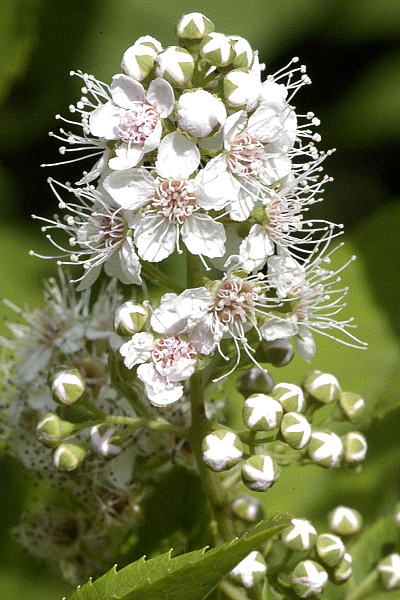
Reeve's Spirea (Spiraea cantoniensis Lour.) is a flowering plant in the family Rosaceae, order Rosales and class Magnoliopsida. The species is native to Southeast China and has been introduced to Assam, India, North and South New Zealand, and several states in the United States. It produces frothy, pompom-like clusters of snow-white flowers along its arching branches.
Written 26 November 2026 from the sources listed below. Each statement was checked against the passage it cites; statements that could not be supported were removed.
Appearance
Reeve's Spirea is a deciduous or semi-evergreen shrub with numerous thin, arching, flexible and hairless branches. It can reach a height of 1–2 metres and is also described as growing up to 1.5 metres tall.[1][2][3][4]
Its alternate, simple leaves have small petioles and green blades measuring 2–6 cm in length. Three veins run parallel from the base, and the distal half of each leaf has irregularly crenate-dentate margins. The leaves may become yellowish-red during autumn.[5][6][7][8][9]
Its hermaphroditic flowers are radially symmetrical and arranged in axillary corymbs. Each flower has five free sepals, five white petals and numerous stamens shorter than the petals.[10][11][12][13]
The plant produces frothy, pompom-like clusters of snow-white flowers along its arching branches. Its fruit is a polyfollicle consisting of three to five multi-seeded follicles.[14][15]
Habitat
Reeve's Spirea grows best in full sun to partially shaded positions and prefers well-drained soil. The species generally grows best in cooler climates.[16][17][18]
The species is native to Southeast China. It has been introduced to Assam, India, North and South New Zealand, and several states in the United States, including Alabama, Arkansas, Louisiana, New York, North Carolina, Ohio and Virginia.[19][20][21][22]
Behaviour
Reeve's Spirea blooms in May in its native country.[23]
Reproduction and life cycle
The species produces hermaphroditic flowers.[24]
Uses
Reeve's Spirea is cultivated as an ornamental garden plant and a conspicuous feature plant. It is also used for screening and bordering along fence lines.[25][26][27]
Classification of the Reeve's Spirea
| Kingdom | Plantae |
|---|---|
| Subkingdom | Pteridobiotina |
| Phylum | Tracheophyta |
| Class | Magnoliopsida |
| Order | Rosales |
| Family | Rosaceae (Rose Family) |
| Subfamily | Amygdaloideae |
| Tribe | Spiraeeae |
| Genus | Spiraea (Meadowsweet) |
| Species | Spiraea cantoniensis Lour. |
Where the Reeve's Spirea is found
Checklists and occurrence records place Spiraea cantoniensis in 22 countries across Asia, Europe, North America, Oceania and South America. GBIF holds 1,459 georeferenced records of it.
Countries where it is native or its origin is not stated
Countries where it has been introduced
- Brazil 173
- Colombia 11
- Dominican Republic
- Guatemala 7
- Honduras 4
- India 16
- Japan 165
- Mexico 61
- Myanmar
- New Zealand 31
- Nicaragua 1
- Pakistan 1
- Panama 3
- Portugal 30
- South Korea 91
- Sri Lanka 7
- Taiwan 7
- Thailand 2
- Trinidad and Tobago
- United States 333
Regions and cities with the most records
- Shaanxi, China 103
- Anhui, China 79
- Paraná, Brazil 44
- Rio Grande do Sul, Brazil 43
- Henan, China 32
- Pinhais, Brazil 29
- Curitiba, Brazil 27
- Jiangxi, China 26
- São José dos Pinhais, Brazil 26
- Colombo, Brazil 24
- Almirante Tamandaré, Brazil 23
- North Carolina, United States 23
- Quatro Barras, Brazil 22
- Adams Morgan, United States 21
- Brightwood, United States 21
- Central 14th Street / Spring Road, United States 21
- Chillum, United States 21
- Columbia Heights, United States 21
- H Street NE, United States 21
- Hubei, China 21
- Kennedy Street, United States 21
- Mount Pleasant, United States 21
- Mount Vernon Triangle, United States 21
- NoMa, United States 21
- Northwest One, United States 21
- Park View, United States 21
- Petworth, United States 21
- Pleasant Plains, United States 21
- Shaw, United States 21
- Silver Spring, United States 21
- Takoma Park, United States 21
- Beijing, China 20
- Bethesda, United States 20
- Capitol Riverfront, United States 20
- Downtown DC, United States 20
- Foggy Bottom, United States 20
25 more countries have a few records outside this range
These countries hold a few records of Spiraea cantoniensis but lie outside the range the checklists give for it. Such records are often zoo or garden specimens, museum material or vagrants, so the species is not counted as occurring there.
Range as the checklists state it
European Russia [I]; Azores [I] (Sao Miguel Isl. [I]); China (Fujian, Guangdong, Guangxi, Hunan, Jiangxi, Zhejiang, widely cultivated); South Korea [I]; Japan [I]; Taiwan [I]; Pakistan [I]; India [I] (Himachal Pradesh [I], Jammu & Kashmir [I], Meghalaya [I], Nagaland [I], Sikkim [I], Uttarakhand [I], West Bengal [I]); Sri Lanka [I]; Myanmar [I]; Thailand [I]; New Guinea [I]; New Zealand [I]; USA [I] (Alabama [I], Arkansas [I], Louisiana [I], North Carolina [I], New York [I], Virginia [I]); Mexico [I]; Guatemala [I]; Honduras [I]; Nicaragua [I]; Panama [I]; Dominican Republic [I]; Trinidad & Tobago [I]; Colombia [I]; Brazil [I]
A number beside a place is its count of GBIF occurrence records. A place without a number comes from a checklist alone. Records show where a species has been observed or collected, which can include escapes and vagrants.
Common names
English
- Reeve's Spirea
- Bridal Wreath
- Cape May
- Kaapse Mei
- May Bush
- Reeve's Spiraea
- White May
Names in 13 other languages
- Chinese
- ma ye xiu qiu, 麻葉繡球, 麻葉繡線菊
- Czech
- tavolník kantonský
- Estonian
- kantoni enelas
- French
- Spirée de Canton
- Japanese
- ko-demari, コデマリ, スズカケ, 小手毬
- Korean
- 공조팝나무
- Lithuanian
- Stambiažiedė lanksva
- Polish
- tawuła kantońska
- Russian
- Спирея кантонская
- Slovak
- tavoľník kantonský
- Spanish
- Buqué asiático de novia
- Swedish
- kantonspirea
- Turkish
- Gelin Çelengi
Synonyms
16 other scientific names have been used for this species and are now treated as synonyms of Spiraea cantoniensis.
- Spiraea caerulescens Poir.
- Spiraea cantoniensis f. lanceata (Zabel) Zabel
- Spiraea cantoniensis f. lanceolata Zabel
- Spiraea cantoniensis var. lanceata Zabel
- Spiraea cantoniensis var. pilosa T.T.Yu
- Spiraea chamaedrifolia Thunb.
- Spiraea humanni K.Koch
- Spiraea neumannii Zabel
- Spiraea reevesiana Lindl.
- Spiraea roxburghiana Wall.
- Spiraea sinensis Lour. ex B.A.Gomes
- Spiraea barbata Wall. ex F.Dietr. ambiguous synonym
- Spiraea corymbosa Roxb. ambiguous synonym
- Spiraea japonica Siebold ex Blume ambiguous synonym
- Spiraea lanceolata Comm. ex Poir. ambiguous synonym
- Spiraea pubescens Cav. ambiguous synonym
Subspecies and varieties
Related species
-
 Japanese SpiraeaSpiraea japonica
-
 HardhackSpiraea douglasii
-
 Thunberg's MeadowsweetSpiraea thunbergii
-
 MeadowsweetSpiraea alba
-
 Bridal-wreathSpiraea prunifolia
-
 Van Houtt's SpireaSpiraea × vanhouttei
-
 SteeplebushSpiraea tomentosa
-
 Snowmound SpiraeaSpiraea nipponica
Compare
Questions and answers
What is the scientific name of the Reeve's Spirea?
The scientific name of the Reeve's Spirea is Spiraea cantoniensis. Written with its author, the full name is Spiraea cantoniensis Lour..
Which family does the Reeve's Spirea belong to?
Spiraea cantoniensis belongs to the family Rosaceae, in the order Rosales and the class Magnoliopsida.
Where is the Reeve's Spirea found?
Checklists and occurrence records place Spiraea cantoniensis in 22 countries, including China and Nepal.
What is the conservation status of the Reeve's Spirea?
The IUCN Red List category recorded for Spiraea cantoniensis is Least Concern (LC).
What other names does the Reeve's Spirea have?
Spiraea cantoniensis is also known in English as Bridal Wreath, Cape May, Kaapse Mei, May Bush, Reeve's Spiraea and White May.
Does spirea like shade or sun?
Reeve's Spirea grows best in full sun to partially shaded positions.[16]
Is spirea a shade or sun plant?
Reeve's Spirea grows best in full sun to partially shaded positions.[16]
Sources
Passages the profile rests on
- Spiraea cantoniensis is a deciduous or semi-evergreen shrub. Source passage: “It is a deciduous or semi-evergreen shrub” — English Wikipedia
- The plant has numerous thin, arching, flexible and hairless branches. Source passage: “with many thin branches, arched, flexible and glabrous.” — English Wikipedia
- The shrub can reach a height of 1–2 metres. Source passage: “that reaches a size of 1–2 m height” — English Wikipedia
- The plant is also described as growing up to 1.5 metres tall. Source passage: “It is a shrub growing up to 1.5 ...” — inaturalist.org
- Its leaves are alternate and simple, with small petioles. Source passage: “The leaves are alternate, simple, small petiolate” — English Wikipedia
- Its leaf blades are green and measure 2–6 cm in length. Source passage: “with 2–6 cm long green lanceolate, elliptical-rhomboidal or slightly obovate lamina” — English Wikipedia
- Its leaves have three veins running parallel from the base. Source passage: “with 3 nerves parallel from its base” — English Wikipedia
- The distal half of its leaves has irregularly crenate-dentate margins. Source passage: “irregularly crenate-dentate in its distal half.” — English Wikipedia
- Its leaves may become yellowish-red during autumn. Source passage: “The leaves may turn a yellowish red colour in autumn.” — English Wikipedia
- Its flowers are hermaphroditic and radially symmetrical. Source passage: “its flowers are hermaphroditic, actinomorphic” — English Wikipedia
- Its flowers are arranged in axillary corymbs. Source passage: “arranged in axillary corimbos” — English Wikipedia
- Each flower has five free sepals and five white petals. Source passage: “each with 5 free sepals, 5 white petals” — English Wikipedia
- Its flowers contain numerous stamens that are shorter than the petals. Source passage: “numerous stamens shorter than the petals.” — English Wikipedia
- Its fruit is a polyfollicle consisting of three to five multi-seeded follicles. Source passage: “The fruit is a poly-follicle, with 3-5 plurisemined carpidia (follicles).” — English Wikipedia
- The plant produces frothy, pompom-like clusters of snow-white flowers along its arching branches. Source passage: “with frothy, pompom-like clusters of snow-white flowers borne along arching branches” — English Wikipedia
- The plant grows best in full sun to partially shaded positions. Source passage: “May bushes prefer a full sun to partly shaded position” — English Wikipedia
- The species prefers well-drained soil. Source passage: “with well drained soil” — English Wikipedia
- The species generally grows best in cooler climates. Source passage: “It is generally best grown in cooler climates” — English Wikipedia
- Spiraea cantoniensis is native to Southeast China. Source passage: “It is native to Southeast China” — English Wikipedia
- The species has been introduced to Assam, India. Source passage: “is found as an introduced species in Assam” — English Wikipedia
- The species has been introduced to North and South New Zealand. Source passage: “North and South New Zealand” — English Wikipedia
- The species has been introduced to several states in the United States, including Alabama, Arkansas, Louisiana, New York, North Carolina, Ohio and Virginia. Source passage: “The United States (Alabama, Arkansas, Louisiana, New York, North Carolina, Ohio, and Virginia).” — English Wikipedia
- The plant blooms in May in its native country. Source passage: “that bloom in May in its native country” — English Wikipedia
- The species produces hermaphroditic flowers. Source passage: “its flowers are hermaphroditic” — English Wikipedia
- The species is cultivated as an ornamental garden plant. Source passage: “It is an ornamental plant featured in gardens” — English Wikipedia
- The plant is used for screening and bordering along fence lines. Source passage: “It is used as a screening or bordering plant alongside a fence line” — English Wikipedia
- The species is also cultivated as a conspicuous feature plant. Source passage: “or as a conspicuous feature plant.” — English Wikipedia
Data
- Catalogue of Life, 2026-10-16 XR cc by
- Global Biodiversity Information Facility CC BY 4.0
- Wikidata CC0
- GeoNames CC BY 4.0
- Wikimedia Commons per image; credit shown with each image
- Within the Catalogue of Life, this name comes from Synonymic Checklists of the Vascular Plants of the World cc by
References
- Lour. (1790). Fl. Cochinch. 1: 322 (1790). where the name was published
This species in other databases
- Catalogue of Life 4Z6FN
- Wikidata Q3338874
- iNaturalist 125789
- World Flora Online wfo-0001016819
- GRIN 35276
Page built on 26 November 2026. See how the catalog is made and all sources and licences.
Cite this page
ScientificNames.org. (2026). Spiraea cantoniensis (Reeve's Spirea). Retrieved November 26, 2026, from https://scientificnames.org/species/spiraea-cantoniensis
“Spiraea cantoniensis (Reeve's Spirea).” ScientificNames.org, 2026, scientificnames.org/species/spiraea-cantoniensis. Accessed 26 Nov. 2026.
ScientificNames.org. “Spiraea cantoniensis (Reeve's Spirea).” Accessed November 26, 2026. https://scientificnames.org/species/spiraea-cantoniensis.
@misc{scientificnames_spiraea_cantoniensis_reeves_spirea,
  author = {{ScientificNames.org}},
  title = {Spiraea cantoniensis (Reeve's Spirea)},
  year = {2026},
  url = {https://scientificnames.org/species/spiraea-cantoniensis},
  note = {Accessed 2026-11-26}
}