Species · Flowering plants
Japanese Spiraea Spiraea japonica
The scientific name of the Japanese Spiraea is Spiraea japonica. It is a species of flowering plant in the family Rosaceae (rose family), order Rosales.
- Scientific name
- Spiraea japonica L.fil.
- Common name
- Japanese Spiraea
- Genus
- Spiraea
- Family
- Rosaceae (Rose Family)
- Order
- Rosales
- Class
- Magnoliopsida
- Recorded in
- 32 countries
- Name status
- accepted in the Catalogue of Life

Overview
Spiraea japonica is native to Japan, China, and Korea and commonly occurs in riparian areas, bogs, and other wetland habitats. It produces rosy-pink flowers in clusters at branch tips and abundant, fertile seeds that can spread over considerable distances.
Written 26 November 2026 from the sources listed below. Each statement was checked against the passage it cites; statements that could not be supported were removed.
Appearance
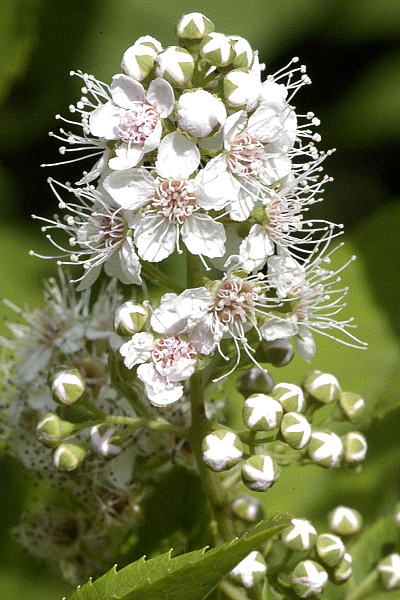
Its leaves are ovate with toothed margins. Its flowers are rosy-pink and grow in clusters at branch tips.[1][2]
The shrub reaches approximately 1.2 m to almost 2 m in height, with a width approximately equal to its height. Its leaves measure approximately 2.5–7.5 cm in length.[3][4][5]
Habitat
Japanese spiraea commonly occurs in riparian areas, bogs, and other wetland habitats. It grows along streams, rivers, forest edges, roadsides, successional fields, and power-line rights-of-way.[6][7]
It prefers full sunlight but tolerates partial shade. It prefers rich, moist loam but can grow in various soil types, including alkaline soils.[8][9]
It requires substantial water during the growing season but cannot tolerate prolonged soil saturation.[10]
Behaviour
Japanese spiraea can spread rapidly and compete with native plant species. It can establish along roadsides.[11][12]
Reproduction and life cycle
Japanese spiraea produces seeds approximately 2.5 mm long, which develop inside small, lustrous capsules. Its abundant, fertile seeds can spread over considerable distances.[13][14][15][16][17]
Seedlings can establish beside mature parent plants and may already be flowering.[18]
Conservation
Japanese spiraea is identified as an invasive plant capable of competing with native vegetation. Some varieties have contributed to unwanted spread that outcompetes native vegetation.[19][20]
Some newer cultivars are marketed as sterile, although their non-invasive status remains uncertain.[21]
The species is naturalized across much of the northeastern, southeastern, and Midwestern United States and parts of Canada.[22]
Uses
Japanese spiraea was introduced to North America as an ornamental landscape plant and was first cultivated in the northeastern United States around 1870.[23][24]
Tall-growing forms can be cultivated as hedges, low screens, or foundation shrubs. Low-growing forms can be used as groundcover or in garden borders.[25][26]
The species has been used in traditional medicine by native people. Extracts from the species have been found to be bioactive.[27][28]
Classification of the Japanese Spiraea
| Kingdom | Plantae |
|---|---|
| Subkingdom | Pteridobiotina |
| Phylum | Tracheophyta |
| Class | Magnoliopsida |
| Order | Rosales |
| Family | Rosaceae (Rose Family) |
| Subfamily | Amygdaloideae |
| Tribe | Spiraeeae |
| Genus | Spiraea (Meadowsweet) |
| Species | Spiraea japonica L.fil. |
Where the Japanese Spiraea is found
Checklists and occurrence records place Spiraea japonica in 32 countries across Asia, Europe, North America, Oceania and South America. GBIF holds 34,157 georeferenced records of it.
Countries where it is native or its origin is not stated
- Armenia 8
- Bangladesh 6
- Belgium 468
- Bolivia 4
- France 755
- Georgia 10
- India 29
- Japan 1,904
- Kazakhstan 8
- Nepal 3
- Norway 1,271
- Sweden 2,216
- Taiwan 748
- The Netherlands 979
Countries where it has been introduced
- Austria 416
- Canada 1,484
- China 4,937
- Finland 398
- Germany 7,969
- Guernsey
- Hungary 2
- Ireland 4
- Italy 209
- Liechtenstein 1
- Myanmar 3
- New Zealand 50
- South Korea 154
- Switzerland 409
- Ukraine 55
- United Kingdom 895
- United States 8,761
- Uzbekistan 1
Regions and cities with the most records
- North Rhine-Westphalia, Germany 1,717
- Bavaria, Germany 1,410
- Pennsylvania, United States 1,113
- Baden-Wurttemberg, Germany 986
- Lower Saxony, Germany 909
- Sichuan, China 811
- Ontario, Canada 794
- New York, United States 793
- North Carolina, United States 665
- Chongqing, China 652
- Yunnan, China 554
- Michigan, United States 541
- Hesse, Germany 530
- England, United Kingdom 525
- Maryland, United States 501
- Taiwan, Taiwan 484
- Schleswig-Holstein, Germany 444
- Wisconsin, United States 413
- Illinois, United States 411
- Rheinland-Pfalz, Germany 389
- Ohio, United States 378
- Gansu, China 375
- Virginia, United States 371
- Massachusetts, United States 366
- Saxony, Germany 363
- Hubei, China 361
- Västra Götaland, Sweden 313
- Nova Scotia, Canada 288
- Occitanie, France 288
- Tennessee, United States 275
- Shaanxi, China 272
- Scotland, United Kingdom 261
- Grand Est, France 259
- Wenxian Chengguanzhen, China 249
- Berlin, Germany 244
- Indiana, United States 243
20 more countries have a few records outside this range
These countries hold a few records of Spiraea japonica but lie outside the range the checklists give for it. Such records are often zoo or garden specimens, museum material or vagrants, so the species is not counted as occurring there.
Range as the checklists state it
England [I] (England [I], Wales [I], Isle of Man [I], Scotland [I]); Ireland [I] (Ireland [I], Northern Ireland [I]); Finland [I]; Germany [I]; Switzerland [I]; Liechtenstein [I]; Austria [I]; Hungary [I]; Channel Isl. [I] (Guernsey [I]); Italy [I]; Ukraine [I]; Uzbekistan [I]; Siberia [I]; China [I] (commonly cultivated); South Korea [I]; Japan (Honshu, Shikoku, Kyushu); India [c]; Myanmar [I]; New Zealand [I]; Canada [I] (Nova Scotia [I], Ontario [I]); USA [I] (Connecticut [I], Delaware [I], Georgia [I], Illinois [I], Indiana [I], Kentucky [I], Massachusetts [I], Maryland [I], Maine [I], Michigan [I], Missouri [I], North Carolina [I], New Hampshire [I], New York [I], Ohio [I], Pennsylvania [I], Rhode Island [I], South Carolina [I], Tennessee [I], Virginia [I], West Virginia [I]); Bolivia [c]
A number beside a place is its count of GBIF occurrence records. A place without a number comes from a checklist alone. Records show where a species has been observed or collected, which can include escapes and vagrants.
Common names
English
- Japanese Spiraea
- Fortune Meadowsweet
Names in 9 other languages
- Chinese
- xiu xian ju
- Dutch
- Japanse spirea
- Finnish
- japaninangervo
- French
- spirée du Japon
- German
- Japanischer Spierstrauch
- Norwegian Bokmål
- japanspirea
- Norwegian Nynorsk
- rosespirea
- Swedish
- höstspirea, praktspirea, rosenspirea
- Welsh
- Erwain Japan
Synonyms
54 other scientific names have been used for this species and are now treated as synonyms of Spiraea japonica.
- Awayus japonicus (L.fil.) Raf.
- Spiraea albiflora C.K.Schneid.
- Spiraea albiflora (Miq.) Zabel
- Spiraea albiflora Du Roi
- Spiraea albiflora x japonica
- Spiraea belloides hort.
- Spiraea bullata Maxim.
- Spiraea callosa var. alba (Clémenc.) Regel
- Spiraea callosa var. albiflora Miq.
- Spiraea callosa var. glabra Regel
- Spiraea callosa var. parviflora Regel
- Spiraea callosa var. pubescens Regel
- Spiraea crispifolia Zabel
- Spiraea glabrata Lange
- Spiraea japonica f. albiflora (Miq.) Geerinck
- Spiraea japonica f. albiflora (Miq.) Kitam.
- Spiraea japonica f. alpina (Maxim.) Koidz.
- Spiraea japonica f. atrosanguinea (Zabel) C.K.Schneid.
- Spiraea japonica f. glabra C.K.Schneid.
- Spiraea japonica f. macrophylla (Zabel) Zabel
- Spiraea japonica f. pubescens (Regel) Kitam.
- Spiraea japonica f. ruberrima (Zabel) C.K.Schneid.
- Spiraea japonica subsp. glabra (Regel) Koidz.
- Spiraea japonica subvar. bullata (Maxim.) Koidz.
- Spiraea japonica var. alba (Clémenc.) Koidz.
- Spiraea japonica var. albiflora (Miq.) Z.Wei & Y.B.Chang
- Spiraea japonica var. albiflora (Miq.) Koidz.
- Spiraea japonica var. alpina Maxim.
- Spiraea japonica var. atrosanguinea Zabel
- Spiraea japonica var. bullata (Maxim.) Makino
- Spiraea japonica var. glabra Koidz.
- Spiraea japonica var. glabrata (Lange) G.Nicholson
- Spiraea japonica var. ibukiensis Makino
- Spiraea japonica var. leucantha Koidz.
- Spiraea japonica var. macrophylla Zabel
- Spiraea japonica var. mayebarae Kitam.
- Spiraea japonica var. mayebarai Kitam.
- Spiraea japonica var. ovatifolia Koidz.
- Spiraea japonica var. parvifolia (Koidz.) Kitam.
- Spiraea japonica var. pubescens (Regel) Koidz.
Showing 40 of 54.
Subspecies and varieties
- Spiraea japonica var. acuminata variety
- Spiraea japonica var. acuta variety
- Spiraea japonica var. formosana variety
- Spiraea japonica var. fortunei variety
- Spiraea japonica var. hypoglauca variety
- Spiraea japonica var. japonica variety
- Spiraea japonica var. kweichowensis variety
- Spiraea japonica var. ripensis variety
- Spiraea japonica var. vulcanica variety
Related species
-
 HardhackSpiraea douglasii
-
 Reeve's SpireaSpiraea cantoniensis
-
 Thunberg's MeadowsweetSpiraea thunbergii
-
 MeadowsweetSpiraea alba
-
 Bridal-wreathSpiraea prunifolia
-
 Van Houtt's SpireaSpiraea × vanhouttei
-
 SteeplebushSpiraea tomentosa
-
 Snowmound SpiraeaSpiraea nipponica
Compare
Questions and answers
What is the scientific name of the Japanese Spiraea?
The scientific name of the Japanese Spiraea is Spiraea japonica. Written with its author, the full name is Spiraea japonica L.fil..
Which family does the Japanese Spiraea belong to?
Spiraea japonica belongs to the family Rosaceae, in the order Rosales and the class Magnoliopsida.
Where is the Japanese Spiraea found?
Checklists and occurrence records place Spiraea japonica in 32 countries, including Sweden, Japan, Norway, The Netherlands, France and Taiwan.
What other names does the Japanese Spiraea have?
Spiraea japonica is also known in English as Fortune Meadowsweet.
How invasive is Japanese spirea?
Japanese spiraea can spread rapidly and compete with native plant species. It produces abundant, fertile seeds that can spread over considerable distances, and it is identified as an invasive plant capable of competing with native vegetation.[17][11][19]
What are the different varieties of Japanese spirea?
Nine varieties have been described within the species.[29]
How big does a Japanese spirea get?
The shrub reaches approximately 1.2 m to almost 2 m in height. Its width is approximately equal to its height.[3][4]
Is spirea a shade or sun plant?
Japanese spiraea prefers full sunlight but tolerates partial shade.[8]
Sources
Passages the profile rests on
- Its deciduous leaves are ovate and have toothed margins. Source passage: “The deciduous leaves are generally an ovate shape about 2.5 cm to 7.5 cm long, have toothed margins” — English Wikipedia
- Its flowers are rosy-pink and grow in clusters at branch tips. Source passage: “Clusters of rosy-pink flowers are found at the tips of the branches.” — English Wikipedia
- The shrub reaches approximately 1.2 m to almost 2 m in height. Source passage: “The shrub reaches 1.2 m to almost 2 m in height” — English Wikipedia
- Its width is approximately equal to its height. Source passage: “and about the same in width.” — English Wikipedia
- Its leaves measure approximately 2.5–7.5 cm in length. Source passage: “about 2.5 cm to 7.5 cm long” — English Wikipedia
- The species commonly occurs in riparian areas, bogs, and other wetland habitats. Source passage: “A common habitat for S. japonica in general seems to be in riparian areas, bogs, or other wetland habitats.” — English Wikipedia
- It grows along streams, rivers, forest edges, roadsides, successional fields, and power-line rights-of-way. Source passage: “It is found growing along streams, rivers, forest edges, roadsides, successional fields, and power line right-of-ways.” — English Wikipedia
- It prefers full sunlight but tolerates partial shade. Source passage: “It prefers full sun, but can tolerate partial shade.” — English Wikipedia
- It prefers rich, moist loam but can grow in various soil types, including alkaline soils. Source passage: “It prefers a rich, moist loam, but it can grow in a wide variety of soils, including those on the alkaline side.” — English Wikipedia
- It requires substantial water during the growing season but cannot tolerate prolonged soil saturation. Source passage: “It prefers much water during the growing season; however, it cannot tolerate saturated soils for extended periods of time.” — English Wikipedia
- The species can spread rapidly and compete with native plant species. Source passage: “Capable of spreading rapidly and competing with native species” — invasivespeciesinfo.gov
- The species can establish along roadsides. Source passage: “Depending on the area, you may find them along the roadside, too.” — extension.psu.edu
- Its seeds develop inside small, lustrous capsules. Source passage: “The seeds measure about 2.5 mm in length and are found in small lustrous capsules.” — English Wikipedia
- Its seeds measure approximately 2.5 mm in length. Source passage: “The seeds measure about 2.5 mm in length” — English Wikipedia
- The species produces seeds approximately 2.5 mm long. Source passage: “The seeds measure about 2.5 mm in length” — English Wikipedia
- Its seeds occur in small, lustrous capsules. Source passage: “are found in small lustrous capsules.” — English Wikipedia
- The species produces abundant, fertile seeds that can spread over considerable distances. Source passage: “they spread their tiny, abundant, fertile seeds far and wide.” — extension.psu.edu
- Seedlings can establish beside mature parent plants and may already be flowering. Source passage: “young seedlings, often in bloom, beside their established parents.” — extension.psu.edu
- The species is identified as an invasive plant capable of competing with native vegetation. Source passage: “Capable of spreading rapidly and competing with native species” — invasivespeciesinfo.gov
- Some Japanese spiraea varieties have contributed to unwanted spread that outcompetes native vegetation. Source passage: “'Little Princess' and 'Anthony Waterer' are among the decades-old varieties responsible for the unplanned, unwanted spread that outcompetes native vegetation.” — extension.psu.edu
- Some newer cultivars are marketed as sterile, although their non-invasive status remains uncertain. Source passage: “Some of the newer cultivars of Japanese spirea are marketed as "sterile". Only time will tell if these varieties are non-invasive.” — extension.psu.edu
- The species is naturalized across much of the northeastern, southeastern, and Midwestern United States and parts of Canada. Source passage: “It is naturalized throughout much of the Northeast, Southeast, and Midwest areas of the United States, and parts of Canada.” — English Wikipedia
- The species was introduced to North America as an ornamental landscape plant. Source passage: “Spiraea japonica was introduced in North America as an ornamental landscape plant” — English Wikipedia
- It was first cultivated in the northeastern United States around 1870. Source passage: “first cultivated in the northeastern states around 1870.” — English Wikipedia
- Tall-growing forms can be cultivated as hedges, low screens, or foundation shrubs. Source passage: “The tall forms may be grown as hedges, low screens, or foundation shrubs.” — English Wikipedia
- Low-growing forms can be used as groundcover or in garden borders. Source passage: “The low-growing forms can be used as groundcover or in borders.” — English Wikipedia
- The species has been used in traditional medicine by native people. Source passage: “S. japonica has been used as traditional medicine by native people” — English Wikipedia
- Extracts from the species have been found to be bioactive. Source passage: “extracts from the plants were found to be bioactive.” — English Wikipedia
- Nine varieties have been described within the species. Source passage: “So far, nine varieties have been described within the species.” — English Wikipedia
Data
- Catalogue of Life, 2026-10-16 XR cc by
- Global Biodiversity Information Facility CC BY 4.0
- Wikidata CC0
- GeoNames CC BY 4.0
- Wikimedia Commons per image; credit shown with each image
- Within the Catalogue of Life, this name comes from Synonymic Checklists of the Vascular Plants of the World cc by
References
- L.fil. Suppl. Pl. [Linnaeus f.] 262 (1781). where the name was published
This species in other databases
Page built on 28 November 2026. See how the catalog is made and all sources and licences.
Cite this page
ScientificNames.org. (2026). Spiraea japonica (Japanese Spiraea). Retrieved November 28, 2026, from https://scientificnames.org/species/spiraea-japonica
“Spiraea japonica (Japanese Spiraea).” ScientificNames.org, 2026, scientificnames.org/species/spiraea-japonica. Accessed 28 Nov. 2026.
ScientificNames.org. “Spiraea japonica (Japanese Spiraea).” Accessed November 28, 2026. https://scientificnames.org/species/spiraea-japonica.
@misc{scientificnames_spiraea_japonica_japanese_spiraea,
  author = {{ScientificNames.org}},
  title = {Spiraea japonica (Japanese Spiraea)},
  year = {2026},
  url = {https://scientificnames.org/species/spiraea-japonica},
  note = {Accessed 2026-11-28}
}