Species · Molluscs
Spirotropis ephamilla
Spirotropis ephamilla has no English name on record in the checklists used here. It is a species of mollusc in the family Drilliidae, order Neogastropoda. The name dates from 1884.
- Scientific name
- Spirotropis ephamilla A. E. Verrill, 1884
- Genus
- Spirotropis
- Family
- Drilliidae
- Order
- Neogastropoda
- Class
- Gastropoda
- Environment
- marine
- Name status
- accepted in the Catalogue of Life
Overview
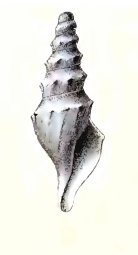
The species occurs in the demersal zone of the Atlantic Ocean off New England. It has an elongated-fusiform shell with a high, somewhat turreted spire and a moderately elongated, slightly curved siphonal canal.
Written 28 November 2026 from the sources listed below. Each statement was checked against the passage it cites; statements that could not be supported were removed.
Appearance
The shell is elongated-fusiform, with a high, somewhat turreted spire and a moderately elongated, slightly curved siphonal canal. Its whorls are moderately convex and strongly angled near their middle.[1][2]
The shell epidermis is yellowish horn-colored and closely adherent. The interior of the aperture is bluish white.[3][4]
The aperture is narrow-ovate and somewhat angled by the shoulder. The outer lip has a broad, deep posterior sinus that reaches its greatest depth at the shoulder.[5][6]
The operculum is well-developed, ovate, and dark horn-colored. The shell reaches 25 mm in length.[7][8]
Habitat
The species occurs in the demersal zone of the Atlantic Ocean off New England.[9]
Classification of Spirotropis ephamilla
| Kingdom | Animalia |
|---|---|
| Phylum | Mollusca |
| Class | Gastropoda (Gastropod) |
| Subclass | Caenogastropoda |
| Order | Neogastropoda |
| Superfamily | Conoidea |
| Family | Drilliidae |
| Genus | Spirotropis |
| Species | Spirotropis ephamilla A. E. Verrill, 1884 |
Related species
-
 Spirotropis monterosatoi
-
 Spirotropis studeriana
-
 Spirotropis stirophora
- Spirotropis modiolus
-
 Spirotropis lithocolleta
-
 Spirotropis azorica
-
 Spirotropis centimata
- Spirotropis confusa
Compare
Questions and answers
Where is Spirotropis ephamilla recorded?
It is recorded from the Atlantic Ocean off New England.[10]
How long does the shell reach?
The shell reaches 25 mm in length.[8]
Sources
Passages the profile rests on
- The shell has an elongated-fusiform shape with a high, somewhat turreted spire and a moderately elongated, slightly curved siphonal canal. Source passage: “The shell has an elongated-fusiform shape, with a high, somewhat turreted spire, and a moderately elongated, slightly curved siphonal canal.” — English Wikipedia
- The shell whorls are moderately convex and strongly angled near their middle. Source passage: “The whorls are moderately convex and strongly angulated near the middle.” — English Wikipedia
- The shell epidermis is yellowish horn-colored and closely adherent. Source passage: “The epidermis is yellowish horn color and closely adherent.” — English Wikipedia
- The interior of the shell aperture is bluish white. Source passage: “The shell is bluish white within the aperture.” — English Wikipedia
- The aperture is narrow-ovate and somewhat angled by the shoulder. Source passage: “The aperture is narrow-ovate and somewhat angulated by the shoulder.” — English Wikipedia
- The outer lip has a broad and deep posterior sinus that reaches its greatest depth at the shoulder. Source passage: “The outer lip is sharp-edged, with a rather broad and deep posterior sinus, which is deepest at the shoulder.” — English Wikipedia
- The operculum is well-developed, ovate, and dark horn-colored. Source passage: “The operculum is well-developed, ovate and dark horn-colored.” — English Wikipedia
- The shell reaches 25 mm in length. Source passage: “The shell grows to a length of 25 mm” — English Wikipedia
- The species occurs in the demersal zone of the Atlantic Ocean off New England. Source passage: “This species occurs in the demersal zone of the Atlantic Ocean off New England.” — English Wikipedia
- The species is recorded from the Atlantic Ocean off New England. Source passage: “This species occurs in the demersal zone of the Atlantic Ocean off New England.” — English Wikipedia
Data
- Catalogue of Life, 2026-10-16 XR cc by
- Wikidata CC0
- Within the Catalogue of Life, this name comes from World Register of Marine Species cc by
References
- Verrill, A. E. (1884). Second catalogue of mollusca recently added to the fauna of the New England Coast and the adjacent parts of the Atlantic, consisting mostly of deep sea species, with notes on others previously recorded. Transactions of the Connecticut Academy of Arts and Sciences, 6. https://doi.org/10.5962/bhl.part.7412 Link where the name was published
This species in other databases
Page built on 29 November 2026. See how the catalog is made and all sources and licences.
Cite this page
ScientificNames.org. (2026). Spirotropis ephamilla. Retrieved November 29, 2026, from https://scientificnames.org/species/spirotropis-ephamilla
“Spirotropis ephamilla.” ScientificNames.org, 2026, scientificnames.org/species/spirotropis-ephamilla. Accessed 29 Nov. 2026.
ScientificNames.org. “Spirotropis ephamilla.” Accessed November 29, 2026. https://scientificnames.org/species/spirotropis-ephamilla.
@misc{scientificnames_spirotropis_ephamilla,
  author = {{ScientificNames.org}},
  title = {Spirotropis ephamilla},
  year = {2026},
  url = {https://scientificnames.org/species/spirotropis-ephamilla},
  note = {Accessed 2026-11-29}
}