Species · Molluscs
Spirotropis stirophora
Spirotropis stirophora has no English name on record in the checklists used here. It is a species of mollusc in the family Drilliidae, order Neogastropoda. The name dates from 1881.
- Scientific name
- Spirotropis stirophora (R. B. Watson, 1881)
- Genus
- Spirotropis
- Family
- Drilliidae
- Order
- Neogastropoda
- Class
- Gastropoda
- Environment
- marine
- Recorded in
- 2 countries
- Name status
- accepted in the Catalogue of Life
Overview
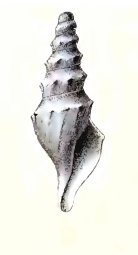
Spirotropis stirophora inhabits the demersal zone of the Atlantic Ocean and occurs from Florida to Brazil. It is distinguished by a narrow, conical shell with longitudinal ribs, tubercles, and keel-like angular ridges.
Written 28 November 2026 from the sources listed below. Each statement was checked against the passage it cites; statements that could not be supported were removed.
Appearance
The shell is high, narrow, angulated, and conical. It is thin, polished, tubercled, and flinty white, with a greyish transparent white coloration.[1][2][3]
The shell has a narrow, high, conical spire and approximately two smooth embryonic whorls. It has seven short whorls that increase slowly in size.[4][5][6]
The body whorl has approximately 12 longitudinal ribs, while the first regular whorl bears nine. The ribs originate from a row of small, rounded, pointed tubercles and do not reach the shell base.[7][8][9][10]
Each whorl has a keel-like angular ridge slightly above its midpoint, bearing small, pointed tubercles.[11][12]
The aperture is club-shaped and oval in its upper portion. The siphonal canal is relatively long, open, and oblique.[13][14]
The outer lip is thin and has a flattened convex curve. The shell has a rounded, relatively shallow, open sinus.[15][16]
Habitat
The species inhabits the demersal zone of the Atlantic Ocean.[17]
Classification of Spirotropis stirophora
| Kingdom | Animalia |
|---|---|
| Phylum | Mollusca |
| Class | Gastropoda (Gastropod) |
| Subclass | Caenogastropoda |
| Order | Neogastropoda |
| Superfamily | Conoidea |
| Family | Drilliidae |
| Genus | Spirotropis |
| Species | Spirotropis stirophora (R. B. Watson, 1881) |
Where Spirotropis stirophora is found
Checklists and occurrence records place Spirotropis stirophora in 2 countries. GBIF holds 6 georeferenced records of it.
Countries
A number beside a place is its count of GBIF occurrence records. A place without a number comes from a checklist alone. Records show where a species has been observed or collected, which can include escapes and vagrants.
Synonyms
2 other scientific names have been used for this species and are now treated as synonyms of Spirotropis stirophora.
- Pleurotoma (Drillia) stirophora R. B. Watson, 1881
- Pleurotoma stirophora R. B. Watson, 1881
Related species
-
 Spirotropis monterosatoi
-
 Spirotropis studeriana
- Spirotropis modiolus
-
 Spirotropis lithocolleta
-
 Spirotropis azorica
-
 Spirotropis centimata
- Spirotropis confusa
- Spirotropis ephamilla
Compare
Questions and answers
How large is Spirotropis stirophora?
The shell reaches a length of 7.6 mm.[18]
Where does Spirotropis stirophora occur?
It occurs in the Atlantic Ocean from Florida to Brazil.[19]
Sources
Passages the profile rests on
- The shell is high, narrow, angulated, and conical in shape. Source passage: “The high, narrow, angulated shell is obsoletely ribbed.” — English Wikipedia
- The shell is thin, polished, tubercled, and flinty white. Source passage: “It is tubercled, thin, polished, flinty white” — English Wikipedia
- The shell has a greyish transparent white coloration. Source passage: “The colour of the shell is greyish transparent white.” — English Wikipedia
- The shell has a narrow, high, conical spire. Source passage: “The high spire is narrow and conical.” — English Wikipedia
- The shell has approximately two smooth embryonic whorls. Source passage: “The protoconch consists of nearly 2 embryonic whorls, which are cylindrical, quite smooth” — English Wikipedia
- The shell has seven short whorls that increase slowly in size. Source passage: “The 7 whorls are short and of slow increase.” — English Wikipedia
- The shell has approximately 12 longitudinal ribs on its body whorl. Source passage: “There are about 12 ribs, of increasing indistinctness, on the body whorl” — English Wikipedia
- The first regular whorl bears nine longitudinal ribs. Source passage: “and 9 on the first regular whorl.” — English Wikipedia
- The longitudinal ribs originate from a row of small, rounded, pointed tubercles. Source passage: “They take their origin in a row of small, round, sharpish tubercles.” — English Wikipedia
- The longitudinal ribs do not reach the shell base. Source passage: “They do not extend to the base.” — English Wikipedia
- Each whorl has a keel-like angular ridge slightly above its midpoint. Source passage: “A little above the middle, each whorl is angulated and carinated” — English Wikipedia
- The keel-like ridge bears small, pointed tubercles. Source passage: “the carinal thread being set with small, sharpish-pointed tubercles” — English Wikipedia
- The aperture is club-shaped and oval in its upper portion. Source passage: “The aperture is club-shaped, oval above” — English Wikipedia
- The siphonal canal is relatively long, open, and oblique. Source passage: “with a longish, open, rather oblique siphonal canal.” — English Wikipedia
- The outer lip is thin and has a flattened convex curve. Source passage: “The outer lip is thin, with a flattened, convex curve” — English Wikipedia
- The shell has a rounded, relatively shallow, open sinus. Source passage: “The sinus is rounded, rather shallow and open” — English Wikipedia
- The species inhabits the demersal zone of the Atlantic Ocean. Source passage: “This species occurs in the demersal zone of the Atlantic Ocean” — English Wikipedia
- The shell reaches a length of 7.6 mm. Source passage: “The shell of this micromollusc grows to a length of 7.6 mm.” — English Wikipedia
- The species occurs in the Atlantic Ocean from Florida to Brazil. Source passage: “from Florida to Brazil” — English Wikipedia
Data
- Catalogue of Life, 2026-10-16 XR cc by
- Global Biodiversity Information Facility CC BY 4.0
- Wikidata CC0
- GeoNames CC BY 4.0
- Wikimedia Commons per image; credit shown with each image
- Within the Catalogue of Life, this name comes from World Register of Marine Species cc by
This species in other databases
Page built on 28 November 2026. See how the catalog is made and all sources and licences.
Cite this page
ScientificNames.org. (2026). Spirotropis stirophora. Retrieved November 28, 2026, from https://scientificnames.org/species/spirotropis-stirophora
“Spirotropis stirophora.” ScientificNames.org, 2026, scientificnames.org/species/spirotropis-stirophora. Accessed 28 Nov. 2026.
ScientificNames.org. “Spirotropis stirophora.” Accessed November 28, 2026. https://scientificnames.org/species/spirotropis-stirophora.
@misc{scientificnames_spirotropis_stirophora,
  author = {{ScientificNames.org}},
  title = {Spirotropis stirophora},
  year = {2026},
  url = {https://scientificnames.org/species/spirotropis-stirophora},
  note = {Accessed 2026-11-28}
}