Species · Molluscs
Spirotropis phaeacra
Spirotropis phaeacra has no English name on record in the checklists used here. It is a species of mollusc in the family Drilliidae, order Neogastropoda. The name dates from 1881.
- Scientific name
- Spirotropis phaeacra (R. B. Watson, 1881)
- Genus
- Spirotropis
- Family
- Drilliidae
- Order
- Neogastropoda
- Class
- Gastropoda
- Environment
- marine
- Name status
- accepted in the Catalogue of Life

Overview
The species occurs in the Atlantic Ocean off northeastern Brazil.
Written 28 November 2026 from the sources listed below. Each statement was checked against the passage it cites; statements that could not be supported were removed.
Appearance
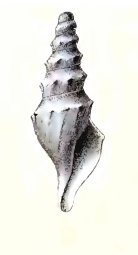
The shell is conical, angular, tuberculate, thin, polished, and glassy. It is polished glassy white, with a translucent dun-coloured apex, and reaches a maximum recorded length of 4.6 mm.[1][2][3]
The shell has a high, relatively narrow, conical spire. Its protoconch comprises approximately two glossy, dun-coloured, globose embryonic whorls, followed by six short whorls that grow slowly.[4][5][6]
Each whorl bears a row of approximately twelve prominent, rounded, blunt-tipped tubercles near its lower edge. These tubercles form an angular keel, and a slightly blunt keel also encircles the base.[7][8][9]
The shell surface bears very indistinct, rounded, flat threads. It lacks longitudinal sculpture apart from fine, scratch-like growth lines.[10][11]
The shell has a contracted conical base extending into a relatively long, slender snout. The aperture is club-shaped and has a long siphonal canal.[12][13]
The outer lip is thin and follows a mostly convex curve.[14]
Habitat
The species occurs in the Atlantic Ocean off northeastern Brazil.[15]
Classification of Spirotropis phaeacra
| Kingdom | Animalia |
|---|---|
| Phylum | Mollusca |
| Class | Gastropoda (Gastropod) |
| Subclass | Caenogastropoda |
| Order | Neogastropoda |
| Superfamily | Conoidea |
| Family | Drilliidae |
| Genus | Spirotropis |
| Species | Spirotropis phaeacra (R. B. Watson, 1881) |
Synonyms
2 other scientific names have been used for this species and are now treated as synonyms of Spirotropis phaeacra.
- Pleurotoma (Drillia) phaeacra R. B. Watson, 1881
- Pleurotoma phaeacra R. B. Watson, 1881
Related species
-
 Spirotropis monterosatoi
-
 Spirotropis studeriana
-
 Spirotropis stirophora
- Spirotropis modiolus
-
 Spirotropis lithocolleta
-
 Spirotropis azorica
-
 Spirotropis centimata
- Spirotropis confusa
Compare
Questions and answers
What is the maximum recorded shell length?
The maximum recorded shell length is 4.6 mm.[1]
Where does Spirotropis phaeacra occur?
It occurs in the Atlantic Ocean off northeastern Brazil.[15]
What colour is the shell?
The shell is polished glassy white, with a translucent dun-coloured apex.[3]
How many whorls does the shell have?
The shell has six short whorls that grow slowly, preceded by a protoconch comprising approximately two embryonic whorls.[5][6]
What characterizes the shell's tubercles?
Each whorl bears approximately twelve prominent, rounded, blunt-tipped tubercles near its lower edge. They form an angular keel.[7][8]
What is the shape of the aperture?
The aperture is club-shaped and has a long siphonal canal.[13]
Sources
Passages the profile rests on
- The shell reaches a maximum recorded length of 4.6 mm. Source passage: “The shell of this micromollusc grows to a length of 4.6 mm.” — English Wikipedia
- The shell is conical, angular, tuberculate, thin, polished, and glassy. Source passage: “The conical, angulated, tubercled shell is thin, polished, glassy” — English Wikipedia
- The shell is polished glassy white, with a translucent dun-coloured apex. Source passage: “The colour of the shell is polished glassy white, with a hyaline dun apex.” — English Wikipedia
- The shell has a high, relatively narrow, conical spire. Source passage: “The spire is high, rather narrow, and conical.” — English Wikipedia
- The protoconch comprises approximately two glossy, dun-coloured, globose embryonic whorls. Source passage: “The protoconch consists of about two glossy, dun-coloured, globose, embryonic whorls.” — English Wikipedia
- The shell has six short whorls that grow slowly. Source passage: “The shell contains 6 short whorls of slow growth” — English Wikipedia
- Each whorl bears a row of approximately twelve prominent, rounded, blunt-tipped tubercles near its lower edge. Source passage: “Toward the bottom of each whorl is a row of about twelve round, blunt-tipped, rather prominent tubercles” — English Wikipedia
- The tubercles form an angular keel on the whorls. Source passage: “which form an angulated keel where otherwise there is no carination.” — English Wikipedia
- The shell also has a slightly blunt keel around its base. Source passage: “There is also a slight blunt keel round the base.” — English Wikipedia
- The shell surface bears very indistinct, rounded, flat threads. Source passage: “Its surface is covered with very obsolete, rounded, flat threads.” — English Wikipedia
- The shell lacks longitudinal sculpture apart from fine, scratch-like growth lines. Source passage: “There is no longitudinal sculpture other than the fine scratch-like lines of growth.” — English Wikipedia
- The shell has a contracted conical base that extends into a relatively long, slender snout. Source passage: “The base, which is a good deal contracted, is conical, and runs out into a fine longish snout.” — English Wikipedia
- The aperture is club-shaped and has a long siphonal canal. Source passage: “The aperture is club-shaped, being somewhat pointedly rhomboidal above, with a longish siphonal canal below.” — English Wikipedia
- The outer lip is thin and follows a mostly convex curve. Source passage: “The outer lip is thin, with a pretty regular convex curve” — English Wikipedia
- The species occurs in the Atlantic Ocean off northeastern Brazil. Source passage: “This species occurs in the Atlantic Ocean off Northeast Brazil” — English Wikipedia
Data
- Catalogue of Life, 2026-10-16 XR cc by
- Wikidata CC0
- Wikimedia Commons per image; credit shown with each image
- Within the Catalogue of Life, this name comes from World Register of Marine Species cc by
This species in other databases
Page built on 29 November 2026. See how the catalog is made and all sources and licences.
Cite this page
ScientificNames.org. (2026). Spirotropis phaeacra. Retrieved November 29, 2026, from https://scientificnames.org/species/spirotropis-phaeacra
“Spirotropis phaeacra.” ScientificNames.org, 2026, scientificnames.org/species/spirotropis-phaeacra. Accessed 29 Nov. 2026.
ScientificNames.org. “Spirotropis phaeacra.” Accessed November 29, 2026. https://scientificnames.org/species/spirotropis-phaeacra.
@misc{scientificnames_spirotropis_phaeacra,
  author = {{ScientificNames.org}},
  title = {Spirotropis phaeacra},
  year = {2026},
  url = {https://scientificnames.org/species/spirotropis-phaeacra},
  note = {Accessed 2026-11-29}
}