Species · Birds
Clay-colored Sparrow Spizella pallida
The scientific name of the Clay-colored Sparrow is Spizella pallida. It is a species of bird in the family Passerellidae (new world sparrow), order Passeriformes. The name dates from 1832.
- Scientific name
- Spizella pallida (Swainson, 1832)
- Common name
- Clay-colored Sparrow
- Genus
- Spizella
- Family
- Passerellidae (New World Sparrow)
- Order
- Passeriformes
- Class
- Aves
- Red List category
- LC Least Concern
- Environment
- terrestrial
- Recorded in
- 13 countries
- Name status
- accepted in the Catalogue of Life

Overview
The breeding range includes central Canada and the central northern United States, extending eastward to the Great Lakes. It has a dark brown crown with a pale central stripe, a white line above the eyes, and a dark eye stripe.
Written 26 November 2026 from the sources listed below. Each statement was checked against the passage it cites; statements that could not be supported were removed.
Appearance
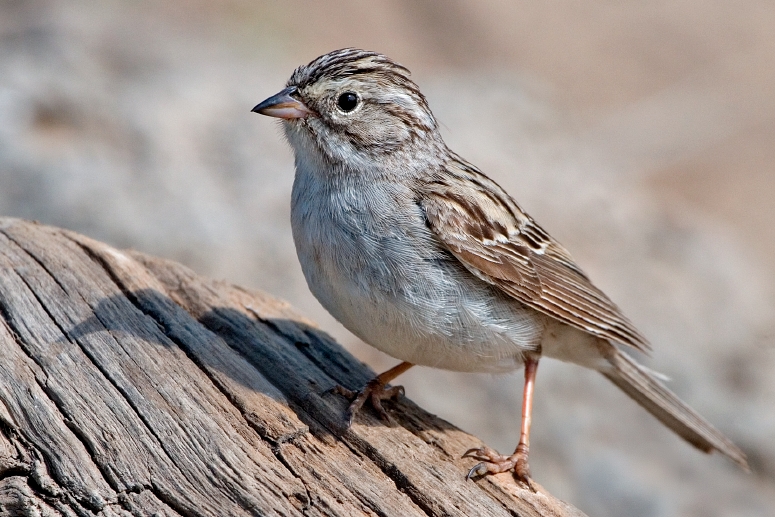
Adults have light brown upperparts, pale underparts, and darker streaks across the back. The crown is dark brown with a pale central stripe.[1][2]
The head has a white line above the eyes, a dark eye stripe, and a light brown cheek patch. The back of the neck is grey and the tail is long.[3][4]
The wings are brown with wing bars. The bill is short and pale with a dark tip.[5][6]
Habitat
Its breeding habitat includes shrubby open areas.[7]
Diet
The species feeds mainly on seeds and insects. Seeds constitute the main component of its diet.[8][9]
Behaviour
The species forages on the ground. During nesting, individuals may forage far from their nests, and nesting individuals do not defend feeding areas.[10][11][12]
Outside the nesting season, individuals often feed in small flocks and may form flocks with Chipping Sparrows and Brewer's Sparrows. The species migrates in flocks.[13][14][15]
Males sing from exposed perches to indicate ownership of nesting territories.[16]
Reproduction and life cycle
The species builds open-cup nests on the ground or in low shrubs. Nests are constructed from grasses and lined with fine materials or hair.[17][18][19]
A typical clutch contains three to five blue-green eggs with splotches. Egg incubation lasts 11 days.[20][21][22]
The species' nests are often parasitized by brown-headed cowbirds. A nest may be abandoned following parasitism.[23][24]
Similar species
Non-breeding adults and immature birds resemble Chipping Sparrows and Brewer's Sparrows. Outside the nesting season, the species often forms flocks with both species.[25][26][14]
Conservation
The species is common within suitable habitat in Montana. Its populations are stable to increasing, and no threats are identified for the species in the Montana field guide.[27][28][29]
Classification of the Clay-colored Sparrow
| Kingdom | Animalia |
|---|---|
| Phylum | Chordata |
| Subphylum | Vertebrata |
| Infraphylum | Gnathostomata |
| Parvphylum | Osteichthyes |
| Megaclass | Tetrapoda |
| Class | Aves (Bird) |
| Order | Passeriformes (Passerine) |
| Family | Passerellidae (New World Sparrow) |
| Genus | Spizella (Chipping Sparrows) |
| Species | Spizella pallida (Swainson, 1832) |
Where the Clay-colored Sparrow is found
Checklists and occurrence records place Spizella pallida in 13 countries across North America. GBIF holds 553,506 georeferenced records of it.
Countries
- Bahamas 39
- Belize 34
- Bermuda 49
- Canada 208,969
- Cayman Islands 13
- Costa Rica 28
- Cuba 91
- Curacao 4
- Guatemala 9
- Honduras 7
- Mexico 17,821
- Saint Pierre and Miquelon 18
- United States 326,424
Regions and cities with the most records
- Alberta, Canada 97,063
- Texas, United States 54,778
- Minnesota, United States 51,273
- Wisconsin, United States 45,212
- Saskatchewan, Canada 37,444
- Manitoba, Canada 33,693
- North Dakota, United States 25,857
- Calgary, Canada 24,529
- Ontario, Canada 21,806
- Colorado, United States 19,100
- Michigan, United States 13,170
- British Columbia, Canada 12,551
- Montana, United States 12,354
- Kansas, United States 11,553
- Chestermere, Canada 10,334
- California, United States 10,042
- Nebraska, United States 9,419
- Edmonton, Canada 8,515
- Illinois, United States 8,154
- Winnipeg, Canada 7,993
- Cottage Grove, United States 7,736
- South Dakota, United States 6,775
- Inver Grove Heights, United States 6,630
- Sherwood Park, Canada 6,347
- South Saint Paul, United States 6,303
- New Mexico, United States 6,224
- St. Albert, Canada 6,165
- Eagan, United States 5,870
- West Saint Paul, United States 5,815
- Woodbury, United States 5,788
- Cochrane, Canada 5,709
- Oklahoma, United States 5,643
- New York, United States 5,589
- Oakdale, United States 5,478
- Hastings, United States 5,472
- Rosemount, United States 5,463
Range as the checklists state it
North America
A number beside a place is its count of GBIF occurrence records. A place without a number comes from a checklist alone. Records show where a species has been observed or collected, which can include escapes and vagrants.
Common names
English
- Clay-colored Sparrow
- Clay-coloured Sparrow
Names in 26 other languages
- Catalan
- Sit pàl·lid, sit de les planes
- Chinese
- 泥色雀鵐, 褐雀鹀
- Croatian
- sivovrati strnadar
- Czech
- strnádka pruhohlavá
- Danish
- Hvidbrynet Træspurv
- Dutch
- Bleke Gors
- Esperanto
- pala paserelo
- Finnish
- sirkkasirkkuli
- French
- Bruantin des plaines, bruant des plaines
- German
- Fahlammer
- Hungarian
- agyagszínű verébsármány
- Italian
- Passero argilla, Passero color argilla
- Japanese
- ウスヒメドリ
- Latvian
- blāvais zvirbulis
- Lithuanian
- blyškioji žvirblinė starta
- Norwegian
- grånakkespurv
- Polish
- spizela blada
- Portuguese
- Pardal-pálido, tico-tico-argiloso, tico-tico-pálido
- Russian
- Бледная воробьиная овсянка, Бледная малая овсянка, Бурая овсянка
- Serbian
- Vrapcoliki strnad
- Slovak
- strnádlik bledý
- Spanish
- Chingolo pálido, Gorrión pálido
- Swedish
- lerfärgad sparv
- Turkish
- Kil Rengi Serçe
- Ukrainian
- карнатка бліда
- Welsh
- bras llwydaidd
Synonyms
One other scientific name has been used for this species and is now treated as a synonym of Spizella pallida.
- Emberiza pallida Swainson, 1832
Related species
-
 Chipping SparrowSpizella passerina
-
 Field SparrowSpizella pusilla
-
 Brewer's SparrowSpizella breweri
-
 Black-chinned SparrowSpizella atrogularis
-
 Worthen's SparrowSpizella wortheni
-
 Dark-eyed JuncoJunco hyemalis
-
 White-throated SparrowZonotrichia albicollis
-
 White-crowned SparrowZonotrichia leucophrys
Compare
Questions and answers
What is the scientific name of the Clay-colored Sparrow?
The scientific name of the Clay-colored Sparrow is Spizella pallida. Written with its author, the full name is Spizella pallida (Swainson, 1832).
Which family does the Clay-colored Sparrow belong to?
Spizella pallida belongs to the family Passerellidae, in the order Passeriformes and the class Aves.
Where is the Clay-colored Sparrow found?
Checklists and occurrence records place Spizella pallida in 13 countries, including United States, Canada, Mexico, Cuba, Bermuda and Bahamas.
What is the conservation status of the Clay-colored Sparrow?
The IUCN Red List category recorded for Spizella pallida is Least Concern (LC).
What other names does the Clay-colored Sparrow have?
Spizella pallida is also known in English as Clay-coloured Sparrow.
What does a clay-colored sparrow look like?
Adults have light brown upperparts, pale underparts, and darker streaks across the back. They have a dark brown crown with a pale central stripe, a white line above the eyes, a dark eye stripe, and a light brown cheek patch. Their wings are brown with wing bars, their bills are short and pale with dark tips, and their tails are long.[1][2][3][5][6][4]
What are the key differences between a chipping sparrow and a clay-colored sparrow?
Non-breeding adult and immature Clay-colored Sparrows resemble Chipping Sparrows. The appearance of Chipping Sparrows is not described here, so specific distinguishing features cannot be stated.[25]
Sources
Passages the profile rests on
- Adults have light brown upperparts, pale underparts, and darker streaks across the back. Source passage: “Adults have light brown upperparts and pale underparts, with darker streaks on the back.” — English Wikipedia
- The crown is dark brown with a pale central stripe. Source passage: “They have a pale crown stripe on a dark brown crown” — English Wikipedia
- The head has a white line above the eyes, a dark eye stripe, and a light brown cheek patch. Source passage: “a white line over the eyes, a dark line through the eyes, a light brown cheek patch” — English Wikipedia
- The back of the neck is grey and the tail is long. Source passage: “the back of the neck is grey; they have a long tail.” — English Wikipedia
- The wings are brown and have wing bars. Source passage: “brown wings with wing bars.” — English Wikipedia
- The bill is short and pale with a dark tip. Source passage: “The short bill is pale with a dark tip” — English Wikipedia
- Its breeding habitat includes shrubby open areas. Source passage: “Their breeding habitat is shrubby open areas” — English Wikipedia
- The species feeds mainly on seeds and insects. Source passage: “They forage on the ground, mainly eating seeds and insects.” — English Wikipedia
- Seeds constitute the main component of its diet, although the diet is not described in detail. Source passage: “The diet of a Clay-colored Sparrow is not known in detail, but feeds mostly on seeds” — audubon.org
- The species forages on the ground. Source passage: “They forage on the ground” — English Wikipedia
- During nesting, individuals may forage far from their nests. Source passage: “While nesting, these birds may feed far from the nest” — English Wikipedia
- Feeding areas are not defended by nesting individuals. Source passage: “feeding areas are not defended.” — English Wikipedia
- Outside the nesting season, individuals often feed in small flocks. Source passage: “Outside the nesting season, they often feed in small flocks.” — English Wikipedia
- Outside the nesting season, the species often forms flocks with Chipping Sparrows and Brewer's Sparrows. Source passage: “they often form flocks with these birds outside the nesting season.” — English Wikipedia
- The species migrates in flocks. Source passage: “These birds migrate in flocks” — English Wikipedia
- Males sing from exposed perches to indicate ownership of nesting territories. Source passage: “The male sings from an open perch to indicate his ownership of the nesting territory.” — English Wikipedia
- The species builds open-cup nests on the ground or in low shrubs. Source passage: “The nest is an open cup on the ground or low in a shrub.” — English Wikipedia
- Nests are constructed from grasses. Source passage: “This bird's nests are made of grasses” — English Wikipedia
- Nest interiors are lined with fine materials or hair. Source passage: “lined with fine materials or hair.” — English Wikipedia
- A typical clutch contains three to five eggs. Source passage: “Three to five splotched blue-green eggs are laid” — English Wikipedia
- The eggs are blue-green and have splotches. Source passage: “Three to five splotched blue-green eggs are laid” — English Wikipedia
- Egg incubation lasts 11 days. Source passage: “incubated for 11 days.” — English Wikipedia
- The species' nests are often parasitized by brown-headed cowbirds. Source passage: “They are often parasitized by the brown-headed cowbird” — English Wikipedia
- A nest may be abandoned following brown-headed cowbird parasitism. Source passage: “the nest may be abandoned when this happens.” — English Wikipedia
- Non-breeding adults and immature birds resemble Chipping Sparrows. Source passage: “Non-breeding adults and immature resemble chipping sparrows” — English Wikipedia
- Non-breeding adults and immature birds resemble Brewer's Sparrows. Source passage: “and Brewer's sparrows;” — English Wikipedia
- The species is common within suitable habitat in Montana. Source passage: “Species is common within suitable habitat.” — fieldguide.mt.gov
- Its populations are stable to increasing. Source passage: “Populations are stable to increasing.” — fieldguide.mt.gov
- No threats are identified for the species in the Montana field guide. Source passage: “No threats are identified.” — fieldguide.mt.gov
Data
- Catalogue of Life, 2026-10-16 XR cc by
- Global Biodiversity Information Facility CC BY 4.0
- Wikidata CC0
- GeoNames CC BY 4.0
- Wikimedia Commons per image; credit shown with each image
- Within the Catalogue of Life, this name comes from The Integrated Taxonomic Information System cc0
References
- Fauna Bor.-Am., 2(1831): 251. 1832 where the name was published
- Banks, R. C., R. W. McDiarmid, and A. L. Gardner. (1987). Checklist of Vertebrates of the United States, the U.S. Territories, and Canada. Resource Publication, No. 166.
- Gibson, Daniel D., and Brina Kessel. (1992). Seventy-four new avian taxa documented in Alaska 1976-1991. The Condor, Vol. 94, No. 2.
- Gill, Frank, & and Minturn Wright. (2006). Birds of the World: Recommended English Names.
- Dickinson, E. C., and L. Christidis, eds. (2014). The Howard and Moore Complete Checklist of the Birds of the World, 4th Edition, Vol. 2 Passerines.
This species in other databases
- Catalogue of Life 6ZCJB
- Wikidata Q551729
- iNaturalist 9148
- WoRMS urn:lsid:marinespecies.org:taxname:1484582
- Avibase clcspa
Page built on 27 November 2026. See how the catalog is made and all sources and licences.
Cite this page
ScientificNames.org. (2026). Spizella pallida (Clay-colored Sparrow). Retrieved November 27, 2026, from https://scientificnames.org/species/spizella-pallida
“Spizella pallida (Clay-colored Sparrow).” ScientificNames.org, 2026, scientificnames.org/species/spizella-pallida. Accessed 27 Nov. 2026.
ScientificNames.org. “Spizella pallida (Clay-colored Sparrow).” Accessed November 27, 2026. https://scientificnames.org/species/spizella-pallida.
@misc{scientificnames_spizella_pallida_clay_colored_sparrow,
  author = {{ScientificNames.org}},
  title = {Spizella pallida (Clay-colored Sparrow)},
  year = {2026},
  url = {https://scientificnames.org/species/spizella-pallida},
  note = {Accessed 2026-11-27}
}