Species · Mammals
Rough-toothed Dolphin Steno bredanensis
The scientific name of the Rough-toothed Dolphin is Steno bredanensis. It is a species of mammal in the family Delphinidae (oceanic dolphin), order Cetacea. The name dates from 1828.
- Scientific name
- Steno bredanensis (G. Cuvier in Lesson, 1828)
- Common name
- Rough-toothed Dolphin
- Genus
- Steno
- Family
- Delphinidae (Oceanic Dolphin)
- Order
- Cetacea
- Class
- Mammalia
- Red List category
- LC Least Concern
- Environment
- marine
- Recorded in
- 34 countries
- Name status
- accepted in the Catalogue of Life

Overview
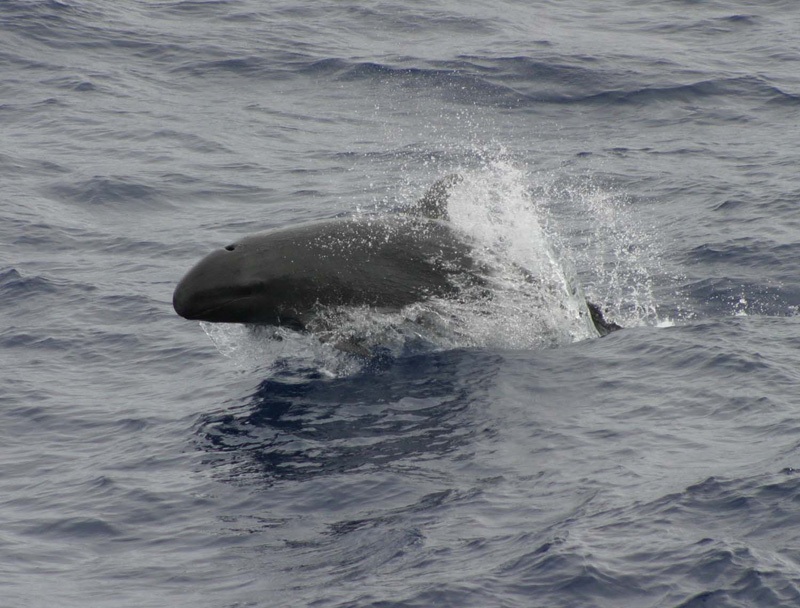
Steno bredanensis inhabits deep, warm, tropical waters in the Pacific, Atlantic, and Indian Oceans and the Mediterranean Sea. It is distinguished by its conical head, slender nose, and teeth with numerous narrow, irregular ridges.
Written 26 November 2026 from the sources listed below. Each statement was checked against the passage it cites; statements that could not be supported were removed.
Appearance
The Rough-toothed Dolphin has a conical head and slender nose. Its teeth have rough surfaces formed by numerous narrow, irregular ridges, with between 19 and 28 teeth in each quarter of the jaw.[1][2][3]
The species has a dark gray body with light gray flanks and white or light-colored spots on its sides. Its back and dorsal fin are darker gray, and the dorsal fin measures between 18 and 28 centimetres in height.[4][5][6]
The upper jaw is blue and gray, while the lower jaw is usually white or pale pink and white. Older individuals may develop pinkish, yellow, or white markings around the mouth and underside.[7][8][9]
A dark, narrow cape passes over the eyes and arches high along the sides of the body. Some individuals have white and yellowish scars associated with encounters with large squid, cookie-cutter sharks, other rough-toothed dolphins, and boats.[10][11]
Adult individuals range from 2.09 to 2.83 metres in length and weigh between 90 and 155 kilograms. Males are larger than females.[12][13][14]
Habitat
The Rough-toothed Dolphin is pelagic and typically inhabits open-ocean, deep-water environments. It prefers deep ocean waters exceeding 1,500 metres, and individuals have been recorded at depths reaching 2,000 metres.[15][16][17]
The species inhabits deep, warm, tropical waters and prefers sea surface temperatures of approximately 25°C during the warm season. During the cold season, individuals have been recorded in waters between 17 and 24°C.[18][19][20]
Live sightings are almost universally recorded offshore, beyond the continental shelf, in waters at least one kilometre deep.[21]
Diet
Recorded stomach contents include silversides, sauries, houndfish, smelts, cutlassfish, squid, and octopuses. Young dolphins begin eating fish at approximately two months of age.[22][23]
Behaviour
Rough-toothed dolphins are typically social, although solitary individuals are also observed. Their average group size is between 10 and 20 individuals, while groups can contain between 2 and 90 dolphins.[24][25]
Groups may consist of smaller, relatively permanent associations of two to eight closely related individuals. The species sometimes forms mixed groups with other dolphin species, pilot whales, false killer whales, and humpback whales.[26][27]
The species commonly travels in groups of 10 to 30 individuals, with occasional sightings of groups containing up to 160 dolphins. It commonly skims the water surface with its head and chin raised above it.[28][29]
Individuals can remain underwater for at least 15 minutes and dive to depths of at least 50 metres. The species does not defend a territory.[30][31][32]
Rough-toothed dolphins have been observed supporting injured dolphins at the surface so that they can breathe. Individuals have also been observed supporting deceased dolphins at the water's surface for periods ranging from several hours to several days.[33][34]
In one natural-habitat study, travelling accounted for 26.6% of observed activity and feeding accounted for 14.9%.[35][36]
Reproduction and life cycle
Female Rough-toothed Dolphins give birth to a single offspring per birth. Newborn dolphins measure approximately 100 centimetres in length.[37][38]
Female Rough-toothed Dolphins reach sexual maturity between six and ten years of age, at a body length of 212 to 217 centimetres and a weight of 101 to 108 kilograms. Males reach sexual maturity between five and ten years of age, at a body length of approximately 216 centimetres and a weight of 92 to 102 kilograms.[39][40][41][42]
Female Rough-toothed Dolphins protect their calves by remaining close and positioning themselves between their young and other dolphins. Calves can successfully nurse within three days of birth, with nursing occurring underwater throughout the day.[43][44]
Similar species
Rough-toothed Dolphins may be confused with spinner, spotted, and bottlenose dolphins at sea. The species is commonly misidentified as bottlenose, spinner, and spotted dolphins.[45][46]
Conservation
The species is not believed to be threatened by human activities. Some individuals have been caught in seine nets by tuna-fishing trawlers, and a small number have been harpooned by Japanese whalers.[47][48][49]
The species is covered by the Agreement on the Conservation of Small Cetaceans of the Baltic, North East Atlantic, Irish and North Seas (ASCOBANS). It is also included in the Agreement on the Conservation of Cetaceans in the Black Sea, Mediterranean Sea and Contiguous Atlantic Area (ACCOBAMS).[50][51]
Six rescued Rough-toothed Dolphins that cannot be released live at Clearwater Marine Aquarium.[52]
Classification of the Rough-toothed Dolphin
| Kingdom | Animalia |
|---|---|
| Phylum | Chordata |
| Subphylum | Vertebrata |
| Infraphylum | Gnathostomata |
| Parvphylum | Osteichthyes |
| Megaclass | Tetrapoda |
| Class | Mammalia (Mammal) |
| Subclass | Theria |
| Infraclass | Eutheria |
| Order | Cetacea (Cetacean) |
| Suborder | Odontoceti (Toothed Whales) |
| Family | Delphinidae (Oceanic Dolphin) |
| Genus | Steno (Rough-toothed Dolphins) |
| Species | Steno bredanensis (G. Cuvier in Lesson, 1828) |
Where the Rough-toothed Dolphin is found
Checklists and occurrence records place Steno bredanensis in 34 countries. GBIF holds 3,845 georeferenced records of it.
Countries
- American Samoa 10
- Australia 41
- Bahamas 25
- Belize 3
- Brazil 233
- Chile 3
- Colombia 23
- Costa Rica 40
- Cuba 40
- Cyprus 3
- Ecuador 10
- El Salvador 7
- France 21
- French Guiana 23
- French Polynesia 147
- Guadeloupe 199
- Guam 5
- Guatemala 12
- Honduras 8
- Martinique 10
- Mexico 357
- New Caledonia 6
- Nicaragua 7
- Northern Mariana Islands 17
- Panama 15
- Portugal 1,126
- Solomon Islands 6
- Spain 76
- Suriname 11
- The Netherlands 4
- Trinidad and Tobago 7
- United Kingdom 26
- United States 1,319
- Wallis and Futuna 5
Regions and cities with the most records
- Caniço, Portugal 1,117
- São Martinho, Portugal 1,117
- Funchal, Portugal 1,116
- Santo António, Portugal 1,116
- Câmara de Lobos, Portugal 1,115
- Baie-Mahault, Guadeloupe 53
- Les Abymes, Guadeloupe 52
- Campeche, Mexico 48
- São Paulo, Brazil 48
- Rio de Janeiro, Brazil 40
- North Carolina, United States 31
- Ilhabela, Brazil 30
- Petit-Bourg, Guadeloupe 30
- Pointe-à-Pitre, Guadeloupe 30
- Sainte-Anne, Guadeloupe 29
- São Sebastião, Brazil 29
- Le Gosier, Guadeloupe 27
- Sainte-Rose, Guadeloupe 27
- Le Moule, Guadeloupe 25
- Basse-Terre, Guadeloupe 24
- Mogán, Spain 24
- Maspalomas, Spain 19
- Îles du Vent, French Polynesia 19
- Ipanema, Brazil 18
- Leblon, Brazil 18
- Botafogo, Brazil 17
- Estácio, Brazil 17
- Los Llanos de Aridane, Spain 17
- Rocinha, Brazil 17
- Vidigal, Brazil 17
- Catete, Brazil 16
- Playa del Ingles, Spain 16
- Rio de Janeiro, Brazil 16
- Santa Teresa, Brazil 16
- Leeward Islands, French Polynesia 14
- Niterói, Brazil 14
17 more countries have a few records outside this range
These countries hold a few records of Steno bredanensis but lie outside the range the checklists give for it. Such records are often zoo or garden specimens, museum material or vagrants, so the species is not counted as occurring there.
Range as the checklists state it
Eastern Atlantic Ocean
Western Atlantic Ocean
Indo-West Pacific
East Pacific
A number beside a place is its count of GBIF occurrence records. A place without a number comes from a checklist alone. Records show where a species has been observed or collected, which can include escapes and vagrants.
Common names
English
- Rough-toothed Dolphin
- Black Porpoise
Names in 29 other languages
- Afrikaans
- growwetand-dolfyn
- Arabic
- دلفين خشن الأسنان
- Catalan
- Dofí rostrat
- Chinese
- 糙齒海豚, 糙齿海豚
- Czech
- delfín drsnozubý
- Dutch
- snaveldolfijn
- Finnish
- rosohammasdelfiini
- French
- Sténo à rostre étroit, dauphin a dents rudes, dauphin à bec étroit, dauphin à long bec, delphinorhynche long-bec, sténo
- German
- Rauzahn-Delfin, Rauzahndelfin
- Greek
- Στενόρυγχο δελφίνι
- Hebrew
- דולפין תלום-שן
- Hungarian
- Barázdásfogú delfin
- Icelandic
- Nefhöfrungur
- Indonesian
- Lumba-lumba Gigi-kasar, lumba-lumba bergigi kasar
- Italian
- steno
- Japanese
- shiwaha iruka, シワハイルカ
- Korean
- baem-meori-dolgorai, 뱀머리돌고래
- Lithuanian
- raukšliadantis delfinas
- Norwegian
- stroppetannet delfin
- Norwegian Bokmål
- Nebbdelfin
- Polish
- Delfin długonosy, steno długonosy
- Portuguese
- Caldeirão, Golfinho-de-dentes-rugosos, golfinho de dentes rugosos
- Russian
- grebnezubyi delfin, Крупнозубый дельфин
- Slovenian
- brazdastozobi delfin
- Spanish
- Delfín dientes rugosos, delfin bastardo, delfin de dientes asperos, delfín de dientes rugosos, delfín de hocico estrecho, delfín de pico largo, esteno, mala tonina
- Swedish
- näbbdelfin
- Thai
- plaloma chud, plaloma fan hang, โลมาฟันห่าง
- Turkish
- pürüzlü dişli yunus
- Ukrainian
- Гребнезубий дельфін, Дельфін крупно-гребенезубий, морщиністозубий дельфін
Synonyms
18 other scientific names have been used for this species and are now treated as synonyms of Steno bredanensis.
- Delphinorhynchus bredanensis Lesson, 1828
- Delphinus bredanensis G. Cuvier in Lesson, 1828
- Delphinus bredanensis Lesson, 1828
- Delphinus chamissonis Wiegmann in Schreber & Wagner, 1846
- Delphinus compressus Gray, 1843
- Delphinus oxyrhynchus Gray, 1850
- Delphinus perspicillatus Peters, 1876
- Delphinus planiceps Van Breda, 1829
- Delphinus reinwardtii Schlegel, 1841
- Delphinus rostratus Desmarest, 1817
- Steno bradanensis (Lesson, 1828)
- Steno compressus Gray, 1846
- Steno frontatus Blyth, 1863
- Steno perspicillatus (Peters, 1876)
- Steno perspicillatus True, 1889
- Steno rostratus Desmarest, 1817
- Steno rostratus Gray, 1846
- Steno rostratus Lutken, 1889
Related species
-
 Killer WhaleOrcinus orca
-
 False Killer WhalePseudorca crassidens
-
 Common Bottlenose DolphinTursiops truncatus
-
 Irrawaddy DolphinOrcaella brevirostris
-
 Risso's DolphinGrampus griseus
-
 Common DolphinDelphinus delphis
-
 Melon-headed WhalePeponocephala electra
-
 Hector's DolphinCephalorhynchus hectori
Compare
Questions and answers
What is the scientific name of the Rough-toothed Dolphin?
The scientific name of the Rough-toothed Dolphin is Steno bredanensis. Written with its author, the full name is Steno bredanensis (G. Cuvier in Lesson, 1828).
Which family does the Rough-toothed Dolphin belong to?
Steno bredanensis belongs to the family Delphinidae, in the order Cetacea and the class Mammalia.
Where is the Rough-toothed Dolphin found?
Checklists and occurrence records place Steno bredanensis in 34 countries, including United States, Portugal, Mexico, Brazil, Guadeloupe and French Polynesia.
What is the conservation status of the Rough-toothed Dolphin?
The IUCN Red List category recorded for Steno bredanensis is Least Concern (LC).
What other names does the Rough-toothed Dolphin have?
Steno bredanensis is also known in English as Black Porpoise.
What are rough-toothed dolphins?
The Rough-toothed Dolphin (Steno bredanensis) is a mammal in the family Delphinidae. It is distinguished by its conical head, slender nose, and teeth with rough surfaces formed by numerous narrow, irregular ridges.[1][2]
What do rough-toothed dolphins eat?
Recorded stomach contents include silversides, sauries, houndfish, smelts, cutlassfish, squid, and octopuses. Young dolphins begin eating fish at approximately two months of age.[22][23]
What do dolphins eat on their diet?
Recorded foods of Rough-toothed Dolphins include silversides, sauries, houndfish, smelts, cutlassfish, squid, and octopuses.[22]
Where do rough-toothed dolphins live?
They occur in the Pacific, Atlantic, and Indian Oceans and the Mediterranean Sea. They are frequently sighted around Kaua'i, Ni'ihau, and O'ahu in the Hawaiian Islands, as well as Tahiti, Moorea, the Mediterranean Sea, the Sicily Channel, and the Windward Islands.[53][54]
Sources
Passages the profile rests on
- The rough-toothed dolphin has a conical head and a slender nose that distinguish it from other dolphins. Source passage: “Its most visible characteristic feature is its conical head and slender nose” — English Wikipedia
- The species has teeth with rough surfaces formed by numerous narrow, irregular ridges. Source passage: “the teeth are also distinctive, having a roughened surface formed by numerous narrow irregular ridges.” — English Wikipedia
- Each quarter of the jaw contains between 19 and 28 teeth. Source passage: “They have been reported to have between nineteen and twenty-eight teeth in each quarter of the jaw.” — English Wikipedia
- The dorsal fin measures between 18 and 28 centimetres in height. Source passage: “The dorsal fin is pronounced, being from 18 to 28 centimetres (7.1 to 11.0 in) in height.” — English Wikipedia
- The flanks are light gray, while the back and dorsal fin are darker gray. Source passage: “The animal's flanks are a light gray, while the back and dorsal fin are a much darker gray.” — English Wikipedia
- The species has a dark gray body with white or light-colored spots on its sides. Source passage: “The body of rough-toothed dolphins is dark grey with white or light colored spots on their sides.” — animaldiversity.org
- The lower jaw is usually white, sometimes with a pinkish coloration. Source passage: “The color of the lower jaw is usually white, but can have a hint of pink mixed in.” — English Wikipedia
- Older individuals may develop pinkish, yellow, or white markings around the mouth and underside. Source passage: “Older individuals often have distinctive pinkish, yellow, or white markings around the mouth and along the underside.” — English Wikipedia
- The upper jaw is blue and gray, while the lower jaw is pale pink and white. Source passage: “The elongated beak is dual colored; the upper jaw is blue and gray while the lower is pale pink and white.” — animaldiversity.org
- The species has a dark, narrow cape that passes over the eyes and arches high along the sides of the body. Source passage: “Rough-toothed dolphins have a distinctive color pattern, consisting of a dark narrow cape which passes over the eyes and arches high on the sides of the body.” — animaldiversity.org
- Some individuals have white and yellowish scars associated with encounters with large squid, cookie-cutter sharks, other rough-toothed dolphins, and boats. Source passage: “Some of these animals show white and yellowish scars, due to encounters with large squid , cookie-cutter sharks , other rough-toothed dolphins, and interactions with boats.” — animaldiversity.org
- Adult individuals range from 2.09 to 2.83 metres in length. Source passage: “adults ranging from 2.09 to 2.83 metres (6.9 to 9.3 ft) in length” — English Wikipedia
- Adults weigh between 90 and 155 kilograms. Source passage: “weighing between 90 and 155 kilograms (198 and 342 lb)” — English Wikipedia
- Male rough-toothed dolphins are larger than females. Source passage: “males are larger than females.” — English Wikipedia
- Rough-toothed dolphins prefer deep ocean waters exceeding 1,500 metres. Source passage: “Although rough-toothed dolphins reside in both shallow and deep ocean waters, they prefer deep waters greater than 1500 m in depth.” — animaldiversity.org
- Individuals have been recorded at depths reaching 2,000 metres. Source passage: “They have been found at depths of up to 2000 m.” — animaldiversity.org
- The species is pelagic and typically inhabits open-ocean, deep-water environments. Source passage: “The rough-toothed dolphin (Steno bredanensis) is a pelagic species of cetacean that typically inhabits open-ocean, deep-water environments in ...” — ecscholar.eckerd.edu
- The species inhabits deep, warm, tropical waters. Source passage: “lives in deep warm and tropical waters around the world.” — English Wikipedia
- The species prefers sea surface temperatures of approximately 25°C during the warm season. Source passage: “They prefer sea surface temperatures of 25 ̊C during the warm season” — animaldiversity.org
- During the cold season, individuals have been recorded in waters between 17 and 24°C. Source passage: “but have been discovered during the cold season in waters ranging from 17 to 24 ̊C.” — animaldiversity.org
- Live sightings are almost universally recorded offshore, beyond the continental shelf, in waters at least one kilometre deep. Source passage: “Live sightings are almost universally made far off-shore, beyond the continental shelf, in water at least 1 kilometre (0.62 mi) deep.” — English Wikipedia
- Recorded stomach contents include silversides, sauries, houndfish, smelts, cutlassfish, squid, and octopuses. Source passage: “the stomach contents of stranded dolphins have included such fish such as silversides, sauries, houndfish, smelts, cutlassfish, and various squid and octopuses.” — English Wikipedia
- Young dolphins begin eating fish at approximately two months of age. Source passage: “At 2 months of age, calves begin to eat fish and decrease nursing time.” — animaldiversity.org
- Rough-toothed dolphins are typically social, although solitary individuals are also observed. Source passage: “Rough-toothed dolphins are typically social animals, although solitary individuals are also sighted.” — English Wikipedia
- Their average group size is between 10 and 20 individuals, although groups can contain between 2 and 90 dolphins. Source passage: “An average group has between ten and twenty members, but they can vary from as few as two to as many as ninety.” — English Wikipedia
- Groups may consist of smaller, relatively permanent associations of two to eight closely related individuals. Source passage: “composed of smaller, more permanent groups of two to eight closely related individuals that occasionally join with others.” — English Wikipedia
- The species sometimes forms mixed groups with other dolphin species, pilot whales, false killer whales, and humpback whales. Source passage: “They have also been reported to school together with other species of dolphin, and with pilot whales, false killer whales, and humpback whales.” — English Wikipedia
- Rough-toothed dolphins commonly skim the water surface with their heads and chins raised above it. Source passage: “They do, however, commonly "skim", by swimming with their heads and chin above the surface of the water.” — English Wikipedia
- The species commonly travels in groups of 10 to 30 individuals, with occasional sightings of groups containing up to 160 dolphins. Source passage: “Rough-toothed dolphins are most commonly seen in groups of 10 to 30 individuals, though pods of up to 160 dolphins have been spotted containing eight smaller groups.” — animaldiversity.org
- Individuals can remain underwater for at least 15 minutes. Source passage: “be able to stay underwater for at least fifteen minutes.” — English Wikipedia
- Rough-toothed dolphins can dive to depths of at least 50 metres. Source passage: “They are known to be able to dive to at least 50 metres (160 ft)” — English Wikipedia
- The species does not defend a territory. Source passage: “Members of this species do not defend a territory.” — animaldiversity.org
- Rough-toothed dolphins have been observed supporting injured dolphins at the surface so that they can breathe. Source passage: “as they swim below injured dolphins, supporting them at the surface so they can breathe.” — animaldiversity.org
- Individuals have been observed supporting deceased dolphins at the water's surface for periods ranging from several hours to several days. Source passage: “Rough-toothed dolphins have also been observed supporting deceased dolphins at the water's surface for several hours up to several days.” — animaldiversity.org
- Travelling accounted for 26.6% of observed activity in one natural-habitat study. Source passage: “travelling comprised 26.6% of total time the dolphins were observed.” — animaldiversity.org
- Feeding accounted for 14.9% of observed activity in the same study. Source passage: “Feeding comprised 14.9% of their activity budget.” — animaldiversity.org
- Female rough-toothed dolphins give birth to a single offspring per birth. Source passage: “Rough-toothed dolphins give birth to a single young” — English Wikipedia
- Newborn dolphins measure approximately 100 centimetres in length. Source passage: “The young are about 100 centimetres (39 in) long at birth” — English Wikipedia
- Female rough-toothed dolphins reach sexual maturity between six and ten years of age. Source passage: “Females reach sexual maturity somewhere between six and ten years of age” — English Wikipedia
- Male rough-toothed dolphins reach sexual maturity between five and ten years of age. Source passage: “and males between five and ten years.” — English Wikipedia
- Females reach sexual maturity at a body length of 212 to 217 centimetres and a weight of 101 to 108 kilograms. Source passage: “Females reach sexual maturity at 9 to 10 years of age at a length of 212 to 217 cm and a weight of 101 to 108 kg.” — animaldiversity.org
- Males reach sexual maturity at a body length of approximately 216 centimetres and a weight of 92 to 102 kilograms. Source passage: “Males reach sexual maturity at 5 to 10 years of age at a length of about 216 cm and a weight of 92 to 102 kg.” — animaldiversity.org
- Female rough-toothed dolphins protect their calves by remaining close and positioning themselves between their young and other dolphins. Source passage: “In captivity, female rough-toothed dolphins protect their calves by swimming in close proximity to their young and positioning themselves between the calf and other dolphins.” — animaldiversity.org
- Calves can successfully nurse within three days of birth, with nursing occurring underwater throughout the day. Source passage: “Within the first 3 days, calves can successfully nurse, which takes place underwater and occurs throughout the day.” — animaldiversity.org
- Rough-toothed dolphins may be confused with spinner, spotted, and bottlenose dolphins at sea. Source passage: “at sea this dolphin may be confused with spinner, spotted and bottlenose dolphins.” — English Wikipedia
- The species is commonly misidentified as bottlenose, spinner, and spotted dolphins. Source passage: “Rough-toothed dolphins are commonly misidentified as bottlenose dolphins , spinner dolphins , and spotted dolphins” — animaldiversity.org
- The species is not believed to be threatened by human activities. Source passage: “The population is not believed to be threatened by human activities.” — English Wikipedia
- Some rough-toothed dolphins have been caught in seine nets by tuna-fishing trawlers. Source passage: “Others have been caught in seine nets by trawlers fishing for tuna.” — English Wikipedia
- A small number of individuals have been harpooned by Japanese whalers. Source passage: “A small number of individuals have been harpooned by Japanese whalers” — English Wikipedia
- The species is covered by the Agreement on the Conservation of Small Cetaceans of the Baltic, North East Atlantic, Irish and North Seas (ASCOBANS). Source passage: “The rough-toothed dolphin is covered by the Agreement on the Conservation of Small Cetaceans of the Baltic, North East Atlantic, Irish and North Seas (ASCOBANS)” — English Wikipedia
- The species is included in the Agreement on the Conservation of Cetaceans in the Black Sea, Mediterranean Sea and Contiguous Atlantic Area (ACCOBAMS). Source passage: “and the Agreement on the Conservation of Cetaceans in the Black Sea, Mediterranean Sea and Contiguous Atlantic Area (ACCOBAMS).” — English Wikipedia
- Six rescued rough-toothed dolphins that cannot be released live at Clearwater Marine Aquarium. Source passage: “There are six rough toothed dolphins located at the Clearwater Marine Aquarium, all of which are rescues that have been determined to be non-releasable.” — English Wikipedia
- The species occurs in the Pacific, Atlantic, and Indian Oceans and the Mediterranean Sea. Source passage: “They inhabit the Pacific, Atlantic, and Indian Oceans, and in the Mediterranean Sea” — English Wikipedia
- The species has been frequently sighted around Kaua'i, Ni'ihau, and O'ahu in the Hawaiian Islands, as well as Tahiti, Moorea, the Mediterranean Sea, the Sicily Channel, and the Windward Islands. Source passage: “They have been frequently sighted along various coastal areas such as Kaua’i, Ni’ihau, and O’ahu of the Hawaiian Islands, the Mediterranean Sea, the Sicily Channel, Tahiti, Moorea, and the Windward Islands.” — animaldiversity.org
Data
- Catalogue of Life, 2026-10-16 XR cc by
- Global Biodiversity Information Facility CC BY 4.0
- Wikidata CC0
- GeoNames CC BY 4.0
- Wikimedia Commons per image; credit shown with each image
- Within the Catalogue of Life, this name comes from The Integrated Taxonomic Information System cc0
References
- Hist. Nat. Gen. Part. Mamm. Oiseaux vol.1 p.206 where the name was published
- Banks, R. C., R. W. McDiarmid, and A. L. Gardner. (1987). Checklist of Vertebrates of the United States, the U.S. Territories, and Canada. Resource Publication, No. 166.
- Wilson, Don E., and DeeAnn M. Reeder, eds. (1993). Mammal Species of the World: A Taxonomic and Geographic Reference, 2nd Ed., 3rd Printing.
- Rice, Dale W. (1998). Marine Mammals of the World: Systematics and Distribution. Special Publications of the Society for Marine Mammals, No. 4.
- Wilson, Don E., and Sue Ruff, eds. (1999). The Smithsonian Book of North American Mammals.
- Wilson, Don E., and F. Russell Cole. (2000). Common Names of Mammals of the World.
- Mead, James G., and Robert L. Brownell, Jr. / Wilson, Don E., and DeeAnn M. Reeder, eds. (2005). Order Cetacea. Mammal Species of the World: A Taxonomic and Geographic Reference, 3rd Ed., Vol. 1.
- Würsig, Bernd, J. G. M. Thewissen, and Kit M. Kovacs, eds. (2018). Encyclopedia of Marine Mammals, 3rd Edition.
This species in other databases
- Catalogue of Life 4ZVS4
- Wikidata Q838812
- iNaturalist 41545
- WoRMS urn:lsid:marinespecies.org:taxname:137110
Page built on 29 November 2026. See how the catalog is made and all sources and licences.
Cite this page
ScientificNames.org. (2026). Steno bredanensis (Rough-toothed Dolphin). Retrieved November 29, 2026, from https://scientificnames.org/species/steno-bredanensis
“Steno bredanensis (Rough-toothed Dolphin).” ScientificNames.org, 2026, scientificnames.org/species/steno-bredanensis. Accessed 29 Nov. 2026.
ScientificNames.org. “Steno bredanensis (Rough-toothed Dolphin).” Accessed November 29, 2026. https://scientificnames.org/species/steno-bredanensis.
@misc{scientificnames_steno_bredanensis_rough_toothed_dolphin,
  author = {{ScientificNames.org}},
  title = {Steno bredanensis (Rough-toothed Dolphin)},
  year = {2026},
  url = {https://scientificnames.org/species/steno-bredanensis},
  note = {Accessed 2026-11-29}
}