Species · Flowering plants
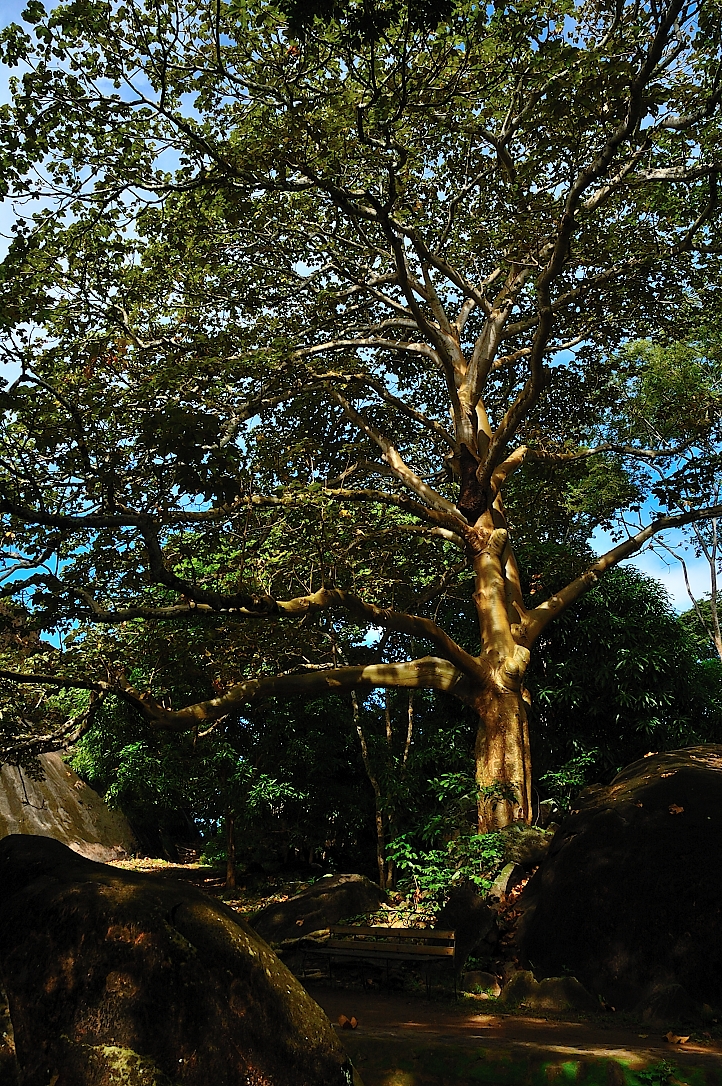
Hazel Sterculia Sterculia foetida
The scientific name of the Hazel Sterculia is Sterculia foetida. It is a species of flowering plant in the family Malvaceae (mallow family), order Malvales.
- Scientific name
- Sterculia foetida L.
- Common name
- Hazel Sterculia
- Genus
- Sterculia
- Family
- Malvaceae (Mallow Family)
- Order
- Malvales
- Class
- Magnoliopsida
- Recorded in
- 23 countries
- Name status
- accepted in the Catalogue of Life

Overview
The native range includes Assam, Bangladesh, India, Sri Lanka, Cambodia, Laos, Myanmar, Thailand, Vietnam, the Lesser Sunda Islands, Malaya, the Philippines and Sumatera. It is a soft-wooded tree with horizontally arranged branches, palmately compound leaves and flowers that are sources of a foul smell.
Written 26 November 2026 from the sources listed below. Each statement was checked against the passage it cites; statements that could not be supported were removed.
Appearance
Hazel sterculia is a soft-wooded tree that can reach 35 metres in height. Its branches grow horizontally in whorls, and its bark is smooth and grey.[1][2][3][4]
The leaves grow at the ends of branchlets and have palmately compound blades with seven to nine elliptical leaflets. The leaf petioles measure between 12.5 and 23 centimetres long, while the leaflets measure between 100 and 170 millimetres long and have short petioles.[5][6][7][8][9]
The flowers grow in panicles measuring 10–15 centimetres long and are green or purple and unisexual. The petioles and flowers are sources of the plant's foul smell.[10][11][12]
The calyx is dull orange and consists of five sepals, each measuring between 10 and 13 millimetres long. The pollen grains are oval and approximately 40 microns long.[13][14][15][16]
The fruit consists of four or five follicles that turn scarlet when ripe.[17][18]
Reproduction and life cycle
Hazel sterculia is dioecious, with male and female flowers occurring on separate trees. The flowers are unisexual.[12][19]
In India, the flowers appear in March, and the leaves emerge between March and April. Flowering was observed in September and October 2015 in Hyderabad, India.[20][21][22]
In Hyderabad, ripe fruits were observed on the upper branches while young green fruits occurred on lower branches. The fruit ripens approximately eleven months after flowering, in February.[23][24]
Each fruit follicle generally contains between 10 and 15 seeds.[25]
Habitat
Hazel sterculia is native to Assam, Bangladesh, India and Sri Lanka. Its native range also includes Cambodia, Laos, Myanmar, Thailand and Vietnam.[26][27]
Its native range includes the Lesser Sunda Islands, Malaya, the Philippines and Sumatera.[28]
The species has been introduced to islands in the Gulf of Guinea, the Comoros, southeastern China and Hainan. Pakistan is also included in its introduced range.[29][30][31][32]
Its introduced range includes Cuba, Jamaica, the Leeward Islands, Puerto Rico, Trinidad-Tobago and the Windward Islands.[33]
Uses
Oil extracted from Hazel sterculia has been found comparable to sunflower, soybean and grapeseed oils for biofuel applications. The seed oil contains the cyclopropene fatty acids malvalic acid and sterculic acid.[34][35]
In Vietnam, the tree's sap is harvested to produce a soft drink called Mủ Trôm.[36]
Diet
The seeds have been reported as edible but purgative. Roasting is recommended before consumption.[37]
Classification of the Hazel Sterculia
| Kingdom | Plantae |
|---|---|
| Subkingdom | Pteridobiotina |
| Phylum | Tracheophyta |
| Class | Magnoliopsida |
| Order | Malvales |
| Family | Malvaceae (Mallow Family) |
| Subfamily | Sterculioideae |
| Genus | Sterculia (Star-chestnuts) |
| Species | Sterculia foetida L. |
Where the Hazel Sterculia is found
Checklists and occurrence records place Sterculia foetida in 23 countries across Africa, Asia and North America. GBIF holds 1,768 georeferenced records of it.
Countries where it is native or its origin is not stated
- Bangladesh 2
- Cambodia 10
- India 1,058
- Indonesia 233
- Laos
- Malaysia 36
- Myanmar 15
- Philippines 126
- Singapore 41
- Sri Lanka 69
- Thailand 93
- Vietnam 12
Countries where it has been introduced
- Benin 5
- China 8
- Cuba 8
- Dominica 1
- Guadeloupe 6
- Jamaica 3
- Montserrat 1
- Mozambique 6
- Puerto Rico 12
- Taiwan 22
- Trinidad and Tobago 1
Regions and cities with the most records
- Maharashtra, India 241
- Kerala, India 178
- Tamil Nadu, India 163
- Khadki, India 144
- Pimpri, India 144
- Pimpri-Chinchwad, India 144
- Kharakvasla, India 142
- Gujarat, India 141
- Pune, India 141
- Vagholi, India 130
- Ariyānkuppam, India 112
- Gundupālaiyam, India 112
- Kurumbapet, India 112
- Manaveli, India 112
- Puducherry, India 112
- Villianur, India 112
- Kottaikuppam, India 111
- Alandi, India 102
- Telangana, India 94
- Hyderabad, India 90
- Kukatpally, India 89
- Malkajgiri, India 89
- Quthbullapur, India 89
- Andada, India 82
- Ankleshwar, India 82
- Anklesvar INA, India 82
- Bharūch, India 82
- Bholav, India 82
- Gadkhol, India 82
- Jhadeshwar, India 82
- Sarangpore, India 82
- Kosamba, India 81
- Tarsadi, India 81
- Mumbai, India 80
- Powai, India 75
- Uppal Kalan, India 71
12 more countries have a few records outside this range
These countries hold a few records of Sterculia foetida but lie outside the range the checklists give for it. Such records are often zoo or garden specimens, museum material or vagrants, so the species is not counted as occurring there.
Range as the checklists state it
Benin [I]; Mozambique [I]; China [I] (Guangdong [I], Guangxi [I], Hainan [I]); Taiwan [I]; India (Andhra Pradesh, Bihar, Kerala, Maharashtra, Odisha, Tamil Nadu, West Bengal); Sri Lanka; Bangladesh; Myanmar (Chin, Kayah, Kayin, Mandalay, Yangon); Thailand; Laos; Cambodia; Vietnam; peninsular Malaysia (north and east of Malaya); Sumatera; Borneo; Sulawesi; Palawan; Philippines (Luzon to Mindanao); Jawa; Lesser Sunda Isl. (Bali, etc.); Moluccas; New Guinea (Irian Jaya); Society Isl. [I] (Moorea [I]); Cuba [I]; Jamaica [I]; Puerto Rico [I]; Montserrat [I]; Guadeloupe [I]; Dominica [I]; Trinidad & Tobago [I]
A number beside a place is its count of GBIF occurrence records. A place without a number comes from a checklist alone. Records show where a species has been observed or collected, which can include escapes and vagrants.
Common names
English
- Hazel Sterculia
- Indian-almond
- Java Olive
- Java-olive
Names in 15 other languages
- Chinese
- xiang ping po, 掌葉蘋婆
- Czech
- lejnice smradlavá
- French
- Sterculier fétide, arbre puant, châtaignier marron
- German
- gewöhnlicher Stinkbaum
- Hindi
- jangli badam
- Indonesian
- Kelumpang, Kepuh, kepoh
- Japanese
- ヤツデアオギリ
- Marathi
- जंगली बदाम
- Polish
- zatwar cuchnący
- Portuguese
- Castanha-da-Índia, Chichá-fedorento, Estercúlia
- Russian
- Стеркулия вонючая
- Slovak
- lajnovec smradľavý
- Spanish
- anacagüita
- Thai
- สำโรง
- fil
- kalumpang
Synonyms
2 other scientific names have been used for this species and are now treated as synonyms of Sterculia foetida.
- Clompanus foetida (L.) Kuntze
- Sterculia polyphylla R.Br.
Related species
-
 Panama TreeSterculia apetala
-
 Indian-tragacanthSterculia urens
-
 Peanut TreeSterculia quadrifida
-
 Chinese ChestnutSterculia monosperma
-
 Large-leaved Star-ChestnutSterculia africana
-
 Elephant Rope TreeSterculia villosa
-
 Spotted SterculiaSterculia guttata
-
 Karaya Gum TreeSterculia setigera
Compare
Questions and answers
What is the scientific name of the Hazel Sterculia?
The scientific name of the Hazel Sterculia is Sterculia foetida. Written with its author, the full name is Sterculia foetida L..
Which family does the Hazel Sterculia belong to?
Sterculia foetida belongs to the family Malvaceae, in the order Malvales and the class Magnoliopsida.
Where is the Hazel Sterculia found?
Checklists and occurrence records place Sterculia foetida in 23 countries, including India, Indonesia, Philippines, Thailand, Sri Lanka and Singapore.
What other names does the Hazel Sterculia have?
Sterculia foetida is also known in English as Indian-almond, Java Olive and Java-olive.
What is sterculia foetida used for?
Oil extracted from Sterculia foetida has been found comparable to sunflower, soybean and grapeseed oils for biofuel applications. In Vietnam, its sap is harvested to produce a soft drink called Mủ Trôm.[34][36]
What does sterculia mean?
The name Sterculia derives from Sterquilinus, the Roman god associated with fertilizer or manure.[38]
Sources
Passages the profile rests on
- Sterculia foetida is a soft-wooded tree. Source passage: “Sterculia foetida is a soft-wooded tree” — English Wikipedia
- Sterculia foetida can reach a height of 35 metres. Source passage: “can grow up to 35 metres (115 feet) tall.” — English Wikipedia
- The branches grow horizontally and are arranged in whorls. Source passage: “The branches of Sterculia foetida are arranged in whorls; they spread horizontally.” — English Wikipedia
- The bark is smooth and grey. Source passage: “The tree's bark is smooth and gray.” — English Wikipedia
- The leaves grow at the ends of branchlets. Source passage: “The leaves are placed at the end of branchlets” — English Wikipedia
- The leaves have palmately compound blades with seven to nine leaflets. Source passage: “the blades are palmately compound, containing 7–9 leaflets.” — English Wikipedia
- The leaf petioles measure between 12.5 and 23 centimetres long. Source passage: “they have petioles ranging from 12.5 and 23 centimetres (4.9 and 9.1 inches) in length;” — English Wikipedia
- The leaflets measure between 100 and 170 millimetres long. Source passage: “The leaflets are elliptical, 100–170 mm long” — English Wikipedia
- The leaflets are elliptical and have short petioles. Source passage: “The leaflets are elliptical, 100–170 mm long, and shortly petioled.” — English Wikipedia
- The petioles and flowers are sources of the plant's foul smell. Source passage: “The petioles and also the flowers are the source of the foul smell of the plant.” — English Wikipedia
- The flowers grow in panicles measuring 10–15 centimetres long. Source passage: “The flowers are arranged in panicles, 10–15 cm (4–6 in) long.” — English Wikipedia
- The flowers are green or purple and are unisexual. Source passage: “The green or purple flowers are large and unisexual” — English Wikipedia
- The pollen grains are approximately 40 microns long. Source passage: “The pollens are oval in shape, approximately 40 microns in length.” — English Wikipedia
- The pollen grains are oval. Source passage: “The pollens are oval in shape” — English Wikipedia
- The calyx is dull orange and consists of five sepals. Source passage: “The calyx is dull orange and is divided into five sepals” — English Wikipedia
- Each sepal measures between 10 and 13 millimetres long. Source passage: “each one 10–13 millimetres (3⁄8–1⁄2 in) long.” — English Wikipedia
- The fruit consists of four or five follicles. Source passage: “The fruit consists of four to five follicles” — English Wikipedia
- The follicles turn scarlet when ripe. Source passage: “The follicles are scarlet when ripe.” — English Wikipedia
- Sterculia foetida is dioecious, with male and female flowers occurring on separate trees. Source passage: “the tree is dioecious (male and female flowers are found on different trees).” — English Wikipedia
- In India, the flowers appear in March. Source passage: “In India, flowers appear in March” — English Wikipedia
- In India, the leaves emerge between March and April. Source passage: “the leaves appear between March and April.” — English Wikipedia
- Flowering was observed in September and October 2015 in Hyderabad, India. Source passage: “At Hyderabad (India), flowering was observed in September–October (2015)” — English Wikipedia
- In Hyderabad, ripe fruits were observed on the upper branches while young green fruits occurred on lower branches. Source passage: “with ripened fruits on the top part and young green fruits at the lower branches.” — English Wikipedia
- The fruit ripens approximately eleven months after flowering, in February. Source passage: “The fruit is ripe in February (11 months after the flowers appeared).” — English Wikipedia
- Each fruit follicle generally contains between 10 and 15 seeds. Source passage: “each follicle generally containing 10–15 seeds.” — English Wikipedia
- Sterculia foetida is native to Assam, Bangladesh, India and Sri Lanka. Source passage: “Indian Subcontinent – Assam, Bangladesh, India, Sri Lanka” — English Wikipedia
- Its native range includes Cambodia, Laos, Myanmar, Thailand and Vietnam. Source passage: “Indo-China – Cambodia, Laos, Myanmar, Thailand, Vietnam” — English Wikipedia
- Its native range includes the Lesser Sunda Islands, Malaya, the Philippines and Sumatera. Source passage: “Malesia – Lesser Sunda Is., Malaya, Philippines, Sumatera” — English Wikipedia
- The species has been introduced to islands in the Gulf of Guinea. Source passage: “West-Central Tropical Africa – Gulf of Guinea Is.” — English Wikipedia
- The species has been introduced to the Comoros. Source passage: “Western Indian Ocean – Comoros” — English Wikipedia
- The species has been introduced to southeastern China and Hainan. Source passage: “China – China Southeast, Hainan” — English Wikipedia
- Pakistan is included in the species' introduced range. Source passage: “Indian Subcontinent – Pakistan” — English Wikipedia
- The species has been introduced to Cuba, Jamaica, the Leeward Islands, Puerto Rico, Trinidad-Tobago and the Windward Islands. Source passage: “Caribbean – Cuba, Jamaica, Leeward Is., Puerto Rico, Trinidad-Tobago, Windward Is.” — English Wikipedia
- The oil extracted from Sterculia foetida has been found comparable to sunflower, soybean and grapeseed oils for biofuel applications. Source passage: “The oil of Sterculia foetida has been found to be comparable to sunflower, soybean, and grapeseed oils for the use of biofuels.” — English Wikipedia
- The seed oil contains the cyclopropene fatty acids malvalic acid and sterculic acid. Source passage: “Sterculia foetida oil contains cyclopropene fatty acids (CPFA) such as 8,9 methylene-heptadec-8-enoic acid (malvalic acid) and 9,10-methylene-ocadec-9-enoic acid (sterculic acid).” — English Wikipedia
- In Vietnam, the tree's sap is harvested to produce a soft drink called Mủ Trôm. Source passage: “In Vietnam, the tree is called Trôm and its sap is harvested to use as a soft drink called "Mủ Trôm".” — English Wikipedia
- The seeds have been reported as edible but purgative, and roasting is recommended before consumption. Source passage: “Evidence suggests that the seeds are edible, but purgative, and should be roasted prior to eating.” — English Wikipedia
- The name Sterculia derives from Sterquilinus, the Roman god associated with fertilizer or manure. Source passage: “The name Sterculia comes from Sterquilinus, the Roman god of fertilizer or manure.” — English Wikipedia
Data
- Catalogue of Life, 2026-10-16 XR cc by
- Global Biodiversity Information Facility CC BY 4.0
- Wikidata CC0
- GeoNames CC BY 4.0
- Wikimedia Commons per image; credit shown with each image
- Within the Catalogue of Life, this name comes from Synonymic Checklists of the Vascular Plants of the World cc by
References
- L. (1753). Sp. Pl. [Linnaeus] 2: 1008 (1753). where the name was published
This species in other databases
- Catalogue of Life 52DD9
- Wikidata Q2948337
- iNaturalist 346407
- World Flora Online wfo-0000491589
- GRIN 101996
Page built on 28 November 2026. See how the catalog is made and all sources and licences.
Cite this page
ScientificNames.org. (2026). Sterculia foetida (Hazel Sterculia). Retrieved November 28, 2026, from https://scientificnames.org/species/sterculia-foetida
“Sterculia foetida (Hazel Sterculia).” ScientificNames.org, 2026, scientificnames.org/species/sterculia-foetida. Accessed 28 Nov. 2026.
ScientificNames.org. “Sterculia foetida (Hazel Sterculia).” Accessed November 28, 2026. https://scientificnames.org/species/sterculia-foetida.
@misc{scientificnames_sterculia_foetida_hazel_sterculia,
  author = {{ScientificNames.org}},
  title = {Sterculia foetida (Hazel Sterculia)},
  year = {2026},
  url = {https://scientificnames.org/species/sterculia-foetida},
  note = {Accessed 2026-11-28}
}