Species · Flowering plants
Indian-tragacanth Sterculia urens
The scientific name of the Indian-tragacanth is Sterculia urens. It is a species of flowering plant in the family Malvaceae (mallow family), order Malvales.
- Scientific name
- Sterculia urens Roxb.
- Common name
- Indian-tragacanth
- Genus
- Sterculia
- Family
- Malvaceae (Mallow Family)
- Order
- Malvales
- Class
- Magnoliopsida
- Recorded in
- 8 countries
- Name status
- accepted in the Catalogue of Life

Overview
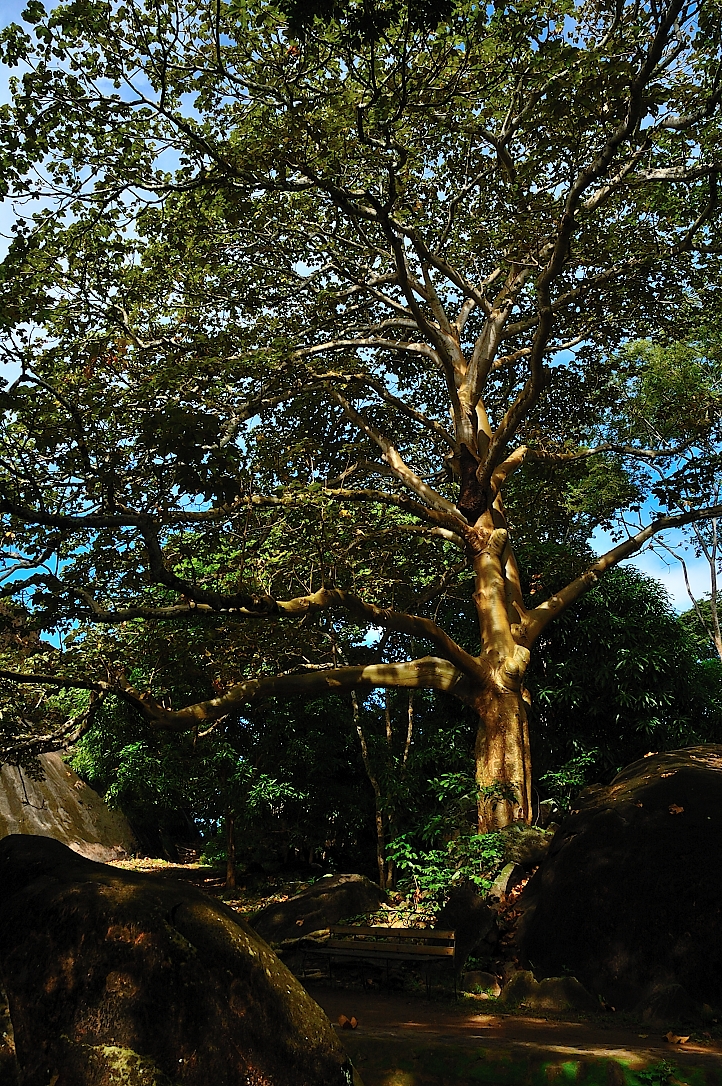
Indian-tragacanth (Sterculia urens Roxb.) is a small to medium-sized deciduous tree with a pale-coloured trunk. It grows in wet and dry deciduous forests, often on steep, rocky slopes, at elevations between 400 and 800 metres. Its bark produces a natural gum called gum karaya when damaged.
Written 26 November 2026 from the sources listed below. Each statement was checked against the passage it cites; statements that could not be supported were removed.
Appearance
Indian-tragacanth is a small to medium-sized tree with a pale-coloured trunk and horizontally spreading branches. Its bark is smooth, fibrous, thick and greenish-grey, with the surface layer peeling off in large flakes.[1][2][3]
Young twigs are initially covered with hairs. The alternate, simple leaves are hairy underneath, divided into three to five palmate lobes and arranged in clusters at the ends of the twigs.[4][5][6]
The yellowish-green flowers grow in panicles in the leaf axils and have sticky or glandular short hairs. They have a five-lobed calyx and lack petals.[7][8][9]
Bisexual flowers have five free, radiating carpels surrounded by a ring of anthers. When fully developed, the carpels become pinkish and densely covered with red hairs, including stinging hairs, and can reach 75 millimetres.[10][11][12]
The ripe fruits split open to expose as many as six squarish brown or black seeds.[13]
The tree can reach a maximum height of approximately 15 metres.[14]
Habitat
Indian-tragacanth grows in both wet and dry deciduous forests. It is often found on steep, rocky slopes at elevations between 400 and 800 metres.[15][16][17]
Reproduction and life cycle
Individual trees produce male, female and bisexual flowers. Male flowers contain ten stamens arranged in a columnar boss.[18][19]
Apis indica is a documented pollinator of the species. Wind does not play a role in pollination.[20][21]
The fruits split open when ripe and release up to six seeds.[22]
Conservation
The species is described as common.[23]
Uses
The tree produces a natural gum called gum karaya when its bark is damaged. Traditional extraction involves cutting or peeling the bark or making deep cuts at the base of the trunk, but crude extraction methods can kill the tree.[24][25][26]
Applying controlled amounts of ethephon stimulates gum production, increases yield and improves wound healing.[27]
Karaya gum swells when it absorbs water. It is used as a laxative because it increases the bulk of intestinal contents and stimulates waste elimination.[28][29]
Karaya gum is used as a thickener in cosmetics and medications and as an adhesive for dentures.[30][31]
The gum is also used as a binder, emulsifier and stabiliser in beverages and food products.[32]
The seeds are roasted and eaten.[33]
Classification of the Indian-tragacanth
| Kingdom | Plantae |
|---|---|
| Subkingdom | Pteridobiotina |
| Phylum | Tracheophyta |
| Class | Magnoliopsida |
| Order | Malvales |
| Family | Malvaceae (Mallow Family) |
| Subfamily | Sterculioideae |
| Genus | Sterculia (Star-chestnuts) |
| Species | Sterculia urens Roxb. |
Where the Indian-tragacanth is found
Checklists and occurrence records place Sterculia urens in 8 countries across Asia and North America. GBIF holds 1,090 georeferenced records of it.
Countries where it is native or its origin is not stated
Countries where it has been introduced
Regions and cities with the most records
- Maharashtra, India 242
- Rajasthan, India 168
- Kerala, India 165
- Bharanikāvu Tekku, India 138
- Kattanam, India 138
- Kayamkulam, India 137
- Pattiyūrgrāmam, India 137
- Adūr, India 132
- Karungappalli, India 132
- Krishnāpuram, India 132
- Ochira, India 132
- Thodiyoor, India 132
- Ayanavelikulangara Vadakku, India 131
- Kalleribhāgam, India 131
- Kulasēkarapuram, India 131
- Ādanāttutekkumuri Kizhakku, India 131
- Panayāttur Vadakkumbhāgam, India 130
- Ponmana, India 130
- Elampalloor, India 128
- Chavara, India 127
- Karuva, India 127
- Kottangara, India 127
- Kottārakara, India 127
- Perunād, India 127
- Tirkadavūr, India 126
- Powai, India 70
- Mumbai, India 69
- Madhya Pradesh, India 68
- Aya Nagar, India 67
- Dera Māndi, India 67
- Bhati, India 66
- Chhatarpur, India 66
- Deoli, India 66
- Kāpas Herd, India 66
- Malakpur Kohi Rangpur, India 66
- Neb Sarai, India 66
2 more countries have a few records outside this range
These countries hold a few records of Sterculia urens but lie outside the range the checklists give for it. Such records are often zoo or garden specimens, museum material or vagrants, so the species is not counted as occurring there.
Range as the checklists state it
India (widespread); Sri Lanka; Bangladesh; Myanmar (Bago); SE-Thailand; Cambodia; Cuba [I]
A number beside a place is its count of GBIF occurrence records. A place without a number comes from a checklist alone. Records show where a species has been observed or collected, which can include escapes and vagrants.
Common names
English
- Indian-tragacanth
- Ghost Tree
- Karaya
- Mucara
Names in 10 other languages
- Czech
- lejnice pálivá
- Gujarati
- કડાયો
- Hindi
- Kulu
- Kannada
- ಕೆಂಪುದಾಳೆ
- Malayalam
- തൊണ്ടി
- Marathi
- कहांडळ
- Russian
- Фирмиана простая
- Slovak
- lajnovec pŕhlivý
- Swedish
- sterkulia
- Tamil
- செந்தனுக்கு
Synonyms
3 other scientific names have been used for this species and are now treated as synonyms of Sterculia urens.
- Cavallium urens (Roxb.) Schott & Endl.
- Clompanus urens (Roxb.) Kuntze
- Kavalama urens (Roxb.) Raf.
Related species
-
 Hazel SterculiaSterculia foetida
-
 Panama TreeSterculia apetala
-
 Peanut TreeSterculia quadrifida
-
 Chinese ChestnutSterculia monosperma
-
 Large-leaved Star-ChestnutSterculia africana
-
 Elephant Rope TreeSterculia villosa
-
 Spotted SterculiaSterculia guttata
-
 Karaya Gum TreeSterculia setigera
Compare
Questions and answers
What is the scientific name of the Indian-tragacanth?
The scientific name of the Indian-tragacanth is Sterculia urens. Written with its author, the full name is Sterculia urens Roxb..
Which family does the Indian-tragacanth belong to?
Sterculia urens belongs to the family Malvaceae, in the order Malvales and the class Magnoliopsida.
Where is the Indian-tragacanth found?
Checklists and occurrence records place Sterculia urens in 8 countries, including India, Sri Lanka, Thailand, Myanmar, Vietnam and Bangladesh.
What other names does the Indian-tragacanth have?
Sterculia urens is also known in English as Ghost Tree, Karaya and Mucara.
What is another name for karaya gum?
Karaya gum is also called katira, sterculia gum and kateera gum. Kullo gum and katilo gum are additional alternative names.[34][35]
Why is it called a ghost tree?
The species is also known by the Marathi name bhutyā, meaning ghost tree.[36]
What is karaya gum used for?
Karaya gum is used as a laxative, a thickener in cosmetics and medications, an adhesive for dentures, and a binder, emulsifier and stabiliser in beverages and food products.[29][30][31][32]
What is sterculia used for?
Sterculia produces karaya gum, which is used as a laxative, a thickener in cosmetics and medications, an adhesive for dentures, and a binder, emulsifier and stabiliser in beverages and food products. Its seeds are roasted and eaten.[24][29][30][31][32][33]
Which is the ghost tree?
Sterculia urens Roxb., also known as Indian-tragacanth, is called the ghost tree.[36]
Sources
Passages the profile rests on
- Sterculia urens is a small to medium-sized tree with a pale-coloured trunk. Source passage: “A small to medium-sized tree with a pale-coloured trunk” — English Wikipedia
- The tree is deciduous and has horizontally spreading branches. Source passage: “a medium-sized deciduous tree with horizontally-spreading branches” — English Wikipedia
- The bark is smooth, fibrous, thick and greenish-grey, with its surface layer peeling off in large flakes. Source passage: “The bark is smooth, fibrous and thick, greenish-grey, with the surface layer peeling off in large flakes.” — English Wikipedia
- Young twigs are initially covered with hairs. Source passage: “The twigs are hairy at first.” — English Wikipedia
- The leaves are alternate, simple, hairy underneath and divided into three to five palmate lobes. Source passage: “The leaves are alternate, simple, hairy beneath and have three to five palmate lobes.” — English Wikipedia
- The leaves grow in clusters at the ends of the twigs. Source passage: “They are clustered at the tips of the twigs.” — English Wikipedia
- The flowers are yellowish-green and grow in panicles in the leaf axils. Source passage: “The flowers are yellowish-green and produced in panicles in the axils of the leaves.” — English Wikipedia
- The flowers have sticky or glandular short hairs. Source passage: “They are polygamous (having male, female and bisexual flowers on the same tree) and are clad in sticky or glandular short hairs.” — English Wikipedia
- The flowers have a five-lobed calyx and lack petals. Source passage: “The calyx has five lobes and there are no petals.” — English Wikipedia
- Bisexual flowers have five free, radiating carpels surrounded by a ring of anthers. Source passage: “bisexual flowers have a ring of anthers round the five free, radiating carpels” — English Wikipedia
- The carpels become pinkish and densely covered with red hairs, including stinging hairs, when fully developed. Source passage: “They are pinkish and densely covered with red hairs, including stinging hairs.” — English Wikipedia
- The carpels can reach 75 millimetres when fully developed. Source passage: “which grow to 75 mm (3 in) when fully developed.” — English Wikipedia
- The ripe fruits split open to expose as many as six squarish brown or black seeds. Source passage: “They split open when ripe to reveal up to six squarish, brown or black seeds.” — English Wikipedia
- The tree can reach a maximum height of approximately 15 metres. Source passage: “growing to a maximum height of about 15 m (49 ft).” — English Wikipedia
- The species grows in both wet and dry deciduous forests. Source passage: “grows in deciduous forests, both wet and dry.” — English Wikipedia
- The species is often found on steep, rocky slopes. Source passage: “It is often found on steep, rock-strewn slopes” — English Wikipedia
- The species occurs at elevations between 400 and 800 metres. Source passage: “at altitudes between 400 and 800 metres (1,300 and 2,600 ft).” — English Wikipedia
- Individual trees produce male, female and bisexual flowers. Source passage: “having male, female and bisexual flowers on the same tree” — English Wikipedia
- Male flowers contain ten stamens arranged in a columnar boss. Source passage: “Male flowers have a columnar boss of ten stamens” — English Wikipedia
- Apis indica is a documented pollinator of the species. Source passage: “Apis indica is a known pollinator” — English Wikipedia
- Wind does not play a role in pollinating the species. Source passage: “wind doesn't play any role in pollination.” — English Wikipedia
- The fruits split open when ripe and release up to six seeds. Source passage: “They split open when ripe to reveal up to six squarish, brown or black seeds.” — English Wikipedia
- The species is described as common. Source passage: “It is a common species” — English Wikipedia
- The tree produces a natural gum called gum karaya when its bark is damaged. Source passage: “A natural gum known as gum karaya is exuded by the tree when the bark is damaged.” — English Wikipedia
- Gum karaya is traditionally extracted by cutting or peeling the bark or making deep cuts at the base of the trunk. Source passage: “This valuable substance is traditionally tapped by cutting or peeling back the bark, or by making deep gashes at the base of the trunk with an axe.” — English Wikipedia
- Crude gum extraction methods can kill the tree. Source passage: “Such crude methods of extraction often kill the tree” — English Wikipedia
- Applying controlled amounts of ethephon stimulates gum production, increases yield and improves wound healing. Source passage: “application of the plant growth regulator ethephon stimulates the production of gum, and when used in carefully controlled amounts, increases gum yield and enhances healing of the wounds.” — English Wikipedia
- Karaya gum swells when it absorbs water. Source passage: “Karaya gum swells when it absorbs water” — English Wikipedia
- Karaya gum is used as a laxative because it increases the bulk of intestinal contents and stimulates waste elimination. Source passage: “is used as a laxative because adds bulk to the contents of the intestine, stimulating the gut to expel waste material.” — English Wikipedia
- Karaya gum is used as a thickener in cosmetics and medications. Source passage: “Other uses for the gum are as a thickener in cosmetics and medications” — English Wikipedia
- Karaya gum is used as an adhesive for dentures. Source passage: “as an adhesive for dentures.” — English Wikipedia
- Karaya gum is used as a binder, emulsifier and stabiliser in beverages and food products. Source passage: “In manufacturing, it is added as a binder, emulsifier and stabiliser in the preparation of beverages and foods.” — English Wikipedia
- The seeds are roasted and eaten. Source passage: “The seeds are roasted and eaten.” — English Wikipedia
- The species is also called karaya gum, katira, sterculia gum and kateera gum. Source passage: “gum karaya, katira, sterculia gum or kateera gum.” — English Wikipedia
- The FDA food-substances record also lists kullo gum and katilo gum as alternative names. Source passage: “KULLO GUM ♢ KATILO GUM” — hfpappexternal.fda.gov
- The species is also known by the Marathi name bhutyā, meaning ghost tree. Source passage: “commonly known as the bhutyā (भुत्या) in Marathi (meaning "ghost tree")” — English Wikipedia
Data
- Catalogue of Life, 2026-10-16 XR cc by
- Global Biodiversity Information Facility CC BY 4.0
- Wikidata CC0
- GeoNames CC BY 4.0
- Wikimedia Commons per image; credit shown with each image
- Within the Catalogue of Life, this name comes from Synonymic Checklists of the Vascular Plants of the World cc by
References
- Roxb. (1795). Pl. Coromandel 1: 25, t. 24 (1795). where the name was published
This species in other databases
- Catalogue of Life 52DN2
- Wikidata Q3498736
- iNaturalist 196563
- World Flora Online wfo-0001141132
- GRIN 101935
Page built on 29 November 2026. See how the catalog is made and all sources and licences.
Cite this page
ScientificNames.org. (2026). Sterculia urens (Indian-tragacanth). Retrieved November 29, 2026, from https://scientificnames.org/species/sterculia-urens
“Sterculia urens (Indian-tragacanth).” ScientificNames.org, 2026, scientificnames.org/species/sterculia-urens. Accessed 29 Nov. 2026.
ScientificNames.org. “Sterculia urens (Indian-tragacanth).” Accessed November 29, 2026. https://scientificnames.org/species/sterculia-urens.
@misc{scientificnames_sterculia_urens_indian_tragacanth,
  author = {{ScientificNames.org}},
  title = {Sterculia urens (Indian-tragacanth)},
  year = {2026},
  url = {https://scientificnames.org/species/sterculia-urens},
  note = {Accessed 2026-11-29}
}