Species · Other invertebrates
Hermit Crab Sponge Suberites domuncula
The scientific name of the Hermit Crab Sponge is Suberites domuncula. It is a species of animal in the family Suberitidae, order Suberitida. The name dates from 1792.
- Scientific name
- Suberites domuncula (Olivi, 1792)
- Common name
- Hermit Crab Sponge
- Genus
- Suberites
- Family
- Suberitidae
- Order
- Suberitida
- Class
- Demospongiae
- Environment
- marine
- Recorded in
- 12 countries
- Name status
- accepted in the Catalogue of Life
Overview
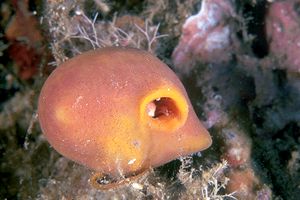
The hermit crab sponge is an invertebrate in the family Suberitidae, order Suberitida and class Demospongiae. The species produces suberitine, a neurotoxin capable of causing fatal hemolytic hemorrhaging in various animals.
Written 26 November 2026 from the sources listed below. Each statement was checked against the passage it cites; statements that could not be supported were removed.
Appearance
The skeleton consists primarily of spicules, including monactinal tylosyles and a smaller proportion of diactinal oxeas. The sponge has a visible osculum through which water exits its body.[1][2]
Its spicules can reach 450 micrometres in length and 5–7 micrometres in diameter. The axial canal within each spicule measures 0.3–1.6 micrometres in width.[3][4]
Habitat
It has also been recorded attached to shells of living gastropods and the carapaces of other crustaceans. In the Mediterranean Sea, it occurs in association with numerous hermit crab species.[5][6]
Diet
The hermit crab sponge obtains nutrients by filtering bacteria from the surrounding water and engulfing them through phagocytosis.[7]
Behaviour
The species is a filter-feeder that moves large volumes of water through its canal system.[8]
The sponge can form gemmules on the outside of its shell when conditions become unfavorable for associated hermit crabs. At least 13 hermit crab species have been recorded in association with this sponge.[9][10]
Reproduction and life cycle
The species reproduces through both sexual and asexual mechanisms. Asexual reproduction occurs through gemmules containing archeocytes enclosed in a collagenous coat.[11][12]
Gemmules can remain viable after the parent sponge dies and persist through harsh environmental conditions. They hatch when environmental conditions become suitable, with juvenile sponges developing over several weeks.[13][14]
Sexual reproduction involves releasing free-swimming larvae that subsequently develop into juvenile sponges.[15]
Classification of the Hermit Crab Sponge
| Kingdom | Animalia |
|---|---|
| Phylum | Porifera |
| Class | Demospongiae (Demosponge) |
| Subclass | Heteroscleromorpha |
| Order | Suberitida |
| Family | Suberitidae |
| Genus | Suberites |
| Species | Suberites domuncula (Olivi, 1792) |
Where the Hermit Crab Sponge is found
Checklists and occurrence records place Suberites domuncula in 12 countries. GBIF holds 989 georeferenced records of it.
Countries
- Canada 173
- Croatia 12
- France 49
- Greece 12
- Guernsey 3
- Iceland 8
- Italy 77
- Mexico 3
- Spain 331
- The Netherlands 3
- United Kingdom 92
- United States 226
Regions and cities with the most records
- Calvià, Spain 23
- Frontignan, France 22
- Occitanie, France 22
- Sète, France 22
- Sant Agustí, Spain 16
- Felanitx, Spain 15
- Ciutadella, Spain 13
- Maó, Spain 13
- Son Rapinya, Spain 13
- Palma, Spain 12
- Calella, Spain 11
- Manacor, Spain 11
- Malgrat de Mar, Spain 10
- Pineda de Mar, Spain 10
- Blanes, Spain 9
- Calafell, Spain 8
- Lloret de Mar, Spain 8
- Sant Pere de Ribes, Spain 8
- Sitges, Spain 8
- Tordera, Spain 8
- Vilanova i la Geltrú, Spain 8
- Marratxí, Spain 7
- Alicante, Spain 6
- California, United States 6
- El Campello, Spain 6
- Mutxamel, Spain 6
- San Vicent del Raspeig, Spain 6
- Sant Joan d'Alacant, Spain 6
- Santa Cruz, United States 6
- Santa Pola, Spain 6
- Arenys de Mar, Spain 5
- Chioggia, Italy 5
- Live Oak, United States 5
- Sant Carles de la Ràpita, Spain 5
- Llucmajor, Spain 4
- Scotland, United Kingdom 4
2 more countries have a few records outside this range
These countries hold a few records of Suberites domuncula but lie outside the range the checklists give for it. Such records are often zoo or garden specimens, museum material or vagrants, so the species is not counted as occurring there.
A number beside a place is its count of GBIF occurrence records. A place without a number comes from a checklist alone. Records show where a species has been observed or collected, which can include escapes and vagrants.
Common names
English
- Hermit Crab Sponge
- Large Encrusting Sponge
- Sulfur Sponge
- Sulphur Sponge
Names in 6 other languages
- Albanian
- sfungjeri me kore
- Czech
- houba domečková
- French
- Subérite-gîte
- German
- Einsiedler-Korkschwamm, Einsiedlerschwamm, Feigenschwamm, Häuschenschwamm, Korkschwamm
- Italian
- Spugna dei paguri
- Russian
- Пробковая губка, Пробковая губка суберитес нарастающий
Synonyms
7 other scientific names have been used for this species and are now treated as synonyms of Suberites domuncula.
- Alcyonium bulbosum Esper, 1794
- Alcyonium compactum Lamarck, 1815
- Alcyonium domuncula Olivi, 1792
- Litamena spugnosa Renier, 1828
- Lithumena spugnosa Renier, 1828
- Suberites domuncula var. domuncula (Olivi, 1792)
- Suberites compactus Balsamo Crivelli, 1863 ambiguous synonym
Subspecies and varieties
- Suberites domuncula domuncula subspecies
Related species
- Orange SpongeSuberites ficus
- Suberites dandelenae
- Fleshy Horny SpongeSuberites carnosus
-
 Suberites aurantiacus
- Hermit Crab SpongeSuberites latus
-
 Suberites mineri
- Suberites massa
- Suberites affinis
Compare
Questions and answers
What is the scientific name of the Hermit Crab Sponge?
The scientific name of the Hermit Crab Sponge is Suberites domuncula. Written with its author, the full name is Suberites domuncula (Olivi, 1792).
Which family does the Hermit Crab Sponge belong to?
Suberites domuncula belongs to the family Suberitidae, in the order Suberitida and the class Demospongiae.
Where is the Hermit Crab Sponge found?
Checklists and occurrence records place Suberites domuncula in 12 countries, including Spain, United States, Canada, United Kingdom, Italy and France.
What other names does the Hermit Crab Sponge have?
Suberites domuncula is also known in English as Large Encrusting Sponge, Sulfur Sponge and Sulphur Sponge.
What is the scientific name of the sulphur sponge?
The scientific name is Suberites domuncula (Olivi, 1792).[16]
What do sea sponges feed on?
The hermit crab sponge feeds by filtering bacteria from the surrounding water and engulfing them through phagocytosis.[7]
Sources
Passages the profile rests on
- The skeleton consists primarily of spicules, including monactinal tylosyles and a smaller proportion of diactinal oxeas. Source passage: “Monactinal tylosyles and a small fraction of diactinal oxeas make up the megascleres found in the skeleton of S. domuncula.” — English Wikipedia
- The sponge has a visible osculum through which water exits its body. Source passage: “S. domuncula contain a visible osculum where water exits the body.” — English Wikipedia
- Its spicules can reach 450 micrometres in length and 5–7 micrometres in diameter. Source passage: “Spicules of the S. domuncula species can grow to 450 𝜇m in length and 5-7 𝜇m in diameter.” — English Wikipedia
- The axial canal within each spicule measures 0.3–1.6 micrometres in width. Source passage: “An axial canal of 0.3-1.6 𝜇m width can be found in all spicules” — English Wikipedia
- The species has also been recorded attached to shells of living gastropods and the carapaces of other crustaceans. Source passage: “It has also been recorded attached to the shells of live gastropods and the carapace of other crustaceans.” — English Wikipedia
- The species occurs in association with numerous hermit crab species in the Mediterranean Sea. Source passage: “Many species of hermit crabs can be found within the Suberites domuncula sponge in the Mediterranean Sea.” — English Wikipedia
- The sponge obtains nutrients by filtering bacteria from the surrounding water and engulfing them through phagocytosis. Source passage: “Bacteria taken from the water column are phagocytized in order to retrieve nutrients.” — English Wikipedia
- The species is a filter-feeder that moves large volumes of water through its canal system. Source passage: “These sponges act as filter-feeders, driving a large amount of water through a highly vascularized canal system.” — English Wikipedia
- The sponge can form gemmules on the outside of its shell when conditions become unfavorable for associated hermit crabs. Source passage: “When hermit crabs find a habitat within this sponge, if unfavorable conditions are encountered the sponge will then form gemmules on the outside of the shell.” — English Wikipedia
- At least 13 hermit crab species have been recorded in association with this sponge. Source passage: “At least 13 species of hermit crabs have been found associated with this sponge.” — English Wikipedia
- The species reproduces through both sexual and asexual mechanisms. Source passage: “Suberites domuncula are able to reproduce both sexually and asexually.” — English Wikipedia
- Asexual reproduction occurs through gemmules containing archeocytes enclosed in a collagenous coat. Source passage: “They reproduce asexually through gemmules made up of archeocytes that are enclosed by a collagenous coat.” — English Wikipedia
- Gemmules can remain viable after the parent sponge dies and persist through harsh environmental conditions. Source passage: “Gemmules still survive upon the death of the sponge, persisting in harsh conditions for prolonged periods of time.” — English Wikipedia
- Gemmules hatch when environmental conditions become suitable, with juvenile sponges developing over several weeks. Source passage: “Gemmules hatch once conditions are right and develop into juvenile sponges over the course of a few weeks.” — English Wikipedia
- Sexual reproduction involves releasing free-swimming larvae that subsequently develop into juvenile sponges. Source passage: “Sexual reproduction involves the release of free-swimming larvae which then develop into juvenile sponge.” — English Wikipedia
- The species belongs to the sponge family Suberitidae. Source passage: “Suberites domuncula is a species of sea sponge belonging to the family Suberitidae.” — English Wikipedia
Data
- Catalogue of Life, 2026-10-16 XR cc by
- Global Biodiversity Information Facility CC BY 4.0
- Wikidata CC0
- GeoNames CC BY 4.0
- Wikimedia Commons per image; credit shown with each image
- Within the Catalogue of Life, this name comes from World Porifera Database cc by
This species in other databases
- Catalogue of Life 53D5Z
- Wikidata Q1309134
- iNaturalist 202039
- WoRMS urn:lsid:marinespecies.org:taxname:134282
- ITIS 48489
Page built on 29 November 2026. See how the catalog is made and all sources and licences.
Cite this page
ScientificNames.org. (2026). Suberites domuncula (Hermit Crab Sponge). Retrieved November 29, 2026, from https://scientificnames.org/species/suberites-domuncula
“Suberites domuncula (Hermit Crab Sponge).” ScientificNames.org, 2026, scientificnames.org/species/suberites-domuncula. Accessed 29 Nov. 2026.
ScientificNames.org. “Suberites domuncula (Hermit Crab Sponge).” Accessed November 29, 2026. https://scientificnames.org/species/suberites-domuncula.
@misc{scientificnames_suberites_domuncula_hermit_crab_sponge,
  author = {{ScientificNames.org}},
  title = {Suberites domuncula (Hermit Crab Sponge)},
  year = {2026},
  url = {https://scientificnames.org/species/suberites-domuncula},
  note = {Accessed 2026-11-29}
}