Species · Other invertebrates
Orange Sponge Suberites ficus
The scientific name of the Orange Sponge is Suberites ficus. It is a species of animal in the family Suberitidae, order Suberitida. The name dates from 1842.
- Scientific name
- Suberites ficus (Johnston, 1842)
- Common name
- Orange Sponge
- Genus
- Suberites
- Family
- Suberitidae
- Order
- Suberitida
- Class
- Demospongiae
- Environment
- marine
- Recorded in
- 17 countries
- Name status
- accepted in the Catalogue of Life
Overview
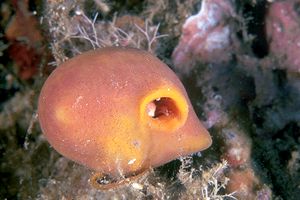
Suberites ficus grows on rocks from the lower shore to depths of 200 metres, particularly in habitats with strong tidal flows. It typically has orange or red coloration, a variable growth form and a small number of large oscules concentrated towards its upper region.
Written 27 November 2026 from the sources listed below. Each statement was checked against the passage it cites; statements that could not be supported were removed.
Appearance
The Orange sponge typically appears orange or red in brightly lit locations. In dimly lit locations, it may appear greyish or brownish.[1][2]
Its growth form varies between lobose, cushion-like and encrusting shapes. It has a smooth-looking surface that feels rough when touched.[3][4]
The sponge possesses a small number of large oscules, mostly concentrated towards its upper region. Its megascleres occur in two size classes, with one class approximately twice the size of the other.[5][6]
It has very few microscleres, measuring one tenth of the size of its megascleres. Its skeleton has radially arranged spicules near the surface and chaotically arranged spicules internally.[7][8]
Gemmules may occur near the base of the sponge.[9]
The sponge can reach a diameter of 30–40 centimetres. A documented description records a massive, lobed form measuring 20 centimetres in diameter.[10][11]
Habitat
The Orange sponge grows on rocks from the lower shore to depths of 200 metres. It prefers habitats with strong tidal flows and frequently grows among seaweed.[12][13][14]
The species also occurs on harbour structures and wreckage. It can completely engulf stones and empty gastropod or bivalve shells.[15][16]
The sponge sometimes grows on shells occupied by living hermit crabs.[17]
The species occurs in the Atlantic Ocean and the Mediterranean Sea. It is widely distributed around the British Isles, particularly along their western coasts.[18][19]
Reproduction and life cycle
Members of the genus Suberites are generally hermaphroditic. Male and female gametes may be released at different times, and fertilisation takes place internally.[20][21][22]
The species releases ciliated larvae into the water column, where they become part of the zooplankton.[23]
The species also reproduces asexually through budding or gemmule development. Its gemmules remain dormant under normal environmental conditions.[24][25]
Gemmules can become active after adverse conditions, including excessive exposure to low temperatures, have ended.[26]
Behaviour
The Orange sponge has relatively few predators. Its unpleasant odour or unpalatable spicules may explain its limited number of predators.[27][28]
When growing on a hermit crab's shell, the sponge may benefit from the crab's ability to move away from nudibranch predators. Hermit crabs carrying the sponge may benefit from its unpalatability and camouflage.[29][30]
Diet
The Orange sponge is consumed by some marine gastropods and nudibranchs. The Atlantic bluefin tuna includes this sponge in its diet in Cape Cod Bay.[31][32]
Uses
The subspecies Suberites ficus ssp. rubrus has been investigated as a potential source of antibiotics and biologically active compounds. It has also been investigated for potential anti-fouling applications.[33][34][35]
Similar species
Suberites farinaria is described as a similar encrusting sponge that is thought to represent a juvenile form of Suberites ficus.[36]
Suberites suberia was formerly considered a synonym of Suberites ficus, but molecular analysis established it as a distinct species. Suberites virgultosa was also formerly treated as a synonym but is now recognized as a valid separate species.[37][38]
Suberites domuncula may be synonymous with Suberites ficus, although further research is required.[39]
Classification of the Orange Sponge
| Kingdom | Animalia |
|---|---|
| Phylum | Porifera |
| Class | Demospongiae (Demosponge) |
| Subclass | Heteroscleromorpha |
| Order | Suberitida |
| Family | Suberitidae |
| Genus | Suberites |
| Species | Suberites ficus (Johnston, 1842) |
Where the Orange Sponge is found
Checklists and occurrence records place Suberites ficus in 17 countries. GBIF holds 5,112 georeferenced records of it.
Countries
- Belgium 3
- Canada 246
- Croatia 3
- Denmark 68
- France 343
- Germany 16
- Ireland 349
- Isle of Man 45
- Jersey 11
- Mexico 19
- Norway 119
- Spain 13
- Svalbard and Jan Mayen 8
- Sweden 137
- The Netherlands 32
- United Kingdom 2,824
- United States 876
Regions and cities with the most records
- Falmouth, United Kingdom 210
- Truro, United Kingdom 194
- Redruth, United Kingdom 180
- Plymstock, United Kingdom 174
- Plymouth, United Kingdom 165
- Saltash, United Kingdom 162
- Brixham, United Kingdom 141
- Paignton, United Kingdom 135
- Torquay, United Kingdom 135
- Camborne, United Kingdom 116
- England, United Kingdom 105
- Christchurch, United Kingdom 102
- Poole, United Kingdom 99
- Bournemouth, United Kingdom 96
- Newtownards, United Kingdom 92
- Hayling Island, United Kingdom 85
- Scotland, United Kingdom 85
- South Hayling, United Kingdom 84
- Wimborne Minster, United Kingdom 84
- Newton Abbot, United Kingdom 83
- Wales, United Kingdom 82
- Bognor Regis, United Kingdom 73
- Ferndown, United Kingdom 72
- Chichester, United Kingdom 70
- Brest, France 65
- Bangor, United Kingdom 60
- Emsworth, United Kingdom 58
- Rottingdean, United Kingdom 48
- Peacehaven, United Kingdom 47
- Brighton, United Kingdom 46
- Lewes, United Kingdom 46
- New Milton, United Kingdom 45
- Hove, United Kingdom 44
- Portslade, United Kingdom 43
- Lancing, United Kingdom 42
- Shoreham-by-Sea, United Kingdom 42
4 more countries have a few records outside this range
These countries hold a few records of Suberites ficus but lie outside the range the checklists give for it. Such records are often zoo or garden specimens, museum material or vagrants, so the species is not counted as occurring there.
A number beside a place is its count of GBIF occurrence records. A place without a number comes from a checklist alone. Records show where a species has been observed or collected, which can include escapes and vagrants.
Common names
English
- Orange Sponge
- Wandering
- Fig Sponge
- Orange Fig Horny Sponge
- Sea Orange
Names in 6 other languages
- Danish
- Figensvamp
- Dutch
- vijgspons
- French
- éponge figuier
- German
- Feigenschwamm, Korkschwamm
- Japanese
- ツミイレカイメン
- Russian
- Пробковая губка суберитес фикус
Synonyms
8 other scientific names have been used for this species and are now treated as synonyms of Suberites ficus.
- Choanites ficus (Johnston, 1842)
- Ficulina ficus (Johnston, 1842)
- Halichondria farinaria Bowerbank, 1866
- Halichondria ficus Johnston, 1842
- Hymeniacidon ficus (Johnston, 1842)
- Suberites domuncula var. ficus (Johnston, 1842)
- Suberites ficus (Linnaeus, 1767)
- Alcyonium ficus misapplied
Related species
-
 Hermit Crab SpongeSuberites domuncula
- Suberites dandelenae
- Fleshy Horny SpongeSuberites carnosus
-
 Suberites aurantiacus
- Hermit Crab SpongeSuberites latus
-
 Suberites mineri
- Suberites massa
- Suberites affinis
Compare
Questions and answers
What is the scientific name of the Orange Sponge?
The scientific name of the Orange Sponge is Suberites ficus. Written with its author, the full name is Suberites ficus (Johnston, 1842).
Which family does the Orange Sponge belong to?
Suberites ficus belongs to the family Suberitidae, in the order Suberitida and the class Demospongiae.
Where is the Orange Sponge found?
Checklists and occurrence records place Suberites ficus in 17 countries, including United Kingdom, United States, Ireland, France, Canada and Sweden.
What other names does the Orange Sponge have?
Suberites ficus is also known in English as Wandering, Fig Sponge, Orange Fig Horny Sponge and Sea Orange.
Sources
Passages the profile rests on
- The sponge typically has orange or red coloration in brightly lit locations. Source passage: “It is usually some shade of orange or red, especially in brightly lit places” — English Wikipedia
- In dimly lit locations, the sponge may appear greyish or brownish. Source passage: “but sometimes is greyish or brownish in dimmer locations.” — English Wikipedia
- Its growth form varies between lobose, cushion-like and encrusting shapes. Source passage: “The shape is irregular and varies, sometimes being lobose, sometimes cushion-like and sometimes encrusting.” — English Wikipedia
- The sponge has a smooth-looking surface that feels rough when touched. Source passage: “It has a smooth-looking surface but this feels rough to the touch.” — English Wikipedia
- The sponge possesses a small number of large oscules, mostly concentrated towards its upper region. Source passage: “There are a small number of large oscules, mostly towards the top of the sponge.” — English Wikipedia
- Its megascleres occur in two size classes, with one class approximately twice the size of the other. Source passage: “the megascleres are in two sizes, one twice as large as the other.” — English Wikipedia
- The sponge has very few microscleres, measuring one tenth of the size of its megascleres. Source passage: “There are very few microscleres, and these are one tenth of the size of the megascleres.” — English Wikipedia
- Its skeleton has radially arranged spicules near the surface and chaotically arranged spicules internally. Source passage: “The skeleton is composed of spicules arranged radially near the surface, but chaotically in the interior.” — English Wikipedia
- Gemmules may occur near the base of the sponge. Source passage: “There may be gemmules near the base of the sponge.” — English Wikipedia
- The sponge can reach a diameter of 30–40 centimetres. Source passage: “S. ficus is a large sponge growing up to thirty or forty centimetres across.” — English Wikipedia
- A documented description records a massive, lobed form measuring 20 centimetres in diameter. Source passage: “Massive, Lobed, 20 cm d.” — pearl.plymouth.ac.uk
- The sponge grows on rocks from the lower shore to depths of 200 metres. Source passage: “S. ficus is found growing on rocks from the lower shore down to a depth of two hundred metres” — English Wikipedia
- The species prefers habitats with strong tidal flows. Source passage: “and prefers locations with strong tidal flows.” — English Wikipedia
- The sponge frequently grows among seaweed. Source passage: “It often grows among seaweed” — English Wikipedia
- The species also occurs on harbour structures and wreckage. Source passage: “and is also found on harbour structures and wreckage.” — English Wikipedia
- The sponge can completely engulf stones and empty gastropod or bivalve shells. Source passage: “When it grows on a stone or an empty gastropod or bivalve shell it may completely engulf it.” — English Wikipedia
- The species sometimes grows on shells occupied by living hermit crabs. Source passage: “It sometimes grows on a shell housing a living hermit crab.” — English Wikipedia
- The species occurs in the Atlantic Ocean and the Mediterranean Sea. Source passage: “S. ficus is found in the Atlantic Ocean as well as in the Mediterranean Sea.” — English Wikipedia
- The sponge is widely distributed around the British Isles, particularly along their western coasts. Source passage: “It is widely distributed around the shores of the British Isles especially the western coasts.” — English Wikipedia
- Members of the genus Suberites are generally hermaphroditic. Source passage: “Members of this genus are generally hermaphrodites.” — English Wikipedia
- Male and female gametes may be released at different times. Source passage: “The male and female gametes may not be released simultaneously” — English Wikipedia
- Fertilisation takes place internally. Source passage: “Fertilisation is internal” — English Wikipedia
- The species releases ciliated larvae into the water column, where they become part of the zooplankton. Source passage: “the ciliated larvae are liberated into the water column and become part of the zooplankton.” — English Wikipedia
- The species also reproduces asexually through budding or gemmule development. Source passage: “Asexual reproduction also takes place, either by budding or through the development of gemmules.” — English Wikipedia
- Its gemmules remain dormant under normal environmental conditions. Source passage: “These are "survival pods" and remain dormant under normal conditions.” — English Wikipedia
- Gemmules can become active after adverse conditions, including excessive exposure to low temperatures, have ended. Source passage: “They can become active when a period of adverse conditions such as an excessive exposure to low temperatures comes to an end.” — English Wikipedia
- The species has relatively few predators. Source passage: “S. ficus does not have many predators.” — English Wikipedia
- Its unpleasant odour or unpalatable spicules may explain its limited number of predators. Source passage: “This may be because it has an unpleasant odour or because the spicules make it unpalatable.” — English Wikipedia
- When growing on a hermit crab's shell, the sponge may benefit from the crab's ability to move away from nudibranch predators. Source passage: “The sponge benefits from the crab's ability to move away from predators such as nudibranchs” — English Wikipedia
- Hermit crabs carrying the sponge may benefit from its unpalatability and camouflage. Source passage: “while the crab may benefit from the sponge's unpalatability and the camouflage it provides.” — English Wikipedia
- The sponge is consumed by some marine gastropods and nudibranchs. Source passage: “It is eaten however by some marine gastropods and some nudibranchs.” — English Wikipedia
- The Atlantic bluefin tuna includes this sponge in its diet in Cape Cod Bay. Source passage: “In Cape Cod Bay, it forms part of the diet of the Atlantic bluefin tuna (Thunnus thynnus).” — English Wikipedia
- The subspecies Suberites ficus ssp. rubrus has been investigated as a potential source of antibiotics. Source passage: “S. ficus ssp. rubrus has been investigated as a possible source of antibiotics” — English Wikipedia
- The subspecies Suberites ficus ssp. rubrus has been investigated for potential anti-fouling applications. Source passage: “as a possible source of antibiotics, anti-fouling, and other biologically active compounds” — English Wikipedia
- The subspecies Suberites ficus ssp. rubrus has been investigated as a possible source of biologically active compounds. Source passage: “and other biologically active compounds” — English Wikipedia
- Suberites farinaria is described as a similar encrusting sponge that is thought to represent a juvenile form of Suberites ficus. Source passage: “Suberites farinaria is a similar but encrusting sponge but it is thought to be a juvenile form of S. ficus.” — English Wikipedia
- Suberites suberia was formerly considered a synonym of Suberites ficus, but molecular analysis established it as a distinct species. Source passage: “Suberites suberia was at one time thought to be a synonym but molecular analysis has shown that it is a distinct species.” — English Wikipedia
- Suberites virgultosa was formerly treated as a synonym of Suberites ficus but is now recognized as a valid separate species. Source passage: “Another species, Suberites virgultosa, used to be considered a synonym but is now considered a valid species in its own right.” — English Wikipedia
- Suberites domuncula may be synonymous with Suberites ficus, although further research is required. Source passage: “Suberites domuncula may also be synonymous and further study is required.” — English Wikipedia
Data
- Catalogue of Life, 2026-10-16 XR cc by
- Global Biodiversity Information Facility CC BY 4.0
- Wikidata CC0
- GeoNames CC BY 4.0
- Within the Catalogue of Life, this name comes from World Porifera Database cc by
References
- Johnston G, 1842, A History of British Sponges and Lithophytes.(W.H. where the name was published
This species in other databases
Page built on 27 November 2026. See how the catalog is made and all sources and licences.
Cite this page
ScientificNames.org. (2026). Suberites ficus (Orange Sponge). Retrieved November 27, 2026, from https://scientificnames.org/species/suberites-ficus
“Suberites ficus (Orange Sponge).” ScientificNames.org, 2026, scientificnames.org/species/suberites-ficus. Accessed 27 Nov. 2026.
ScientificNames.org. “Suberites ficus (Orange Sponge).” Accessed November 27, 2026. https://scientificnames.org/species/suberites-ficus.
@misc{scientificnames_suberites_ficus_orange_sponge,
  author = {{ScientificNames.org}},
  title = {Suberites ficus (Orange Sponge)},
  year = {2026},
  url = {https://scientificnames.org/species/suberites-ficus},
  note = {Accessed 2026-11-27}
}