Species · Fishes
Channel Flounder Syacium micrurum
The scientific name of the Channel Flounder is Syacium micrurum. It is a species of fish in the family Paralichthyidae (sand flounders), order Pleuronectiformes. The name dates from 1842.
- Scientific name
- Syacium micrurum Ranzani, 1842
- Common name
- Channel Flounder
- Genus
- Syacium
- Family
- Paralichthyidae (Sand Flounders)
- Order
- Pleuronectiformes
- Class
- Teleostei
- Red List category
- LC Least Concern
- Environment
- marine
- Recorded in
- 36 countries
- Name status
- accepted in the Catalogue of Life
Overview
Syacium micrurum occurs in the Greater Caribbean, including Florida, the Carolinas, Bermuda, Costa Rica, Venezuela, Nicaragua and Cuba. It has an elongate oval body, both eyes on the left side, and rough scales on the eyed side and smooth scales on the blind side.
Written 28 November 2026 from the sources listed below. Each statement was checked against the passage it cites; statements that could not be supported were removed.
Appearance
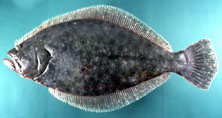
The channel flounder has an elongate oval body with a body height measuring 40–43% of its standard length. The head measures 26–28% of its standard length.[1][2]
Both eyes are located on the left side of the body, with the lower eye distinctly ahead of the upper eye. The snout has a notch immediately before the upper eye.[3][4]
The mouth is large and extends beneath the middle of the lower eye. The upper jaw has two rows of fixed teeth and the lower jaw has one row, with the front teeth larger than the side teeth.[5][6]
The pectoral fins occur on both sides of the body and have branched rays. In males, the first two rays of the eye-side pectoral fin are elongated.[7][8]
The pelvic fins are symmetrically positioned on the belly and have short bases. The urinary papilla is on the blind side immediately behind the anus.[9][10]
The scales are rough on the eyed side and smooth on the blind side. The species has 54–68 lateral-line scales.[11][12]
The lateral line is well developed on both sides, relatively straight and does not extend onto the head. Females have two diffuse dark blotches along the lateral line, one below the folded pectoral fin and another just before the tail base.[13][14]
Habitat
The channel flounder is usually found at depths shallower than 100 metres. It occurs over mud, sand and gravel.[15][16]
Its habitats include beaches, estuaries, mangroves and seagrass habitats.[16]
Diet
The channel flounder feeds on mobile benthic crustaceans, including shrimps and crabs. Its diet also includes mobile benthic gastropods, bivalves and worms.[17][18][19]
Classification of the Channel Flounder
| Kingdom | Animalia |
|---|---|
| Phylum | Chordata |
| Subphylum | Vertebrata |
| Infraphylum | Gnathostomata |
| Parvphylum | Osteichthyes |
| Gigaclass | Actinopterygii |
| Superclass | Actinopteri |
| Class | Teleostei (Teleost) |
| Order | Pleuronectiformes |
| Suborder | Pleuronectoidei |
| Family | Paralichthyidae (Sand Flounders) |
| Genus | Syacium |
| Species | Syacium micrurum Ranzani, 1842 |
Where the Channel Flounder is found
Checklists and occurrence records place Syacium micrurum in 36 countries. GBIF holds 709 georeferenced records of it.
Countries
- Angola 22
- Aruba 3
- Bahamas 4
- Barbados 11
- Belize 9
- Benin 5
- Brazil 140
- Cabo Verde 20
- Colombia 54
- Cuba 9
- Dominica 3
- French Guiana 11
- Gabon 9
- Ghana 23
- Guinea 12
- Guinea-Bissau 9
- Guyana 10
- Haiti 6
- Honduras 3
- Ivory Coast 5
- Jamaica 14
- Liberia 5
- Martinique 11
- Mauritania 15
- Mexico 24
- Nigeria 5
- Panama 23
- Puerto Rico 24
- Saint Barthelemy 3
- Senegal 6
- Sierra Leone 3
- Suriname 15
- Trinidad and Tobago 10
- U.S. Virgin Islands 5
- United States 164
- Venezuela 14
Regions and cities with the most records
- Bahia, Brazil 24
- Florida, United States 21
- Rio de Janeiro, Brazil 13
- Catete, Brazil 11
- Miami Beach, United States 11
- Rio de Janeiro, Brazil 11
- Santa Teresa, Brazil 11
- Allapattah, United States 10
- Botafogo, Brazil 10
- Brownsville, United States 10
- Coconut Grove, United States 10
- Coral Gables, United States 10
- Espírito Santo, Brazil 10
- Estácio, Brazil 10
- Ipanema, Brazil 10
- Leblon, Brazil 10
- Little Havana, United States 10
- Miami, United States 10
- Rocinha, Brazil 10
- Vidigal, Brazil 10
- Vila Velha, Brazil 10
- Vitória, Brazil 10
- West Little River, United States 10
- Cariacica, Brazil 9
- Cativá, Panama 9
- Colón, Panama 9
- Coral Terrace, United States 9
- Cordovil, Brazil 9
- Flagami, United States 9
- Fort-de-France, Martinique 9
- Hialeah, United States 9
- Niterói, Brazil 9
- North Miami, United States 9
- Pinewood, United States 9
- Sabanitas, Panama 9
- Westchester, United States 9
A number beside a place is its count of GBIF occurrence records. A place without a number comes from a checklist alone. Records show where a species has been observed or collected, which can include escapes and vagrants.
Common names
English
- Channel Flounder
Names in 6 other languages
- Chinese
- 小頦潛鮃
- French
- Fausse limande pate, Fausse limande sombre, Rombou de canal, Turbot, fausse limande pâté
- Papiamento
- Tapa Tapa
- Russian
- Короткохвостая сиация
- Spanish
- Lenguado fusco, lenguado anillado
- wol
- Ndérère
Synonyms
9 other scientific names have been used for this species and are now treated as synonyms of Syacium micrurum.
- Citharichthys aethalion Jordan, 1886
- Citharichthys ocellatus (Poey, 1860)
- Hemirhombus aethalion (Jordan, 1886)
- Hemirhombus aramaca Günther, 1862
- Hemirhombus micrurus (Ranzani, 1842)
- Hemirhombus ocellatus (Poey, 1860)
- Hippoglossus ocellatus Poey, 1860
- Scyacium micrurum Ranzani, 1842
- Syacium aethalion Jordan, 1886
Related species
-
 Dusky FlounderSyacium papillosum
-
 Shoal FlounderSyacium gunteri
- Oval FlounderSyacium ovale
- Beach FlounderSyacium latifrons
- Pompadour FlounderSyacium longidorsale
- Cocos FlounderSyacium maculiferum
- Papillose FlounderSyacium guineense
-
 Summer FlounderParalichthys dentatus
Compare
Questions and answers
What is the scientific name of the Channel Flounder?
The scientific name of the Channel Flounder is Syacium micrurum. Written with its author, the full name is Syacium micrurum Ranzani, 1842.
Which family does the Channel Flounder belong to?
Syacium micrurum belongs to the family Paralichthyidae, in the order Pleuronectiformes and the class Teleostei.
Where is the Channel Flounder found?
Checklists and occurrence records place Syacium micrurum in 36 countries, including United States, Brazil, Colombia, Mexico, Puerto Rico and Ghana.
What is the conservation status of the Channel Flounder?
The IUCN Red List category recorded for Syacium micrurum is Least Concern (LC).
What do flounder fish eat?
The channel flounder feeds on mobile benthic crustaceans, including shrimps and crabs, as well as gastropods, bivalves and worms.[17][18][19]
What is the dark side of flounder?
The channel flounder has rough scales on its eyed side and smooth scales on its blind side. Females have two diffuse dark blotches along the lateral line.[11][14]
How deep of water do flounder live in?
The channel flounder is usually found at depths shallower than 100 metres.[15]
Sources
Passages the profile rests on
- The species has an elongate oval body with a body height measuring 40–43% of its standard length. Source passage: “Body an elongate oval, height 40-43% of SL” — biogeodb.stri.si.edu
- The head measures 26–28% of the species' standard length. Source passage: “head length 26-28% of SL” — biogeodb.stri.si.edu
- Both eyes are located on the left side of the body, with the lower eye positioned distinctly ahead of the upper eye. Source passage: “eyes on left side, lower distinctly before upper” — biogeodb.stri.si.edu
- The snout has a notch immediately before the upper eye. Source passage: “snout with a notch before top eye” — biogeodb.stri.si.edu
- The mouth is large and extends to a position beneath the middle of the lower eye. Source passage: “mouth large, ends under middle lower eye” — biogeodb.stri.si.edu
- The upper jaw has two rows of fixed teeth, while the lower jaw has one row, with the front teeth larger than the side teeth. Source passage: “fixed teeth in 2 rows on upper jaw, 1 row on lower jaw, front teeth larger than side teeth” — biogeodb.stri.si.edu
- The pectoral fins occur on both sides of the body and have branched rays. Source passage: “pectoral fins on both sides of body, with branched rays” — biogeodb.stri.si.edu
- Males have the first two rays of the eye-side pectoral fin elongated. Source passage: “eye-side pectoral with first 2 rays elongate in males” — biogeodb.stri.si.edu
- The pelvic fins are symmetrically positioned on the belly and have short bases. Source passage: “pelvic fins symmetrically positioned on belly, base of eye-side fin on body midline, short bases” — biogeodb.stri.si.edu
- The urinary papilla is located on the blind side immediately behind the anus. Source passage: “urinary papilla on blind side, immediately behind anus” — biogeodb.stri.si.edu
- The scales are rough on the eyed side and smooth on the blind side. Source passage: “scales rough on eye side, smooth on blind side” — biogeodb.stri.si.edu
- The species has 54–68 lateral-line scales. Source passage: “54-68 lateral line scales” — biogeodb.stri.si.edu
- The lateral line is well developed on both sides, relatively straight, and does not extend onto the head. Source passage: “lateral line well developed on both sides, not extending onto head, relatively straight” — biogeodb.stri.si.edu
- Females have two diffuse dark blotches along the lateral line, one below the folded pectoral fin and another just before the tail base. Source passage: “female with 2 diffuse dark blotches on lateral line, one under laid-down pectoral, the other just before tail base.” — biogeodb.stri.si.edu
- The species is usually found at depths shallower than 100 metres. Source passage: “but usually in less than 100 m.” — biogeodb.stri.si.edu
- The species occurs over mud, sand, gravel, beaches, estuaries, mangroves, and seagrass habitats. Source passage: “Soft bottom (mud/sand/gravel/beach/estuary/mangrove/seagrass)” — biogeodb.stri.si.edu
- The species feeds on mobile benthic crustaceans, including shrimps and crabs. Source passage: “Mobile benthic crustacea (shrimps/crabs)” — biogeodb.stri.si.edu
- The species feeds on mobile benthic gastropods and bivalves. Source passage: “Mobile benthic gastropods/bivalves” — biogeodb.stri.si.edu
- The species feeds on mobile benthic worms. Source passage: “Mobile benthic worms” — biogeodb.stri.si.edu
Data
- Catalogue of Life, 2026-10-16 XR cc by
- Global Biodiversity Information Facility CC BY 4.0
- Wikidata CC0
- GeoNames CC BY 4.0
- Within the Catalogue of Life, this name comes from World Register of Marine Species cc by
References
- Ranzani, C. (1842). De novis speciebus piscium. Dissertatio Secunda. Novi Commentarii Academiae Scientiarum Instituti Bononiensis, v. 5: 3–21, Pls. 1–7. where the name was published
This species in other databases
- Catalogue of Life 7B67L
- Wikidata Q14422428
- iNaturalist 317399
- WoRMS urn:lsid:marinespecies.org:taxname:158877
- ITIS 172792
Page built on 29 November 2026. See how the catalog is made and all sources and licences.
Cite this page
ScientificNames.org. (2026). Syacium micrurum (Channel Flounder). Retrieved November 29, 2026, from https://scientificnames.org/species/syacium-micrurum
“Syacium micrurum (Channel Flounder).” ScientificNames.org, 2026, scientificnames.org/species/syacium-micrurum. Accessed 29 Nov. 2026.
ScientificNames.org. “Syacium micrurum (Channel Flounder).” Accessed November 29, 2026. https://scientificnames.org/species/syacium-micrurum.
@misc{scientificnames_syacium_micrurum_channel_flounder,
  author = {{ScientificNames.org}},
  title = {Syacium micrurum (Channel Flounder)},
  year = {2026},
  url = {https://scientificnames.org/species/syacium-micrurum},
  note = {Accessed 2026-11-29}
}