Species · Fishes
Dusky Flounder Syacium papillosum
The scientific name of the Dusky Flounder is Syacium papillosum. It is a species of fish in the family Paralichthyidae (sand flounders), order Pleuronectiformes. The name dates from 1758.
- Scientific name
- Syacium papillosum (Linnaeus, 1758)
- Common name
- Dusky Flounder
- Genus
- Syacium
- Family
- Paralichthyidae (Sand Flounders)
- Order
- Pleuronectiformes
- Class
- Teleostei
- Red List category
- LC Least Concern
- Environment
- marine
- Recorded in
- 17 countries
- Name status
- accepted in the Catalogue of Life

Overview
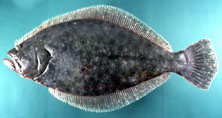
The dusky flounder occurs in the tropical western Atlantic. It has both eyes on the left side of its body, a grey-brown eye-facing side, and three or four dark bars on each pectoral fin.
Written 28 November 2026 from the sources listed below. Each statement was checked against the passage it cites; statements that could not be supported were removed.
Appearance
The dusky flounder has an elongate oval body with a body height equal to 40–44% of its standard length. Both eyes are on the left side, with the lower eye distinctly ahead of the upper eye.[1][2]
The eye-facing side is grey-brown, while the blind side is dusky. The pectoral fins have three or four dark bars in both sexes.[3][4]
Males have blue lines along the snout before the upper eye, sometimes extending onto the lips and lower jaw. They also have two greatly elongated initial rays on the eye-side pectoral fin.[5][6]
The scales are rough on the eye-facing side and smooth on the blind side. The lateral line is well developed on both sides, relatively straight, and does not extend onto the head.[7][8]
The species has 82–94 dorsal-fin rays and 64–75 anal-fin rays. The lateral line has 47–60 scales.[9][10]
Habitat
The dusky flounder occurs on soft substrates including mud, sand, and gravel. Its habitats include beaches, estuaries, mangroves, and seagrass habitats.[11]
Diet
The dusky flounder feeds on mobile benthic crustaceans, including shrimps and crabs. Its diet also includes mobile benthic gastropods, bivalves, and worms.[12][13][14]
Behaviour
The dusky flounder commonly remains buried and camouflaged in sand, making it difficult to notice. It can change its coloration to match the substrate.[15][16]
Classification of the Dusky Flounder
| Kingdom | Animalia |
|---|---|
| Phylum | Chordata |
| Subphylum | Vertebrata |
| Infraphylum | Gnathostomata |
| Parvphylum | Osteichthyes |
| Gigaclass | Actinopterygii |
| Superclass | Actinopteri |
| Class | Teleostei (Teleost) |
| Order | Pleuronectiformes |
| Suborder | Pleuronectoidei |
| Family | Paralichthyidae (Sand Flounders) |
| Genus | Syacium |
| Species | Syacium papillosum (Linnaeus, 1758) |
Where the Dusky Flounder is found
Checklists and occurrence records place Syacium papillosum in 17 countries. GBIF holds 2,334 georeferenced records of it.
Countries
- Belize 19
- Bonaire, Saint Eustatius and Saba 3
- Brazil 284
- Colombia 30
- French Guiana 35
- Guyana 17
- Honduras 11
- Jamaica 5
- Martinique 3
- Mexico 211
- Panama 7
- Puerto Rico 4
- Suriname 62
- Trinidad and Tobago 11
- U.S. Virgin Islands 4
- United States 1,616
- Venezuela 12
Regions and cities with the most records
- Florida, United States 23
- Espírito Santo, Brazil 17
- Ilhabela, Brazil 13
- São Paulo, Brazil 13
- São Sebastião, Brazil 13
- Myrtle Grove, United States 11
- Pensacola, United States 11
- West Pensacola, United States 11
- Allapattah, United States 9
- Brownsville, United States 9
- Governador Celso Ramos, Brazil 9
- Little Havana, United States 9
- Miami, United States 9
- Miami Beach, United States 9
- Pinecrest, United States 9
- Santa Catarina, Brazil 9
- Coconut Grove, United States 8
- Coral Gables, United States 8
- Cutler, United States 8
- Bellview, United States 7
- Coral Terrace, United States 7
- Flagami, United States 7
- Glenvar Heights, United States 7
- Jupiter, United States 7
- Kendall, United States 7
- Key West, United States 7
- North Miami, United States 7
- Rio de Janeiro, Brazil 7
- Texas, United States 7
- Balneário Camboriú, Brazil 6
- Boca Del Mar, United States 6
- Boca Raton, United States 6
- Deerfield Beach, United States 6
- Hialeah, United States 6
- Palm Beach Gardens, United States 6
- Palmetto Bay, United States 6
A number beside a place is its count of GBIF occurrence records. A place without a number comes from a checklist alone. Records show where a species has been observed or collected, which can include escapes and vagrants.
Common names
English
- Dusky Flounder
Names in 5 other languages
- Chinese
- 暗色潛鮃, 暗色潜鲆
- French
- Fausse limande sombre
- Japanese
- Hanaguro-darmagarei, ハナグロダルマガレイ
- Portuguese
- Solha de dente
- Spanish
- lenguado moreno
Synonyms
11 other scientific names have been used for this species and are now treated as synonyms of Syacium papillosum.
- Aramaca papillosa (Linnaeus, 1758)
- Aramaca soleaeformis (Agassiz, 1831)
- Citharichthys aramaca (Walbaum, 1792)
- Citharichthys paetulus (Jordan & Gilbert, 1882)
- Citharichthys peatulus Jordan & Gilbert, 1882
- Hemirhombus paetulus Jordan & Gilbert, 1882
- Hemirhombus soleaeformis (Agassiz, 1831)
- Hippoglossus intermedius Ranzani, 1842
- Pleuronectes aramaca Walbaum, 1792
- Pleuronectes papillosus Linnaeus, 1758
- Rhombus soleaeformis Agassiz, 1831 ambiguous synonym
Related species
-
 Shoal FlounderSyacium gunteri
- Oval FlounderSyacium ovale
- Beach FlounderSyacium latifrons
- Pompadour FlounderSyacium longidorsale
- Channel FlounderSyacium micrurum
- Cocos FlounderSyacium maculiferum
- Papillose FlounderSyacium guineense
-
 Summer FlounderParalichthys dentatus
Compare
Questions and answers
What is the scientific name of the Dusky Flounder?
The scientific name of the Dusky Flounder is Syacium papillosum. Written with its author, the full name is Syacium papillosum (Linnaeus, 1758).
Which family does the Dusky Flounder belong to?
Syacium papillosum belongs to the family Paralichthyidae, in the order Pleuronectiformes and the class Teleostei.
Where is the Dusky Flounder found?
Checklists and occurrence records place Syacium papillosum in 17 countries, including United States, Brazil, Mexico, Suriname, French Guiana and Colombia.
What is the conservation status of the Dusky Flounder?
The IUCN Red List category recorded for Syacium papillosum is Least Concern (LC).
What is the dark side of flounder?
The blind side of the dusky flounder is dusky.[3]
Sources
Passages the profile rests on
- The species has an elongate oval body with a body height equal to 40–44% of its standard length. Source passage: “Body an elongate oval, height 40-44% of SL” — biogeodb.stri.si.edu
- Both eyes are located on the left side of the body, with the lower eye distinctly ahead of the upper eye. Source passage: “eyes on left side, lower distinctly before upper” — biogeodb.stri.si.edu
- The eye-facing side is grey-brown, while the blind side is dusky. Source passage: “Eye side grey-brown, female with little or no dark mottling; blind side dusky” — biogeodb.stri.si.edu
- The pectoral fins have three or four dark bars in both sexes. Source passage: “pectoral fin with 3-4 dark bars in both sexes” — biogeodb.stri.si.edu
- Males have blue lines along the snout before the upper eye, sometimes extending onto the lips and lower jaw. Source passage: “male with blue lines along snout before upper eye, sometimes also on lips and lower jaw.” — biogeodb.stri.si.edu
- Males have two greatly elongated initial rays on the eye-side pectoral fin. Source passage: “eye-side pectoral with first 2 rays greatly elongate in male” — biogeodb.stri.si.edu
- The scales are rough on the eye-facing side and smooth on the blind side. Source passage: “scales rough on eye side, smooth on blind side” — biogeodb.stri.si.edu
- The lateral line is well developed on both sides, relatively straight, and does not extend onto the head. Source passage: “lateral line well developed on both sides, not extending onto head, relatively straight.” — biogeodb.stri.si.edu
- The species has 82–94 dorsal-fin rays and 64–75 anal-fin rays. Source passage: “82-94 dorsal rays; 64-75 anal rays” — biogeodb.stri.si.edu
- The lateral line has 47–60 scales. Source passage: “47-60 lateral line scales” — biogeodb.stri.si.edu
- The species occurs on soft substrates including mud, sand, gravel, beaches, estuaries, mangroves, and seagrass habitats. Source passage: “Soft bottom (mud/sand/gravel/beach/estuary/mangrove/seagrass)” — biogeodb.stri.si.edu
- The species feeds on mobile benthic crustaceans, including shrimps and crabs. Source passage: “Mobile benthic crustacea (shrimps/crabs)” — biogeodb.stri.si.edu
- The species feeds on mobile benthic gastropods and bivalves. Source passage: “Mobile benthic gastropods/bivalves” — biogeodb.stri.si.edu
- The species feeds on mobile benthic worms. Source passage: “Data Mobile benthic worms” — biogeodb.stri.si.edu
- The species commonly remains buried and camouflaged in sand, making it difficult to notice. Source passage: “usually left unnoticed buried and camouflaged by sand.” — sanctuaries.noaa.gov
- The species can change its coloration to match the substrate. Source passage: “They are capable of changing color to match substrate.” — sanctuaries.noaa.gov
Data
- Catalogue of Life, 2026-10-16 XR cc by
- Global Biodiversity Information Facility CC BY 4.0
- Wikidata CC0
- GeoNames CC BY 4.0
- Wikimedia Commons per image; credit shown with each image
- Within the Catalogue of Life, this name comes from World Register of Marine Species cc by
This species in other databases
- Catalogue of Life 53K8Y
- Wikidata Q2695472
- iNaturalist 179454
- WoRMS urn:lsid:marinespecies.org:taxname:158878
- ITIS 172793
Page built on 29 November 2026. See how the catalog is made and all sources and licences.
Cite this page
ScientificNames.org. (2026). Syacium papillosum (Dusky Flounder). Retrieved November 29, 2026, from https://scientificnames.org/species/syacium-papillosum
“Syacium papillosum (Dusky Flounder).” ScientificNames.org, 2026, scientificnames.org/species/syacium-papillosum. Accessed 29 Nov. 2026.
ScientificNames.org. “Syacium papillosum (Dusky Flounder).” Accessed November 29, 2026. https://scientificnames.org/species/syacium-papillosum.
@misc{scientificnames_syacium_papillosum_dusky_flounder,
  author = {{ScientificNames.org}},
  title = {Syacium papillosum (Dusky Flounder)},
  year = {2026},
  url = {https://scientificnames.org/species/syacium-papillosum},
  note = {Accessed 2026-11-29}
}