Species · Fishes
Estuarine Stonefish Synanceia horrida
The scientific name of the Estuarine Stonefish is Synanceia horrida. It is a species of fish in the family Synanceiidae (stonefishes), order Perciformes. The name dates from 1766.
- Scientific name
- Synanceia horrida (Linnaeus, 1766)
- Common name
- Estuarine Stonefish
- Genus
- Synanceia
- Family
- Synanceiidae (Stonefishes)
- Order
- Perciformes
- Class
- Teleostei
- Red List category
- LC Least Concern
- Environment
- brackish, marine
- Recorded in
- 9 countries
- Name status
- accepted in the Catalogue of Life

Overview
Synanceia horrida inhabits sheltered inshore reefs, estuaries, shallow reef flats and seagrass beds. It has drab, warty skin, uses camouflage to resemble a stone and reaches a maximum total length of 60 cm.
Written 26 November 2026 from the sources listed below. Each statement was checked against the passage it cites; statements that could not be supported were removed.
Appearance
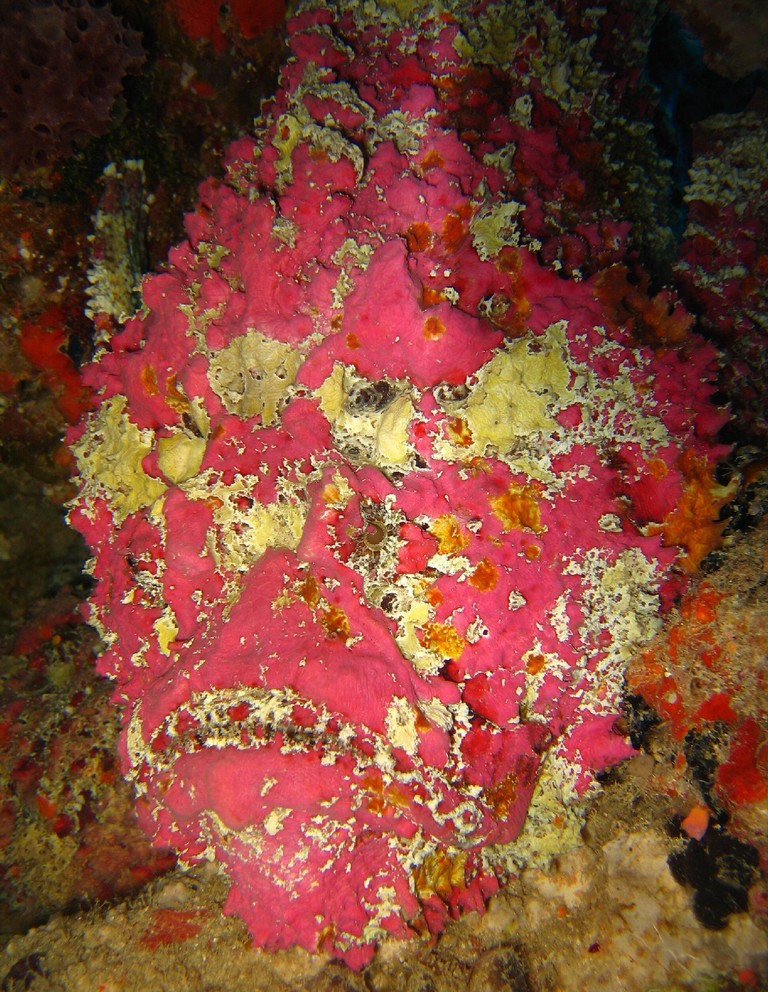
Its coloration ranges from brownish-grey to reddish or greenish-brown. Its skin lacks scales and is covered in warts, sometimes with growths of filamentous algae.[1][2]
Its head is depressed, with small, widely spaced eyes positioned high on the head and directed upwards. A deep pit is present behind and below each eye.[3][4]
It has a large, nearly vertical mouth with a wide gape and cirrhi fringing its lips. Its pectoral fins are large and fleshy.[5][6]
Its dorsal fin has 13 or 14 spines and six soft rays, with the second through fourth spines longer than the others. Its anal fin has three spines and five soft rays.[7][8]
The species reaches a maximum total length of 60 cm.[9]
Habitat
It inhabits sheltered inshore reefs and estuaries. It frequently occupies shallow water among coral rubble and rocks on reef flats.[10][11]
It also occurs in seagrass beds.[12]
Diet
Its diet includes smaller fishes, crustaceans and cephalopods.[13]
Behaviour
The species uses camouflage to resemble a stone resting on the bottom. It excavates a depression in the substrate using its large pectoral fins and curls its tail around its body to improve its camouflage.[14][15][16]
It is a nocturnal ambush predator that captures nearby prey by sucking it into its large mouth.[17][18]
It can tolerate being outside water for up to 24 hours.[19]
Reproduction and life cycle
Its reproductive biology is poorly understood, although sexual reproduction is documented. Females are larger than males.[20][21]
Spawning has been observed in aggregations in shallow water over a silt substrate in Queensland.[22]
Conservation
FishBase reports a minimum population doubling time exceeding 14 years.[23]
Uses
The species is popular as an exhibit in public aquaria and is sometimes traded in the home aquarium industry.[24][25]
It is occasionally harvested by subsistence fisheries and appears in some live fish markets in Asia. It has also been considered as a potential aquaculture species.[26][27][28]
Classification of the Estuarine Stonefish
| Kingdom | Animalia |
|---|---|
| Phylum | Chordata |
| Subphylum | Vertebrata |
| Infraphylum | Gnathostomata |
| Parvphylum | Osteichthyes |
| Gigaclass | Actinopterygii |
| Superclass | Actinopteri |
| Class | Teleostei (Teleost) |
| Order | Perciformes |
| Suborder | Scorpaenoidei |
| Family | Synanceiidae (Stonefishes) |
| Subfamily | Synanceiinae |
| Genus | Synanceia |
| Species | Synanceia horrida (Linnaeus, 1766) |
Where the Estuarine Stonefish is found
Checklists and occurrence records place Synanceia horrida in 9 countries. GBIF holds 490 georeferenced records of it.
Countries
- Australia 343
- India 4
- Indonesia 65
- Malaysia 7
- New Caledonia 4
- Papua New Guinea 7
- Philippines 15
- Singapore 41
- Thailand 4
Regions and cities with the most records
- Queensland, Australia 97
- Eunos, Singapore 36
- MacPherson, Singapore 36
- Marine Parade, Singapore 36
- Novena, Singapore 36
- Anak Bukit, Singapore 32
- Ang Mo Kio New Town, Singapore 32
- Bukit Timah, Singapore 32
- Queenstown Estate, Singapore 32
- Singapore, Singapore 32
- Jurong East, Singapore 31
- Jurong Town, Singapore 29
- Darwin, Australia 28
- Bukit Panjang New Town, Singapore 27
- Palmerston, Australia 26
- Yio Chu Kang, Singapore 25
- Bedok New Town, Singapore 24
- Kampong Pasir Ris, Singapore 24
- Sengkang New Town, Singapore 24
- Ulu Bedok, Singapore 24
- Boon Lay, Singapore 23
- Teck Whye, Singapore 23
- Choa Chu Kang New Town, Singapore 22
- Jurong West, Singapore 22
- Keat Hong Village, Singapore 22
- Narangba, Australia 22
- Yew Tee, Singapore 21
- Caloundra, Australia 17
- Matilda Estate, Singapore 17
- Sunshine Coast, Australia 17
- Western Australia, Australia 17
- Northern Territory, Australia 16
- Gold Coast, Australia 15
- Capalaba, Australia 14
- Kampong Loyang, Singapore 13
- Bitung, Indonesia 12
A number beside a place is its count of GBIF occurrence records. A place without a number comes from a checklist alone. Records show where a species has been observed or collected, which can include escapes and vagrants.
Common names
English
- Estuarine Stonefish
- Hollow-cheeked Stonefish
- Horrid Stonefish
- True Stonefish
- Nepe Asado
Names in 10 other languages
- Asturian
- pexe piedra
- Czech
- odranec příšerný
- Danish
- Delta-stenfisk
- Dutch
- Steenvis
- French
- Grand poisson-pierre
- Italian
- Pesce pietra, Pesce pietra di estuario, Pesce pietra orrido
- Japanese
- ツノダルマオコゼ
- Portuguese
- Peixe-pedra-estuarino
- Spanish
- Pez Piedra de Estuario
- Thai
- ปลากะรังหัวโขน, ปลาหินปากแม่น้ำ
Synonyms
6 other scientific names have been used for this species and are now treated as synonyms of Synanceia horrida.
- Scorpaena horrida Linnaeus, 1766
- Synanceia horrid (Linnaeus, 1766)
- Synanceia trachynis Richardson, 1842
- Synanceja horrida (Linnaeus, 1766)
- Synanceja trachynis Richardson, 1842
- Synaneceiea horrida (Linnaeus, 1766)
Related species
-
 Reef StonefishSynanceia verrucosa
-
 Red Sea StonefishSynanceia nana
- Midget StonefishSynanceia alula
- Bleeker's StonefishSynanceia platyrhynchus
- Quinque StonefishSynanceia quinque
-
 Devil StingerInimicus didactylus
-
 Stargazing StonefishTrachicephalus uranoscopus
-
 Two-stick StingfishInimicus filamentosus
Compare
Questions and answers
What is the scientific name of the Estuarine Stonefish?
The scientific name of the Estuarine Stonefish is Synanceia horrida. Written with its author, the full name is Synanceia horrida (Linnaeus, 1766).
Which family does the Estuarine Stonefish belong to?
Synanceia horrida belongs to the family Synanceiidae, in the order Perciformes and the class Teleostei.
Where is the Estuarine Stonefish found?
Checklists and occurrence records place Synanceia horrida in 9 countries, including Australia, Indonesia, Singapore, Philippines, Malaysia and Papua New Guinea.
What is the conservation status of the Estuarine Stonefish?
The IUCN Red List category recorded for Synanceia horrida is Least Concern (LC).
What other names does the Estuarine Stonefish have?
Synanceia horrida is also known in English as Hollow-cheeked Stonefish, Horrid Stonefish, True Stonefish and Nepe Asado.
What habitat do stonefish live in?
The Estuarine Stonefish inhabits sheltered inshore reefs and estuaries. It frequently occupies shallow water among coral rubble and rocks on reef flats and also occurs in seagrass beds.[10][11][12]
What is the diet of a stonefish?
Its diet includes smaller fishes, crustaceans and cephalopods.[13]
How long can a stonefish survive out of water?
The Estuarine Stonefish can tolerate being outside water for up to 24 hours.[19]
Sources
Passages the profile rests on
- Synanceia horrida has drab coloration ranging from brownish-grey to reddish or greenish-brown. Source passage: “Synanceia horrida is a drab-coloured benthic fish, which can be brownish-grey to reddish or greenish-brown.” — English Wikipedia
- Its skin lacks scales and is covered in warts, sometimes with growths of filamentous algae. Source passage: “The skin has no scales, but is covered in warts and often has growths of filamentous algae on it.” — English Wikipedia
- Its head is depressed, with small, widely spaced eyes positioned high on the head and directed upwards. Source passage: “The head is depressed with small, widely spaced eyes that sit high on the head and are upwards directed.” — English Wikipedia
- A deep pit is present behind and below each eye. Source passage: “A deep pit is behind and under each eye.” — English Wikipedia
- It has a large, nearly vertical mouth with a wide gape and cirrhi fringing its lips. Source passage: “The large mouth is almost vertical and has a wide gape and fringing cirrhi on the lips.” — English Wikipedia
- Its pectoral fins are large and fleshy. Source passage: “The pectoral fins are large and fleshy.” — English Wikipedia
- Its dorsal fin has 13 or 14 spines and six soft rays, with the second through fourth spines longer than the others. Source passage: “It has 13 or 14 spines and six soft rays in the dorsal fin, the second to fourth spines being longer than the others.” — English Wikipedia
- Its anal fin has three spines and five soft rays. Source passage: “The anal fin has three spines and five soft rays.” — English Wikipedia
- The species reaches a maximum total length of 60 cm. Source passage: “This species reaches a maximum total length of 60 cm (24 in).” — English Wikipedia
- It inhabits sheltered inshore reefs and estuaries. Source passage: “The estuarine stonefish is found on sheltered inshore reefs and in estuaries,” — English Wikipedia
- It frequently occupies shallow water among coral rubble and rocks on reef flats. Source passage: “frequently in the shallowest water in coral rubble and rocks on reef flats,” — English Wikipedia
- It also occurs in seagrass beds. Source passage: “as well as in seagrass beds.” — English Wikipedia
- Its diet includes smaller fishes, crustaceans and cephalopods. Source passage: “preying on smaller fishes, crustaceans, and cephalopods.” — English Wikipedia
- The species uses camouflage to resemble a stone resting on the bottom. Source passage: “resembles a stone resting on the bottom.” — English Wikipedia
- It excavates a depression in the substrate using its large pectoral fins. Source passage: “It scoops out a depression in the substrate with its large pectoral fins” — English Wikipedia
- It curls its tail around its body to improve its camouflage. Source passage: “and curls its tail around its body to enhance this camouflage.” — English Wikipedia
- It is a nocturnal ambush predator. Source passage: “It is a nocturnal ambush predator,” — English Wikipedia
- It captures nearby prey by sucking it into its large mouth. Source passage: “The large mouth is used to suck in prey that swims close enough to be engulfed.” — English Wikipedia
- It can tolerate being outside water for up to 24 hours. Source passage: “This species can tolerate being out of the water for up to 24 hours.” — English Wikipedia
- Its reproductive biology is poorly understood, although sexual reproduction is documented. Source passage: “Little is known about its reproductive biology, other than it is sexual.” — English Wikipedia
- Females are larger than males. Source passage: “The females are larger than the males,” — English Wikipedia
- Spawning has been observed in aggregations in shallow water over a silt substrate in Queensland. Source passage: “it has been observed spawning in aggregations in shallow water over a silt substrate in Queensland.” — English Wikipedia
- FishBase reports a minimum population doubling time exceeding 14 years. Source passage: “Very Low, minimum population doubling time more than 14 years” — fishbase.se
- The species is popular as an exhibit in public aquaria. Source passage: “This species is popular as a new exhibit in public aquaria” — English Wikipedia
- It is sometimes traded in the home aquarium industry. Source passage: “and is sometimes found in the home aquarium trade.” — English Wikipedia
- It is occasionally harvested by subsistence fisheries. Source passage: “It is occasionally taken by subsistence fisheries,” — English Wikipedia
- It appears in some live fish markets in Asia. Source passage: “and it appears in some Asia live fish markets.” — English Wikipedia
- It has been considered as a potential aquaculture species. Source passage: “It has been considered as a potential species for aquaculture.” — English Wikipedia
Data
- Catalogue of Life, 2026-10-16 XR cc by
- Global Biodiversity Information Facility CC BY 4.0
- Wikidata CC0
- GeoNames CC BY 4.0
- Wikimedia Commons per image; credit shown with each image
- Within the Catalogue of Life, this name comes from World Register of Marine Species cc by
This species in other databases
- Catalogue of Life 53TC4
- Wikidata Q13405122
- iNaturalist 64491
- WoRMS urn:lsid:marinespecies.org:taxname:276862
- ITIS 643705
Page built on 28 November 2026. See how the catalog is made and all sources and licences.
Cite this page
ScientificNames.org. (2026). Synanceia horrida (Estuarine Stonefish). Retrieved November 28, 2026, from https://scientificnames.org/species/synanceia-horrida
“Synanceia horrida (Estuarine Stonefish).” ScientificNames.org, 2026, scientificnames.org/species/synanceia-horrida. Accessed 28 Nov. 2026.
ScientificNames.org. “Synanceia horrida (Estuarine Stonefish).” Accessed November 28, 2026. https://scientificnames.org/species/synanceia-horrida.
@misc{scientificnames_synanceia_horrida_estuarine_stonefish,
  author = {{ScientificNames.org}},
  title = {Synanceia horrida (Estuarine Stonefish)},
  year = {2026},
  url = {https://scientificnames.org/species/synanceia-horrida},
  note = {Accessed 2026-11-28}
}