Species · Fishes
Reef Stonefish Synanceia verrucosa
The scientific name of the Reef Stonefish is Synanceia verrucosa. It is a species of fish in the family Synanceiidae (stonefishes), order Perciformes. The name dates from 1801.
- Scientific name
- Synanceia verrucosa Bloch & Schneider, 1801
- Common name
- Reef Stonefish
- Genus
- Synanceia
- Family
- Synanceiidae (Stonefishes)
- Order
- Perciformes
- Class
- Teleostei
- Red List category
- LC Least Concern
- Environment
- marine
- Recorded in
- 41 countries
- Name status
- accepted in the Catalogue of Life
Overview
Synanceia verrucosa inhabits shallow tropical marine waters of the western Pacific and Indian Oceans. Its scale-free, wart-covered skin and venomous dorsal spines distinguish the species.
Written 26 November 2026 from the sources listed below. Each statement was checked against the passage it cites; statements that could not be supported were removed.
Appearance
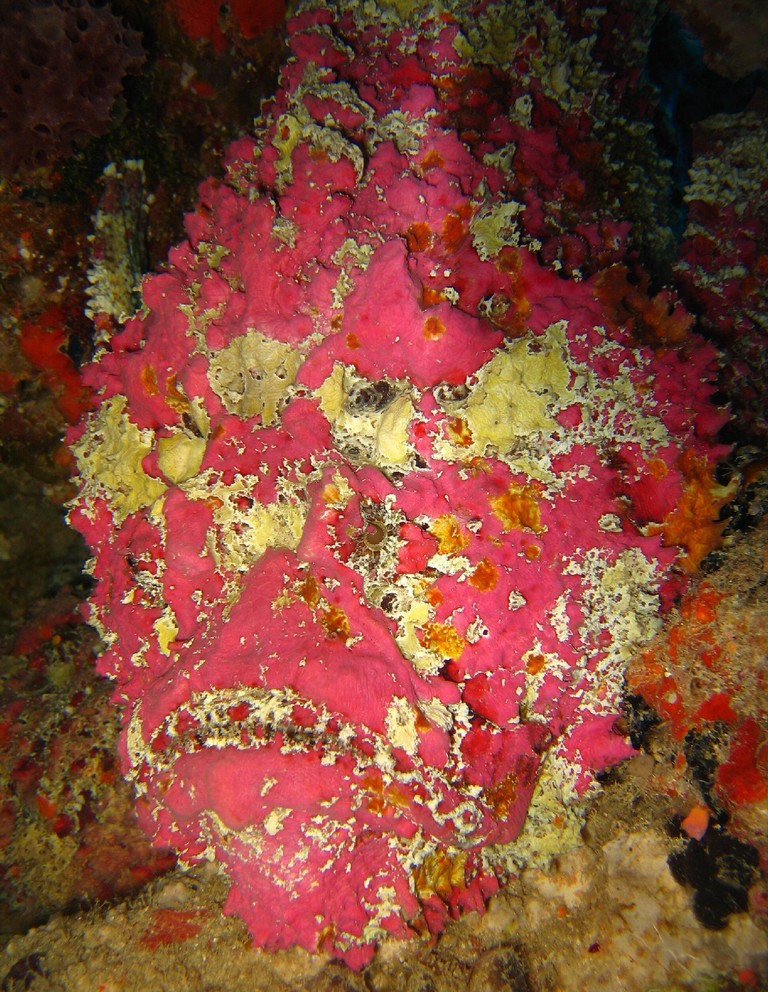
The Reef Stonefish is usually brown or grey, with possible yellow, orange, or red patches. It has a wide, flattened head, small upward-facing eyes, scale-free skin covered in wart-like growths, and fleshy pectoral fins.[1][2][3][4]
Its dorsal fin has 12–14 spines and 5–7 soft rays, while its anal fin has three spines and five or six soft rays. The dorsal spines have venom glands enclosed in thicker skin at their bases, and thirteen stout dorsal-fin spines are capable of injecting venom.[5][6][7][8]
Its irregular skin texture and coloration help it blend into rocks and corals. The species reaches a maximum recorded total length of 40 cm, although 27 cm is more typical, and commonly grows to approximately 35 cm.[9][10][11]
Habitat
The Reef Stonefish inhabits coral reefs and commonly occupies rubble or coral bottoms, including areas beneath rocks and ledges. It may settle around rocks and plants, rest on the seabed, or bury itself in sand using its large pectoral fins.[12][13][14]
Diet
The Reef Stonefish primarily consumes small fish, shrimp, and other crustaceans.[15][16]
Behaviour
The Reef Stonefish captures prey by remaining motionless on the reef floor until an animal swims past, then engulfing it at extremely high speed. Recorded prey strikes by some stonefish have taken as little as 0.015 seconds.[17][18][19]
When disturbed, the species generally remains in place and raises its venomous dorsal spines rather than swimming away. Sharks and rays are predators of the Reef Stonefish.[20][21]
Reproduction and life cycle
The Reef Stonefish spends most of its life alone and briefly aggregates with the opposite sex during mating season. Females are larger than males.[22][23]
After reaching sexual maturity, females deposit unfertilized eggs on the reef floor. Males fertilize the deposited eggs by releasing sperm over them.[24][25]
The species produces relatively large eggs from which well-developed young hatch. Its mating system is promiscuous, and females do not discriminate between males fertilizing their egg layers.[26][27]
Conservation
FishBase reports a minimum population doubling time estimate of 4.5–14 years for the species.[28]
Uses
The Reef Stonefish is primarily commercially significant as an aquarium pet. It is also sold for meat in markets in southern China and consumed in the Philippines and Japan.[29][30][31]
Classification of the Reef Stonefish
| Kingdom | Animalia |
|---|---|
| Phylum | Chordata |
| Subphylum | Vertebrata |
| Infraphylum | Gnathostomata |
| Parvphylum | Osteichthyes |
| Gigaclass | Actinopterygii |
| Superclass | Actinopteri |
| Class | Teleostei (Teleost) |
| Order | Perciformes |
| Suborder | Scorpaenoidei |
| Family | Synanceiidae (Stonefishes) |
| Subfamily | Synanceiinae |
| Genus | Synanceia |
| Species | Synanceia verrucosa Bloch & Schneider, 1801 |
Where the Reef Stonefish is found
Checklists and occurrence records place Synanceia verrucosa in 41 countries. GBIF holds 1,214 georeferenced records of it.
Countries
- Australia 92
- China 7
- Cocos Islands 3
- Cook Islands 8
- Egypt 159
- Fiji 23
- French Polynesia 69
- Guam 12
- India 7
- Indonesia 140
- Israel 9
- Japan 115
- Jordan 5
- Kenya 36
- Madagascar 14
- Malaysia 37
- Maldives 30
- Marshall Islands 29
- Mauritius 26
- Mayotte 4
- Micronesia 8
- Mozambique 17
- New Caledonia 72
- Northern Mariana Islands 5
- Palau 11
- Palestinian Territory 5
- Papua New Guinea 16
- Philippines 65
- Reunion 36
- Samoa 10
- Saudi Arabia 3
- Seychelles 21
- Solomon Islands 4
- South Africa 16
- Sri Lanka 5
- Taiwan 44
- Tanzania 18
- Thailand 18
- Tonga 3
- Vanuatu 8
- Wallis and Futuna 4
Regions and cities with the most records
- Nouméa, New Caledonia 42
- Dumbéa, New Caledonia 35
- Hurghada, Egypt 35
- Mont-Dore, New Caledonia 35
- Saint-Leu, Reunion 24
- Amlapura city, Indonesia 23
- Bedugul, Indonesia 23
- Saint-Paul, Reunion 23
- Amlapura, Indonesia 22
- Safaga, Egypt 21
- Le Port, Reunion 19
- La Possession, Reunion 18
- Sabah, Malaysia 18
- Taiwan, Taiwan 17
- Faaa, French Polynesia 12
- Aqaba, Jordan 11
- Eilat, Israel 11
- Sharm el-Sheikh, Egypt 11
- Ukunda, Kenya 11
- Victoria, Seychelles 11
- Watamu, Kenya 11
- Al Quşayr, Egypt 10
- Bauan, Philippines 10
- Donggongon, Malaysia 10
- Kota Kinabalu, Malaysia 10
- Nungwi, Tanzania 10
- Papeete, French Polynesia 10
- Petagas, Malaysia 10
- Punaauia, French Polynesia 10
- Putatan, Malaysia 10
- San Pascual, Philippines 10
- Bali, Indonesia 9
- Bitung, Indonesia 9
- Gushikawa, Japan 9
- Ishikawa, Japan 9
- Katsuren-haebaru, Japan 9
3 more countries have a few records outside this range
These countries hold a few records of Synanceia verrucosa but lie outside the range the checklists give for it. Such records are often zoo or garden specimens, museum material or vagrants, so the species is not counted as occurring there.
A number beside a place is its count of GBIF occurrence records. A place without a number comes from a checklist alone. Records show where a species has been observed or collected, which can include escapes and vagrants.
Common names
English
- Reef Stonefish
- Stonefish
Names in 19 other languages
- Arabic
- Abu al-Laban
- Chinese
- 合笑, 拗豬頭, 沙薑鱠仔, 玫瑰毒鮋, 玫瑰毒鲉, 石頭魚, 腫瘤毒鮋, 虎魚
- Czech
- odranec pravý
- Danish
- Stenfisk
- Dutch
- Echte Steenvis
- French
- Crapaud, Poisson-pierre, Poisson-pierre commun, Synancée
- German
- Echter Steinfisch, Steinfisch
- Hebrew
- אבנון מגושם
- Italian
- Pesce pietra, Pesce pietra del reef, Pesce pietra verrucoso
- Japanese
- オニダルマオコゼ
- Polish
- Szkaradnica
- Portuguese
- Peixe-pedra-dos-recifes
- Russian
- Бородавчатка
- Slovenian
- veščec
- Spanish
- Pez Piedra Común
- Thai
- ปลาหิน
- mrv
- no'u
- pau
- Louch
- tah
- nohu
Synonyms
9 other scientific names have been used for this species and are now treated as synonyms of Synanceia verrucosa.
- Scorpaena brachion Lacepède, 1801
- Synaceia verrucosa Bloch & Schneider, 1801
- Synanceia brachio Cuvier, 1829
- Synanceia thersites Seale, 1901
- Synanceichthys verrucosa (Bloch & Schneider, 1801)
- Synanceichthys verrucosus (Bloch & Schneider, 1801)
- Synanceja verrucosa Bloch & Schneider, 1801
- Synancejia verrucosa Bloch & Schneider, 1801
- Synancia verrucosa Bloch & Schneider, 1801
Related species
-
 Estuarine StonefishSynanceia horrida
-
 Red Sea StonefishSynanceia nana
- Midget StonefishSynanceia alula
- Bleeker's StonefishSynanceia platyrhynchus
- Quinque StonefishSynanceia quinque
-
 Devil StingerInimicus didactylus
-
 Stargazing StonefishTrachicephalus uranoscopus
-
 Two-stick StingfishInimicus filamentosus
Compare
Questions and answers
What is the scientific name of the Reef Stonefish?
The scientific name of the Reef Stonefish is Synanceia verrucosa. Written with its author, the full name is Synanceia verrucosa Bloch & Schneider, 1801.
Which family does the Reef Stonefish belong to?
Synanceia verrucosa belongs to the family Synanceiidae, in the order Perciformes and the class Teleostei.
Where is the Reef Stonefish found?
Checklists and occurrence records place Synanceia verrucosa in 41 countries, including Egypt, Indonesia, Japan, Australia, New Caledonia and French Polynesia.
What is the conservation status of the Reef Stonefish?
The IUCN Red List category recorded for Synanceia verrucosa is Least Concern (LC).
What other names does the Reef Stonefish have?
Synanceia verrucosa is also known in English as Stonefish.
What is the scientific name for stonefish?
The scientific name of the Reef Stonefish is Synanceia verrucosa Bloch & Schneider, 1801.[32]
Are reef stonefish poisonous?
The Reef Stonefish has venom glands at the bases of its dorsal spines. Thirteen stout dorsal-fin spines are capable of injecting venom.[7][8]
Where are reef stonefish found?
Reef Stonefish occur in shallow tropical marine waters of the western Pacific and Indian Oceans. Their documented range extends from the Red Sea and coastal East Africa to French Polynesia, southern Japan, and Taiwan. They have also been observed in the eastern Mediterranean near Israel since at least 2010.[33][34][35]
What habitat do stonefish live in?
Reef Stonefish inhabit coral reefs and commonly occupy rubble or coral bottoms, including areas beneath rocks and ledges. They may rest on the seabed or bury themselves in sand using their large pectoral fins.[12][13][14]
What is the diet of a stonefish?
The Reef Stonefish primarily consumes small fish, shrimp, and other crustaceans.[15][16]
Do stonefish live in fresh or saltwater?
Reef Stonefish inhabit shallow tropical marine waters.[33]
Sources
Passages the profile rests on
- The Reef Stonefish is usually brown or grey, with possible yellow, orange, or red patches. Source passage: “Synanceia verrucosa are usually brown or grey, and may have areas of yellow, orange, or red.” — English Wikipedia
- The species has a wide, flattened head and small upward-facing eyes. Source passage: “The head is wide and flattened. The skin is tough and rough with warts. The small upwardly directed eyes” — English Wikipedia
- Its skin lacks scales and has numerous wart-like growths. Source passage: “The skin has no scales but there are numerous warts.” — English Wikipedia
- Its pectoral fins are fleshy. Source passage: “The pectoral fins are fleshy.” — English Wikipedia
- Its dorsal fin has 12–14 spines and 5–7 soft rays. Source passage: “The dorsal fin contains between 12 and 14 spines and 5 and 7 soft rays” — English Wikipedia
- The species has three anal-fin spines and five or six soft rays. Source passage: “the anal fin has 3 spines and 5 or 6 soft rays.” — English Wikipedia
- The dorsal spines have venom glands enclosed in thicker skin at their bases. Source passage: “The dorsal spines are of equal length with a thicker sheath of skin containing the venom glands at their base.” — English Wikipedia
- The species has thirteen stout dorsal-fin spines capable of injecting venom. Source passage: “The Reef Stonefish has thirteen stout dorsal fin spines which can inject an extremely poisonous venom.” — australian.museum
- Its irregular skin texture and coloration help it blend into rocks and corals. Source passage: “Their skin texture and color is highly irregular which helps them hide and remain camouflaged when among rocks and corals.” — English Wikipedia
- The species reaches a maximum recorded total length of 40 cm, although 27 cm is more typical. Source passage: “This species reaches a maximum recorded total length of 40 cm (16 in) but 27 cm (11 in) is more typical.” — English Wikipedia
- Reef Stonefish commonly grow to approximately 35 cm in length. Source passage: “Reef Stonefish grow to 35 cm in length” — australian.museum
- The species inhabits coral reefs and may settle around rocks and plants or rest on the seabed. Source passage: “This fish lives in coral reefs. It may settle on and around rocks and plants, or rest on the seabed.” — English Wikipedia
- Reef Stonefish commonly occupy rubble or coral bottoms, including areas beneath rocks and ledges. Source passage: “They usually live on rubble or coral bottoms, often under rocks or ledges” — australian.museum
- The species can bury itself in sand using its large pectoral fins. Source passage: “but are also known to be able to bury in sand using their large pectoral fins.” — australian.museum
- The Reef Stonefish primarily consumes small fish, shrimp, and other crustaceans. Source passage: “The reef stonefish eats mostly small fish, shrimp and other crustaceans.” — English Wikipedia
- Its diet includes fishes and crustaceans. Source passage: “The Reef Stonefish eats fishes and crustacea.” — australian.museum
- The species captures prey by remaining motionless on the reef floor until an animal swims past. Source passage: “It captures prey by sitting motionless on the reef floor and waiting for animals to swim by.” — English Wikipedia
- The Reef Stonefish engulfs prey at extremely high speed. Source passage: “The stonefish will then engulf its prey, doing so at incredible speeds.” — English Wikipedia
- Recorded prey strikes by some stonefish have taken as little as 0.015 seconds. Source passage: “Some stonefish have been recorded striking their prey in 0.015 seconds.” — English Wikipedia
- When disturbed, the species generally remains in place and raises its venomous dorsal spines rather than swimming away. Source passage: “The species is extremely well camouflaged and will not swim away when disturbed, but rather erects its poisonous dorsal fin spines.” — australian.museum
- Sharks and rays are predators of the Reef Stonefish. Source passage: “Predators of the Reef Stonefish include sharks and rays.” — australian.museum
- The Reef Stonefish spends most of its life alone and briefly aggregates with the opposite sex during mating season. Source passage: “The reef stonefish lives most of its life as a solitary animal, and during mating season only aggregates with the opposite sex for a short time.” — English Wikipedia
- Female Reef Stonefish are larger than males. Source passage: “Sexual dimorphism is apparent in reef stonefish, with females being larger than males.” — English Wikipedia
- Females deposit unfertilized eggs on the reef floor after reaching sexual maturity. Source passage: “When a female stonefish has reached sexual maturity, she will lay her unfertilized eggs on the floor of the reef.” — English Wikipedia
- Males fertilize the deposited eggs by releasing sperm over them. Source passage: “A male will then swim by and release sperm onto the layer of eggs, fertilizing them.” — English Wikipedia
- The species produces relatively large eggs from which well-developed young hatch. Source passage: “Stonefish eggs are fairly large, with young fish hatching well developed.” — English Wikipedia
- The Reef Stonefish has a promiscuous mating system in which females do not discriminate between males fertilizing their egg layers. Source passage: “The mating system of the reef stonefish is promiscuity, as the female will not discriminate between which males can lay their sperm on the egg layer.” — English Wikipedia
- FishBase reports a minimum population doubling time estimate of 4.5–14 years for the species. Source passage: “Low, minimum population doubling time 4.5 - 14 years (Preliminary K or Fecundity.).” — fishbase.se
- The species is primarily commercially significant as an aquarium pet. Source passage: “The primary commercial significance of this stonefish is as an aquarium pet.” — English Wikipedia
- The Reef Stonefish is sold for meat in markets in southern China. Source passage: “It is also sold for meat in Southern China markets.” — English Wikipedia
- The species is consumed in the Philippines and Japan. Source passage: “It is consumed in the Philippines, especially in Chinese restaurants, and in Japan.” — English Wikipedia
- The Reef Stonefish is identified as the type species of the genus Synanceia. Source passage: “It is the type species of Synanceia.” — English Wikipedia
- The species is distributed across shallow tropical marine waters of the western Pacific and Indian Oceans. Source passage: “known from shallow tropical marine waters in the western Pacific Ocean and the Indian Ocean” — English Wikipedia
- Its documented range extends from the Red Sea and coastal East Africa to French Polynesia, southern Japan, and Taiwan. Source passage: “ranging from the Red Sea and coastal East Africa to French Polynesia, southern Japan and surrounding Taiwan.” — English Wikipedia
- The Reef Stonefish has been observed in the eastern Mediterranean near Israel since at least 2010. Source passage: “There is recent evidence showing the presence of S. verrucosa in the far eastern Mediterranean Sea since at least 2010” — English Wikipedia
Data
- Catalogue of Life, 2026-10-16 XR cc by
- Global Biodiversity Information Facility CC BY 4.0
- Wikidata CC0
- GeoNames CC BY 4.0
- Wikimedia Commons per image; credit shown with each image
- Within the Catalogue of Life, this name comes from World Register of Marine Species cc by
References
- Bloch, M. E., & Schneider, J. G. (1801). M.E. Blochii, Systema Ichthyologiae iconibus cx illustratum. Post obitum auctoris opus inchoatum absolvit, correxit, interpolavit Jo. Gottlob Schneider, Saxo. Berolini. Sumtibus Auctoris Impressum et Bibliopolio Sanderiano Commissum, Pp i–lx + 1–584, Pls. 1–110. https://doi.org/10.5962/bhl.title.5750 Link where the name was published
This species in other databases
- Catalogue of Life 53TCB
- Wikidata Q2330446
- iNaturalist 64490
- WoRMS urn:lsid:marinespecies.org:taxname:215627
- ITIS 167078
Page built on 29 November 2026. See how the catalog is made and all sources and licences.
Cite this page
ScientificNames.org. (2026). Synanceia verrucosa (Reef Stonefish). Retrieved November 29, 2026, from https://scientificnames.org/species/synanceia-verrucosa
“Synanceia verrucosa (Reef Stonefish).” ScientificNames.org, 2026, scientificnames.org/species/synanceia-verrucosa. Accessed 29 Nov. 2026.
ScientificNames.org. “Synanceia verrucosa (Reef Stonefish).” Accessed November 29, 2026. https://scientificnames.org/species/synanceia-verrucosa.
@misc{scientificnames_synanceia_verrucosa_reef_stonefish,
  author = {{ScientificNames.org}},
  title = {Synanceia verrucosa (Reef Stonefish)},
  year = {2026},
  url = {https://scientificnames.org/species/synanceia-verrucosa},
  note = {Accessed 2026-11-29}
}