Species · Mammals
Short-beaked Echidna Tachyglossus aculeatus
The scientific name of the Short-beaked Echidna is Tachyglossus aculeatus. It is a species of mammal in the family Tachyglossidae (echidnas), order Monotremata. The name dates from 1792.
- Scientific name
- Tachyglossus aculeatus (Shaw, 1792)
- Common name
- Short-beaked Echidna
- Genus
- Tachyglossus
- Family
- Tachyglossidae (Echidnas)
- Order
- Monotremata
- Class
- Mammalia
- Red List category
- LC Least Concern
- Recorded in
- 3 countries
- Name status
- accepted in the Catalogue of Life
Overview
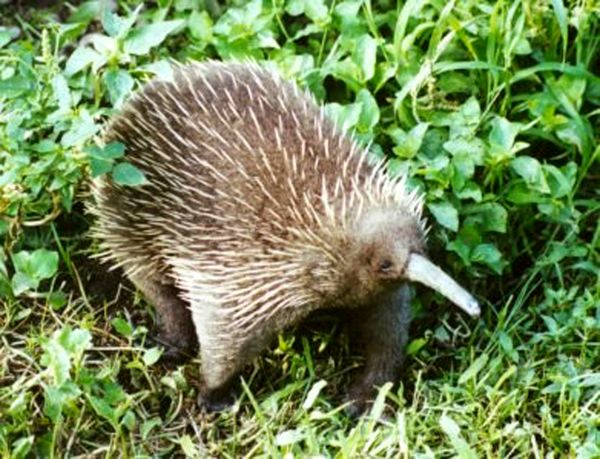
Tachyglossus aculeatus occurs throughout Australia, including Tasmania, and in coastal and highland regions of New Guinea. It has sharp spines, short legs and a long snout.
Written 26 November 2026 from the sources listed below. Each statement was checked against the passage it cites; statements that could not be supported were removed.
Appearance
The body is covered with cream-coloured spines except on the underside, face and legs. The spines can reach 50 mm in length.[1][2]
Its insulating fur ranges in colour from honey to dark reddish-brown and black. The species lacks external ear pinnae and teeth.[3][4]
Adult Short-beaked Echidnas typically measure 30–45 cm in length and weigh between 2 and 7 kg. Their eyes are approximately 9 mm in diameter.[5][6][7]
Habitat
The species inhabits forests, woodlands, heath, grasslands, arid environments, savannas, agricultural areas and semi-arid environments. It occupies elevations from sea level to at least 1,675 metres.[8][9][10]
Short-beaked Echidnas use fallen logs and leaf litter for shelter when available. They commonly use leaf litter and grass tussocks as hibernation sites.[11][12]
Behaviour
Short-beaked Echidnas can burrow rapidly using their strong front limbs and claws. When threatened, they curl into a ball and protect themselves with their spines.[13][14]
The species avoids daytime activity during hot weather and enters hibernation from early autumn to late spring. It can swim when necessary.[15][16][17]
Short-beaked Echidnas have overlapping home ranges and use temporary nesting sites. Their movements depend on food availability rather than territoriality, and they predominantly detect other echidnas through smell.[18][19][20]
The species can tolerate low oxygen concentrations and elevated carbon dioxide concentrations.[21]
Reproduction and life cycle
Females have a courtship period between June and August. Gestation lasts approximately 23 days, and the female lays a single soft-shelled egg that she incubates in her pouch.[22][23][24][25]
Eggs hatch approximately 10 or 11 days after being laid. Young echidnas suckle inside the mother's pouch for approximately two or three months and continue suckling for approximately six months after leaving it.[26][27][28]
Young echidnas reach full adult size after three to five years.[29]
Conservation
The species has experienced little to no range or population decline despite habitat loss and fragmentation. It is not considered threatened with extinction.[30][31]
Cars, dogs, foxes and occasionally goannas can kill Short-beaked Echidnas. Cats may prey on young individuals.[32][33]
Uses
Echidna foraging excavates and aerates soil, increasing its fertility.[34]
Similar species
The Short-beaked Echidna is the only living member of the genus Tachyglossus.[35]
Classification of the Short-beaked Echidna
| Kingdom | Animalia |
|---|---|
| Phylum | Chordata |
| Subphylum | Vertebrata |
| Infraphylum | Gnathostomata |
| Parvphylum | Osteichthyes |
| Megaclass | Tetrapoda |
| Class | Mammalia (Mammal) |
| Subclass | Prototheria (Egg-laying Mammals) |
| Order | Monotremata (Monotreme) |
| Family | Tachyglossidae (Echidnas) |
| Genus | Tachyglossus (Short-beaked Echidna) |
| Species | Tachyglossus aculeatus (Shaw, 1792) |
Where the Short-beaked Echidna is found
Checklists and occurrence records place Tachyglossus aculeatus in 3 countries across Oceania. GBIF holds 125,811 georeferenced records of it.
Countries
Regions and cities with the most records
- New South Wales, Australia 59,895
- Victoria, Australia 32,586
- South Australia, Australia 12,499
- Queensland, Australia 6,457
- Tasmania, Australia 4,205
- Hornsby, Australia 3,956
- Western Australia, Australia 3,938
- Sydney, Australia 3,498
- Parramatta, Australia 3,005
- Northern Territory, Australia 2,800
- Canberra, Australia 2,422
- Australian Capital Territory, Australia 2,240
- Liverpool, Australia 1,611
- Burwood, Australia 1,589
- Frankston East, Australia 1,488
- Tuggeranong, Australia 1,429
- Adelaide Hills, Australia 1,422
- Adelaide, Australia 1,348
- Wollongong, Australia 1,223
- Central Coast, Australia 1,094
- Balwyn North, Australia 1,080
- Torquay, Australia 999
- Batemans Bay, Australia 946
- Wodonga, Australia 838
- Coffs Harbour, Australia 750
- Maitland, Australia 625
- Mount Barker, Australia 618
- Logan City, Australia 605
- Newcastle, Australia 576
- Hobart, Australia 540
- Ballarat, Australia 539
- Capalaba, Australia 496
- Armidale, Australia 494
- Cessnock, Australia 486
- Brisbane, Australia 480
- Bathurst, Australia 458
4 more countries have a few records outside this range
These countries hold a few records of Tachyglossus aculeatus but lie outside the range the checklists give for it. Such records are often zoo or garden specimens, museum material or vagrants, so the species is not counted as occurring there.
Range as the checklists state it
Australia
A number beside a place is its count of GBIF occurrence records. A place without a number comes from a checklist alone. Records show where a species has been observed or collected, which can include escapes and vagrants.
Common names
English
- Short-beaked Echidna
- Australian Echidna
- Bristly Echidna
- Echidna
- Kangaroo Island Echidna
- Short-nosed Echidna
- Spiny Anteater
Names in 27 other languages
- Arabic
- آكل النمل الشوكي قصير المنقار, إيكيدنا قصير المنقار, نضناض قصير المنقار
- Chinese
- 澳洲針鼴, 短吻針鼴
- Czech
- ježura australská
- Danish
- Kortnæbbet myrepindsvin
- Dutch
- Australische Mierenegel, Gewone Mierenegel, Mierenegel
- Estonian
- sipelgasiil
- Finnish
- nokkasiili
- French
- Échidné à nez court, Échidnés À Nez Court Épineux, Échidnés à nez court èpineux
- German
- Kurzschnabel-Ameisenigel, Kurzschnabeligel
- Greek
- Έχιδνα, Κοντόρυγχη Έχιδνα
- Hebrew
- קיפודן נמלים אוסטרלי
- Hungarian
- rövidcsőrű hangyászsün
- Icelandic
- Maurígull
- Indonesian
- Nokdiak Moncong-pendek
- Italian
- Echidna beccocorto, Echidna dal becco corto, Echidna istrice
- Japanese
- ハリモグラ
- Korean
- 짧은코가시두더지
- Norwegian Bokmål
- Australsk Maurpiggsvin, Kortsnutemaurpiggsvin
- Polish
- Kolczatka australijska
- Portuguese
- Equidna-de-focinho-curto
- Russian
- Австралийская ехидна
- Slovenian
- kratkorili kljunati ježek
- Spanish
- Equidna de hocico corto Equidna australiano, equidna
- Thai
- อิคิดนาปากสั้น
- Turkish
- Kısa Gagalı Ekidne
- Ukrainian
- Єхидна австралійська, Коротконоса єхидна
- bar
- Kurzschnoowe-Auhmoasenigé
Synonyms
One other scientific name has been used for this species and is now treated as a synonym of Tachyglossus aculeatus.
- Myrmecophaga aculeata Shaw, 1792
Subspecies and varieties
- Tachyglossus aculeatus acanthion (Western Short-beaked Echidna) subspecies
- Tachyglossus aculeatus aculeatus (Eastern Short-beaked Echidna) subspecies
- Tachyglossus aculeatus lawesii (New Guinea Short-beaked Echidna) subspecies
- Tachyglossus aculeatus multiaculeatus (Kangaroo Island Echidna) subspecies
- Tachyglossus aculeatus setosus (Tasmanian Echidna) subspecies
Related species
-
 Attenborough's Long-beaked EchidnaZaglossus attenboroughi
-
 Western Long-beaked EchidnaZaglossus bruijni
-
 Eastern Long-beaked EchidnaZaglossus bartoni
Compare
Questions and answers
What is the scientific name of the Short-beaked Echidna?
The scientific name of the Short-beaked Echidna is Tachyglossus aculeatus. Written with its author, the full name is Tachyglossus aculeatus (Shaw, 1792).
Which family does the Short-beaked Echidna belong to?
Tachyglossus aculeatus belongs to the family Tachyglossidae, in the order Monotremata and the class Mammalia.
Where is the Short-beaked Echidna found?
Checklists and occurrence records place Tachyglossus aculeatus in 3 countries: Australia, Papua New Guinea and New Zealand.
What is the conservation status of the Short-beaked Echidna?
The IUCN Red List category recorded for Tachyglossus aculeatus is Least Concern (LC).
What other names does the Short-beaked Echidna have?
Tachyglossus aculeatus is also known in English as Australian Echidna, Bristly Echidna, Echidna, Kangaroo Island Echidna, Short-nosed Echidna and Spiny Anteater.
What type of diet do echidnas have?
Adult Short-beaked Echidnas eat ants, termites and other invertebrates.[36]
What is the habitat of a Short-beaked Echidna?
It inhabits forests, woodlands, heath, grasslands, arid environments, savannas, agricultural areas and semi-arid environments.[8][9]
How do echidnas find food?
They catch prey by inserting their sticky tongues into ant and termite nests.[37]
Sources
Passages the profile rests on
- The body is covered with cream-coloured spines except on the underside, face and legs. Source passage: “The body of the short-beaked echidna is, with the exception of the underside, face and legs, covered with cream-coloured spines.” — English Wikipedia
- The echidna's spines can reach 50 mm in length. Source passage: “The spines, which may be up to 50 mm (2 in) long, are modified hairs, mostly made of keratin.” — English Wikipedia
- Its insulating fur ranges in colour from honey to dark reddish-brown and black. Source passage: “Insulation is provided by fur between the spines, which ranges in colour from honey to a dark reddish-brown and even black” — English Wikipedia
- The short-beaked echidna lacks external ear pinnae and teeth. Source passage: “Tachyglossus aculeatus lacks external pinnae and teeth but does have hard pads in the back of the mouth.” — animaldiversity.org
- The eyes of the short-beaked echidna are approximately 9 mm in diameter. Source passage: “The eyes are small, about 9 mm (0.4 in) in diameter” — English Wikipedia
- Adult short-beaked echidnas typically measure 30–45 cm in length. Source passage: “Short-beaked echidnas are typically 30 to 45 cm (12 to 18 in) in length” — English Wikipedia
- Adult short-beaked echidnas weigh between 2 and 7 kg. Source passage: “weigh between 2 and 7 kg (4.4 and 15.4 lb).” — English Wikipedia
- The species inhabits forests, woodlands, heath, grasslands and arid environments. Source passage: “The Short-beaked Echidna lives in forests and woodlands, heath, grasslands and arid environments.” — australian.museum
- The species inhabits open woodlands, savannas, agricultural areas and semi-arid environments. Source passage: “Short-beaked echidnas thrive in a variety of habitats including open woodlands, savanna, agricultural areas, semi-arid, and arid regions.” — animaldiversity.org
- The species occupies elevations from sea level to at least 1,675 metres. Source passage: “Short-beaked echidnas have a broad altitudinal range from sea level to at least 1,675 meters.” — animaldiversity.org
- Short-beaked echidnas commonly use leaf litter and grass tussocks as hibernation sites. Source passage: “Short-beaked echidnas are flexible in their exploitation of substrates for hibernacula, commonly using leaf litter and grass tussocks.” — animaldiversity.org
- The species uses fallen logs and leaf litter for shelter when these are available. Source passage: “although they are found to readily utilise fallen logs and leaf litter for shelter when available” — pmc.ncbi.nlm.nih.gov
- The species can burrow rapidly using its strong front limbs and claws. Source passage: “The short-beaked echidna has extremely strong front limbs and claws, which allow it to burrow quickly with great power.” — English Wikipedia
- When threatened, the echidna curls into a ball and protects itself with its spines. Source passage: “It has no weapons or fighting ability but deters predators by curling into a ball and protecting itself with its spines.” — English Wikipedia
- The species avoids daytime activity during hot weather. Source passage: “It cannot sweat or deal well with heat, so it tends to avoid daytime activity in hot weather.” — English Wikipedia
- Short-beaked echidnas enter hibernation from early autumn to late spring. Source passage: “They decrease energy usage by hibernating from early autumn to late spring.” — animaldiversity.org
- Echidnas can swim when necessary. Source passage: “It can swim if needed.” — English Wikipedia
- Short-beaked echidnas have overlapping home ranges and use temporary nesting sites. Source passage: “Short-beaked echidnas nest at temporary sites, and have overlapping home ranges.” — animaldiversity.org
- Their movements depend on food availability rather than territoriality. Source passage: “Their movements depend on food availability and not territoriality.” — animaldiversity.org
- The species predominantly detects other echidnas through smell. Source passage: “Short-beaked echidnas sense other echidnas predominantly through smell.” — animaldiversity.org
- The species can tolerate low oxygen concentrations and elevated carbon dioxide concentrations. Source passage: “As it needs to be able to survive underground, it has a significant tolerance to high levels of carbon dioxide and low levels of oxygen.” — English Wikipedia
- The short-beaked echidna lays a single egg at a time. Source passage: “Like the Platypus, the Short-beaked Echidna is an egg-laying mammal or monotreme and lays one egg at a time.” — australian.museum
- Females have a courtship period between June and August. Source passage: “Tachyglossus aculeatus has a courtship period between June and August” — animaldiversity.org
- Gestation lasts approximately 23 days. Source passage: “Gestation in Tachyglossus aculeatus lasts about 23 days” — animaldiversity.org
- The female incubates a single soft-shelled egg in her pouch. Source passage: “after which the female will lay a single soft-shelled egg in her pouch for incubation.” — animaldiversity.org
- Eggs hatch approximately 10 or 11 days after being laid. Source passage: “Eggs hatch 10 or 11 days later.” — animaldiversity.org
- Young echidnas suckle for approximately two or three months while inside the mother's pouch. Source passage: “Clinging to hairs inside the mother's pouch, the young echidna suckles for two or three months.” — australian.museum
- Young echidnas continue suckling for approximately six months after leaving the pouch. Source passage: “It continues to suckle for the next six months.” — australian.museum
- Young echidnas reach full adult size after three to five years. Source passage: “Young reach full adult size after three to five years.” — animaldiversity.org
- The species has experienced little to no range or population decline despite habitat loss and fragmentation. Source passage: “One exception is the short-beaked echidna (Tachyglossus aculeatus), which has shown little to no range or population declines despite habitat loss and fragmentation” — pmc.ncbi.nlm.nih.gov
- The species is not considered threatened with extinction. Source passage: “It is not threatened with extinction” — English Wikipedia
- Cars, dogs, foxes and occasionally goannas can kill short-beaked echidnas. Source passage: “it may be killed by cars, dogs, foxes and occasionally goannas” — australian.museum
- Cats may prey on young short-beaked echidnas. Source passage: “and cats may take the young.” — australian.museum
- Echidna foraging excavates and aerates soil, increasing its fertility. Source passage: “This process turns and aerates the soil, increasing its fertility” — pmc.ncbi.nlm.nih.gov
- The short-beaked echidna is the only living member of the genus Tachyglossus. Source passage: “and the only member of the genus Tachyglossus” — English Wikipedia
- Adult short-beaked echidnas eat ants, termites and other invertebrates. Source passage: “Adult short-beaked echidnas eat ants, termites, and other invertebrates.” — animaldiversity.org
- The species catches prey by inserting its sticky tongue into ant and termite nests. Source passage: “Using its pointed snout and sharp claws, the Short-beaked Echidna breaks into ant and termite nests and catches its prey by flicking its long sticky tongue in and out.” — australian.museum
Data
- Catalogue of Life, 2026-10-16 XR cc by
- Global Biodiversity Information Facility CC BY 4.0
- Wikidata CC0
- GeoNames CC BY 4.0
- Within the Catalogue of Life, this name comes from The Integrated Taxonomic Information System cc0
References
- Nat. Misc. vol.3 p.pl. 109 where the name was published
- Nowak, Ronald M. (1991). Walker’s Mammals of the World, Vol. 1, 5th Ed.
- Wilson, Don E., and DeeAnn M. Reeder, eds. (1993). Mammal Species of the World: A Taxonomic and Geographic Reference, 2nd Ed., 3rd Printing.
- Wilson, Don E., and DeeAnn M. Reeder, eds. (2005). Mammal Species of the World: A Taxonomic and Geographic Reference, 3rd Ed., Vols. 1 & 2.
- Wilson, Don E., and Russell A. Mittermeier, eds. (2015). Order Monotremata. Handbook of the Mammals of the World, Vol. 5. Monotremes and Marsupials.
- Burgin, Connor J., Don E. Wilson, Russell A. Mittermeier, Anthony B. Rylands, et al. (2020). Illustrated Checklist of the Mammals of the World. Vol. 1. Monotremata to Rodentia.
This species in other databases
Page built on 27 November 2026. See how the catalog is made and all sources and licences.
Cite this page
ScientificNames.org. (2026). Tachyglossus aculeatus (Short-beaked Echidna). Retrieved November 27, 2026, from https://scientificnames.org/species/tachyglossus-aculeatus
“Tachyglossus aculeatus (Short-beaked Echidna).” ScientificNames.org, 2026, scientificnames.org/species/tachyglossus-aculeatus. Accessed 27 Nov. 2026.
ScientificNames.org. “Tachyglossus aculeatus (Short-beaked Echidna).” Accessed November 27, 2026. https://scientificnames.org/species/tachyglossus-aculeatus.
@misc{scientificnames_tachyglossus_aculeatus_short_beaked_echidna,
  author = {{ScientificNames.org}},
  title = {Tachyglossus aculeatus (Short-beaked Echidna)},
  year = {2026},
  url = {https://scientificnames.org/species/tachyglossus-aculeatus},
  note = {Accessed 2026-11-27}
}