Species · Mammals
Attenborough's Long-beaked Echidna Zaglossus attenboroughi
The scientific name of the Attenborough's Long-beaked Echidna is Zaglossus attenboroughi. It is a species of mammal in the family Tachyglossidae (echidnas), order Monotremata. The name dates from 1998.
- Scientific name
- Zaglossus attenboroughi Flannery & Groves, 1998
- Common name
- Attenborough's Long-beaked Echidna
- Genus
- Zaglossus
- Family
- Tachyglossidae (Echidnas)
- Order
- Monotremata
- Class
- Mammalia
- Red List category
- CR Critically Endangered
- Recorded in
- 1 country
- Name status
- accepted in the Catalogue of Life

Overview
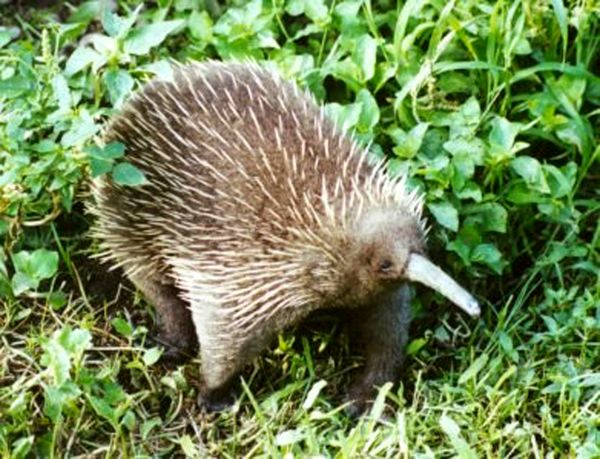
The species is endemic to Papua, New Guinea, and is currently restricted to the summits of the Cyclops Mountains near Jayapura. It is the smallest member of the genus Zaglossus and has a relatively straight rostrum, short dense fur, and almost-white spines.
Written 26 November 2026 from the sources listed below. Each statement was checked against the passage it cites; statements that could not be supported were removed.
Similar species
Attenborough's Long-beaked Echidna resembles the short-beaked echidna in size and general appearance. It differs in its primary dietary preference for earthworms rather than termites and ants.[1][2]
Appearance
The species is the smallest member of the genus Zaglossus and weighs approximately 2 to 3 kilograms. Its rostrum measures approximately 70 millimeters in length and is relatively straight compared with other echidnas.[3][4][5][6]
The species has short, fine, dense fur that is raw umber brown. Short fur covers the few spines on the middle of the back, while almost-white spines are densest near the tail.[7][8][9][10]
The species has five claws on each foot. Adult males have a small non-venomous spur on the inside of each ankle, while adult females lack ankle spurs.[11][12][13]
Adults lack teeth, but their tongues have tooth-like spikes. The species has no external genitalia, and males are larger than females.[14][15][16]
Habitat
Attenborough's Long-beaked Echidna inhabits forested mountainous areas and mountain-top environments of the Cyclops Mountains. Its documented mountainous habitat covers approximately 50 square kilometers.[17][18][19]
The species is endemic to Papua, New Guinea, and is currently restricted to the summits of the Cyclops Mountains near Jayapura. It may historically have occurred along the North Coast Ranges of New Guinea.[20][21][22]
Diet
Earthworms constitute the primary diet of the species. It is also thought to feed on worms and larvae.[23][24]
The species uses its beak to locate food. Researchers have identified ground holes made while it probes for food with its rostrum.[25][26]
Behaviour
The species is nocturnal. When threatened, it rolls into a spiky ball.[27][28]
The species is not social and reportedly comes together with other members of its species once a year to mate.[29]
Reproduction and life cycle
The reported mating period occurs in July. Females reportedly lay eggs approximately eight days after mating.[30][31]
The offspring reportedly remain in their mother's pouch for approximately eight weeks or until their spines develop. Females are thought to care for and protect their young after laying eggs and after hatching.[32][33]
The reproductive period, breeding season, and mating system remain insufficiently documented. The number of offspring produced during a breeding cycle and the gestation period are unknown.[34][35][36]
Conservation
Attenborough's Long-beaked Echidna is classified as critically endangered by the IUCN. Hunting and habitat loss threaten the species, with farming and mining-related habitat loss considered major threats.[37][38][39]
The Cyclops Mountains Strict Nature Reserve was established to protect the species' habitat. The species was rediscovered through evidence found during an expedition in 2007.[40][41]
Living individuals were recorded on trail-camera footage during a 2023 expedition. Researchers recorded footage of individuals preying on worms and engaging in courtship behaviour.[42][43]
Uses
The species has cultural importance among communities surrounding the Cyclops Mountains. Echidna meat is sometimes shared as a meal to resolve disputes between opposing parties.[44][45]
People may be required to pay a fine or find an echidna in the mountains as punishment.[46]
Classification of the Attenborough's Long-beaked Echidna
| Kingdom | Animalia |
|---|---|
| Phylum | Chordata |
| Subphylum | Vertebrata |
| Infraphylum | Gnathostomata |
| Parvphylum | Osteichthyes |
| Megaclass | Tetrapoda |
| Class | Mammalia (Mammal) |
| Subclass | Prototheria (Egg-laying Mammals) |
| Order | Monotremata (Monotreme) |
| Family | Tachyglossidae (Echidnas) |
| Genus | Zaglossus (Long-beaked Echidna) |
| Species | Zaglossus attenboroughi Flannery & Groves, 1998 |
Origin of the name. David Attenborough
Where the Attenborough's Long-beaked Echidna is found
Checklists and occurrence records place Zaglossus attenboroughi in 1 country across Oceania.
Countries
1 more country has a few records outside this range
These countries hold a few records of Zaglossus attenboroughi but lie outside the range the checklists give for it. Such records are often zoo or garden specimens, museum material or vagrants, so the species is not counted as occurring there.
Range as the checklists state it
Australia
A number beside a place is its count of GBIF occurrence records. A place without a number comes from a checklist alone. Records show where a species has been observed or collected, which can include escapes and vagrants.
Common names
English
- Attenborough's Long-beaked Echidna
- Attenborough's Echidna
- Attenborough's Long-nosed Echidna
- Cyclops Long-beaked Echidna
- Cyclops Long-nosed Echidna
- Payangko
- Sir David S Long-beaked Echidna.
- Sir David's Long-beaked Echidna
- Sir David's Long-nosed Echidna
Names in 18 other languages
- Arabic
- إيكيدنا سير ديفيد طويل المنقار, نضناض سير ديفيد طويل المنقار
- Chinese
- 阿滕伯勒長喙針鼴鼠
- Czech
- paježura Attenboroughova
- Dutch
- Attenboroughs vachtegel
- French
- Échidné d'Attenborough
- German
- Attenborough-Langschnabeligel, Attenboroughlangschnabeligel, Attenboroughs Langschnabeligel, Sir David-Langschnabeligel, Zykloplangschnabeligel
- Greek
- Μακρόρυγχη Έχιδνα του Άττενμπόροχ
- Indonesian
- Nokdiak Sentani
- Japanese
- アッテンボローミユビハリモグラ
- Korean
- 데이빗경긴코가시두더지, 아텐버러긴코가시두더지, 키클롭스긴코가시두더지
- Polish
- Prakolczatka górska
- Portuguese
- Equidna-de-attenborough
- Russian
- Проехидна Аттенборо
- Spanish
- equidna de hocico largo de Attenborough
- Thai
- อิคิดนาปากยาวแอตเทนบะระ
- Turkish
- Attenborough'nun Uzun Gagalı Ekidnesi
- Ukrainian
- Довгоноса єхидна-циклоп
- tzm
- Altan=D'attenbourghis so Ychid'na
Related species
-
 Western Long-beaked EchidnaZaglossus bruijni
-
 Eastern Long-beaked EchidnaZaglossus bartoni
- Short-beaked EchidnaTachyglossus aculeatus
Compare
Questions and answers
What is the scientific name of the Attenborough's Long-beaked Echidna?
The scientific name of the Attenborough's Long-beaked Echidna is Zaglossus attenboroughi. Written with its author, the full name is Zaglossus attenboroughi Flannery & Groves, 1998.
Which family does the Attenborough's Long-beaked Echidna belong to?
Zaglossus attenboroughi belongs to the family Tachyglossidae, in the order Monotremata and the class Mammalia.
Where is the Attenborough's Long-beaked Echidna found?
Checklists and occurrence records place Zaglossus attenboroughi in 1 country: Australia.
What is the conservation status of the Attenborough's Long-beaked Echidna?
The IUCN Red List category recorded for Zaglossus attenboroughi is Critically Endangered (CR).
What other names does the Attenborough's Long-beaked Echidna have?
Zaglossus attenboroughi is also known in English as Attenborough's Echidna, Attenborough's Long-nosed Echidna, Cyclops Long-beaked Echidna, Cyclops Long-nosed Echidna, Payangko and Sir David S Long-beaked Echidna..
What do long-beaked echidnas eat?
Earthworms constitute the primary diet of Attenborough's Long-beaked Echidna. It is also thought to feed on other worms and larvae.[23][24]
What type of diet do echidnas have?
Attenborough's Long-beaked Echidna primarily eats earthworms and is thought to feed on worms and larvae.[23][24]
Sources
Passages the profile rests on
- The species resembles the short-beaked echidna in size and general appearance. Source passage: “The short rostrum and their size makes them appear similar to short-beaked echidnas ( Tachyglossus aculeatus ).” — animaldiversity.org
- The species differs from the short-beaked echidna in its primary dietary preference for earthworms rather than termites and ants. Source passage: “The diet of Attenborough's long-beaked echidna consists primarily of earthworms, in contrast to the termites and ants preferred by the short-beaked echidna.” — English Wikipedia
- The species is the smallest member of the genus Zaglossus. Source passage: “It is the smallest member of the genus Zaglossus” — English Wikipedia
- The species weighs approximately 2 to 3 kilograms. Source passage: “Sir David's long-beaked echidnas are the smallest echidna species, weighing 2 to 3 kilograms.” — animaldiversity.org
- The rostrum measures approximately 70 millimeters in length. Source passage: “The rostrum is approximately 70 mm long” — animaldiversity.org
- The species has a relatively straight rostrum compared with other echidnas. Source passage: “and is somewhat straighter than other echidna species.” — animaldiversity.org
- The species has short, fine, dense fur. Source passage: “The fur is distinctive, short, fine, and dense, unlike other echidnas” — animaldiversity.org
- The fur is raw umber brown. Source passage: “and raw umber brown in color.” — animaldiversity.org
- Short fur covers the few spines on the middle of the back. Source passage: “There is short fur that covers the few spines on the middle back of this species.” — animaldiversity.org
- The species has almost-white spines that are densest near the tail. Source passage: “The spines are almost white and are most dense nearest the tail.” — animaldiversity.org
- The species has five claws on each foot. Source passage: “They have 5 claws on each foot” — animaldiversity.org
- Adult males have a small non-venomous spur on the inside of each ankle. Source passage: “adult males have a small non-venomous spur on the inside of each ankle.” — animaldiversity.org
- Adult females lack ankle spurs. Source passage: “Adult females lack these spurs.” — animaldiversity.org
- Adults lack teeth, but their tongues have tooth-like spikes. Source passage: “Adults have no teeth, but the tongue is covered in teeth-like spikes.” — animaldiversity.org
- The species has no external genitalia. Source passage: “Like other Zaglossus species, they have no external genitalia” — animaldiversity.org
- Males are larger than females. Source passage: “The male is larger than the female” — English Wikipedia
- The species inhabits forested mountainous areas of the Cyclops Mountains. Source passage: “Sir David's long-beaked echidnas live in forested mountainous areas of the Cyclops Mountains” — animaldiversity.org
- The documented mountainous habitat covers approximately 50 square kilometers. Source passage: “an area of approximately 50 square kilometers.” — animaldiversity.org
- The species inhabits mountain-top environments. Source passage: “reflecting its mountain-top habitat.” — English Wikipedia
- The species is endemic to Papua, New Guinea. Source passage: “Zaglossus attenboroughi is endemic to Papua, New Guinea.” — animaldiversity.org
- The species is currently restricted to the summits of the Cyclops Mountains near Jayapura. Source passage: “they are now restricted to the tops of the Cyclops Mountains near Jayapura.” — animaldiversity.org
- The species may historically have occurred along the North Coast Ranges of New Guinea. Source passage: “Sir David's long-beaked echidnas may once have been distributed along the North Coast Ranges” — animaldiversity.org
- Earthworms constitute the primary diet of the species. Source passage: “The diet of Attenborough's long-beaked echidna consists primarily of earthworms” — English Wikipedia
- The species is thought to feed on worms and larvae. Source passage: “they inhabit the Cyclops Mountains and feed on worms and larvae.” — animaldiversity.org
- The species uses its beak to locate food. Source passage: “They use their beak to find food.” — animaldiversity.org
- Researchers have identified ground holes made by the species while probing for food with its rostrum. Source passage: “Researchers have identified holes in the ground made by their rostra as they poke for food.” — animaldiversity.org
- The species is nocturnal. Source passage: “The creature is nocturnal;” — English Wikipedia
- When threatened, the species rolls into a spiky ball. Source passage: “it rolls up into a spiky ball when it feels threatened” — English Wikipedia
- The species is not social and reportedly comes together with other members of its species once a year to mate. Source passage: “The long-beaked echidna is not a social animal, and it comes together with its own kind only once a year, in July, to mate.” — English Wikipedia
- The reported mating period occurs in July. Source passage: “only once a year, in July, to mate.” — English Wikipedia
- Females reportedly lay eggs approximately eight days after mating. Source passage: “the female lays the eggs after about eight days” — English Wikipedia
- The offspring reportedly remain in their mother's pouch for approximately eight weeks or until their spines develop. Source passage: “with the offspring staying in their mother's pouch for around eight weeks or until their spines develop.” — English Wikipedia
- Females are thought to care for and protect their young after laying eggs and after hatching. Source passage: “It is thought that Sir David's long-beaked echidnas females care for and protect their young after laying the eggs and after their hatching.” — animaldiversity.org
- The reproductive period, breeding season, and mating system of the species remain insufficiently documented. Source passage: “It is unknown when these animals breed or whether they are promiscuous.” — animaldiversity.org
- The number of offspring produced during a breeding cycle is unknown. Source passage: “The number of offspring during a breeding cycle is unknown” — animaldiversity.org
- The gestation period of the species is unknown. Source passage: “as is the gestation period” — animaldiversity.org
- The species is classified as critically endangered by the IUCN. Source passage: “Z. attenboroughi is classified as critically endangered by the IUCN.” — English Wikipedia
- Hunting and habitat loss threaten the species. Source passage: “the echidna is endangered by hunting and habitat loss.” — English Wikipedia
- Farming and mining-related habitat loss are considered major threats to the species. Source passage: “hunting and loss of habitat due to farming and mining are the main reasons for the threat to their survival.” — animaldiversity.org
- The Cyclops Mountains Strict Nature Reserve was established to protect the species' habitat. Source passage: “The Cyclops Mountains Strict Nature Reserve was created to protect the habitat of Zaglossus attenboroughi .” — animaldiversity.org
- The species was rediscovered through evidence found during an expedition in 2007. Source passage: “The species was thought to be extinct until 2007, when an expedition led by EDGE team members discovered evidence that Zaglossus attenboroughi still existed.” — animaldiversity.org
- Living individuals of the species were recorded on trail-camera footage during a 2023 expedition. Source passage: “the species was spotted on footage retrieved from a trail camera.” — English Wikipedia
- Researchers recorded footage of individuals preying on worms and engaging in courtship behaviour. Source passage: “They also captured footage of predation on worms and courtship behavior among multiple individuals” — English Wikipedia
- The species has cultural importance among communities surrounding the Cyclops Mountains. Source passage: “Sir David's long-beaked echidnas have cultural importance in the communities surrounding the Cyclops Mountains.” — animaldiversity.org
- Echidna meat is sometimes shared as a meal to resolve disputes between opposing parties. Source passage: “Sometimes disputes are resolved by having the two fighting parties share a meal of echidna.” — animaldiversity.org
- People may be required to pay a fine or find an echidna in the mountains as punishment. Source passage: “At other times, people are punished by either having to pay a fine or by having to find an echidna in the mountains.” — animaldiversity.org
Data
- Catalogue of Life, 2026-10-16 XR cc by
- Wikidata CC0
- GeoNames CC BY 4.0
- Wikimedia Commons per image; credit shown with each image
- iNaturalist per image; credit shown with each image
- Within the Catalogue of Life, this name comes from The Integrated Taxonomic Information System cc0
References
- Mammalia vol.62 p.387 where the name was published
- Wilson, Don E., and DeeAnn M. Reeder, eds. (2005). Mammal Species of the World: A Taxonomic and Geographic Reference, 3rd Ed., Vols. 1 & 2.
- Wilson, Don E., and Russell A. Mittermeier, eds. (2015). Order Monotremata. Handbook of the Mammals of the World, Vol. 5. Monotremes and Marsupials.
- Burgin, Connor J., Don E. Wilson, Russell A. Mittermeier, Anthony B. Rylands, et al. (2020). Illustrated Checklist of the Mammals of the World. Vol. 1. Monotremata to Rodentia.
This species in other databases
Page built on 29 November 2026. See how the catalog is made and all sources and licences.
Cite this page
ScientificNames.org. (2026). Zaglossus attenboroughi (Attenborough's Long-beaked Echidna). Retrieved November 29, 2026, from https://scientificnames.org/species/zaglossus-attenboroughi
“Zaglossus attenboroughi (Attenborough's Long-beaked Echidna).” ScientificNames.org, 2026, scientificnames.org/species/zaglossus-attenboroughi. Accessed 29 Nov. 2026.
ScientificNames.org. “Zaglossus attenboroughi (Attenborough's Long-beaked Echidna).” Accessed November 29, 2026. https://scientificnames.org/species/zaglossus-attenboroughi.
@misc{scientificnames_zaglossus_attenboroughi_attenboroughs_long_beaked_echidna,
  author = {{ScientificNames.org}},
  title = {Zaglossus attenboroughi (Attenborough's Long-beaked Echidna)},
  year = {2026},
  url = {https://scientificnames.org/species/zaglossus-attenboroughi},
  note = {Accessed 2026-11-29}
}